

NRNP6675 Pharmacology Week 11 Final Exam With Answers (100 Solved Questions)
- Nursing
- Chamberlain College of Nursing
- 21 pages
- Shared May 2025
NRNP6675 Pharmacology Week 11 Final Exam With Answers offers a step-by-step approach to solving past exam questions.
Preview 7 of 21 pages
See the first 7 pages exactly as they appear in the document.
Page 1 Read page 1 as text
NRNP 6675 Week 11 Final Exa m Question: 1 Concerns when treating geriatric patients with psychotherapeutic drugs include all of the following EXCEPT: A. Elderly persons may be more susceptible to adverse effects of psychotherapeutic drugs. B. Elderly persons may metabolize psychotherapeutic drugs more slowly. C. Elderly persons may metabolize psychotherapeutic drugs more rapidly. D. Elderly persons may excrete psychotherapeutic drugs more slowly. Question 2 The treatment of others equitab ly and distribution of benefits/burdens fairly is known as which of the following? A. Fidelity B. Justice C. Benef icence D. Non - maleficence Question 3 Persons who subordinate their own needs to those of others, get other to assume responsibility for maj or areas of the lives, lack self - confidence, and may experience intense disc omfort when alone for more than a brief period of time are demonstrating characteristics consistent with whi ch of the following personality disorders? A. Avoidant personality diso rder B. Passive personality disorder C. Dependent personality disorder D. Antisocial personality disorder Question 4 According to Sullivan, which of the following are consistent with a mentor/mentee relationship? A. Mentors are assigned B. Mentor relat ionships are shorter term C. Goals for the mentoring relationship are set mutually . D. A and B only Question 5 A form of child abuse in which a parent or caretaker repeatedly fabricates or actually inflicts injury or illness in a child for whom medical intervention is then sought, often in an emergency
Page 2 Page 3 Read page 3 as text
setting, is known as which of the following? A. Korsakoff's syndrome B. Snyder's syndrome C. Munchausen syndrome D. Munchausen syndrome by proxy Question 6 The need for nurse practitioners to practice t o the full extent of their educ ation and training is necessary for which of the following reasons? Select all that apply. A. The growth in number and proportion of older Americans B. The projected primary care physician shortage by 2025 C. Increased numbe r of individuals who have access to healthcare D. The economic push for cost - effective healthcare Question 7 The ARNP assessing lifestyle as a social determinant of health would ask about which of the following? A. Diet B. Education C. Health literacy D. Inherited diseases Question 8 In educating the patient beginning to take Lithium, the ARNP explains wh ich of the following related to diet and fluid intake? A. Caffeine and alcohol act as hydration ag ents and can raise your lithium concentrations. B. Drink at least a gallon or more of water per day and limit your salt intake. C. If you go on a diet, your doctor may need to increase frequency of blood tests. D. All of the above Question 9 The goal of psychotropic treatment is to eliminate all manifes tations of a disorder to below the syndromal threshold, which is defined as which of the following? A. Response B. Remission C. Resistance D. Sensitization Question 10 The NP can impact health policy and healthcare by doing which of the following?
Page 4 Read page 4 as text
A. Be come an active member of local, state, and/or national NP organizations. B. Become familiar with the resources available on NP organization websites. C. Volunteer to serve on legislative co mmittees within professional NP organizations. D. All the above Question 11 A term used to describe individuals and families who are found to live in overcrowded homes , relocate frequently, and struggle to pay rent and monthly expenses is which of the following? A. Homelessness B. Housing instability C. Transiency D. A and B Question 12 Which of the following is consistent with current literature regarding the epidemiology of dependent personality disorder? A. Dependent personality is more common in men than in women. B. Dependent personality disorder is more common in young children than in older ones. C. Persons with chronic physical illness in childhood may be most susceptible to this disorder. D. B and C only Question 13 Patients who injure themselves by self - mutilation (i.e., cutting their skin) but who usual ly do not wish to die are said to have which of the following? A. Suicide intent B. Suicidal ideations C. Parasuicidal behavior D. Aborted suicide attempt Question 14 The NP preceptor should have which of the following? A. Knowledge of the NP role B. T he ability to be a role model for the preceptee C. Solid clinical skill set in the specialty fo r which the NP student is being precepted D. All the above Question 15 The treatment of choice for patients with histrionic personality disorder include which o f the following?
Page 5 Read page 5 as text
A. Psychoanalytic oriented ind ividual psychotherapy B. Psychoanalytic oriented group psychotherapy C. Exposure therapy D. A or B Question 16 The antipsychotics which are most likely to cause neuroleptic - indu ced parkinsonism are which h ave which of the following effects? A. High potency drugs wit h low levels of anticholinergic activity. B. Low potency drugs with low levels of anticholinergic activity. C. High potency drugs with high levels of anticholinergic activity. D. Low potency dru gs with high levels of anticholinergic activity. Question 17 Treatment aimed at reducing intimate partner violence and domestic violence includes which of the following? A. Enhancing self - efficacy of the victim. B. Reducing recidivism of the abuser. C. Hormonal therapy for the perpetrator of abuse D. A and B only Question 18 A patient presents with a formal, tense manner. He reluctantly repo rts a longstanding (since early adulthood) pervasive suspiciousness of others, preoccupied with trustwor thiness o f friends, unjustified concerns about others deceiving him, angry about perceived insults and sligh ts, reluctant to confide in the ARNP. The ARNP suspects the patient likely has which of the following personality disorders? A. Schizoid personality disorde r B. Paranoid personality disorder C. Borde rline personality disorder D. Antisocial personality disorder Question 19 Which of the following is consistent with current perspectives on nurse practitioner competencies? A. The National Organization of Nurse Practitioner Faculties has developed a list of core competencies that all students should have upon graduation from a master's program. B. Nursing specialty organizations DO NOT publish competencies for NPs who provi de care in specialty areas. C. Employer s DO NOT establish their own set of competencies. D. There are national standards for judging/evaluating nurse practitioner competencies.
Page 6 Read page 6 as text
Question 20 Which of the following core competencies are quality competencies? A. Uses best available evidence to c ontinually improve quality of practice. B. Integrates ethical policies in decision making. C. Evaluates the relationships among access cost quality safety and their influence on health care. D. A and C Question 21 Which of the following are criteria for a particular suicide to be considered inevitable? A. Strong genetic history of suicide in one or more family members. B. A strong genetic loading of mental illness in the family. C. The patient must have received the highest standard of treatment and that treatment failed. D. All of the above. Question 22 The misuse of the charge's funds for personal gain is known as which of the following? A. Neglect B. Physical abuse C. Financial abuse/exploitation D. Emotional/psychological abuse Question 23 Which of the following professionals would be able to precept a nurse practitioner student? A. An advanced registered nurse practitioner B. A physician C. A unlicensed social worker D. A and B Question 24 According to Freud, passive and dependent personalit y traits are associated with which s tage of development? A. Oral stage B. Anal st age C. Phallic stage D. Latency stage Question 25 Self - injurious behavior with a nonfatal outcome, accompanied by explici t or implicit evidence that
Page 7 Read page 7 as text
the person intended to die, is most specifically known as which of the following? A. Suicide B. Suicide intent C. Sui cide attempt D. Aborted suicide attempt Question 26 The incidence of suicide is highest for which of the following populations? A. Older Latino men B. Older C aucasian men C. Older Caucasian women D. Older African American men Question 27 "Assumes complex and advanced leadership roles to initiate and guide change" is a NP core competency for which NP competency area? A. Policy competencies B. Quality competen cies C. Leadership competencies D. Practice inquiry competencies Question 28 At a minimum, a psychiatric evaluation in an emergency should include whi ch of the following? Select all that apply. A. Is the patient psychotic? B. Is the patient suicidal or homicidal? C. Is the problem organic, functional, or a combination? D. Is it safe for the patient to be in the emergency room? Question 29 Which stage of the cycle of domestic violence is characterized by the abuser subconsciously implementing defense me chanisms and cognitive distortions to alleviate the ego dystonic implication of the abuse? A. Sweetheart phase B. Hone ymoon phase C. Tension building phase D. Defensive phase Question 30 An ARNP takes a position in which the ARNP is guaranteed a set sa lary bu t can make additional salary if he or she generates practice income over some set amount. This is known as what type of pay structure?
14 more pages in the full document
Unlock it once and it stays in your library, ready to chat with or turn into flashcards.
Unlock the full documentMore Nursing study materials
See all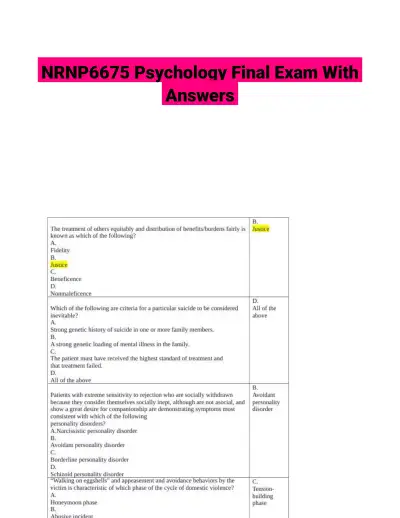 Past Exams
NRNP6675 Psychology Final Exam With Answers (11 Solved Questions)
Nursing
4 pagesMay 2025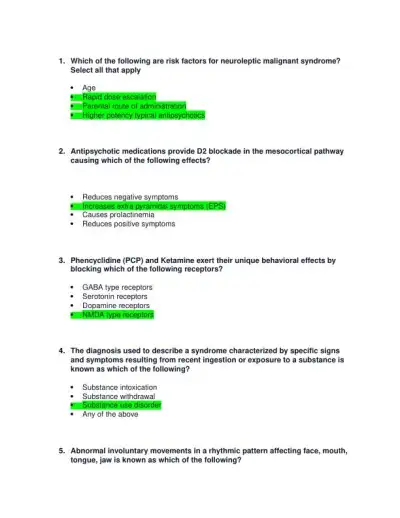 Past Exams
NRNP6675 Neurology Week 6 Midterm Exam With Answers (100 Solved Questions)
Nursing
23 pagesMay 2025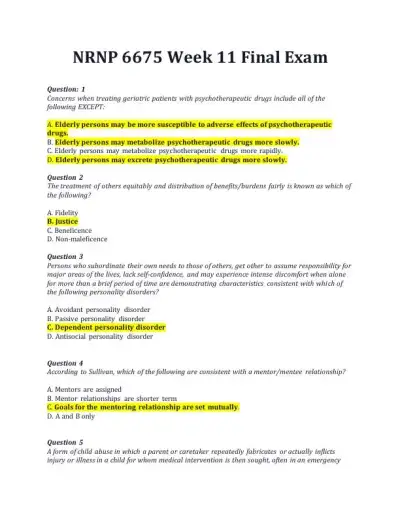 Past Exams
NRNP6675 Week 11 Final Exam With Answers (100 Solved Questions)
Nursing
21 pagesMay 2025 Exam Guides
Test Bank for Critical Care Nursing: Diagnosis and Management, 9th Edition (Chapters 1-27)
Nursing
299 pages167downloadsFeb 2025 Class Notes
An Invitation To Health, Third Canadian Edition Lecture Notes
Nursing
439 pages163downloadsFeb 2025 Exam Guides
Test Bank for Physical Examination and Health Assessment, 9th Edition (Chapters 1-15)
Nursing
200 pages161downloadsFeb 2025 Exam Guides
Focus on Nursing Pharmacology Seventh, North American Edition Test Bank
Nursing
1144 pages160downloadsFeb 2025 Exam Guides
Test Bank for Fundamentals of Nursing, 11th edition (Chapters 1-24)
Nursing
200 pages160downloadsFeb 2025
Study this document with CramX
Once it is in your library, every tool can work from it.