
CramX Logo
NUR205 Weeks 3, 4, 5 Final Exam with Answers (61 Solved Questions) - Document preview page 1

NUR205 Weeks 3, 4, 5 Final Exam with Answers (61 Solved Questions) - Page 1

Document preview content for NUR205 Weeks 3, 4, 5 Final Exam with Answers (61 Solved Questions)

NUR205 Weeks 3, 4, 5 Final Exam with Answers (61 Solved Questions)

Maximize your exam readiness with NUR205 Weeks 3, 4, 5 Final Exam with Answers, which provides access to solved past exams and detailed solutions.

Violet Stevens
Contributor
4.9
0
12 months ago
Preview (7 of 20 Pages)
100%
Log in to unlock
Page 1 of 7
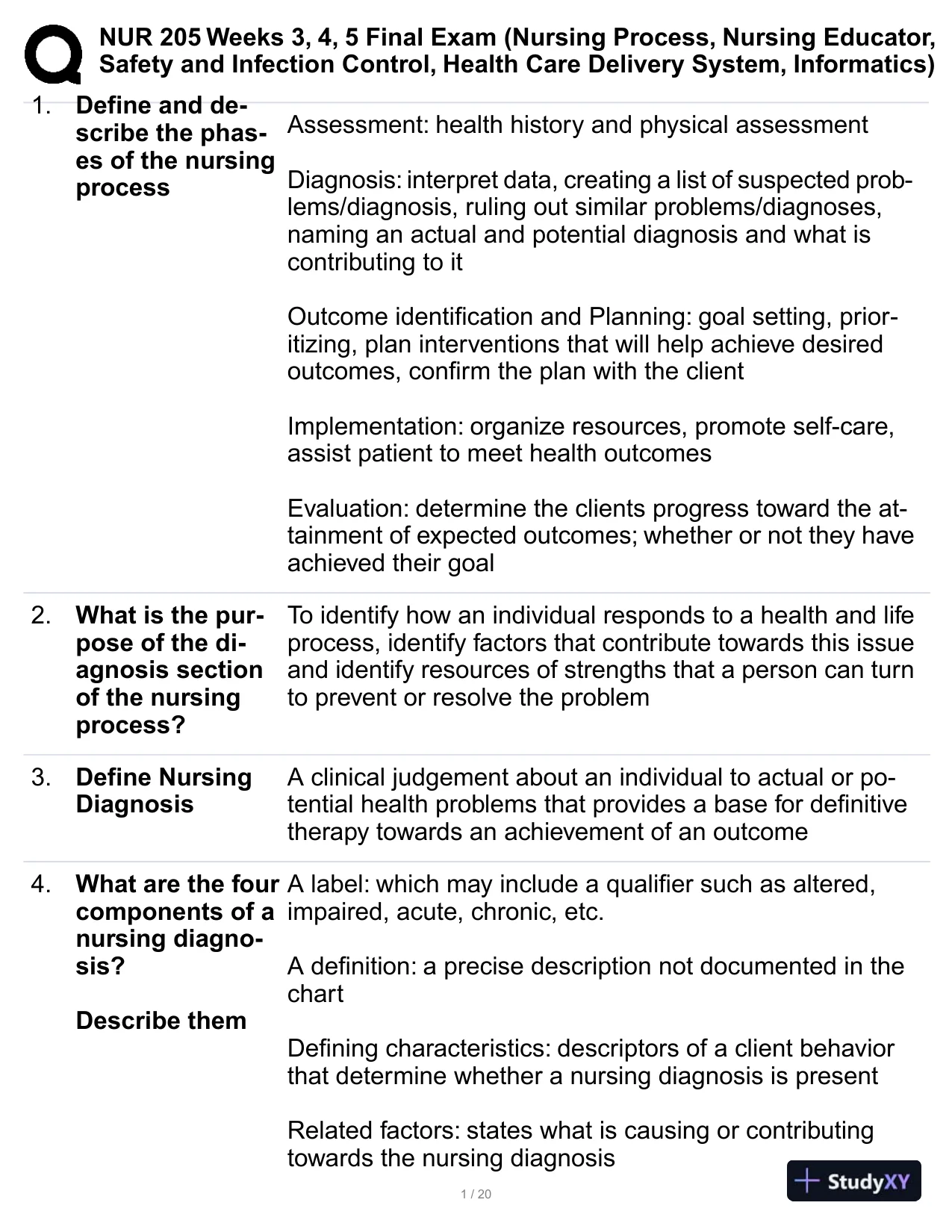
NUR205 Weeks 3, 4, 5 Final Exam with Answers (61 Solved Questions) - Page 1 preview imageNUR 205 Weeks 3, 4, 5 Final Exam (Nursing Process, Nursing Educator,Safety and Infection Control, Health Care Delivery System, Informatics)1.Define and de-scribe the phas-es of the nursingprocessAssessment: health history and physical assessmentDiagnosis: interpret data, creating a list of suspected prob-lems/diagnosis, ruling out similar problems/diagnoses,naming an actual and potential diagnosis and what iscontributing to itOutcome identification and Planning: goal setting, prior-itizing, plan interventions that will help achieve desiredoutcomes, confirm the plan with the clientImplementation: organize resources, promote self-care,assist patient to meet health outcomesEvaluation: determine the clients progress toward the at-tainment of expected outcomes; whether or not they haveachieved their goal2.What is the pur-pose of the di-agnosis sectionof the nursingprocess?To identify how an individual responds to a health and lifeprocess, identify factors that contribute towards this issueand identify resources of strengths that a person can turnto prevent or resolve the problem3.Define NursingDiagnosisA clinical judgement about an individual to actual or po-tential health problems that provides a base for definitivetherapy towards an achievement of an outcome4.What are the fourcomponents of anursing diagno-sis?Describe themA label: which may include a qualifier such as altered,impaired, acute, chronic, etc.A definition: a precise description not documented in thechartDefining characteristics: descriptors of a client behaviorthat determine whether a nursing diagnosis is presentRelated factors: states what is causing or contributingtowards the nursing diagnosis1 / 20
Page 2 of 7
NUR205 Weeks 3, 4, 5 Final Exam with Answers (61 Solved Questions) - Page 2 preview image
Page 3 of 7
NUR205 Weeks 3, 4, 5 Final Exam with Answers (61 Solved Questions) - Page 3 preview imageNUR 205 Weeks 3, 4, 5 Final Exam (Nursing Process, Nursing Educator,Safety and Infection Control, Health Care Delivery System, Informatics)5.What are thethree types ofnursing diag-noses?Actual nursing diagnoses: describes human responsesto health conditions that exist in an individual, family, orcommunityRisk for nursing diagnoses: describes human responsesthat MAY develop into a vulnerable person, family, or com-munity. The plan is aimed at preventing the problemWellness nursing diagnoses: describes human responsesto levels of wellness in an individual, family, or communitythat have to potential for growth or the enhancement to ahigher state of well-being6.Define Collabora-tive Problem:A clinical problem that you cannot solve alone. It may re-quire other healthcare professionals, medications or treat-ments.There is an overlap between medical and nursing diagno-sis7.When writing anursing diagno-sis, what threethings should itcontain?Describe themProblem, r/t etiology, and AEBProblem: NANDA labelr/t: related factorsAEB: data supporting the diagnosis8.When writing a"risk for..." state-ment, what threethings should itcontain?Problem, etiology, and secondary pathophysiology9.What are thethree types ofplanning for indi-vidual patients?Initial planning: starts right away while doing an assess-mentOngoing planning: as the patient starts to shift, client's2 / 20
Page 4 of 7
NUR205 Weeks 3, 4, 5 Final Exam with Answers (61 Solved Questions) - Page 4 preview imageNUR 205 Weeks 3, 4, 5 Final Exam (Nursing Process, Nursing Educator,Safety and Infection Control, Health Care Delivery System, Informatics)Describe themhealth condition may change rapidlyDischarge planning: starts right away to help them get toa space where they can leave the hospital10.Identify three pri-orities for plan-ning patient care:What needs to be done immediately and what can besafely postponed.Basic survival needs to take first priority when your clienthas a threat to physiological integrity.Maslow's Hierarchy of Needs (self actualization, esteem,love, safety, physiological needs)11.Define expectedoutcome:What are thedifferent timeframes:Must include a subject, verb, performance criteria, andtarget time. It should be able to be measured, timed,and directly observed, while also remaining realistic andachievableShort: 1 hour-1weekLong: weeks to months12.What are the fourdifferent types ofoutcomes?Describe themExamples ofbroad outcomes:Examples of spe-cific outcomes:Cognitive: increased the patient's knowledge, you havetaught them something and they can repeat or apply theinformationPsychomotor: teaching the patient new skill and they candemonstrate itAffective: changing beliefs or attitudes; thinking, feelings,motivationPhysiological: there is a physical change in the patient; useassessment skills to collect and compare dataImprove nutritional status, decrease painClient will gain 5lbs by Oct. 31st3 / 20
Page 5 of 7
NUR205 Weeks 3, 4, 5 Final Exam with Answers (61 Solved Questions) - Page 5 preview imageNUR 205 Weeks 3, 4, 5 Final Exam (Nursing Process, Nursing Educator,Safety and Infection Control, Health Care Delivery System, Informatics)13.What are somepatient variablesinfluencing out-come achieve-ment?What are somenursing variablesinfluencing out-come achieve-ment?Developmental stage and psychosocial backgroundResources, standard of care, research findings, ethicaland legal guides to practice14.Name someproblems asso-ciated with out-come identifica-tion and planningFailure to involve the patientInsufficient data/diagnosis developed from insufficientdataOutcomes stated are too broadFailure to evaluate and update the plan15.Define interven-tion:Define nurse-ini-tiated interven-tions:Name some ex-amples of nurs-ing interventionsDefine Physi-cian-initiated in-terventions:Collaborative in-terventions:Any treatment based on clinical judgement and knowledgethat a nurse performs to enhance a patient's outcomeInterventions that are independent from the physicianassist w activities, reduce risk of injury or infection, reposi-tion the patient, protect, sustaining life and physical func-tion, monitoring the clients statusSomething within the scope of nursing practice but re-quires a physician's order for the nurse to implementTreatments initiated by other providers and carried out bya nurse (PT, OT, etc.)16.What are the ele-ments of a nurs-ing intervention?Who, what, where, when, why, howWho is providing careWhat care will most effectively meet the client's needs4 / 20
Page 6 of 7
NUR205 Weeks 3, 4, 5 Final Exam with Answers (61 Solved Questions) - Page 6 preview imageNUR 205 Weeks 3, 4, 5 Final Exam (Nursing Process, Nursing Educator,Safety and Infection Control, Health Care Delivery System, Informatics)Where are they receiving careWhen is the time the care is deliveredWhy provides a rationale for careHow defines the methods of interventions17.What is the pur-pose of accuratedocumentation?Why do we usemedical abbrevi-ations?Why is it impor-tant to record in-formation legibly,concisely, com-pletely, and se-quentially?Accurate documentation of information is essential in or-der to communicate info to all members of the healthcareteam, to ensure legal accountability, and to demonstrateeffective use of the nursing process and appropriate stan-dards of care.It saves both time and spaceIt needs to be legible if it is not going into the EHR so thatindividuals can read what you are saying. It needs to belogically organized according to time. You want to makeentries about nursing care as close to the time of deliveryas possible. Make sure to include important details.18.What can doc-umentation beused for?What kinds ofthings do/don'tnurses docu-ment?Communication/quality of careCare planning/Support decision analysisEducation: educate studentsLegal accountability, reimbursementDo not document opinions or biased statements. Do notdocument entries suggesting an error or unsafe practice.Do use objective and measurable terms. Do report failureof client to follow through with treatment/meds and theirrationale.19.Define theprocess of pa-tient education:What are the ben-efits of patienteducation?The process of influencing patient's behavior to effectchanges in knowledge, attitudes, and skills to maintainand promote health, restore health, prevent illness, andfacilitate coping.Increases patient satisfaction, increased quality of life,5 / 20
Page 7 of 7
NUR205 Weeks 3, 4, 5 Final Exam with Answers (61 Solved Questions) - Page 7 preview imageNUR 205 Weeks 3, 4, 5 Final Exam (Nursing Process, Nursing Educator,Safety and Infection Control, Health Care Delivery System, Informatics)ensures continuity of care, maximizes independence andreduces anxiety20.Describe the roleof a nurse as aneducatorDefine the teach-ing processDefine the learn-ing processDefine patient ed-ucationThe giver of information, the assessor of needs, the eval-uator of learning, the reviser of teaching/learning methodPlanned method that involves sharing information andexperiences to meet the intended learner outcomeThe process by which a person acquires or increasesknowledge or changes behavior in a measurable way asa result of the experienceThe process of helping patient's learn health related be-haviors to achieve the goal of optimal health and indepen-dence in self-care21.What factors canaffect a nursesrole in teaching?Name some bar-riers to patienteducation thatare carried out bythe nurse:Name of factorsaffecting patientlearning:Social, economic and political factors can affect a nursesrole in teachingTalking too much, interrupting the patient, the nurse makesassumptions, when the nurse lectures, ignores patientconcernsLimited time to learn due to rapid discharge, low literacylevels, different learning styles, cultural or language barri-ers, stress, anxiety22.Name the clientcharacteristics toconsider whenassessing teach-ing needsDescribe themReadiness to learn: motivation, how much is the patientwilling to change, can they see why the are susceptibleto the disease, can they see there are actions to take tomake a changeAbility to learn: physiological factors such as needing as-sistive devices, cognitive ability to learn, literacy, level ofeducation, communication skills6 / 20
Preview Mode

This document has 20 pages. Sign in to access the full document!