

Olds' Maternal-Newborn Nursing and Women's Health Across the Lifespan 8th Edition Test Bank
- Nursing
- 153 pages
- Shared May 2025
Stay ahead of the curve with Olds' Maternal-Newborn Nursing and Women's Health Across the Lifespan 8th Edition Test Bank, an essential exam preparation tool filled with practice questions.
Preview 16 of 153 pages
See the first 16 pages exactly as they appear in the document.
Page 1 Read page 1 as text
Chapter 1 Current Issues in Maternal - Newborn Nursing MULTIPLE CHOICE. Choose the o ne alternative that best completes the statement or answers the question. 1) An experienced nurse is working with a new graduate. The experienced nurse suspects that the multiparous client is going to deliver precipitously, while the new graduate is unaware that the labor is proceeding rapidly. One reason for this difference in interpretation of the client situation is because experienced nurses are able to view situations more holistically because they: A) Know more about the pathophysiology of diseases. B) Need less supervision in managing complex clinical situations. C) Spend less time providing direct client care. D) Are more aware of subtle cues that indicate client changes. Answer: D 2) Self - care has gained wide acceptance with clients, the healthcare community, and third - party payors due to research findings that suggest that it has: A) Reduced health care costs. B) Decreased the number of emergency room visits. C) Decreased use of home health agencies. D) Shortened newborn length of stay. Answer: A 3) The new graduate is learning about advanced practice nursing. Which of the following situations best illustrates an advanced practice nursing role? (Select all that apply.) A) An experienced registered nurse who is the manager of a large obstetrical unit B) A nurse - midwife attending vaginal deliveries of uncomplicated pregnancies. C) A registered nurse who is the circulating nurse at surgical (cesarean) deliveries D) A clinical nurse specialist who is working as a staff nurse on a mother - baby unit E) A nurse practitioner who is consulting with a physician in the newborn nursery Answer: B, E 4) The nurse at an elementary school is performing TB screenings on all of the students. Permission slips were returned for all children except for the Nguyen children. When the nurse phones to obtain permission, the mother states in clearly - understandable English that she is unable to give permission at this time because her grandmother is out of town for two more weeks. Which of the following elements of culture is contributing to the dilemma that faces the nurse? A) Belief and understanding about the concepts of health and illness B) Permissible physical contact with strangers C) Presence and influence of the extended family D) Religion and social beliefs Answer: C 5) The insurance company is demanding that a client who is experiencing complications be discharged in two days, because her benefits will run out. The physician and nurses who are involved in this client's care all feel that, because there is no one at home to provide assistance, it is an ethical breach of duty to send this client home when she cannot care for herself. Which of the six components of ethical decision making is the nurse considering when evaluating the driving and restraining forces and assessing the likelihood of a successful outcome? A) Action and implementation B) Conflict resolution
Page 2 Page 3 Read page 3 as text
C) Data gathering D) Plan formulation Answer: B 6) The nurse is reviewing care of clients on a mother - baby unit. Which of the following situations should be reported to the supervisor? A) The client who delivered by cesarean delivery yesterday received oral narcotics. B) An infant was placed in the wrong crib after examination by the physician. C) A 2 - day - old infant has breastfed every three hours and voided four times. D) A primiparous client who delivered today is requesting discharge within 24 hours. Answer: B 7) The nurse manager is planning a presentation on ethical issues in caring for the childbearing families. Which of the following should the nurse manager include as an example of maternal - fetal conflict? A) A 39 - year - old nulliparous client undergoes therapeutic insemination. B) A cesarean delivery of a breech fetus is court - ordered after the client refuses. C) A family of a child with leukemia requests cord blood banking at this birth. D) A client chooses an abortion after her fetus is diagnosed with a genetic anomaly. Answer: B 8) The nurse is working at a community clinic. For which of the following clients must the nurse seek parental permission to obtain informed consent? A) A 16 - year - old who is seeking information on contraceptive use B) An emancipated minor who is requesting treatment for a urinary tract infection C) A 12 - year - old with an ectopic (tubal) pregnancy who requires surgery D) A married 17 - year - old who is recommended for a planned cesarean birth Answer: C 9) In explaining descriptive statistics to the student nurse, the experienced nurse should include which of the following examples? A) Comparison of maternal mortality rates across racial groups B) Understanding the behavioral variations within a cultural group C) Determining why the infant mortality is declining in the United States D) Assessment of maternal nutrition with age and birth weight Answer: A 10) The nurse knows the birth rate by age group in the state. Which research question could be developed for further study from this data? A) What is the average number of children per family in the United States? B) Which high schools provide day care for student parents? C) How does educational level affect the incidence of unplanned pregnancy? D) What is the overall nutritional status of adolescents? Answer: C 11) The nurse manager is leading an in - service educational session about evidence - based nursing practice. Which participant statement indicates the need for additional information? "Evidence - based nursing
Page 4 Read page 4 as text
practice: A) Incorporates research findings into clinical practice." B) Is a lifelong learning approach to client care." C) Is supported by current, valid research." D) Is unnecessary on a unit with established policies." Answer: D 12) State nurse practice acts define the legal scope of nursing practice. How can the policies of an institution or organization such as a hospital influence nursing practice? The institution: (Select all that apply.) A) Cannot redefine in any way the limits set by the practice act. B) Can permit nurses to do some things that are forbidden by the state practice act. C) Should remain aware of changes or updates as they are enacted. D) Can either restrict or expand the limits of the practice act. E) Can restrict nurses from doing some things that are allowed by the state nurse practice act. Answer: C, E 13) The maternity nurse has been named in a negligence malpractice suit. The best defense against the accusation of negligence is if the nurse: A) Was acting on the advice of the nurse manager. B) Followed the physician's written orders. C) Met the Association of Women's Health, Obstetric and Neonatal Nurses (AWHONN) standards of practice. D) Is a certified nurse midwife or nurse practitioner. Answer: C 14) The nurse is planning care in a labor and delivery unit. Which of the following families is most likely to request cord blood banking? A) A family with a history of leukemia B) A family who wishes to avoid a future intrauterine fetal surgery C) A family who wishes to select the sex of a future child D) A family with a history of infertility Answer: A 15) A nurse has attended a cesarean birth. Without first consulting the parents the nurse goes to the waiting room and tells family members the sex of a newborn baby. In this situation, the nurse would be considered to have committed: A) A breach of ethics. B) Malpractice. C) A breach of privacy. D) Negligence. Answer: C
Page 5 Read page 5 as text
1) D 2) A 3) B, E 4) C 5) B 6) B 7) B 8) C 9) A 10) C 11) D 12) C, E 13) C 14) A 15) C
Page 6 Read page 6 as text
Chapter 2 Care of the Family in a Culturally Diverse Society MULTIPLE CHO ICE. Choose the one alternative that best completes the statement or answers the question. 1) Which examples of a pregnant client's culture may influence her decision making? (Select all that apply.) A) The client follows the nutrition advice of the certified nurse - midwife. B) The client's husband comes to a prenatal visit to hear the fetal heartbeat. C) The client plans to return to work full - time at six weeks postpartum. D) The client's grandfather makes the family's major health care decisions. E) The client includes specific foods in her diet every day during pregnancy. Answer: D, E 2) At 38 weeks gestation, the client reports to the nurse that she will return to work when her child is two weeks old, and her grandmother will care for the infant. This is an example of: A) A family development stage. B) A spiritual belief. C) A developmental task. D) An economic employment trend. Answer: D 3) The public health nurse is working with a student nurse. The student nurse asks which of the six groups of people seen today are families. How should the nurse respond? "The clients we visited today that are families are the: (Select all that apply.) A) Married heterosexual couple with three children, living with grandparents." B) Unmarried heterosexual couple with two biological children." C) Gay couple with two adopted children." D) The married heterosexual couple without children." E) Lesbian couple not living together that have no children" Answer: A, B, C, D 4) The nurse is preparing a community presentation on family development. Which of the following statements should the nurse include? A) A family does not experience overlapping of stages. B) The stages describe the family's progression over time. C) The youngest child's age determines the family's current stage. D) Family development ends when the youngest child leaves home. Answer: B 5) The family the nurse is caring for in the community has a two - month - old child. The infant is breastfed, and the father helps care for the child by changing diapers, and dressing and bathing the baby. The mother will be returning to work when the baby is three months old, and a day care provider has been arranged. Although the mother occasionally feels fatigued, the couple has resumed having sexual relations, although not as frequently as before the pregnancy. Which family model best describes this family? A) Model of the Breastfeeding Mother B) Model of the Childbearing Family C) Model Incorporating the Unattached Young Adult D) Model of the Nuclear Family Answer: B
Page 7 Read page 7 as text
6) The pregnant client reports to the nurse that she is eating dirt on a weekly basis, and was told to do this by her grandmother to have a healthy pregnancy. How should the nurse respond? A) "There is no problem with this practice. Feel free to continue." B) "Your grandmother gave you bad advice. Stop at once." C) "This practice is completely unhealthy and should be stopped." D) "The soil may contain contaminants that could harm your baby." Answer: D 7) The nurse is performing a cultural assessment using the Transcultural Assessment Model. What aspect of communication should the nurse keep in mind when planning the assessment? A) Personal space does not vary from one culture to another. B) The use of silence may differ among different groups. C) Non - verbal communication is consistent across cultures. D) Cultural groups living in America are future - oriented. Answer: B 8) A family is said to be acculturating to United States norms when the parent makes which of the following statements? A) "Our diet now includes hamburgers and French fries." B) "We celebrate the same holidays that we used to at home." C) "The children are much less well - behaved than they used to be." D) "When the children leave the house, I worry about them." Answer: A 9) The nurse is working with an immigrant group in the community that has been in the state for several years. Which of the following findings would indicate that the immigrant group is acculturating? A) Fewer screening mammograms B) Lowered cholesterol levels and insulin resistance C) Decreased incidence of obesity in adults and children D) Increased rates of cervical cancer screening exams Answer: D 10) The nurse manager in a hospital with a large immigrant population is planning an inservice. The nurse manager is aware of how ethnocentrism affects nursing care. Which statement should the nurse manager include? "The belief that one's own values and beliefs are the only or the best: A) Can create barriers to communication through misunderstanding." B) Leads to an expectation that all clients will exhibit pain the same way." C) Improves the quality of care provided to culturally diverse clients." D) Means that newcomers to the United States should adopt United States norms and values." Answer: A 11) When planning care of childbearing families, the nurse encounters different spiritual and religious beliefs and practices. Which of the following is a spiritual practice that could impact the nurse's care of the childbearing family? A) A strong belief in reincarnation, and thus refusal of an autopsy B) Refusing consent for a blood transfusion by a Jehovah's Witness C) Request by the family to speak to a Roman Catholic priest
Page 8 Read page 8 as text
D) The desire to light candles at home during a naming ceremony Answer: A 12) When preparing to teach a group of culturally diverse childbearing families about hospital birthing options, in order to be culturally competent, the nurse should: A) Understand that the family has the same values as the nurse. B) Teach the family how childbearing takes place in the United States. C) Learn about the cultural groups that are likely to attend the class. D) Insist that the client answer questions instead of her husband. Answer: C 13) The laboring client is being tended by her mother, older sisters, and aunts. The husband of the client is not at the hospital. The most likely explanation for this, based on an understanding of the client's culture, is: A) Labor support is to be provided by adult women, not men. B) The client and her husband are not legally married. C) This is the indirect communication of this culture. D) The husband is angry at his wife. Answer: A 14) The nurse in the community should use a family assessment tool to obtain what type of information? A) How they meet their nutritional needs and obtain food B) What other health insurance the family has had in the past C) How long the family has lived at their current address D) What eye color they desire in their unborn child Answer: A 15) The laboring client the nurse is caring for speaks English well, and has identified her race as Asian. She has requested only warm water to drink, and has refused ice chips and cold liquids throughout the labor. The nurse understands that this is most likely related to: A) Folklore concerning the desired sex of the unborn child. B) A desire to have complete control of the environment. C) The client's belief in the role of hot and cold in health. D) The fact that the client has not yet become thirsty. Answer: C
Page 9 Read page 9 as text
1) D, E 2) D 3) A, B, C, D 4) B 5) B 6) D 7) B 8) A 9) D 10) A 11) A 12) C 13) A 14) A 15) C
Page 10 Read page 10 as text
Chapter 3 Complementary and Alternative Therapies MULTIPLE CHOICE. Choose the one alternative that best completes the statement or answers the question. 1) The client states "I am using homeopathic remedies to help with my morning sickness." The nurse understands that the client is utilizing: A) Traditional Chinese medicine. B) A complementary therapy. C) Naturopathy. D) An alternative therapy. Answer: B 2) Complementary and alternative therapies are becoming more commonly used in the U.S. Based on an understanding of how clients learn about these therapies, which client is most likely to use either a complementary or an alternative therapy? A) A middle - aged woman who travels internationally for her job B) An adolescent male who plays many sports through school C) An elderly couple on a fixed income without a computer at home D) A young mother of three preschoolers who works part - time Answer: A 3) The National Center for Complementary and Alternative Medicine (NCCAM) is responsible for: A) Ensuring the safety of complementary and alternative therapies. B) Disseminating information to consumers. C) Performing testing on new therapies and products. D) Endorsing products for further approval by the FDA. Answer: B 4) The nurse is planning a community education program on the role of complementary and alternative therapies during pregnancy. Which statement should the nurse include? "Alternative and complementary therapies: A) Bring about cures for illnesses and diseases." B) Prevent pregnancy complications." C) Emphasize prevention and wellness." D) Are invasive but effective for achieving health." Answer: C 5) The pregnant client asks the nurse about the safety and risks of using complementary and alternative therapies. How should the nurse respond? "The use of complementary and alternative therapies is: A) Not regulated by the FDA and little has been proven about some methods." B) Safe as long as you see a certified and registered practitioner of the therapy." C) Completely safe and therefore not a problem during pregnancy." D) Very inexpensive and can easily be tried to see if they help your health." Answer: A 6) The nurse is teaching a community education class on complementary and alternative therapies. To assess learning, the nurse asks this question about traditional Chinese medicine: "What is the invisible flow of energy in the body that maintains health and assures physiologic functioning?" Which answer indicates teaching was successful?
Page 11 Read page 11 as text
A) Yin B) Chi C) Yang D) Meridians Answer: B 7) The client reports to the nurse that she is utilizing Ayurvedic medicine. Which statements would the nurse expect this client to make? "Aryurvedic medicine (Select all that apply.) A) Uses both traditional means with current modern medicine." B) Cures an illness with a like substance." C) Combines heat and cold with spinal manipulation." D) Seeks balance to achieve harmony in my life." E) Is knowledge of how to live a vital, healthful life." Answer: D, E 8) The nurse is seeing clients at the wellness clinic. Which client is most likely to be using a form of chromotherapy? A) A client with severe burns B) A client with cancer C) A baby with spina bifida D) A client with a seasonal mood disorder Answer: D 9) The nurse is teaching a class to the community on mind - body therapies. A class participant gives an example of a friend with leukemia who was taught by her complementary therapist to concentrate on making antibodies that will fight and kill the cancer cells in the blood stream. The nurse would describe this technique as: A) Homeopathy. B) Biofeedback. C) Qigong. D) Guided imagery. Answer: D 10) The client reports using an alternative therapy that inv olves the manipulation of soft tissues. This therapy has reduced the client's stress, diminished pain, and increased circulation. This therapy is most likely: A) Homeopathy. B) Guided imagery. C) Massage therapy. D) Reflexology. Answer: C 11) The client asks why she should not use a sauna or sweat bath in the first trimester of pregnancy. The best explanation by the nurse is that saunas and sweat baths have been associated with fetal: A) Neural tube defects. B) Craniofacial defects. C) Patent ductus arteriosus. D) Gastroschisis.
Page 12 Read page 12 as text
Answer: A 12) The client reports relief from headaches when she rubs the temples on each side of the head. The nurse understands that this is a form of: A) The Alexander technique. B) The Feldenkrais method. C) Acupressure. D) Acupuncture. Answer: C 13) The nurse is reviewing charts. A client seen in the clinic yesterday reported seeing a practitioner that placed his hands above a painful abdomen in order to transfer energy. This resulted in a decrease in pain simultaneously with an improved overall sense of well - being. The nurse understands this therapy to be: A) Therapeutic touch. B) Chiropractic. C) Reiki. D) Homeopathy. Answer: C 14) The nurse is preparing a class on complementary and alternative medicine (CAM). One fact that could be included in this presentation is: A) Men are more likely to use CAM than women. B) People of lower educational levels use more CAM. C) 36% of Americans use some form of CAM. D) Prayer and megavitamin therapy are not considered CAM Answer: C 15) The pregnant client has brought an herbal remedy to the clinic to learn about the safety of the remedy. The nurse should include which statements about herbal therapies? "Herbal remedies: (Select all that apply.) A) Are not subject to safety and effectiveness testing." B) Are used to eliminate certain diseases." C) Are subject to FDA approval." D) Cannot be sold over the counter." E) Are different from homeopathic remedies." Answer: A, E
Page 13 Read page 13 as text
1) B 2) A 3) B 4) C 5) A 6) B 7) D, E 8) D 9) D 10) C 11) A 12) C 13) C 14) C 15) A, E
Page 14 Read page 14 as text
Chapter 4 Women’s Health Across the Lifespan MULTIPLE CHOICE. Choose the one alternative that best completes the statement or answers the question. 1) A client asks her nurse "Is it okay for me to take a tub bath during the heavy part of my menstruation?" The best response by the nurse is: A) "Either a bath or a shower is fine at that time." B) "You should bathe and use a feminine deodorant spray during menstruation." C) "Tub baths are contraindicated during menstruation." D) "You should shower and douche daily instead." Answer: A 2) An adolescent client is asking the nurse about using tampons during heavy menstrual flow. Which answer is best for the nurse to provide? A) Tampons are recommended for use at the end of the menstrual period rather than at the beginning. B) Tampons should be avoided when the menstrual flow is heavy. C) Super tampons with added deodorants are recommended for the day, while regular tampons may be worn at night. D) Tampons should be used during the day; change to napkins at night when flow is lighter to decrease the risk of toxic shock syndrome. Answer: D SHORT ANSWER. Write the word or phrase that best completes each statement or answers the question. 3) The nurse is beginning to take a sexual history from the client. List the answer choices in chronological order of how the nurse should proceed. Your answer should be a four digit number. 1. Ask specific questions about the client's current sexual practices. 2. Ask the client mostly open - ended questions. 3. Have the client fill out a comprehensive questionnaire. 4. Explain that the history is obtained from all clients and will be confidential. Answer: 4321 MULTIPLE CHOICE. Choose the one alternative that best completes the statement or answers the question. 4) The nurse has successfully completed a client's sexual and gynecologic history. Which of the following questions is the nurse most likely to have included? A) When was the last time you had intercourse? B) Have you had a sexually - transmitted infection? C) Have you ever had any type of surgery? D) Have you had any elective abortions? Answer: C 5) A 19 - year - old woman comes to the gynecologist's office. When the nurse asks the reason for this visit, the woman explains that she has never had a menstrual period and that she is concerned there may be something wrong. The diagnosis that the physician is most likely to make based on this information is: A) Primary amenorrhea. B) Secondary amenorrhea. C) Secondary infertility. D) Primary dysmenorrhea. Answer: A
Page 15 Read page 15 as text
6) The nurse is interviewing an adolescent client. The client reports a weight loss of 50 pounds over the last four months, and reports running at least five miles per day. The client asserts that her menarche was five years ago. Her menses are usually every 28 days, but her last menstrual period was four months ago. The client denies any sexual activity. Which of the following statements is best for the nurse to make? A) "Adolescents rarely have regular menses, even if they used to be regular." B) "Your lack of menses may be related to your rapid weight loss." C) "Increase your intake of iron - rich foods to reestablish menses." D) "It is common and normal for runners to stop having any menses." Answer: B 7) A client comes to the clinic complaining of severe menstrual cramps. She has never been pregnant, has been diagnosed with ovarian cysts, and has had an intrauterine device (IUD) for two years. The most likely cause for the client's complaint is: A) Primary dysmenorrhea. B) Menorrhagia. C) Secondary dysmenorrhea. D) Hypermenorrhea. Answer: C 8) A teaching plan for a client with premenstrual syndrome (PMS) should include a recommendation to restrict her intake of: A) Chicken, eggs, and fish. B) Coffee, colas, and chocolate cake. C) Whole grain breads and cereals, and beans. D) High - starch foods such as potatoes and spaghetti. Answer: B 9) A 49 - year - old client comes to the clinic with complaints of severe perimenopausal symptoms including hot flashes, night sweats, urinary urgency, and vaginal dryness. The physician has prescribed a combination hormone replacement therapy of estrogen and progestin. When the client asks the nurse why she must take both hormones, the best reply is: A) "There is an increased risk of tissue abnormality inside the uterus if only one is given." B) "Your blood pressure may become elevated if only one hormone is used." C) "Hot flashes respond better when replacement includes both hormones." D) "You are having very severe symptoms, so you need more hormones replaced." Answer: A 10) The nurse is answering the perimenopausal client's questions about hormone replacement therapy. Which client statement indicates a need for additional teaching? "The Women's Health Initiative of 2002 reported that long - term hormone replacement therapy caused decreased: A) Risk of heart attack." B) Hip fractures." C) Risk of blood clots to the lungs." D) Risk of gallbladder disease." Answer: B SHORT ANSWER. Write the word or phrase that best completes each statement or answers the question.
Page 16 Read page 16 as text
11) Rank the following clients in order from highest to lowest risk for developing osteoporosis. Your answer should be a four - digit number. 1. Small - boned, underweight 40 - year - old woman 2. Overweight 55 - year - old with type II diabetes 3. 60 - year - old African American woman who smokes. 4. 75 - year - old male who plays tennis three times per week Answer: 3124 MULTIPLE CHOICE. Choose the one alternative that best completes the statement or answers the question. 12) The client is given a prescription for hormone replacement therapy (HRT). She asks the nurse, "What type of side effects or consequences should I expect from taking this medicine?" The nurse's best response would be: "You may A) Experience irregular, heavy menstrual bleeding." B) Notice chest pains initially that will subside." C) Notice some intermittent abdominal cramping." D) Have a decrease in vaginal dryness." Answer: D 13) A menopausal woman tells her nurse that she experiences discomfort from vaginal dryness during sexual intercourse and asks, "What should I use as a lubricant?" The nurse should recommend: A) Less frequent intercourse. B) Petroleum jelly. C) Body cream or body lotion. D) A water - soluble lubricant. Answer: D 14) The client is experiencing symptoms of menopause, and states that she would prefer to use herbs rather than medication. Which statement indicates that no further teaching is indicated? A) "Soy protein may be helpful, but should not be taken over a long time period." B) "Studies have shown significant improvement of menopausal symptoms." C) "Dong quai decreases hot flashes, and does not interfere with medications." D) "Black cohosh will reduce the frequency of my hot flashes and mood swings." Answer: A 15) The nurse is conducting health screening at a community clinic. The client has asked if there are any risks with body piercing and tattooing, or if these activities would impact sexual activity. How should the nurse respond? A) "Both piercing and tattooing carry risks of infection, including hepatitis." B) "The benefit of body art outweighs any risk of infection of a tattoo or piercing." C) "There are no problems that occur with either body piercing or tattooing." D) "You should avoid piercing your genitalia and your nipples." Answer: A
137 more pages in the full document
Unlock it once and it stays in your library, ready to chat with or turn into flashcards.
Unlock the full documentMore Nursing study materials
See all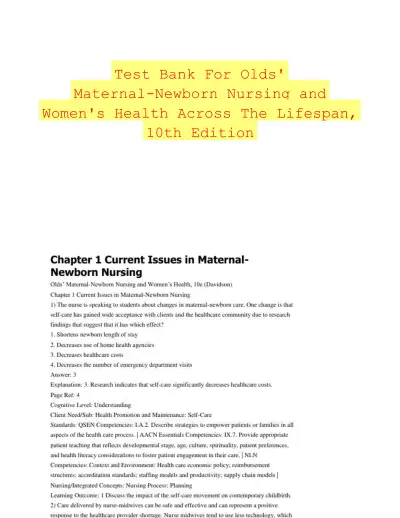 Exam Guides
Test Bank For Olds' Maternal-Newborn Nursing and Women's Health Across The Lifespan, 10th Edition
Nursing
1036 pagesMay 2025 Exam Guides
Test Bank for Critical Care Nursing: Diagnosis and Management, 9th Edition (Chapters 1-27)
Nursing
299 pages167downloadsFeb 2025 Class Notes
An Invitation To Health, Third Canadian Edition Lecture Notes
Nursing
439 pages163downloadsFeb 2025 Exam Guides
Test Bank for Physical Examination and Health Assessment, 9th Edition (Chapters 1-15)
Nursing
200 pages161downloadsFeb 2025 Exam Guides
Focus on Nursing Pharmacology Seventh, North American Edition Test Bank
Nursing
1144 pages160downloadsFeb 2025 Exam Guides
Test Bank for Fundamentals of Nursing, 11th edition (Chapters 1-24)
Nursing
200 pages160downloadsFeb 2025 Class Notes
Class Notes for Child Health Nursing, 3rd Edition
Nursing
861 pages154downloadsFeb 2025 Class Notes
Class Notes for Clinical Nursing Skills: Basic to Advanced Skills, 9th Edition
Nursing
150 pages154downloadsFeb 2025
Study this document with CramX
Once it is in your library, every tool can work from it.