

Test Bank For Urinalysis and Body Fluids, 6th Edition
- Nursing
- 280 pages
- Shared May 2025
Build a strong knowledge base with Test Bank For Urinalysis and Body Fluids, 6th Edition, featuring expert-reviewed content and exam-focused exercises.
Preview 16 of 280 pages
See the first 16 pages exactly as they appear in the document.
Page 1 Read page 1 as text
Chapter 1: Safety and Quality Assessment Multiple Choice 1. Laboratory e quipment and other inanimate objects serve as what in the chain of infection? A. H ost B. R eservoir C. P oint of entry D. P oint of exit ANS: B DIF: Level 1 OBJ: 1 TOP: Biol ogic hazards 2. The chain of infection includes all of the following except a: A. S ource B. H ost C. D isinfectant D. T ransmission method ANS: C DIF: Level 2 OBJ: 1 TOP: Biol ogic hazards 3. You arrive to work in the clinical laboratory with a small cut on your hand . Y our supervisor pulls you from specimen collection (phlebotomy) duties for the day , citing chain of infection protocols. Why is your supervisor concerned about the cut on your hand? A. Because you will not have the mobility in your hand to properly collect blood B. Because you are going to have to wear a bandage all day long C. Because you have a point of entry that could expose you to infectious agents D. Because you are going to be an active transmitter of infection onto general surfaces ANS: C DIF: Level 3 OBJ: 1 TOP: Biol ogic h azards
Page 2 Page 3 Read page 3 as text
4. Centrifuging an uncapped tube of urine is most likely to produce a/an: A. E lectrical shock B. B roken tube C. U nbalancing D. A erosol ANS: D DIF: Level 2 OBJ: 2 TOP: Biol ogic hazards 5. Which of the following guidelines tells laboratory personnel to consider all patients as possible carriers of blood - borne pathogens ? A. Urinalysis p recautions B. Blood - borne pathogen precautions C. Standard p recautions D. Body fluid precautions ANS: C DIF: Level 1 OBJ: 2 TOP: Biol ogic hazards 6. The Centers for Disease Control ( CDC ) recommends that u niversal p recautions be followed when encountering: A. S pecimens containing visible blood B. P atients who are infected with blood - borne pathogens C. A ll body fluid specimens D. S pecimens that may produce aerosols ANS: A DIF: Level 1 OBJ: 2 TOP: Biol ogic hazards 7. Which of the following CDC guidelines considers all moist body substances to be potentially infectious and stresses hand washing ?
Page 4 Read page 4 as text
A. Universal p recautions B. Body fluid precautions C. Standard p recautions D. Health - care personnel standards ANS: C DIF: Level 1 OBJ: 3 TOP: Biol ogic hazards 8. The Occupational Exposure to Blood - B orne Pathogens Standard is: A. A guideline developed by the FDA B. A n additional precaution associated with urinalysis C. A guideline recommended by the CDC D. A law enforced by Occupational Safety and Health Administration ( OSHA ) ANS: D DIF: Level 1 OBJ: 3 TOP: Biol ogic hazards 9. A laboratory worker who observes a red hand rash after remov ing gloves should: A. A void wearing gloves for 2 days B. W ash the hands with antimicrobial soap C. A pply cortisone cream to the hands D. A void wearing latex gloves in the future ANS: D DIF: Level 2 OBJ: 4 TOP: Biol ogic hazards 10. Plexiglas shields are used in the laboratory when urine tube specimens are being: A. S orted according to lab B. U ncapped for analysis C. C entrifuged for analysis D. O bserved for color characteristics ANS: B DIF: Level 2
Page 5 Read page 5 as text
OBJ: 4 TOP: Biol ogic hazards 11. A urine specimen received in the laboratory is leaking in a transport bag . What is the next course of action? A. It should be relabeled B. It should be rejected C. It should be processed with no special handling D. It should be poured into a clean container ANS: B DIF: Level 1 OBJ: 6 TOP: Biol ogic hazards 12. Lab coats worn in the urinalysis lab should: A. B e worn loosely over uniforms B. H ave short sleeves C. B e completely buttoned D. B e worn at all times in and outside of the laboratory ANS: C DIF: Level 2 OBJ: 4 TOP: Biol ogic hazards 13. Proper hand washing includes all of the following procedures except: A. R ubbing to create a lather B. U sing warm water C. R insing hands in a downward position D. U sing a paper towel to turn on the water faucet ANS: D DIF: Level 2 OBJ: 5 TOP: Biol ogic hazards 14. The acceptable method for disposing of urine specimens is:
Page 6 Read page 6 as text
A. A utoclaving in the entire collection B. P ouring down the sink followed by copious amounts of water C. P lacing the specimen in a biohazard bag D. D iluting with sodium hypochlorite ANS: B DIF: Level 1 OBJ: 6 TOP: Biol ogic hazards 15. Disinfection of the sink in the urinalysis laboratory should be performed: A. O n a daily basis B. W hen a positive bilirubin is detected C. F ollowing an accidental spill D. B y using dilute hydrochloric acid ANS: A DIF: Level 2 OBJ: 6 TOP: Biol ogic hazards 16. Safety precautions observed in the urinalysis laboratory include all of the following except: A. W earing goggles or a face shield B. C hecking tube balance in the centrifuge C. C entrifuging only uncapped tubes D. W earing a fluid - resistant lab coat ANS: C DIF: Level 2 OBJ: 6 TOP: Biol ogic hazards 17. The source, method of transmission , and host are all deemed : A. S teps in the urinalysis B. C omponents of the chain of infection C. P roblems encountered in urinalysis D. C onsiderations in urine specimen transport ANS: B DIF: Level 1
Page 7 Read page 7 as text
OBJ: 1 TOP: Biol ogic hazards 18. Which of the following is a practice that all laboratory workers must avoid ? A. C hanging gloves that are soiled B. C entrifuging conical tubes C. M oving puncture - resistant containers D. M anually recapping needles ANS: D DIF: Level 1 OBJ: 6 TOP: Sharp hazards 19. Before using a water hose on a burning chemical cabinet, a firefighter would visually check that what is posted on the outside of the cabinet ? A. N ational F ire P rotection A ssociation (NFPA) symbol B. M aterial S afety D ata Sheet (MSDS) C. Chemical Hygiene Plan D. O ccupational S afety and H ealth A dministration manual ANS: A DIF: Level 1 OBJ: 8 TOP: Chemical hazards 20. Immediate information concerning the health hazards, flammability, and reactivity of a chemical can be obtained from the: A. MSDS B. NFPA symbol C. CDC D. OSHA ANS: B DIF: Level 2 OBJ: 8 TOP: Chemical hazards
Page 8 Read page 8 as text
21 . Laboratory personnel wear special monitory badges w hen working frequently with which of the following hazards ? A. Biol ogic B. Chemical C. Radi oactive D. Explosive ANS: C DIF: Level 1 OBJ: 9 TOP: Radioactive hazards 22 . When encountering a person experiencing an electrical shock, the first thing to do is: A. T urn off the circuit breaker for area B. L ower the person's head below the heart C. W rap the person in a wet fire blanket D. M ove the person away from the electrical object ANS: A DIF: Level 2 OBJ: 9 TOP: Electrical hazards 2 3 . When a fire is discovered in the laboratory, you should do all of the following except: A. A ctivate the fire alarm B. E vacuate the area using the stairs C. U se an appropriate fire extinguisher D. L eave the door open when evacuating ANS: D DIF: Level 2 OBJ: 10 TOP: Fire hazards 24 . The acronym RACE is used when encountering a/an: A. F ire B. C hemical spill C. E lectrical shock D. N eedlestick
Page 9 Read page 9 as text
ANS: A DIF: Level 1 OBJ: 10 TOP: Fire hazards 25 . Which of the following i tems found in the laboratory should be securely fast ened to a nonmovable object? A. B iohazard bags B. C ompressed gas cylinders C. C hemical spill kits D. R adiation detectors ANS: B DIF: Level 1 OBJ: 7 TOP: Fire hazards 26 . The most commonly available fire extinguisher in a hospital is : A. T ype A B. T ype B C. T ype C D. T ype ABC ANS: D DIF: Level 1 OBJ: 9 TOP: Fire hazards 27 . W hen using a fire extinguisher , which action do you perform first? A. P oint the nozzle B. P ull the pin C. P rotect the patient samples D. P osition the extinguisher ANS: B DIF: Level 2 OBJ: 10 TOP: Fire h azards
Page 10 Read page 10 as text
28. Variables that are included in a quality assurance program include all of the following except: A. P re - examination B. C linical C. E xamination D. P ost - examination ANS: B DIF: Level 1 OBJ: 12 TOP: Quality assessment 29. Clinical laboratory personnel have the least control over which of the following conditions ? A. P re - examination variables B. E xamination variables C. P ost - examination variables D. P ost - discharge variables ANS: A DIF: Level 2 OBJ: 12 TOP: Quality assessment 30. When you receive a specimen and a requisition form that do not match, you should: A. N otify the personnel who collected the specimen B. T est the specimen and note the error on the requisition C. I mmediately discard the specimen D. A nalyze the error and make appropriate changes to the label ANS: A DIF: Level 2 OBJ: 12 TOP: Quality assessment 31. When a critical value is obtained in the laboratory: A. T he test should be repeated B. T he pathologist should be notified C. A new specimen must be requested D. T he result must be reported to the health - care provider
Page 11 Read page 11 as text
ANS: D DIF: Level 2 OBJ: 12 TOP: Quality assessment 32. The ability to obtain the published result on a control sample is referred to as: A. P recision B. A ccuracy C. S tandardization D. R eliability ANS: B DIF: Level 1 OBJ: 13 TOP: Quality assessment 33. Obtaining the same result after testing the same specimen three times is called test: A. R eliability B. Q uality control C. P recision D. A ccuracy ANS: C DIF: Level 1 OBJ: 13 TOP: Quality assessment 34. The highest acceptable range for confidence limits in the clinical laboratory is: A. ±1 SD B. ±2 SD C. ±3 SD D. ±4 SD ANS: C DIF: Level 1 OBJ: 13 TOP: Quality assessment
Page 12 Read page 12 as text
35. A procedure with a coefficient of variation of 10% is considered: A. R eliable B. P recise C. C onfident D. I mprecise ANS: D DIF: Level 2 OBJ: 13 TOP: Quality assessment 36. When plotted on a Levy - Jennings chart, a control that has been left on the counter overnight instead of being refrigerated might show a/an: A. S hift B. I ncreased CV C. T rend D. C hange in precision ANS: A DIF: Level 2 OBJ: 13 TOP: Quality assessment 37. Proficiency testing should be performed: A. W hen control results exceed the confidence limits B. B y personnel performing the tests routinely C. B y the laboratory supervisor only D. D uring an accreditation site inspection ANS: B DIF: Level 2 OBJ: 13 TOP: Quality assessment 38. The least regulated level of Clinical Laboratory Improvement Amendments ( CLIA ) testing categories is: A. W aived B. P rovider - performed microscopy C. M oderate - complexity
Page 13 Read page 13 as text
D. H igh - complexity ANS: A DIF: Level 1 OBJ: 13 TOP: Quality assessment 39. A urinalysis laboratory that subscribes to an external proficiency testing program from which all samples are tested by the supervisor is an example of: A. R ight things done right B. W rong things done wrong C. R ight things done wrong D. W rong things done right ANS: C DIF: Level 3 OBJ: 13 TOP: Quality assessment True/False 40 . Personnel in the urinalysis laborat ory are best protected from blood - borne pathogen exposure when following s tandard p recautions. ANS: True DIF: Level 2 OBJ: 3 TOP: Biol ogic hazards 41 . It is not necessary to change gloves when performing tasks on the same patient. ANS: False DIF: Level 1 OBJ: 4 TOP: Biol ogic hazards
Page 14 Read page 14 as text
42 . OSHA requires employers to provide free immunization for hepatitis B virus ( HBV ) to workers in urinalysis. ANS: True DIF: Level 1 OBJ: 3 TOP: Biol ogic hazards 43 . Hands should be washed before and after testing each urine specimen. ANS: False DIF: Level 2 OBJ: 5 TOP: Biol ogic hazards 44 . A paper towel used to absorb a urine spill is discarded in a biohazard container . ANS: True DIF: Level 2 OBJ: 6 TOP: Biol ogic hazards 45 . It is acceptable to recap a needle on a syringe containing urine, but not blood. ANS: False DIF: Level 2 OBJ: 6 TOP: Sharp hazards 46 . Only nontoxic chemicals can be pipetted by mouth. ANS: False DIF: Level 1 OBJ: 7 TOP: Chemical hazards
Page 15 Read page 15 as text
4 7 . The MSDS should be provided to laboratories by chemical manufacturers or vendors. ANS: True DIF: Level 1 OBJ: 7 TOP: Chemical hazards 4 8 . Electrical current can pass through glass and wood. ANS: False DIF: Level 2 OBJ: 9 TOP: Electrical hazards 49 . Flammable chemicals must be stored in explosion - proof refrigerators. ANS: True DIF: Level 1 OBJ: 7 TOP: Fire hazards 5 0 . When lifting heavy objects, laboratory workers should bend their knees. ANS: True DIF: Level 1 OBJ: 2 TOP: Physical hazards Matching Match the burning material with the type of fire: A. Type A B. Type B C. Type C D. Type D
Page 16 Read page 16 as text
5 1 . Electrical 5 2 . Organic chemicals 5 3 . Combustible metals 5 4 . Wood 51 . ANS: C DIF: Level 1 OBJ: 9 TOP: Fire hazards 52 . ANS: B DIF: Level 1 OBJ: 9 TOP: Fire hazards 53 . ANS: D DIF: Level 1 OBJ: 9 TOP: Fire hazards 54 . ANS: A DIF: Level 1 OBJ: 9 TOP: Fire hazards Match the following safety hazards with the possible injury: A. Carcinogen exposure B. Strained back C. Viral infection D. Shock 5 5 . Biol ogic 5 6 . Chemical 5 7 . Electrical 5 8 . Physical 55. ANS: C DIF: Level 1 OBJ: 2 TOP: Biol ogic hazards 56 . ANS: A DIF: Level 1 OBJ: 7 TOP: Chemical hazards 57. ANS: D DIF: Level 1 OBJ: 9 TOP: Electrical hazards 58 . ANS: B DIF: Level 1 OBJ: 2 TOP: Physical hazards Short Answer 59 . State the six components of the chain of infection. ANS: Infectious agent, reservoir, portal of exit, means of transmission, portal of entry, susceptible host DIF: Level 1 OBJ: 1 TOP: Biol ogic hazards
264 more pages in the full document
Unlock it once and it stays in your library, ready to chat with or turn into flashcards.
Unlock the full documentMore Nursing study materials
See all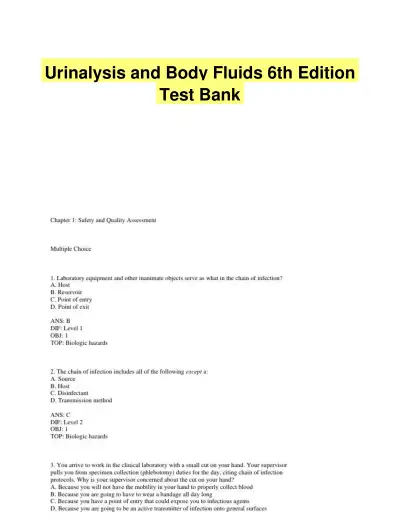 Exam Guides
Urinalysis and Body Fluids 6th Edition Test Bank
Nursing
280 pagesMay 2025 Exam Guides
Test Bank for Critical Care Nursing: Diagnosis and Management, 9th Edition (Chapters 1-27)
Nursing
299 pages167downloadsFeb 2025 Class Notes
An Invitation To Health, Third Canadian Edition Lecture Notes
Nursing
439 pages163downloadsFeb 2025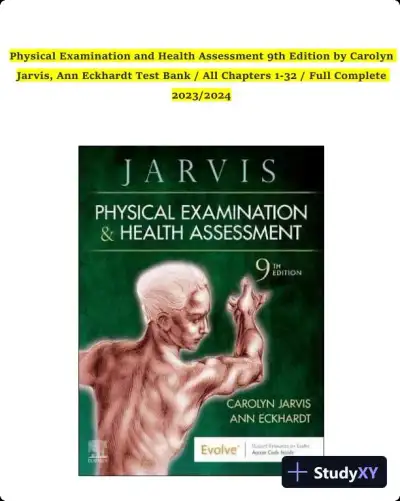 Exam Guides
Test Bank for Physical Examination and Health Assessment, 9th Edition (Chapters 1-15)
Nursing
200 pages161downloadsFeb 2025 Exam Guides
Focus on Nursing Pharmacology Seventh, North American Edition Test Bank
Nursing
1144 pages160downloadsFeb 2025 Exam Guides
Test Bank for Fundamentals of Nursing, 11th edition (Chapters 1-24)
Nursing
200 pages160downloadsFeb 2025 Class Notes
Class Notes for Child Health Nursing, 3rd Edition
Nursing
861 pages154downloadsFeb 2025 Class Notes
Class Notes for Clinical Nursing Skills: Basic to Advanced Skills, 9th Edition
Nursing
150 pages154downloadsFeb 2025
Study this document with CramX
Once it is in your library, every tool can work from it.