

Varcarolis' Foundations of Psychiatric-Mental Health Nursing: A Clinical Approach 8th Edition Test Bank
- Nursing
- 414 pages
- Shared May 2025
Ensure success with Varcarolis' Foundations of Psychiatric-Mental Health Nursing: A Clinical Approach 8th Edition Test Bank, an essential exam guide that helps you grasp concepts quickly and effectively.
Preview 16 of 414 pages
See the first 16 pages exactly as they appear in the document.
Page 1 Read page 1 as text
Chapter 01: Mental Health and Mental Illness Halter: Varcarolis’ Foundations of Psychiatric Mental Health Nursing: A Clinical Approach, 8th Edition MULTIPLE CHOICE 1. A s taff nurse completes orientation to a psychiatric unit. This nurse may expect an advanced practice nurse to perform which additional intervention? a. Conduct mental health assessments. b. Prescribe psychotropic medication. c. Establish therapeutic relationships. d. Individualize nursing care plans. ANS: B In most states, prescriptive privileges are granted to master’s - prepared nurse practitioners and clinical nurse specialists who have taken special courses on prescribing medication. The nurse prepared at the basic level is permitted to perform mental health assessments, establish relationships, and provide individualized care planning. PTS: 1 DIF: Cognitive Level: Understand (Comprehension) REF: Page 1 - 23 TOP: Nursing Process: Implementation MSC: Client Needs: Safe, Effective Care Environment 2. A nursing student expresses concerns that mental health nurses “lose all their clinical nursing skills.” Select the best response by the mental health nurse. a. “Psychiatric nurses practice in safer environments than other specialties. Nurse - to - patient ratios must be better because of the nature of the patients’ problems.” b. “Psychiatric nurses use complex communication skills as well as critical thinking to solve multidimensional problems. I am challenged by those situations.” c. “That’s a misconception. Psychiatric nurses frequently use high technology monitoring equipment and manage complex intravenous therapies.” d. “Psychiatric nurses do not have to deal with as much pain and suffering as medical – surgical nurses do. That appeals to me.” ANS: B The practice of psychiatric nursing requires a different set of skills than medical – surgical nursing, though there is substantial overlap. Psychiatric nurses must be able to help patients with medical as well as mental health problems, reflecting the holistic perspective these nurses must have. Nurse – patient ratios and workloads in psychiatric settings have increased, just like other specialties. Psychiatric nursing involves clinical practice, not just documentation. Psychosocial pain and suffering are as real as physical pain and suffering. PTS: 1 DIF: Cognitive Level: Apply (Application) REF: Pages 1 - 2, 21 TOP: Nursing Process: Implementation MSC: Client Needs: Safe, Effective Care Environment 3. Wh en a new bill introduced in Congress reduces funding for care of persons diagnosed with mental illness, a group of nurses write letters to their elected representatives in opposition to the legislation. Which role have the nurses fulfilled?
Page 2 Page 3 Read page 3 as text
a. Recovery b. Attending c. Advocacy d. Evidence - based practice ANS: C An advocate defends or asserts another’s cause, particularly when the other person lacks the ability to do that for self. Examples of individual advocacy include helping patients understand their rights or make decisions. On a community scale, advocacy includes political activity, public speaking, and publication in the interest of improving the human condition. Since funding is necessary to deliver quality programming for persons with mental illness, the letter - writing campaign advocates for that cause on behalf of patients who are unable to articulate their own needs. PTS: 1 DIF: Cognitive Level: Understand (Comprehension) REF: Page 1 - 26 TOP: Nursing Process: Evaluation MSC: Client Needs: Safe, Effective Care Environment 4. A family has a long history of conflicted relationships among the members. Which family member’s comment best reflects a mentally healthy perspective? a. “I’ve made mistakes but everyone else in this family has also.” b. “I remember joy and mutual respect from our early years together.” c. “ I will make some changes in my behavior for the good of the family.” d. “It’s best for me to move away from my family. Things will never change.” ANS: C The correct response demonstrates the best evidence of a healthy recognition of the importance of relationships. Mental health includes rational thinking, communication skills, learning, emotional growth, resilience, and self - esteem. Recalling joy from earlier in life may be healthy, but the correct response shows a higher level of mental health. The other incorrect responses show blaming and avoidance. PTS: 1 DIF: Cognitive Level: Analyze (Analysis) REF: Pages 1 - 2, 3, 32 (Figure 1 - 1) TOP: Nursing Process: Assessment MSC: Client Needs: Psychosocial Integrity 5. Which assessment finding most clearly indicates that a patient may be experiencing a mental illness? The patient a. reports occasional sleeplessness and anxiety. b. reports a consistently sad, discouraged, and hopeless mood. c. is able to describe the difference between “as if” and “for real.” d. perceives difficulty making a decision about whether to change jobs. ANS: B The correct response describes a mood alteration, which reflects mental illness. The distracters describe behaviors that are mentally healthy or within the usual scope of human experience. PTS: 1 DIF: Cognitive Level: Apply (Application) REF: Pages 1 - 2 to 4 TOP: Nursing Process: Assessment MSC: Client Needs: Psychosocial Integrity
Page 4 Read page 4 as text
6. Which finding best indicates that the goal “Demonstrate mentally healthy behavior ” was achieved for an adult patient? The patient a. sees self as capable of achieving ideals and meeting demands. b. behaves without considering the consequences of personal actions. c. aggressively meets own needs without considering the rights of others. d. seeks help from others when assuming responsibility for major areas of own life. ANS: A The correct response describes an adaptive, healthy behavior. The distracters describe maladaptive behaviors. PTS: 1 DIF: Cognitive Level: Apply (Application) REF: Pages 1 - 2 to 4 TOP: Nursing Process: Evaluation MSC: Client Needs: Psychosocial Integrity 7. A nurse encounters an unfamiliar psychiatric disorder on a new patient’s admission form. Which resource should the nurse consult to determine criteria used to establish this diagnosis? a. International Statistical Classification of Diseases and Related Health Problems (ICD - 10) b. The ANA’s Psychiatric - Mental Health Nursing Scope and Standards of Practice c. Diagnostic and Statistical Manual of Mental Disorders (DSM - V) d. A behavioral health reference manual ANS: C The DSM - V gives the criteria used to diagnose each mental disorder. It is the official guideline for diagnosing psychiatric disorders. The distracters may not contain diagnostic criteria for a psychiatric illness. PTS: 1 DIF: Cognitive Level: Apply (Application) REF: Pages 1 - 18, 19 TOP: Nursing Process: Assessment MSC: Client Needs: Safe, Effective Care Environment 8. A nurse wants to find a description of diagnostic criteria for anxiety disorders. Which resource would have the most complete information? a. Nursing Outcomes Classification (NOC) b. DSM - V c. The ANA’s Psychiatric - Mental Health Nursing Scope and Standards of Practice d. ICD - 10 ANS: B The DSM - V details the diagnostic criteria for psychiatric clinical conditions. It is the official guideline for diagnosing psychiatric disorders. The other references are good resources but do not define the diagnostic criteria. PTS: 1 DIF: Cognitive Level: Understand (Comprehension) REF: Pages 1 - 18, 19 TOP: Nursing Process: Implementation MSC: Client Needs: Safe, Effective Care Environment 9. Which individual is demonstrating the highest level of resilience? One who a. is able to repress stressors. b. becomes depressed after the death of a spouse. c. lives in a shelter for 2 years after the home is destroyed by fire.
Page 5 Read page 5 as text
d. takes a temporary job to maintain financial stability after loss of a permanent job. ANS: D Resilience is closely associated with the process of adapting and helps people f acing tragedies, loss, trauma, and severe stress. It is the ability and capacity for people to secure the resources they need to support their well - being. Repression and depression are unhealthy. Living in a shelter for 2 years shows a failure to move forward after a tragedy. See related audience response question. PTS: 1 DIF: Cognitive Level: Apply (Application) REF: Pages 1 - 5, 6 TOP: Nursing Process: Assessment MSC: Client Needs: Psychosocial Integrity 10. Complete this analogy. NANDA: clinical judgment: NIC : _________________ a. patient outcomes. b. nursing actions. c. diagnosis. d. symptoms. ANS: B Analogies show parallel relationships. NANDA, the North American Nursing Diagnosis Association, identifies diagnostic statements regarding human responses to actual or potential health problems. These statements represent clinical judgments. NIC ( Nursing Interventions Classification ) identifies actions provided by nurses that enhance patient outcomes. Nursing care activities may be direct or indirect. PTS: 1 DIF: Cognitive Level: Analyze (Analysis) REF: Pages 1 - 21, 22 TOP: Nursing Process: Evaluation MSC: Client Needs: Safe, Effective Care Environment 11. An adult says, “Most of the time I’m happy and feel good about myself. I have learned that what I get out of something is proportional to the effort I put into it.” Which number on this mental health continuum should the nurse select? Mental Illness Mental Health 1 2 3 4 5 a. 1 b. 2 c. 3 d. 4 e. 5 ANS: E The adult is generally happy and has an adequate self - concept. The statement indicates the adult is reality - oriented, works effectively, and has control over own behavior. Mental health does not mean that a person is always happy. PTS: 1 DIF: Cognitive Level: Apply (Application) REF: Pages 1 - 2, 3, 32 (Figure 1 - 1) TOP: Nursing Process: Assessment MSC: Client Needs: Psychosocial Integrity
Page 6 Read page 6 as text
12. Which disorder is an example of a culture - bound syndrome? a. Epilepsy b. Schizophrenia c. Running amok d. Major depressive disorder ANS: C Culture - bound syndromes occur in specific sociocultural contexts and are easily recognized by people in those cultures. A syndrome recognized in parts of Southeast Asia is running amok, in which a person (usually a male) runs around engaging in furious, almost indiscriminate violent behavior. PTS: 1 DIF: Cognitive Level: Understand (Comprehension) REF: Page 1 - 7 TOP: Nursing Process: Assessment MSC: Client Needs: Psychosocial Integrity 13. The DSM - V classifies: a. deviant behaviors. b. present disability or distress. c. people with mental disorders. d. mental disorders people have. ANS: D The DSM - V classifies d isorders people have rather than people themselves. The terminology of the tool reflects this distinction by referring to individuals with a disorder rather than as a “schizophrenic” or “alcoholic,” for example. Deviant behavior is not generally considered a mental disorder. Present disability or distress is only one aspect of the diagnosis. PTS: 1 DIF: Cognitive Level: Understand (Comprehension) REF: Pages 1 - 18, 19 TOP: Nursing Process: Implementation MSC: Client Needs: Safe, Effective Care Environment 14. A citizen at a community health fair asks the nurse, “What is the most prevalent mental disorder in the United States?” Select the nurse’s correct response. a. Schizophrenia b. Bipolar disorder c. Dissociative fugue d. Alzheimer’s disease ANS: D The 12 - month prevalence for Alzheimer’s disease is 10% for persons older than 65% and 50% for persons older than 85. The prevalence of schizophrenia is 1.1% per year. The prevalence of bipolar disorder is 2.6%. Dissociative fugue is a rare disorder. PTS: 1 DIF: Cognitive Level: Understand (Comprehension) REF: Page 1 - 33 (Table 1 - 1) TOP: Nursing Process: Implementation MSC: Client Needs: Health Promotion and Maintenance 15. In the majority culture of the United States, which individual has the greatest risk to be labeled mentally ill? One who a. describes hearing God’s voice speaking. b. is usually pessimistic but strives to meet personal goals.
Page 7 Read page 7 as text
c. is wealthy and gives away $20 bills to needy individuals. d. always has an optimistic viewpoint about life and having own needs met. ANS: A The question asks about risk. Hearing voices is generally associated with mental illness, but in charismatic religious groups, hearing the voice of God or a prophet is a desirable event. Cultural norms vary, which makes it more difficult to make an accurate diagnosis. The individuals described in the other options are less likely to be labeled mentally ill. PTS: 1 DIF: Cognitive Level: Analyze (Analysis) REF: Pages 1 - 3, 4 TOP: Nursing Process: Assessment MSC: Client Needs: Psychosocial Integrity 16. A patient’s relationships are intense and unstable. The patient initially idealizes the significant other and then devalues him or her, resulting in frequent feelings of emptiness. This patient will benefit from interventions to develop which aspect of mental health? a. Effectiveness in work b. Communication skills c. Productive activities d. Fulfilling relationships ANS: D The information given centers on relationships with others that are described as intense and unstable. The relationships of mentally healthy individuals are stable, satisfying, and socially integrated. Data are not present to describe work effectiveness, communication skills, or activities. PTS: 1 DIF: Cognitive Level: Understand (Comprehension) REF: Page 1 - 32 (Figure 1 - 1) TOP: Nursing Process: Planning MSC: Client Needs: Psychosocial Integrity 17. Which belief will best support a nurse’s efforts to provide patient advocacy during a multidisciplinary patient care planning session? a. All mental illnesses are culturally determined. b. S chizophrenia and bipolar disorder are cross - cultural disorders. c. Symptoms of mental disorders are unchanged from culture to culture. d. Assessment findings in mental illness reflect a person’s cultural patterns. ANS: D Symptoms must be understood in terms of a person’s cultural background. A nurse who understands that a patient’s symptoms are influenced by culture will be able to advocate for the patient to a greater degree than a nurse who believes that culture is of little relevance. The distracters are untrue statements. PTS: 1 DIF: Cognitive Level: Understand (Comprehension) REF: Page 1 - 27 TOP: Nursing Process: Implementation MSC: Client Needs: Psychosocial Integrity 18. A nurse is part of a multidisciplinary team working with groups of depressed patients. One group of patients receives supportive interventions and antidepressant medication. The other group receives only medication. The team measures outcomes for each group. Which type of study is evident?
Page 8 Read page 8 as text
a. Incidence b. Prevalence c. Comorbidity d. Clinical epidemiology ANS: D Clinical epidemiology is a broad field that addresses studies of the natural history (or what happens if there is no treatment and the problem is left to run its course) of an illness, studies of diagnostic screening tests, and observational and experimental studies of interventions used to treat people with the illness or symptoms. Prevalence refers to numbers of new cases. Comorbidity refers to having more than one mental disorder at a time. Incidence refers to the number of new cases of mental disorders in a healthy population within a given period. See related audience response question. PTS: 1 DIF: Cognitive Level: Understand (Comprehension) REF: Page 1 - 17 TOP: Nursing Process: Evaluation MSC: Client Needs: Safe, Effective Care Environment 19. The spouse of a patient diagnosed with schizophrenia says, “I don’t understand how events from childhood have anything to do with this disabling illness.” Which response by the nurse will best help the spouse understand the cause of this disorder? a. “Psychological stress is the basis of most mental disorders.” b. “This illness results from developmental factors rather than stress.” c. “Research shows that this condition more likely has a biological basis.” d. “It must be frustrating for you that your spouse is sick so much of the time.” ANS: C Many of the most prevalent and disabling mental disorders have strong biological influences. Genetics are only one part of biological factors. Empathy does not address increasing the spouse’s level of knowledge about the cause of the disorder. The other distracters are not established facts. PTS: 1 DIF: Cognitive Level: Apply (Application) REF: Pages 1 - 5, 6 TOP: Nursing Process: Implementation MSC: Client Needs: Psychosocial Integrity 20. A category 5 tornado occurred in a community of 400 people. Many homes and businesses were destroyed. In the 2 years following the disaster, 140 individuals were diagnosed with posttraumatic stress disorder (PTSD). Which term best applies to these newly diagnosed cases? a. Prevalence b. Comorbidity c. Incidence d. Parity ANS: C
Page 9 Read page 9 as text
Incidence refers to the number of new cases of mental disorders in a healthy population within a given period of time. Prevalence describes the total number of cases, new and existing, in a given population during a specific period of time, regardless of when they became ill. Parity refers to equivalence, and legislation required insurers that provide mental health coverage to offer annual and lifetime benefits at the same level provided for medical – surgical coverage. Comorbidity refers to having more than one mental disorder at a time. PTS: 1 DIF: Cognitive Level: Understand (Comprehension) REF: Page 1 - 16 TOP: Nursing Process: Planning/Outcomes Identification MSC: Client Needs: Safe, Effective Care Environment 21. Which component of treatment of mental illness is specifically recognized by Quality and Safety Education for Nurses (QSEN)? a. All genomes are unique. b. Care is centered on the patient. c. Healthy development is vital to mental health. d. Recovery occurs on a continuum from illness to health. ANS: B The key areas of care promoted by QSEN are patient - centered care, teamwork and collaboration, evidence - based practice, quality improvement, safety, and informatics. PTS: 1 DIF: Cognitive Level: Understand (Comprehension) REF: Page 1 - 14 TOP: Nursing Process: Implementation MSC: Client Needs: Safe, Effective Care Environment 22. Select the best response for the nurse to a question from another health professional regarding the difference between a diagnosis in DSM - V and a nursing diagnosis. a. “There is no functional difference between the two. Both identify human disorders.” b. “The DSM - V diagnosis disregards culture, whereas the nursing diagnosis takes culture into account.” c. “The DSM - V diagnosis describes causes of disorders whereas a nursing diagnosis does not explore etiology.” d. “The DSM - V diagnosis guides medical treatment, whereas the nursing diagnosis offers a framework for identifying interventions for issues a patient is experiencing.” ANS: D The medical diagnosis is concerned with the patient’s disease state, causes, and cures, whereas the nursing diagnosis focuses on the patient’s response to stress and possible caring interventions. Both tools consider culture. The DSM - V is multiaxial. Nursing diagnoses also consider potential problems. PTS: 1 DIF: Cognitive Level: Apply (Application) REF: Page 1 - 21 TOP: Nursing Process: Implementation MSC: Client Needs: Safe, Effective Care Environment 23. Which nursing intervention below is part of the scope of an advanced practice psychiatric/mental health nurse rather than a basic level registered nurse? a. Coordination of care
Page 10 Read page 10 as text
b. Health teaching c. Milieu therapy d. Psychotherapy ANS: D Psychotherapy is part of the scope of practice of an advanced practice nurse. The distracters are within a basic level registered nurse’s scope of practice. PTS: 1 DIF: Cognitive Level: Understand (Comprehension) REF: Pages 1 - 23, 35 (Table 1 - 2) TOP: Nursing Process: Implementation MSC: Client Needs: Safe, Effective Care Environment MULTIPLE RESPONSE 1. An experienced nurse says to a new graduate, “When you’ve practiced as long as I have, you automatically know how to take care of patients experiencing psychosis.” Which factors should the new graduate consider when analyzing this comment? ( Select all that apply. ) a. The experienced nurse may have lost sight of patients’ individuality, which may compromise the integrity of practice. b. New research findings should be integrated continuously into a nurse’s practice to provide the most effective care. c. Experience provides mental health nurses with the essential tools and skills needed for effective professional practice. d. Experienced psychiatric nurses have learned the best ways to care for mentally ill patients through trial and error. e. An intuitive sense of patients’ needs guides effective psychiatric nurses. ANS: A, B Evidence - based practice involves using research findings and standards of care t o provide the most effective nursing care. Evidence is continuously emerging, so nurses cannot rely solely on experience. The effective nurse also maintains respect for each patient as an individual. Overgeneralization compromises that perspective. Intuition and trial and error are unsystematic approaches to care. PTS: 1 DIF: Cognitive Level: Apply (Application) REF: Page 1 - 14 TOP: Nursing Process: Diagnosis/Analysis MSC: Client Needs: Safe, Effective Care Environment 2. Which findings are signs of a person who is mentally healthy? ( Select all that apply. ) a. Says, “I have some weaknesses, but I feel I’m important to my family and friends.” b. Adheres strictly to religious beliefs of parents and family of origin. c. Spends all holidays alone watching old movies on television. d. Considers past experiences when deciding about the future. e. Experiences feelings of conflict related to changing jobs. ANS: A, D, E Mental health is a state of well - being in which each individual is able to reali ze his or her own potential, cope with the normal stresses of life, work productively, and make a contribution to the community. Mental health provides people with the capacity for rational thinking, communication skills, learning, emotional growth, resilience, and self - esteem.
Page 11 Read page 11 as text
PTS: 1 DIF: Cognitive Level: Apply (Application) REF: Pages 1 - 2, 3, 32 (Figure 1 - 1) TOP: Nursing Process: Assessment MSC: Client Needs: Psychosocial Integrity 3. A patient in the emergency department says, “Voices say someone is stalking me. They want to kill me because I developed a cure for cancer. I have a knife and will stab anyone who is a threat.” Which aspects of the patient’s mental health have the greatest and most immediate concern to the nurse? ( Select all that apply. ) a. Happiness b. Appraisal of reality c. Control over behavior d. Effectiveness in work e. Healthy self - concept ANS: B, C, E The aspects of mental health of greatest concern are the patient’s appraisal of and control over behavior. The appraisal of reality is inaccurate. There are auditory hallucinations, delusions of persecution, and delusions of grandeur. In addition, the patient’s control over behavior is tenuous, as evidenced by the plan to stab anyone who seems threatening. A healthy self - concept is lacking, as evidenced by the delusion of grandeur. Data are not present to suggest that the other aspects of mental health (happiness and effectiveness in work) are of immediate concern. PTS: 1 DIF: Cognitive Level: Apply (Application) REF: Pages 1 - 3, 4 TOP: Nursing Process: Assessment MSC: Client Needs: Psychosocial Integrity
Page 12 Read page 12 as text
Chapter 02: Theories and Therapies Halter: Varcarolis’ Foundations of Psychiatric Mental Health Nursing: A Clinical Approach, 8th Edition MULTIPLE CHOICE 1. A parent says, “My 2 - year - old child refuses toilet training and shouts ‘No!’ when given directions. What do you think is wrong?” Select the nurse’s best reply. a. “Your child needs firmer control. It is important to set limits now.” b. “This is normal for your child’s age. The child is striving for independence.” c. “ There may be developmental problems. Most children are toilet trained by age 2.” d. “Some undesirable attitudes are developing. A child psychologist can help you develop a plan.” ANS: B This behavior is conventional of a child around the age of 2 years, whose developmental task is to develop autonomy. The distracters indicate the child’s behavior is abnormal. PTS: 1 DIF: Cognitive Level: Apply (Application) REF: Page 2 - 52 (Table 2 - 6) TOP: Nursing Process: Implementation MSC: Client Needs: Health Promotion and Maintenance 2. A nurse wants to find information on current evidence - based research, programs, and practices regarding mental illness and addictions. Which resource should the nurse consult? a. American Psychiatric Association b. American Psychological Association (APA) c. Clinician’s Quick Guide to Interpersonal Psychotherapy d. Substance Abuse and Mental Health Services Administration (SAMHSA) ANS: D The SAMHSA maintains a National Registry of Evidence - based Practices and Program s. New therapies are entered into the database on a regular basis. The incorrect responses are resources but do not focus on evidence - based information. PTS: 1 DIF: Cognitive Level: Understand (Comprehension) REF: Page 2 - 32 TOP: Nursing Process: Planning MSC: Client Needs: Management of Care 3. A 26 - month - old displays negative behavior, refuses toilet training, and often says, “No!” Which psychosocial crisis is evident? a. Trust versus mistrust b. Initiative versus guilt c. Industry versus inferiority d. Autonomy versus shame and doubt ANS: D
Page 13 Read page 13 as text
The crisis of autonomy versus shame and doubt relates to the developmental task of gaining control of self and environment, as exemplified by toilet training. This psychosocial crisis occurs during the period of early childhood. Trust versus mistrust is the crisis of the infant. Initiative versus guilt is the crisis of the preschool and early - school - aged child. Industry versus inferiority is the crisis of the 6 - to 12 - year - old child. PTS: 1 DIF: Cognitive Level: Understand (Comprehension) REF: Page 2 - 52 (Table 2 - 6) TOP: Nursing Process: Assessment MSC: Client Needs: Health Promotion and Maintenance 4. A 4 - year - old grabs toys from other children and says, “I want that now!” From a psychoanalytic perspective, this behavior is a product of impulses originating in which system of the personality? a. Id b. Ego c. Superego d. Preconscious ANS: A The id operates on the pleasure principle, seeking immediate gratification of im pulses. The ego acts as a mediator of behavior and weighs the consequences of the action, perhaps determining that taking the toy is not worth the mother’s wrath. The superego would oppose the impulsive behavior as “not nice.” The preconscious is a level of awareness rather than an aspect of personality. PTS: 1 DIF: Cognitive Level: Understand (Comprehension) REF: Pages 2 - 4, 5 TOP: Nursing Process: Assessment MSC: Client Needs: Health Promotion and Maintenance 5. The parent of a 4 - year - old rewards and praises the child for helping a sibling, being polite, and using good manners. These qualities are likely to be internalized and become part of which system of the personality? a. Id b. Ego c. Superego d. Preconscious ANS: C The superego contains the “shoulds,” or moral standards internalized from interactions with significant others. Praise fosters internalization of desirable behaviors. The id is the center of basic instinctual drives, and the ego is the mediator. The ego is the problem - solving and reality - testing portion of the personality that negotiates solutions with the outside world. The preconscious is a level of awareness from which material can be retrieved easily with conscious effort. This item relates to an audience response question. PTS: 1 DIF: Cognitive Level: Understand (Comprehension) REF: Pages 2 - 4, 5 TOP: Nursing Process: Implementation MSC: Client Needs: Health Promotion and Maintenance
Page 14 Read page 14 as text
6. A nurse supports a parent for praising a child who behaves in helpful ways to others. When this child behaves with politeness and helpfulness in adulthood, which feeling will most likely result? a. Guilt b. Anxiety c. Humility d. Self - esteem ANS: D The individual will be living up to the ego ideal, which will result in positive feelings about self. The other options are incorrect because each represents a negative feeling. PTS: 1 DIF: Cognitive Level: Understand (Comprehension) REF: Pages 2 - 4, 5 TOP: Nursing Process: Implementation MSC: Client Needs: Health Promotion and Maintenance 7. An adult says, “I never know the answers,” and “My opinion does not count.” Which psychosocial crisis was unsuccessfully resolved for this adult? a. Initiative versus guilt b. Trust versus mistrust c. Autonomy versus shame and doubt d. Generativity versus self - absorption ANS: C These statements show severe self - doubt, indicating that the crisis of gaining control over the environment was not met successfully. Unsuccessful resolution of the crisis of initiative versus guilt results in feelings of guilt. Unsuccessful resolution of the crisis of trust versus mistrust results in poor interpersonal relationships and suspicion of others. Unsuccessful resolution of the crisis of generativity versus self - absorption results in self - absorption that limits the ability to grow as a person. PTS: 1 DIF: Cognitive Level: Understand (Comprehension) REF: Page 2 - 52 (Table 2 - 6) TOP: Nursing Process: Assessment MSC: Client Needs: Health Promotion and Maintenance 8. Which statement by a patient would lead the nurse to suspect unsuccessful completion of the psychosocial developmental task of infancy? a. “I know how to do things right, so I prefer jobs where I work alone rather than on a team.” b. “I do not allow other people to truly get to know me.” c. “ I depend on frequent praise from others to feel good about myself.” d. “I usually need to do things several times before I get them right.” ANS: B According to Erikson, the developmental task of infancy is the development of trust. The correct response is the only statement clearly showing lack of ability to trust others. An inability to work with others, coupled with a sense of superiority, suggests unsuccessful completion of the task of intimacy versus isolation. Relying on praise from others suggests unsuccessful completion of the task of identity versus role confusion. Shame suggests failure to resolve the crisis of initiative versus guilt.
Page 15 Read page 15 as text
PTS: 1 DIF: Cognitive Level: Analyze (Analysis) REF: Pages 2 - 28, 29, 52 (Table 2 - 6) TOP: Nursing Process: Assessment MSC: Client Needs: Health Promotion and Maintenance 9. A patient is suspicious and frequently manipulates others. To which psychosexual stage do these traits relate? a. Oral b. Anal c. Phallic d. Genital ANS: A The behaviors in the stem develop as the result of attitudes formed during the oral stage, when an infant first learns to relate to the environment. Anal - stage traits include stinginess, stubbornness, orderliness, or their opposites. Phallic - stage traits include flirtatiousness, pride, vanity, difficulty with authority figures, and difficulties with sexual identity. Genital - stage traits include the ability to form satisfying sexual and emotional relationships with members of the opposite sex, emancipation from parents, a strong sense of personal identity, or the opposites of these traits. PTS: 1 DIF: Cognitive Level: Understand (Comprehension) REF: Pages 2 - 4, 5, 40 (Table 2 - 1) TOP: Nursing Process: Assessment MSC: Client Needs: Health Promotion and Maintenance 10. A patient expresses a desire to be cared for by others and often behaves in a helpless fashion. Which stage of psychosexual development is most relevant to the patient’s needs? a. Latency b. Phallic c. Anal d. Oral ANS: D Fixation at the oral stage sometimes produces dependent infantile behaviors in adults. Latency fixations often result in difficulty identifying with others and developing social skills, resulting in a sense of inadequacy and inferiority. Phallic fixations result in having difficulty with authority figures and poor sexual identity. Anal fixation sometimes results in retentiveness, rigidity, messiness, destructiveness, and cruelty. This item relates to an audience response question. PTS: 1 DIF: Cognitive Level: Understand (Comprehension) REF: Page 2 - 40 (Table 2 - 1) TOP: Nursing Process: Assessment MSC: Client Needs: Health Promotion and Maintenance 11. A nurse listens to a group of recent retirees. One says, “I volunteer with Meals on Wheels, coach teen sports, and do church visitation.” Another laughs and says, “I’m too busy taking care of myself to volunteer to help others.” Which psychosocial developmental task do these statements contrast? a. Trust and mistrust b. Intimacy and isolation
Page 16 Read page 16 as text
c. Industry and inferiority d. Generativity and self - absorption ANS: D Both retirees are in middle adulthood, when the developmental crisis to be resolved is generativity versus self - absorption. One exemplifies generativity; the other embodies self - absorption. This developmental crisis would show a contrast between relating to others in a trusting fashion and being suspicious and lacking trust. Failure to negotiate this developmental crisis would result in a sense of inferiority or difficulty learning and working as opposed to the ability to work competently. Behaviors that would be contrasted would be emotional isolation and the ability to love and commit oneself. PTS: 1 DIF: Cognitive Level: Understand (Comprehension) REF: Page 2 - 52 (Table 2 - 6) TOP: Nursing Process: Assessment MSC: Client Needs: Health Promotion and Maintenance 12. An adult dies in a tragic accident. Afterward, the siblings plan a funeral service. Which statement by a sibling best indicates a sense of self - actualization? a. “Of all of us, I am the most experienced with planning these types of events.” b. “Funerals are supposed to be conducted quietly, respectfully, and according to a social protocol.” c. “This death was unfair but I hope we can plan a service that everyone feels is a celebration of life.” d. “This death was probably the consequence of years of selfish and inconsiderate behavior by our sibling.” ANS: C The correct response shows an accurate perception of reality as well as a focus on solving the problem in a way that involves others. These factors are characteristic of self - actualization. The incorrect responses demonstrate self - centeredness, rigidity, and blaming which are characteristic of a failure to achieve self - actualization. PTS: 1 DIF: Cognitive Level: Apply (Application) REF: Pages 2 - 24, 62 (Box 2 - 1) TOP: Nursing Process: Assessment MSC: Client Needs: Health Promotion and Maintenance 13. A student nurse says, “I don’t need to interact with my patients. I learn what I need to know by observation.” An instructor can best interpret the nursing implications of Sullivan’s theory to this student by responding: a. “ Interactions are required in order to help you develop therapeutic communication skills.” b. “Nurses cannot be isolated. We must interact to provide patients with opportunities to practice interpersonal skills.” c. “ Observing patient interactions will help you formulate priority nursing diagnoses and appropriate interventions.” d. “It is important to pay attention to patients’ behavioral changes, because these signify adjustments in personality.” ANS: B
398 more pages in the full document
Unlock it once and it stays in your library, ready to chat with or turn into flashcards.
Unlock the full documentMore Nursing study materials
See all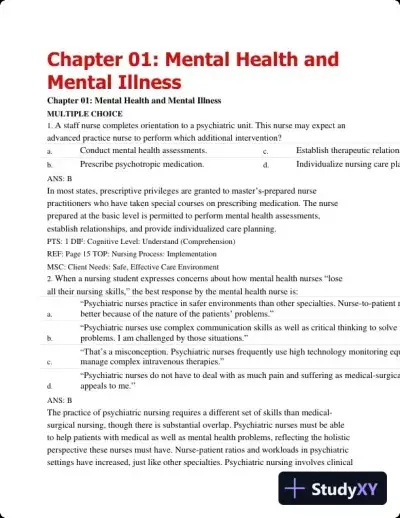 Exam Guides
Test Bank For Varcarolis' Foundations Of Psychiatric Mental Health Nursing: A Clinical Approach, 7th Edition
Nursing
499 pages55downloadsFeb 2025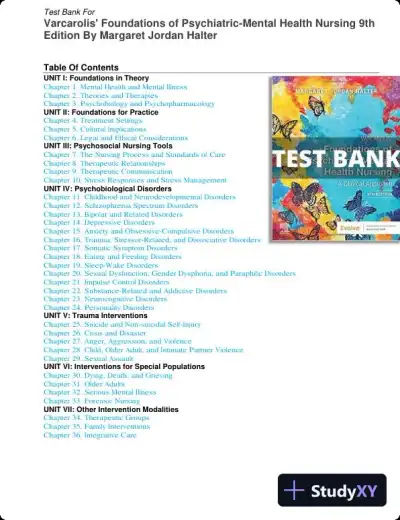 Exam Guides
Test Bank for Varcarolis' Foundations of Psychiatric-Mental Health Nursing, 9th Edition (Chapters 1-36)
Nursing
392 pages34downloadsFeb 2025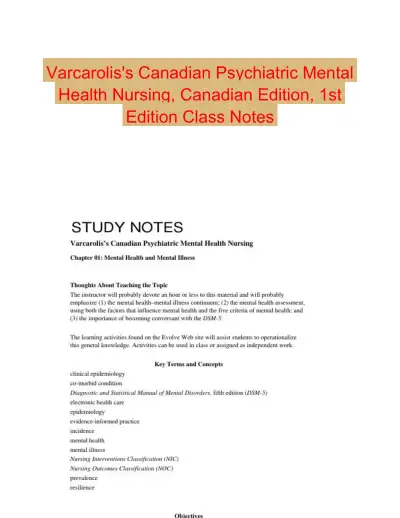 Class Notes
Varcarolis's Canadian Psychiatric Mental Health Nursing, Canadian Edition, 1st Edition Class Notes
Nursing
247 pagesMay 2025 Exam Guides
Test Bank for Critical Care Nursing: Diagnosis and Management, 9th Edition (Chapters 1-27)
Nursing
299 pages167downloadsFeb 2025 Class Notes
An Invitation To Health, Third Canadian Edition Lecture Notes
Nursing
439 pages163downloadsFeb 2025 Exam Guides
Test Bank for Physical Examination and Health Assessment, 9th Edition (Chapters 1-15)
Nursing
200 pages161downloadsFeb 2025 Exam Guides
Focus on Nursing Pharmacology Seventh, North American Edition Test Bank
Nursing
1144 pages160downloadsFeb 2025 Exam Guides
Test Bank for Fundamentals of Nursing, 11th edition (Chapters 1-24)
Nursing
200 pages160downloadsFeb 2025
Study this document with CramX
Once it is in your library, every tool can work from it.