

Test Bank For Operations Management, 11th Edition
- Operations Management
- 1680 pages
- Shared May 2025
Find everything you need to prepare for your exams in Test Bank For Operations Management, 11th Edition, a comprehensive guide filled with solved questions.
Preview 16 of 1680 pages
See the first 16 pages exactly as they appear in the document.
Page 1 Read page 1 as text
Chapter 01 - Introduction to Operations Management 1 - 1 Chapter 01 Introduction to Operations Management True / False Questions 1. Operations managers are responsible for assessing consumer wants and needs and selling and promoting the organization's goods or services. True False 2. Often, the collective success or failure of companies' operations functions will impact the ability of a nation to compete with other nations. True False 3. Companies are either producing goods or delivering services. This means that only one of the two types of operations management strategies are used. True False 4. Operations, marketing, and finance function independently of each other in most organizations. True False 5. The greater the degree of customer involvement, the more challenging the design and management of operations. True False 6. Goods producing organizations are not involved in service activities. True False
Page 2 Page 3 Read page 3 as text
Chapter 01 - Introduction to Operations Management 1 - 2 7. Service operations require additional inventory because of the unpredictability of consumer demand. True False 8. The value of outputs is measured by the prices customers are willing to pay for goods or services. True False 9. The use of models will guarantee the best possible decisions. True False 10. People who work in the field of operations should have skills that include both knowledge and people skills. True False 11. Assembly lines achieved productivity but at the expense of standard of living. True False 12. The operations manager has primary responsibility for making operations system design decisions, such as system capacity and location of facilities. True False 13. The word "technology" is used only to refer to "information technology". True False 14. ‘Value added' by definition is always a positive number since 'added' implies increases. True False
Page 4 Read page 4 as text
Chapter 01 - Introduction to Operations Management 1 - 3 15. Service often requires greater labor content, whereas manufacturing is more capital intensive. True False 16. Measurement of productivity in service is more straightforward than in manufacturing since it is not necessary to take into account the cost of materials. True False 17. Special - purpose technology is a common way of offering increased customization in manufacturing or services without taking on additional labor costs. True False 18. One concern in the design of production systems is the degree of standardization. True False 19. Most people encounter operations only in profit - making organizations. True False 20. Service involves a much higher degree of customer contact than manufacturing. True False 21. A systems approach emphasizes interrelationships among subsystems, but its main theme is that the whole is greater than the sum of its individual parts. True False 22. The Pareto phenomenon is one of the most important and pervasive concepts that can be applied at all levels of management. True False
Page 5 Read page 5 as text
Chapter 01 - Introduction to Operations Management 1 - 4 23. Operations managers, who usually use quantitative approaches, are not really concerned with ethical decision - making. True False 24. The optimal solutions produced by quantitative techniques should always be evaluated in terms of the larger framework. True False 25. Managers should most often rely on quantitative techniques for important decisions since quantitative approaches result in more accurate decisions. True False 26. Many operations management decisions can be described as tradeoffs. True False 27. A systems approach means that we concentrate on efficiency within a subsystem and thereby assure overall efficiency. True False 28. Prior to the Industrial Revolution, goods were produced primarily by craftsmen or their apprentices using custom made parts. True False 29. Elton Mayo's "Hawthorne Experiment" was the focal point of the Human Relations Movement, which emphasized the importance of the human element in job design. True False
Page 6 Read page 6 as text
Chapter 01 - Introduction to Operations Management 1 - 5 30. Among Ford's many contributions was the introduction of mass production, using the concept of interchangeable parts and division of labor. True False 31. Operations management and marketing are the two functional areas that exist to support activities in other functions such as accounting, finance, IT and human resources. True False 32. Lean production systems incorporate the advantages of both mass production and craft production. True False 33. As an abstraction of reality, a model is a simplified version of a real phenomenon. True False 34. Lean production systems use a highly skilled work force and flexible equipment. True False 35. The lean production philosophy has been slow to be adopted in service industries. True False 36. Operations Management activities will be less important in the future because many firms are becoming service - oriented operations rather than goods producing operations. True False
Page 7 Read page 7 as text
Chapter 01 - Introduction to Operations Management 1 - 6 37. A modern firm has two supply chain considerations - external links with suppliers and customers, and an internal network of flows to and between the operations function itself. True False Multiple Choice Questions 38. Operations management involves continuous decision - making; hopefully most decisions made will be: A. redundant B. minor in nature C. informed D. quantitative E. none of the above 39. A 'product package' consists of: A. the exterior wrapping B. the shipping container C. a combination of goods and services D. goods if a manufacturing organization E. customer relations if a service organization 40. Business organizations consist of three major functions which, ideally: A. support one another B. are mutually exclusive C. exist independently of each other D. function independently of each other E. do not interface with each other
Page 8 Read page 8 as text
Chapter 01 - Introduction to Operations Management 1 - 7 41. Which of the following is not a type of operations? A. goods production B. storage/transportation C. entertainment D. communication E. all the above involve operations 42. Technology choices seldom affect: A. costs. B. productivity. C. union activity. D. quality. E. flexibility. 43. Measurements taken at various points in the transformation process for control purposes are called: A. plans B. directions C. controls D. feedback E. budgets 44. Budgeting, analysis of investment proposals, and provision of funds are activities associated with the _______ function. A. operation B. marketing C. purchasing D. finance E. internal audit
Page 9 Read page 9 as text
Chapter 01 - Introduction to Operations Management 1 - 8 45. Which one of the following would not generally be classified under the heading of transformation? A. assembling B. teaching C. staffing D. farming E. consulting 46. Manufacturing work sent to other countries is called: A. downsized B. outsourced C. internationalization D. vertical integration E. entrepreneurial ship 47. Product design and process selection are examples of _______ decisions. A. financial B. tactical C. system design D. system operation E. forecasting 48. The responsibilities of the operations manager are: A. planning, organizing, staffing, procuring, and reviewing B. planning, organizing, staffing, directing, and controlling C. forecasting, designing, planning, organizing, and controlling D. forecasting, designing, operating, procuring, and reviewing E. designing and operating
Page 10 Read page 10 as text
Chapter 01 - Introduction to Operations Management 1 - 9 49. Knowledge skills usually don't include: A. process knowledge B. accounting skills C. communication skills D. global knowledge E. all of the above 50. Which of the following is not true about systems approach? A. A systems viewpoint is almost always beneficial in decision making. B. A systems approach emphasizes interrelationships among subsystems. C. A systems approach concentrates on efficiency within subsystems. D. A systems approach is essential whenever something is being redesigned or improved. E. All of the above are true. 51. What is credited with gains in industrial productivity, increased standards of living and affordable products? A. personal computers B. the internet C. mass transportation D. assembly lines E. multi - level marketing 52. Production systems with customized outputs typically have relatively: A. high volumes of output B. low unit costs C. high amount of specialized equipment D. fast work movement E. skilled workers
Page 11 Read page 11 as text
Chapter 01 - Introduction to Operations Management 1 - 10 53. Which is not a significant difference between manufacturing and service operations? A. cost per unit B. uniformity of output C. labor content of jobs D. customer contact E. measurement of productivity 54. Which of the following is not a characteristic of service operations? A. intangible output B. high customer contact C. high labor content D. easy measurement of productivity E. low uniformity of output 55. Which of the following is a recent trend in business? A. pollution control B. total quality management C. supply chain management D. competition from foreign manufacturers E. technological change 56. Farming is an example of: A. an obsolete activity B. a virtual organization C. non - manufactured goods D. a growth industry E. customized manufacturing
Page 12 Read page 12 as text
Chapter 01 - Introduction to Operations Management 1 - 11 57. Dealing with the fact that certain aspects of any management situation are more important than others is called: A. analysis of tradeoffs B. sensitivity analysis C. recognition of priorities D. analysis of variance E. decision table analysis 58. The fact that a few improvements in a few key areas of operations will have more impact than many improvements in many other areas is consistent with the: A. Irwin phenomenon B. Pareto phenomenon C. Stevenson phenomenon D. Tellier phenomenon E. Adam Smith phenomenon 59. The process of comparing outputs to previously established standards to determine if corrective action is needed is called: A. planning B. directing C. controlling D. budgeting E. disciplining 60. Which of the following does not relate to system design? A. altering the system capacity B. location of facilities C. inventory management D. selection and acquisition of equipment E. physical arrangement of departments
Page 13 Read page 13 as text
Chapter 01 - Introduction to Operations Management 1 - 12 61. Taking a systems viewpoint with regard to operations in today's environment increasingly leads decision - makers to consider ______________ in response to the ___________. A. flexibility; pressure to be more efficient B. offshoring; need to promote domestic production C. sustainability; threat of global warming D. technology; impact of random variation E. forecasting; stabilization of demand 62. Some companies attempt to maximize the revenue they receive from fixed operating capacity by influencing demands through price manipulation. This is an example of __________________: A. Illegal price discrimination B. Collusion C. Volume analysis D. Revenue management E. Outsourcing 63. Which of the following is not an ongoing trend in manufacturing? A. globalization B. quality improvement C. flexibility and agility D. mass production for greater economies of scale E. technological advances 64. Which of the following is not a benefit of using models in decision making? A. They provide a standardized format for analyzing a problem. B. They serve as a consistent tool for evaluation. C. They are easy to use and less expensive than dealing with the actual situation. D. All of the above are benefits. E. None of the above is a benefit.
Page 14 Read page 14 as text
Chapter 01 - Introduction to Operations Management 1 - 13 65. Modern firms increasingly rely on other firms to supply goods and services instead of doing these tasks themselves. This increased level of _____________ is leading to increased emphasis on ____________ management. A. outsourcing; supply chain B. offshoring; lean C. downsizing; total quality D. optimizing; inventory E. internationalization; intercultural 66. Operations and sales are the two ________ functions in businesses. A. strategic B. tactical C. support D. value - adding E. line 67. Marketing depends on operations for information regarding ___________. A. productivity B. lead time C. cash flow D. budgeting E. corporate intelligence
Page 15 Read page 15 as text
Chapter 01 - Introduction to Operations Management 1 - 14 68. Two widely used metrics of variation are the __________ and the _________. A. mean; standard deviation B. productivity ratio; correlation C. standardized mean; assignable deviation D. randomized mean; standardized deviation E. normal distribution; random variation 69. Which of the following statements about variation is FALSE? A. Variation prevents a production process from being as efficient as it can be. B. Some variation can be prevented. C. Variation can either be assignable or random. D. Any variation makes a production process less productive. E. Random variation generally cannot be influenced by managers. 70. Which of the following is essential to consider with respect to managing a process to meet demand? A. strategy B. demand forecasts C. capacity D. random variability E. all of the above
Page 16 Read page 16 as text
Chapter 01 - Introduction to Operations Management 1 - 15 Chapter 01 Introduction to Operations Management Answer Key True / False Questions 1. Operations managers are responsible for assessing consumer wants and needs and selling and promoting the organization's goods or services. FALSE Operation managers are not responsible for promoting goods/services. AACSB: Reflective Thinking Bloom's: Remember Difficulty: Easy Learning Objective: 01 - 04 Describe the operations function and the nature of the operations manager's job. Topic Area: The Scope of Operations Management 2. Often, the collective success or failure of companies' operations functions will impact the ability of a nation to compete with other nations. TRUE A nation is often only as competitive as its companies. AACSB: Reflective Thinking Bloom's: Remember Difficulty: Easy Learning Objective: 01 - 01 Define the term operations management. Topic Area: Operations Today
1664 more pages in the full document
Unlock it once and it stays in your library, ready to chat with or turn into flashcards.
Unlock the full documentMore Operations Management study materials
See all Exam Guides
Operations Management, 5th Canadian Edition Test Bank
Operations Management
1208 pagesMay 2025 Textbook Guides
Operations Management, 5th Canadian Edition Solution Manual
Operations Management
669 pagesMay 2025 Textbook Guides
Solution Manual for Operations and Supply Chain Management, 14th Edition
Operations Management
342 pages133downloadsFeb 2025 Textbook Guides
Managing Quality: Integrating the Supply Chain, 6th Edition Solution Manual
Operations Management
262 pages115downloadsFeb 2025 Textbook Guides
Operations Management, (Mcgraw-hill Education Operations and Decision Sciences) 1st Edition Solution Manual
Operations Management
153 pages91downloadsFeb 2025 Textbook Guides
Solution Manual For Matching Supply with Demand: An Introduction to Operations Management, 4th Edition
Operations Management
76 pages36downloadsFeb 2025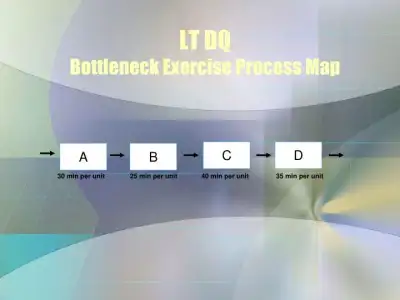 Class Notes
LT DQ Bottleneck Exercise Process Map
Operations Management
1 pageMay 2025 Textbook Guides
Solution Manual for Introduction to Materials Management, 8th Edition
Operations Management
44 pagesMay 2025
Study this document with CramX
Once it is in your library, every tool can work from it.