

2023 UTAH Cosmetology Practice Exam With Answers (151 Solved Questions)
- Other Exams & Certifications
- 16 pages
- Shared May 2025
2023 UTAH Cosmetology Practice Exam With Answers lets you practice with past papers and refine your problem-solving skills.
Preview 5 of 16 pages
See the first 5 pages exactly as they appear in the document.
Page 1 Read page 1 as text
UTAH COSMETOLOGY INSTRUCTOR 2023 1. Learning Style An individual's preferred method of thinking, understand- ing, and processing information. 2. Four Steps to Learning Desire, Input & Environment, Assimilation, Repetition 3. Verbal/Linguis- tic Intelligence The ability to communicate through language, which in- cludes listening, reading, writing, and speaking 4. Visual/Spatial In- telligence The ability to understand spatial relationships and com- prehend and create images 5. Logical/Mathe- matical Intelligence The ability to understand logical reasoning and problem solving in areas such as math, science, sequences, and patterns 6. Intrapersonal In- telligence The ability to understand one's own behavior and feelings 7. Bodily/Kinesthet- ic Intelligence The ability to use the physical body skillfully to solve prob- lems, create products, or present ideas and emotions, as well as take in knowledge through bodily sensations such as coordination or working with the hands 8. Interpersonal In- telligence The ability to relate to others, noticing their moods, moti- vations, and feelings 9. Musical/Rhyth- mic Intelligence The ability to comprehend and/or create meaningful mu- sical sounds 10. Naturalist Intelli- gence The ability to make consequential distinctions in the nat- ural world and to use this ability productively such as in farming or biological sciences 11. Authority An individual cited or appealed to as an expert; the power to influence or command thought, opinion, and behavior 12. Ethics The moral principals by which we live and work 13. Initiative 1 / 16
Page 2 Page 3 Read page 3 as text
The power, ability, or instinct to begin and/or follow through with a plan or task 14. Study Group A group of like minded students who get together to share notes, questioning, discussions, and so forth to prepare for each class or test 15. Deductive Resoning This process allows learners to reach a probable conclu- sion by employing logical reasoning 16. Characteriza- tions Used in the classroom by the educator to allow the learn- ers to translate the content of the lesson into personage 17. Mind Mapping Creates a free-flowing, graphic organizing system to out- line material or information 18. Mnemonics Any aid that is used to assist the learners memory 19. Peer Coaching A method that provides for one-on-one personalized in- struction that can increase learning results by allowing learners to set their own pace and receive individualized feedback on a regular basis 20. Visualization The process by which the mind translates the content of a lesson into visual imagery 21. Window Paning The process of transferring key elements, points, or steps in a lesson to visual images that are then hand-sketched into the squares or "panes" of a matrix. 22. Teaching The act of imparting knowledge or instructing by precept, example, or experience; communicating information or skills so that others may learn 23. Encoding The packaging and controlling of messages 24. Decode To interpret or give meaning to a message 25. Responsive, Reflective, Fugitive, Combative 2 / 16
Page 4 Read page 4 as text
The Four Basic Modes of Body Language 26. Responsive Body Language The open/forward mode that indicates that the listener is actively accepting the message. 27. Reflective Body Language The open/back mode that indicates that the listener is open and receptive, but not actively accepting the infor- mation. 28. Fugitive Body Language The closed/back mode that suggests the listener is trying to escape, either physically out the door, or mentally with boredom. 29. Combative Body Language The closed/forward mode that suggests the listener is likely to present resistance. 30. Active listening Being with the speaker; concentrating on what is being said; not interrupting; repeating what the speaker has said and paraphrasing it back to make certain you have understood. 31. Responsiveness The degree to which a person is open to interactions with others. 32. Assertiveness The degree of boldness or confidence one has in dealing with others. 33. Analogies Similarity in some respects between things that are oth- erwise dissimilar 34. Anecdotes A short account of some interesting or humorous incident 35. Articulation The act or process of pronouncing distinctly and carefully; enunciation 36. Stimuli Anything causing or regarded as causing a response; something that incites or rouses to action 3 / 16
Page 5 Read page 5 as text
37. The 6 P's (posi- tive) Proper Preparation and Practice Promote Positive Perfor- mance 38. C.R.E.A.T.E. Consider the topic, Research the topic, Examples for clar- ification, Analyze your learners, Teach with poise, Enjoy and be enthusiastic 39. Situational Barri- er When a learner temporarily exhibits difficult behavior that is different than the behavior/personality that is usually exhibited 40. Chronic Barrier When a learner behaves in a difficult manner consistently and affects other learners in a uncomfortable way 41. Conflict Manage- ment Implementing strategies to limit and manage negative aspects of conflict and to enhance learning and group effectiveness or performance in an educational setting 42. Accommodation Plan Provides the necessary information for the learner re- garding the steps the school is able to reasonably take to accommodate the individual learner's needs 43. Dyslexia A neurologically based specific learning disability that hin- ders the learning of literacy or reading skills and creates a problem with managing verbal codes in memory 44. Epathetic Characterized by an understanding so intimate that the feelings, thoughts, and motives of one individual are read- ily comprehended and understood by another 45. Input One of four stages of information processing used in learning; the information perceived through the senses, such as visual and auditory perception 46. Americans with Disabilities Act (ADA) Legislation passed in 1990 that prohibits discrimination against people with disabilities. 47. Major Life Activi- ties 4 / 16
11 more pages in the full document
Unlock it once and it stays in your library, ready to chat with or turn into flashcards.
Unlock the full documentMore Other Exams & Certifications study materials
See all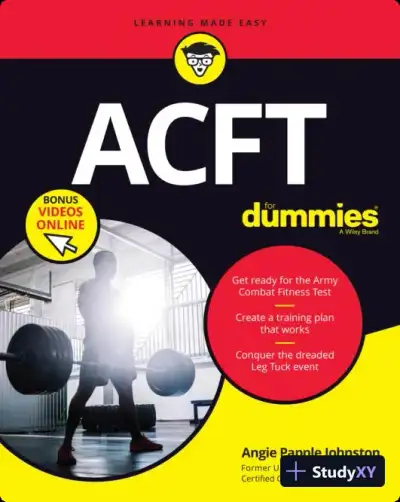 Certification Guides
ACFT For Dummies (2020)
Other Exams & Certifications
467 pages156downloadsFeb 2025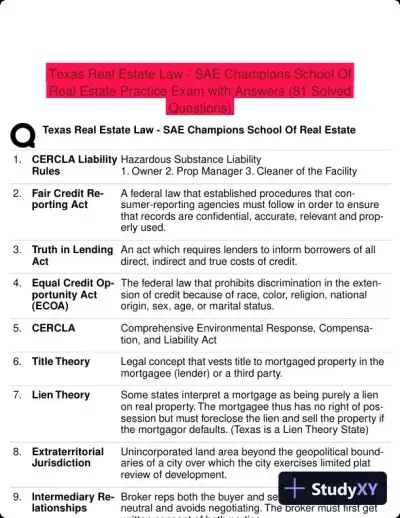 Past Exams
Texas Real Estate Law - SAE Champions School Of Real Estate Practice Exam with Answers (81 Solved Questions)
Other Exams & Certifications
9 pages153downloadsFeb 2025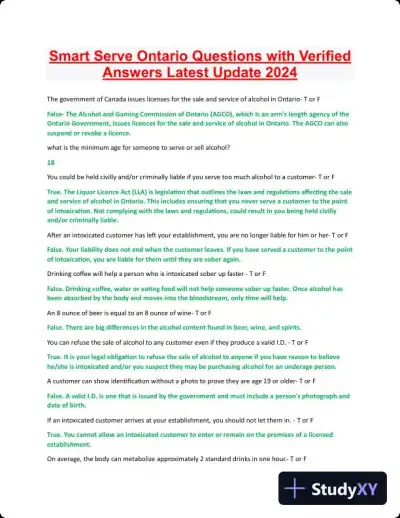 Past Exams
2024 Smart Serve Ontario Practice Exam with Answers (53 Solved Questions)
Other Exams & Certifications
6 pages153downloadsFeb 2025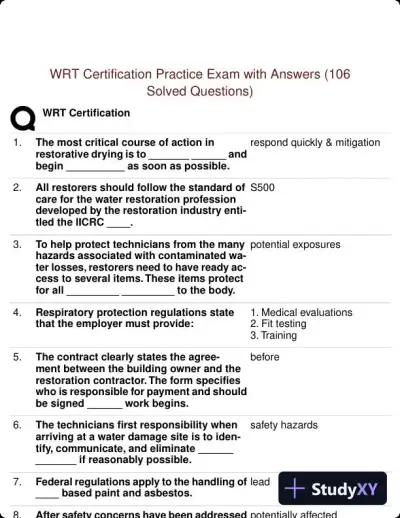 Past Exams
WRT Certification Practice Exam with Answers (106 Solved Questions)
Other Exams & Certifications
16 pages151downloadsFeb 2025 Past Exams
2024 Vivint SHP Practice Exam with Answers (35 Solved Questions)
Other Exams & Certifications
4 pages144downloadsFeb 2025 Past Exams
2024-2025 Wall Street Prep Premium Exam with Answers (50 Solved Questions)
Other Exams & Certifications
13 pages138downloadsFeb 2025 Past Exams
2024-2025 Lifeguard Final Exam with Answers (69 Solved Questions)
Other Exams & Certifications
11 pages137downloadsFeb 2025 Past Exams
2023-2024 ISSA Certification Final Exam with Answers (200 Solved Questions)
Other Exams & Certifications
49 pages136downloadsFeb 2025
Study this document with CramX
Once it is in your library, every tool can work from it.