

2024 Psychiatric Rehabilitation CPRP Exam With Answers (384 Solved Questions)
- Other Exams & Certifications
- 45 pages
- Shared May 2025
Identify common exam themes with 2024 Psychiatric Rehabilitation CPRP Exam With Answers, packed with past test papers.
Preview 14 of 45 pages
See the first 14 pages exactly as they appear in the document.
Page 1 Read page 1 as text
CERTIFIED PSYCHIATRIC REHABILITATION PRACTITIONER (CPRP) EXAM PREP 2024 VERIFIED QUESTIONS AND ANSWERS ALREADY PASSED 12 Core Principles and Values (1) - Principle 1: Psychiatric rehabilitation practitioners convey hope and respect, and believe that all individuals have the capacity for learning and growth. 12 Core Principles and Values (2) - Principle 2: Psychiatric rehabilitation practitioners recognize that culture is central to recovery, and strive to ensure that all services are culturally relevant to individuals receiving services. 12 Core Principles and Values (3) - Principle 3: Psychiatric rehabilitation practitioners engage in the processes of informed and shared decision ‐ making and facilitate partnerships with other persons identified by the individual receiving services. 12 Core Principles and Values (4) - Principle 4: Psychiatric rehabilitation practices build on the strengths and capabilities of individuals. 12 Core Principles and Values (5) - Principle 5: Psychiatric rehabilitation practices are person ‐ centered; they are designed to address the unique needs of individuals, consistent with their values, hopes and aspirations. 12 Core Principles and Values (6) - Principle 6: Psychiatric rehabilitation practices support full integration of people in recovery into their communities where they can exercise their rights of citizenship, as well as to accept the responsibilities and explore the opportunities that come with being a member of a community and a larger society. 12 Core Principles and Values (7) - Principle 7: Psychiatric rehabilitation practices promote self ‐ determination and empowerment. All individuals have the right to make their own decisions, including decisions about the types of services and supports they receive. 12 Core Principles and Values (8) - Principle 8: Psychiatric rehabilitation practices facilitate the development of personal support networks by utilizing natural supports within communities, peer support initiatives, and self ‐ and mutual ‐ help groups.
Page 2 Page 3 Read page 3 as text
12 Core Principles and Values (9) - Principle 9: Psychiatric rehabilitation practices strive to help individuals improve the quality of all aspects of their lives; including social, occupational, educational, residential, intellectual, spiritual and financial. 12 Core Principles and Values (10) - Principle 10: Psychiatric rehabilitation practices promote health and wellness, encouraging individuals to develop and use individualized wellness plans. 12 Core Principles and Values (11) - Principle 11: Psychiatric rehabilitation services emphasize evidence ‐ based, promising, and emerging best practices that produce outcomes congruent with personal recovery. Programs include structured program evaluation and quality improvement mechanisms that actively involve persons receiving services. 12 Core Principles and Values (12) - Principle 12: Psychiatric rehabilitation services must be readily accessible to all individuals whenever they need them. These services also should be well coordinated and integrated with other psychiatric, medical, and holistic treatments and practices. Priniciples 1 - 3 Focus - Focus on the role of practitioners Principles 4 - 10 Focus - Focus on best practices in the field Principles 11 - 12 - Focus on psychiatric rehabilitation service delivery 12 Core Principles and Values (1) - Principle 1: Psychiatric rehabilitation practitioners convey hope and respect, and believe that all individuals have the capacity for learning and growth. - 12 Core Principles and Values (2) - Principle 2: Psychiatric rehabilitation practitioners recognize that culture is central to recovery, and strive to ensure that all services are culturally relevant to individuals receiving services.
Page 4 Read page 4 as text
12 Core Principles and Values (3) - Principle 3: Psychiatric rehabilitation practitioners engage in the processes of informed and shared decision ‐ making and facilitate partnerships with other persons identified by the individual receiving services. 12 Core Principles and Values (4) - Principle 4: Psychiatric rehabilitation practices build on the strengths and capabilities of individuals. 12 Core Principles and Values (5) - Principle 5: Psychiatric rehabilitation practices are person ‐ centered; they are designed to address the unique needs of individuals, consistent with their values, hopes and aspirations. 12 Core Principles and Values (6) - Principle 6: Psychiatric rehabilitation practices support full integration of people in recovery into their communities where they can exercise their rights of citizenship, as well as to accept the responsibilities and explore the opportunities that come with being a member of a community and a larger society. 12 Core Principles and Values (7) - Principle 7: Psychiatric rehabilitation practices promote self ‐ determination and empowerment. All individuals have the right to make their own decisions, including decisions about the types of services and supports they receive. 12 Core Principles and Values (8) - Principle 8: Psychiatric rehabilitation practices facilitate the development of personal support networks by utilizing natural supports within communities, peer support initiatives, and self ‐ and mutual ‐ help groups. 12 Core Principles and Values (9) - Principle 9: Psychiatric rehabilitation practices strive to help individuals improve the quality of all aspects of their lives; including social, occupational, educational, residential, intellectual, spiritual and financial. 12 Core Principles and Values (10) - Principle 10: Psychiatric rehabilitation practices promote health and wellness, encouraging individuals to develop and use individualized wellness plans. 12 Core Principles and Values (11) - Principle 11: Psychiatric rehabilitation services emphasize evidence ‐ based, promising, and emerging best practices that produce outcomes congruent
Page 5 Read page 5 as text
with personal recovery. Programs include structured program evaluation and quality improvement mechanisms that actively involve persons receiving services. 12 Core Principles and Values (12) - Principle 12: Psychiatric rehabilitation services must be readily accessible to all individuals whenever they need them. These services also should be well coordinated and integrated with other psychiatric, medical, and holistic treatments and practices. - Mental health affects about 20% of the population. - True Psychiatric rehabilitation emerged out of the deinstitutionalization movement of the 1930's. - False ________________ is/are example(s) of evidence-based practices. - All of the above Delusion are bizarre beliefs or ideas that a person cannot be talked out of while hallucinations are incorrect sensory information that the individual experiences as real. - True Mood disorders effect between - about 5-20% of the population. The "Vermont study" by Dr. Hardng was one of the first longitudinal studies to demonstrate that persons with schizophrenia could have positive long-term outcomes. - True Illness Management and Recovery is an evidence based practice consisting of - psychoeducation and self-management strategies. Recovery is a operationalized construct that can only be measured by medical doctors. - False The main goal of Psychiatric Rehabilitation is: - to promote recovery.
Page 6 Read page 6 as text
Shared decision making involves consumers defering to the needs of the treatment team they are working with. - False The PsyR process has three stages: the diagnostic stage, the planning stage and the _________________ stage. - intervention stage. Since deinstitutionalization PsyR has had a focus on the concept of interdependence. - True A wellness coach helps individuals identify strengths in the 8 dimensions of wellness and then helps them to clarify what they hope to change or improve. - True Much of the early development of psychiatric rehabilitation took place in psychiatric hospitals and asylums. - False SMART goals are integral to the coaching process and are used to help individuals achieve health and wellness goals. The acronym SMART stands for: - Specific, Measurable, Attainable, Realistic, and Time-framed. Research shows that the life span of individuals with mental illnesses is 10 years less than that of the general population. - False Psychiatric rehabilitation day programming services maintain a strong reputation and are overwhelmingly popular with consumers and families. - False The authors discussed 4 basic service objectives of case management. They include: - continuity of care, accessibility, accountability and efficiency. Historically, there are six models of case management. Which of the following has been most researched and is the only evidence-based practice? - Assertive Community Treatment. Research conducted by Dr. Gary Bond on ACT programs found that service recipients have superior treatment outcomes, such as: - less use of emergency, crisis intervention and other services.
Page 7 Read page 7 as text
Long-term unemployment can result in the deterioration of physical, emotional and psychiatric well-being and overall functioning. - True One of the greatest barriers to employment for people with mental illnesses is symptom management and hospitalization. - False Actual Supported Education (SEd) programs are only located on college campuses. - False The strategies used for supported employment are also used when providing SEd services. - True Deinstitutionalization and transinstitutionalization are synonymous terms to describe a key residential movement from the 60's. - False The US Fair Housing Act of 1968, was originally enacted to prohibit discrimination based on race or ethnicity in the sale or rental of housing; however, 20 years later it was amended to add protections against individuals with disabilities. - True Institutionalization syndrome was a formerly diagnosable condition in the DSM-III. - False Supported housing and independent living sought to facilitate opportunities for people to reside in independent living situations of their choice in the community and receive support services to help them maintain those situations. - True The Olmstead v L.C. US Supreme Court case was a major victory for the disability community and upheld Title IV of the Americans with Disabilities Act. - False The WRAP is the best known, evidence based self-help approach in psychiatric rehabilitation. - False Psychiatric Rehabilitation - .... promotes recovery, full community integration and improved quality of life for persons who have been diagnosed with any mental health condition that seriously impairs their ability to lead meaningful lives. Psychiatric rehabilitation services
Page 8 Read page 8 as text
are collaborative, person-directed and individualized. These services are an essential element of the health care and human services spectrum, and should be evidenced-based. WRAP - Wellness Recovery Action Plan Assertive Community Treatment (ACT) - -an evidence-based practice that improves outcomes for people with severe mental illness who are most vulnerable to homelessness and hospitalization. Principles of Psych Rehab Groupings - 1-3= Roles of the Practitioners 4-10= Best Practices in the Field 11-12 PsyR Service Delivery Evidence-Based Practice (EBP) - - recognizes the importance of understanding and following research recommendations, while taking into account the service provider's clinical expertise and the goals, preferences, interests, values, and characteristics of the people using the service Empirically Supported Treatment (EST) - -a type of intervention that has been proven effective, such as cognitive behavioral therapy for treatment of depression. Evidenced-Based Medicine (EBM) - -the process an individual practitioner follows in selecting the appropriate intervention for one individual diagnosed with a particular condition who is experiencing specific symptoms. Recovery - ......a deeply personal unique process of changing one's attitudes, values, feelings, goals, skills, and/or roles. it is a way of living a satisfying, hopeful, and contributing life even with limitations cause by illness. Recovery involves the development of new meaning and purpose in one's life as one grows beyond the catastrophic effects of mental illness. Recovery Relating to principles of PsyR - Recovery from mental illness involves much more than recovery from the illness. itself. People with mental illness(es) may have to recover from the stigma that they incorporated into their very being; from the iatrogenic effects of treatment setting; from the lack of recent opportunities for self-determination; from the
Page 9 Read page 9 as text
negative side effects of unemployment; and from crushed dreams. Recover is a complex, time-consuming process. The Eight Essential Features of recover-oriented mental health services - 1. Recovery can occur without professional intervention. 2. A common denominator of recovery is the presence of individuals who believe in the person in recovery and will stand by him/her. 3. Recovery as a vision does function as a part of a person's ideas or theories about "mental illnesses". 4. Recovery occurs despite that mental health symptoms may reoccur. 5. Recovery changes frequency and duration of mental health symptoms. 6. Recovery is not necessarily a linear process. 7. The consequences of the "illness" (eg. stigma) often can be harder to overcome than any of its symptoms. 8. Recovery does not suggest that a person never had a mental illness of never experienced mental health symptoms. Noordsy et al. definition of recovery is centered around what 3 core concepts: - 1. hope 2. taking personal responsibility 3. getting on with life. Principles of Psychiatric Rehabilitation - 1. Psychiatric rehabilitation practitioners (PRP) convey hope and respect and believe that all individuals have the capacity for learning and growth. 2. PRP recognize that culture is central to recovery and strive to ensure that all services are culturally relevant to individuals receiving services. 3. PRP engage in the processes of informed and shared-decision making and facilitate partnerships with other people the individual receiving services has identified 4. PsyR practices build on strengths and capabilities of individuals. 5. PsyR practices are person-centered; they are designed to address the unique needs of individuals, consistent with their values, hopes, and aspirations. 6. PsyR practices support full integration of people in recovery into their communities where they exercise their rights of citizenship as well as to accept the responsibilities and
Page 10 Read page 10 as text
explore the opportunities that come with being a member of a community and a larger society. 7. PsyR practices promote self-determination and empowerment. All individuals have the right to make their own decisions, including decisions about the types of services and support they receive. 8. PsyR practices facilitate the development of personal support networks by utilizing natual supports within communities, peer support initiatives, and self-and mutual-help groups. 9. PsyR practices strive to help individuals improve the quality of all aspects of their lives, including social, occupational, educational, residential, intellectual, spiritual, and financial. 10. PsyR practices promote health and wellness, encouraging individuals to develop and use individualized wellness plans. 11. PsyR Services emphasize evidence-based, promising, and emerging best practices that produce outcomes congruent with personal recovery. Programs include structured program evaluatio SAMHSA's definition of recovery: - A process of change through which individuals improve their health and wellness, live a self-directed life, and strive to reach their full potential. SAMHSA's Four Major Dimensions of Recovery - 1. HEALTH: Overcoming or managing one's disease(s) as well as living in a physically and emotionally healthy way; 2. HOME: A stable and safe place to live; 3. PURPOSE: Meaningful daily activities, such as a job, school, volunteerism, family caretaking, or creative endeavors, and the independence, income, and resources to participate in society; 4. COMMUNITY: Relationships and social networks that provide support, friendship, love, and hope. The Medical Perspective on Psychiatric Disability - -Focused on treating the mental health condition (the symptoms of the psychiatric illness). -Use language such as mental impairment, psychiatric disorder, emotional disturbance, or diagnosis. -Follows the DSM- to be a disorder: -symptoms must be noticeable (clinically significant)
Page 11 Read page 11 as text
-must be/or at risk of causing difficulty in role functioning -must have abnormal/not "culturally-sanctioned" reactions/behaviors to events -a faulty way of perceiving or reacting to the world The Disability Perspective - -psych disabilities occur when a mental health condition interferes with a person's function in living, learning, working, and/or social environments and roles. Americans with Disabilities Act (ADA) definition for Disability - -a physical or mental impairment that substantially limits one or more major life activities of such individual Social Security Act (SSA) definition for Disability - -"the inability to engage in any substantial gainful activity by reason of any medically determinable physical or mental impairment which can be expected to result in death or which has lasted or can be expected to last for a continuous period of no less than 12 months." PRA's definition for Disability - -the concept is seen as more relevant to rehabilitation than is the concept of illness and implies the hope of reacquiring abilities and valued roles. The Bio-Psycho-Social Perspective - -the health condition is seen as interacting with environmental and personal factors to affect an individual's functioning at the level of body functions and structures, in performance of daily activities, and in participation in values roles and life domains. Bio-Psycho-Social Perspective Functions related to Symptoms of the Body - ABC -Affective functions: experience, expression, regulation of affect. -Behavioral functions: energy and drive, sleep and appetites, and psychomotor functions -Cognitive functions: experience of self and time, attention/concentration, memory, and executive functions Positive Symptoms (in regards to Medical Perspective of Psychiatric Disbility) - -additions to typical behaviors (present) Ex. delusion, hallucinations, bizzare behaviors, etc.
Page 12 Read page 12 as text
Negative Symptoms (in regards to Medical Perspective of Psychiatric Disbility) - -showing a lack of something (absent) Ex. social withdrawl, difficulty producing thoughts or speech, blunted of flat affect, etc. The Social Perspective on Psychiatric Disability - -sees the disability as a product of the social and interpersonal factors. -"there is no such thing as a mental illness" -believes that psychiatric symptoms can be a healthy response to a dysfunctional world. -"what looks like illness often represents a method of surviving difficult times or coping with trauma -Believes that because the environment helps to define 'disability', disability is a socially constructed concept. Competency - -the ability to apply or use knowledge, skills, attitudes, and personal characteristics to successfully perform critical work tasks, specific functions, or operate in a given role or position. KSA - Knowledge, Skills, and Attitudes KSA's Three competency blocks - Foundational (bottom tier), industry-related (middle tier), and occupation-related (top tier) KSA's Foundational Block - -can be generalized/are core competencies -three tiers: basic workplace skills, basic academic skills, and the personal effectiveness skill (soft skills) Accredidation - the approval of an organization stating that they meet the expected standards and competencies Certification - granted to an individual by a non-governmental agency Licensure/Registration - granted to an individual by a government agency
Page 13 Read page 13 as text
Person-Centered Planning (PCP) - -an ongoing collaborative process between an individual and his or her team members (including clinical and rehabilitation professionals as well as natural supports) Process Perspective (in regards to PCP) - -how roles, relationships, and planning meetings look different when conducted in a person-centered fashion Documentation Perspective (in regards to PCP) - -how the person-centered process is reflected in a written plan. "Dignity of Risk"/"Right to Fail" - -respecting each individual's autonomy and self- determination (or "dignity") to make choices for himself or herself IAPSRS Plans Should Include: - -person-first language -diagnosis is not as important as the persons' individuality -language should be understandable to all involved and if professional terminology is necessary it should be explained to all. -goals should be written using individuals' own words. PROS - Personalized Recovery-Oriented Services A Comprehensive approach to Psychiatric Rehabilitation Assessment includes an assessment of: - 1. the person's readiness and preferences for life changes 2. the person's everyday functional strengths and needs 3. the nature of the person's resource supports an barriers Assessment in PsyR Practice - -an ongoing process that the person in recovery and their psych practitioner engage in mutually to determine the need to and direction of change in the person's daily living skills and living learning, and working domains Rehabilitation Readiness Assessment explores: - 1. Need for Change (is person dissatisfied with their current situation?) 2. Commitment to Change (are they committed to making changes?) 3. Personal Closeness (are they open to connect w/others?)
Page 14 Read page 14 as text
4. Self-Awareness (have insight?) 5. Environmental Awareness (aware of the differences between environments?) Psych Rehab Assessment includes: - 1. a readiness assessment 2. an assessment of the person's functional strengths and needs 3. an assessment of the environmental and/or contextual resources and barriers. Focus of Functional Assessment - -the behavioral routines and skills needed for the life domains targeted for change by the rehabilitation readiness assessment. -the starting point is always the person's expressed goals. Performance-Based Assessments - -assessments in which the person in recovery is actually engaged in doing the activity, and the CPRP is observing the person's engagement. Interventions - -the actions service providers take to help individuals achieve their personal recovery goals, and in a service plan, they indicate the methods by which goals and objectives are achieved. Psych Rehab Interventions Defnition - -building the skills and supports needed to help people choose and achieve their personal goals. Best Practice definition - -is valued by the people who use it, has been evaluated as effective through high quality research , and has been implemented correctly by a competent practitioner the APA's Three Relationship Components for Effective Indidvidual Therapy: - 1. Demonstrating empathy 2. Monitoring the alliance 3. achieving goal consensus A Skill: - -a complex action made up of both knowledge and behavior A Behavior: - -a simple observable action and is conceptually small than a skill
31 more pages in the full document
Unlock it once and it stays in your library, ready to chat with or turn into flashcards.
Unlock the full documentMore Other Exams & Certifications study materials
See all Certification Guides
ACFT For Dummies (2020)
Other Exams & Certifications
467 pages156downloadsFeb 2025 Past Exams
Texas Real Estate Law - SAE Champions School Of Real Estate Practice Exam with Answers (81 Solved Questions)
Other Exams & Certifications
9 pages153downloadsFeb 2025 Past Exams
2024 Smart Serve Ontario Practice Exam with Answers (53 Solved Questions)
Other Exams & Certifications
6 pages153downloadsFeb 2025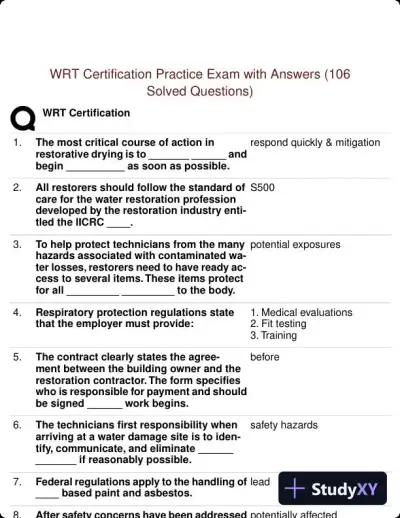 Past Exams
WRT Certification Practice Exam with Answers (106 Solved Questions)
Other Exams & Certifications
16 pages151downloadsFeb 2025 Past Exams
2024 Vivint SHP Practice Exam with Answers (35 Solved Questions)
Other Exams & Certifications
4 pages144downloadsFeb 2025 Past Exams
2024-2025 Wall Street Prep Premium Exam with Answers (50 Solved Questions)
Other Exams & Certifications
13 pages138downloadsFeb 2025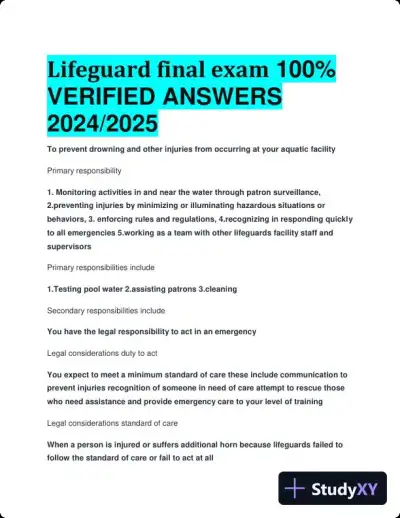 Past Exams
2024-2025 Lifeguard Final Exam with Answers (69 Solved Questions)
Other Exams & Certifications
11 pages137downloadsFeb 2025 Past Exams
2023-2024 ISSA Certification Final Exam with Answers (200 Solved Questions)
Other Exams & Certifications
49 pages136downloadsFeb 2025
Study this document with CramX
Once it is in your library, every tool can work from it.