

2024-2025 BIOD171 Portage Learning Biology Final Exam With Answers (170 Solved Questions)
- Other Exams & Certifications
- 51 pages
- Shared May 2025
2024-2025 BIOD171 Portage Learning Biology Final Exam With Answers allows you to simulate exam conditions with real past papers.
Preview 16 of 51 pages
See the first 16 pages exactly as they appear in the document.
Page 1 Read page 1 as text
Portage Learning BIOD 171 Final EXAM Questions and Answers 100%Correct2024-2025 Update True or False: A virus is considered a microorganism. False. Viruses are not living and as such are not considered microorganisms. Viruses can, however, be classified as microbes, a more general term that includes microorganisms and viruses. 1. What is the smallest biological unit of life? A cell. 2. At a generalized level, all cells are comprised of what? Macromolecules* *A student may also answer: Proteins, Lipids, Nucleic acids and Polysaccharides but they must answer with all four to be fully correct. 1. Which of the following microorganisms are considered to be Eukarya? Select all that apply. A. Animalia B. Plantae C. Fungi D. Protista A,B,C,D 2. True of False: All multicellular microorganisms classified as Animalia are
Page 2 Page 3 Read page 3 as text
heterotrophic. True 3. Microorganisms classified as Plantae obtain most of their energy by converting energy into energy. Light (sunlight); chemical (sugars) 1. Define catabolism. Catabolism is the process of breaking down larger molecules into useful energy sources. 2. Upon cellular injury, which metabolic process is involved during the growth and repair phases of the cell? The anabolic process would be active as it (by definition) is involved in the building up of small complexes into larger complexes. 1. In phosphorylation, the light reactions always occur where? The process of converting light energy into chemical energy (photophosphorylation) always occurs in the membrane. 2. True or False: The Calvin cycle must occur in the absence of light. False. The term ‘dark reactions’ (also known as the Calvin Cycle) simply denotes the second stage in photosynthesis—dark reactions do not actually require darkness in order to occur.
Page 4 Read page 4 as text
1. Assuming a constant (non-adjustable) light source power, identify the part of the microscope you would adjust to limit the amount of light entering the microscope. Select all that apply. A. Objective B. Condenser C. Iris diaphragm D. Eye piece C. The iris controls the amount of light that passes through the sample and into the objective lens. Thus, it can be adjusted (opened or closed) to alter the amount of light. 2. What is the total magnification (relative to your eye) of a sample imaged with a 60x objective and a 10x eyepiece? Show your math. 60 x 10 = 600x magnification
Page 5 Read page 5 as text
1. Identify what type of electron microscope was used to capture the following image and explain your choice. The image was captured using a Scanning Electron Microscope (SEM). The above image shows the trademark ‘shell’ image (no subcellular organelles are visible) reminiscent of SEM. Only TEM is capable of visualizing subcellular substrucutres. 1. True or False: LB agar is classified as a selective, non-differential media. False. LB agar is the most basic type of agar and like LB media supports the growth of virtually all microbes without restriction. 2. What is agar used for in microbiology? Agar is used to create a solid, smooth surface on which microbes can grow. 1. True or False. When performing a dilution streak a new (or sterilized) loop is not required for each phase as long as the bacterial culture is pure.
Page 6 Read page 6 as text
False. 2. The number of phases (3 vs. 4) and/or the number of times a loop passes through a previous phase (once vs. multiple times) is acceptable provided what happens? Either deviation is acceptable in practice provided the resulting gradient contains within it the growth of individual colonies—if not, the experiment must be repeated. 3. True or False. Pathogenic strains of bacteria tend to grow slower than normal non-pathogenic bacterial strains. False. 1. Match the following symptoms with their respective diseases: 1. Folliculitis D 2. Scalded- skin syndrome E 3. Impetigo A 4. Conjunctiv itis B A. Childhood skin disease near mouth/ nose B. Infection of thin, transparent scleral tissue C. Infection occurs at time of birth D. Pus-filled lesions on skin or hair
Page 7 Read page 7 as text
5. Ophthal mia Neonatoru m C E. Ruptured pustules; treated with Penicillin 2. True or False. The causative agent of conjunctivitis can be either bacterial or viral. True. 1. True or False. There are currently no cures for tetanus. True. 2. Identify the medical condition characterized by robust carbohydrate fermentation under anaerobic conditions, swelling of the infected areas and fever. Gas gangrene. The key identifier here is the robust carbohydrate fermentation, which manifests as intense gas production and swelling—both trademark conditions of gas gangrene. 3. The alpha-toxin perfringolysin is associated with which medical condition caused by Gram-positive anaerobic bacteria? A. Tetanus B. Botulism C. Gas gangrene D. Leprosy
Page 8 Read page 8 as text
C. Gas gangrene. The bacterium that produces the alpha toxin perfringolysin is aptly named Clostridium perfringens. 1. The envelope surrounds the of some viruses. Capsid. 2. True or False. You would expect to see a viral envelope on a virus infecting a bacterial cell. False 3. Rank the following viruses based on their size from largest to smallest: Paramyxovi rus Poliovirus Smallpox virus Smallpox (~200nm) > Paramyxovirus (100-150nm) > Poliovirus (~30nm) 1. What linear, double-stranded, enveloped DNA virus is the first virus (as of Oct. 26, 1977) to be officially declared eradicated? Smallpox (Variola virus). Although once a major cause of death in the world, a smallpox vaccine was developed in 1796 by Edward Jenner. Global vaccination efforts have prevented smallpox from appearing in humans since October 26, 1977, making smallpox the first infectious disease ever to be eradicated.
Page 9 Read page 9 as text
2. What small (~30nm) single-stranded, non-enveloped RNA virus targets the CNS (central nervous system), causing potentially catastrophic damage to motor neurons? Polio, also known as poliomyelitis. 3. By whom and where was the first Polio vaccine developed? Jonas Salk and his research team developed the polio vaccine at the University of Pittsburgh in 1955. 4. Which subtype of Influenza is the most virulent? Influenza A. Module 1 Exam Exam Page 1 1. True or False: A virus is classified as a microbe. True
Page 10 Read page 10 as text
2. True or False: The smallest biological unit of life is the molecule. false 3. What are the 4 main types of macromolecules found in cells? Proteins, nucleic acids, polysaccharides, and lipids Exam Page 2 1. How many different types of amino acids are available from which to make proteins? There are 20 different types of amino acids. 2. Define an essential amino acid. Amino acids are known as the primary structure of protein. 9 out of 20 of the amino acids are considered essential amino acids and cannot be produced by the human body but is found in the environment in other ways, such as the foods you consume. Exam Page 3 1. Where can the two major types of nucleic acids be found in the cell and what are their roles? DNA- contains a lot of hereditary information which is responsible for the characteristics of living organisms that can be inherited. It is found in the nucleus but cannot leave the nucleus. RNA- deciphers the hereditary information in DNA which is used to synthesize
Page 11 Read page 11 as text
proteins. It is found in the nucleus but can also leave the nucleus. Exam Page 4 1. Complete the following DNA strand and indicate how many bonds are formed for each complementary pair: 3’ GGTCATCG 5’ 5’ CC AGC 3’ AGT. A-T pairings results in 2 hydrogen bonds. C-G pairings results in 3 hydrogen bonds. Exam Page 5 1. The plasma membrane (select all that are true): A. Only restricts movement of materials into the cell B. Is often a bilayer comprised of lipids C. Cannot prevent essential nutrients from escaping D. Contains hydrophobic tails pointing inward 2. Carbon, Hydrogen and Oxygen atoms come together to form what primary macromolecule? Give an example. They come together to form polysaccharides. An example would be sucrose. 1. True of False: Eukaryotic cells do not have a nucleus False. Eukaryotic cells do have a nucleus (prokaryotic cells do not). 2. True or False: Prokaryotic cells can be subdivided into Bacteria and Archaea. True
Page 12 Read page 12 as text
3. Describe the 4 basic bacterial morphologies. Coccus (round/spherical), bacillus (rod), vibrio (curved rod) or spirillum (spiral/corkscrew). 4. True or False: Archaea, a eukaryotic class of microorganisms, are capable of surviving harsh environments. False. Exam Page 7 1. Which of the following microorganisms are considered to be Eukarya? Select all that apply. A. Animalia B. Plantae C. Fungi D. Protista
Page 13 Read page 13 as text
2. True of False: All multicellular microorganisms classified as Animalia are heterotrophic. True 3. Microorganisms classified as Plantae obtain most of their energy by converting energy into energy. light energy (sunlight), chemical energy (sugars) Exam Page 8 1. A defining characteristic of fungi is the presence of chitin in the cell walls. Which of following also contain chitin? Select all that apply. A. Mushrooms B. Bacteria C. Yeast D. Molds 2. True or False: A defining characteristic of Protista is the inability of colonies to form tissue layers. true Exam Page 9 1. Cell walls are found in which of the following (select all that apply): A. Plants B. Fungi C. Bacteria D. Mammalian cells
Page 14 Read page 14 as text
E. Algae 2. The function of the ribosome is (select all that apply): A. Lipid synthesis B. Protein synthesis C. To produce energy (ATP) D. Protein modification and distribution E. Waste disposal via hydrolytic enzymes Exam Page 10 1. Identify the following cellular components by matching the number with the description. A. Rough endoplasmic reticulum B. Golgi apparatus C. Nucleus
Page 15 Read page 15 as text
D. Cell wall E. Plasma membrane F. Centriole G. Lysosome 1C 2G 3E 4B 5A Module 2 Exam 1. True or False: Metabolism is a controlled set of biochemical reactions that occur in living organisms in order to maintain life. True. 2. True or False: Enzymes are polysaccharides that catalyze chemical reactions. False. Enzymes are proteins that catalyze chemical reactions. 3. What are usually metal ions known to assists enzyme during the catalysis reaction? Cofactors are usually metal ions and assist enzyme during the catalysis reaction. 1. Define catabolism.
Page 16 Read page 16 as text
It is a process that allows larger molecules to be broken down into useful energy sources. 2. Upon cellular injury, which metabolic process is involved during the growth and repair phases of the cell? The anabolic process because it is involved with building up small complexes into larger complexes. Exam Page 3 1. Describe the energy transfer process relative to both ATP and ADP. ATP gives energy whereas ADP accepts energy to become ATP. During the donation of energy, ATP transfers energy from the breakdown reactions which is used for building up. This fuels cells to carry out necessary biochemical reactions for survival. 2. From what source do chemotrophs acquire energy? From chemicals that already exist in the environment. 3. An organism that obtains its source of carbon from inorganic molecules such as carbon dioxide is referred to as a ? autotrophs 4. This phosphorylation process occurs in the mitochondria of chemotropic eukaryotes. A. Photophosphorylation B. Substrate-level phosphorylation C. Oxidative phosphorylation 1. Identify the products of the following chemical equation: Glucose + 2NAD+ → 2 NADH + 2 Pyruvate + 2 ATP
35 more pages in the full document
Unlock it once and it stays in your library, ready to chat with or turn into flashcards.
Unlock the full documentMore Other Exams & Certifications study materials
See all Certification Guides
ACFT For Dummies (2020)
Other Exams & Certifications
467 pages156downloadsFeb 2025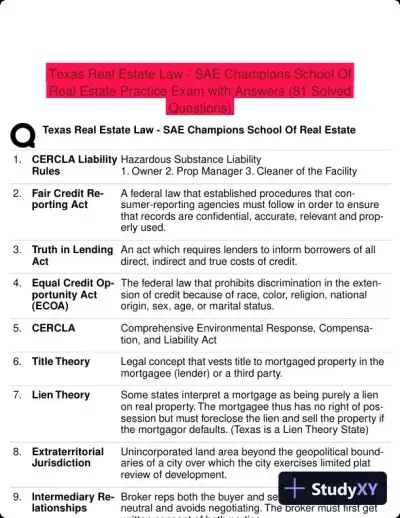 Past Exams
Texas Real Estate Law - SAE Champions School Of Real Estate Practice Exam with Answers (81 Solved Questions)
Other Exams & Certifications
9 pages153downloadsFeb 2025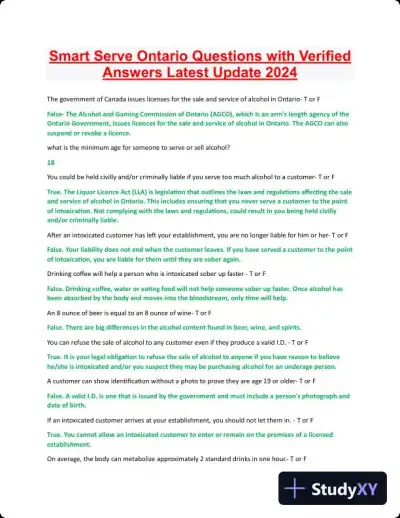 Past Exams
2024 Smart Serve Ontario Practice Exam with Answers (53 Solved Questions)
Other Exams & Certifications
6 pages153downloadsFeb 2025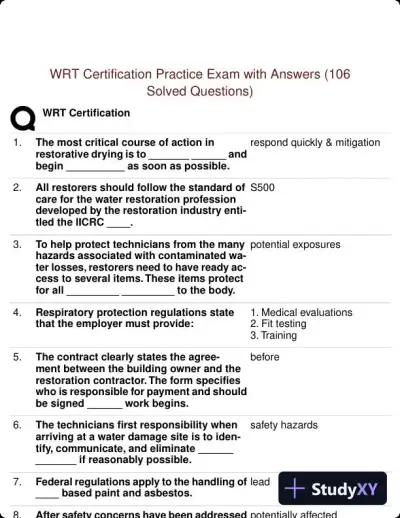 Past Exams
WRT Certification Practice Exam with Answers (106 Solved Questions)
Other Exams & Certifications
16 pages151downloadsFeb 2025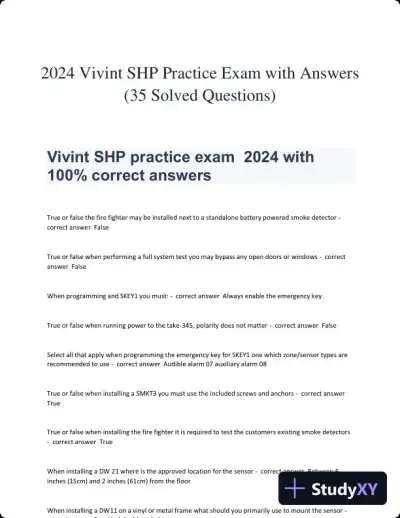 Past Exams
2024 Vivint SHP Practice Exam with Answers (35 Solved Questions)
Other Exams & Certifications
4 pages144downloadsFeb 2025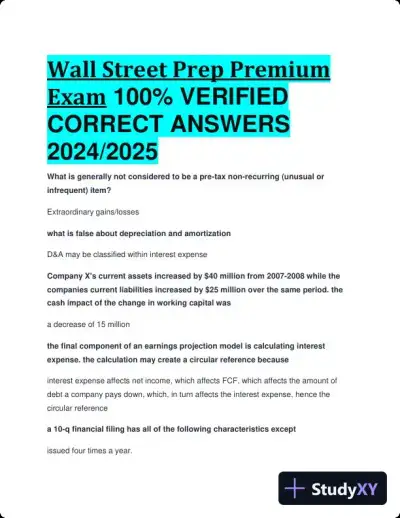 Past Exams
2024-2025 Wall Street Prep Premium Exam with Answers (50 Solved Questions)
Other Exams & Certifications
13 pages138downloadsFeb 2025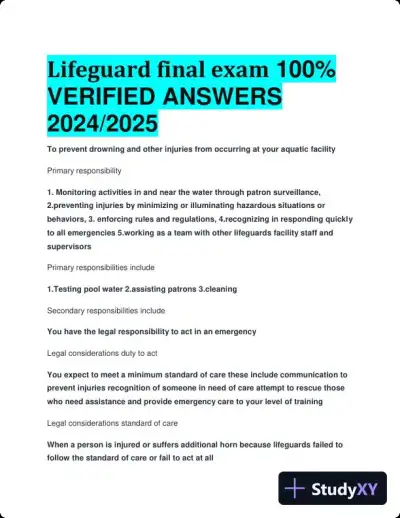 Past Exams
2024-2025 Lifeguard Final Exam with Answers (69 Solved Questions)
Other Exams & Certifications
11 pages137downloadsFeb 2025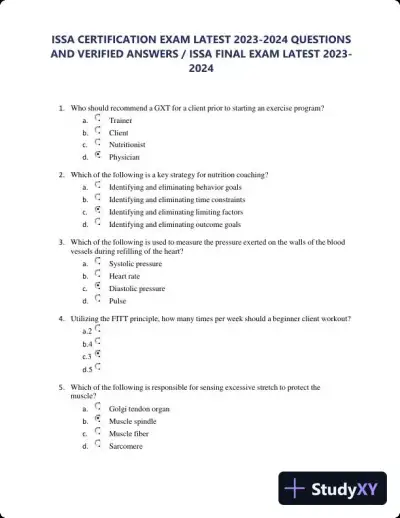 Past Exams
2023-2024 ISSA Certification Final Exam with Answers (200 Solved Questions)
Other Exams & Certifications
49 pages136downloadsFeb 2025
Study this document with CramX
Once it is in your library, every tool can work from it.