

ATLS Nursing Diagnosis Post Test With Answers (40 Solved Questions)
- Other Exams & Certifications
- 13 pages
- Shared May 2025
ATLS Nursing Diagnosis Post Test With Answers allows you to study at your own pace with a vast archive of past exams.
Preview 4 of 13 pages
See the first 4 pages exactly as they appear in the document.
Page 1 Read page 1 as text
ATLS POST TEST MCQ With Answers
Page 2 Page 3 Read page 3 as text
1. Which of the following signs is LEAST reliable for diagnosing esophageal intubation? a. symmetrical chest wall movement b. end-tidal CO2 presence by colorimetry c. bilateral breath sounds d. oxygen saturation >92% e. ETT above carina on chest x-ray 2. Which of the following signs the necessitates a definitive airway in severe trauma patients? a. fascial lacerations b. repeated vomiting c. severe maxillofacial fractures d. sternal fracture e. Glasgow Coma Scale score of 12 3. Twenty-seven patients are seriously injured in an aircraft crash at a local airport. The principles of triage include: a. establish a triage site within the internal perimeter of the crash site b. treat only the most severely injured patients first c. immediately transport all patients to the nearest hospital d. treat the greatest number of patients in the shortest period of time e. produce the greatest number of survivors based on available resources 4. Which of the following statements is correct? a. Cerebral contusions may coalesce to form an intracerebral hematoma. b. Epidural hematomas are usually seen in the frontal region. c. Subdural hematomas are caused by injury to the middle meningeal artery. d. Subdural hematomas typically have a lenticular shape on CT scan. e. The associated brain damage is more severe in epidural hematomas. 5. An 18-ycar-old male is brought to the emergenc} department after having been shot. He has one bullet wound just below the right clavicle and another just below the costal margin in the right posterior axillary line. His blood pressure is110/60 mm Hg. ATLS Post Test. MCQ With Answers
Page 4 Read page 4 as text
heart rate is 90 beats per minute, and respiratory rate is 34 breaths per minute. After ensuring a patent airway and inserting 2 large caliber IVlines., the next appropriate step is to: a. obtain a portable chest x-ray b. administer a bolus of additional IV fluid c. perform a laparotomy d. obtain an abdominal CT scan e. perform diagnostic peritoneal lavage 6. A 47-year-old house painter is brought to the hospital after falling 6 meters (20 feet) from a ladder and landing straddled on a fence. Examination of his perineum reveals extensive ecchymosis. There is a blood in the external urethral meatus. The initial diagnostic study for the evaluation of the urinary tract in this patient should be: a. cystoscopy b. cystography c. intravenous pyelography d. CT scan e. retrograde urethrography 7. Neurogenic shock has all of the following classic characteristics except which one? a. hypotension b. vasodilation c. bradycardia d. neurologic deficit e. narrowed pulse pressure 8. Which one of the following statements is false concerning Rh isoimmunization in pregnant trauma patients? a. It occurs in blunt or penetrating abdominal trauma. b. It is produced by minor degrees of fetomaternal hemorrhage. c. Rh immunoglobulin therapy should be administered to pregnant females who have sustained a gunshot wound to the leg. d. This is not a problem in traumatized, Rh-positive pregnant patients. e. Initiation of Rh immunoglobulin therapy does not require proof of fetomaternal hemorrhage. 9. An 18-year-old motorcyclist sustains massive facial injuries in a head-on crash with a pick-up truck. He is brought to the emergency department completely immobilized on a long spine board and wearing a cervical collar. His blood pressure is 150/88 mmHg, heart rate is 88 beats per minute and regular, and respiratory rate is 26 breaths per minute. His respirations are labored and sonorous. His Glasgow Coma Scale score is 7. Attempts at orotracheal intubation with manual inline stabilization of the c-spine are unsuccessful due to bleeding and distorted anatomy. The patient becomes apneic. The best procedure for airway management in this situation is: a. nasotracheal intubation
9 more pages in the full document
Unlock it once and it stays in your library, ready to chat with or turn into flashcards.
Unlock the full documentMore Other Exams & Certifications study materials
See all Certification Guides
ACFT For Dummies (2020)
Other Exams & Certifications
467 pages156downloadsFeb 2025 Past Exams
Texas Real Estate Law - SAE Champions School Of Real Estate Practice Exam with Answers (81 Solved Questions)
Other Exams & Certifications
9 pages153downloadsFeb 2025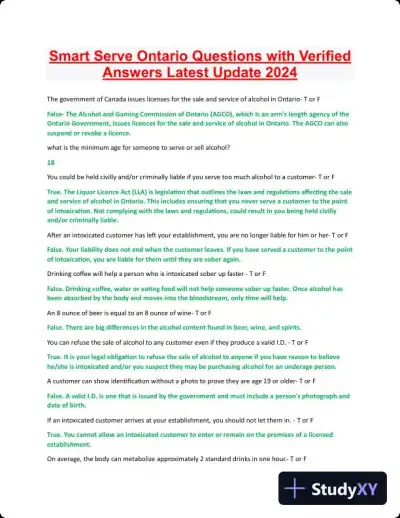 Past Exams
2024 Smart Serve Ontario Practice Exam with Answers (53 Solved Questions)
Other Exams & Certifications
6 pages153downloadsFeb 2025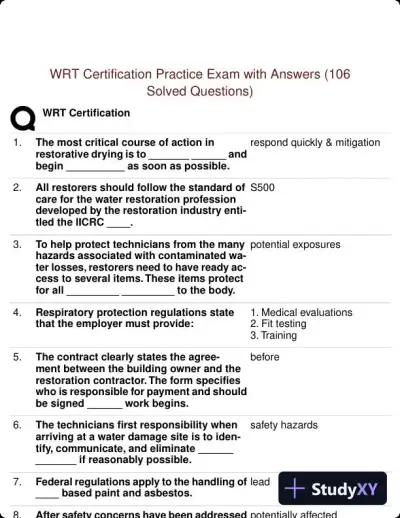 Past Exams
WRT Certification Practice Exam with Answers (106 Solved Questions)
Other Exams & Certifications
16 pages151downloadsFeb 2025 Past Exams
2024 Vivint SHP Practice Exam with Answers (35 Solved Questions)
Other Exams & Certifications
4 pages144downloadsFeb 2025 Past Exams
2024-2025 Wall Street Prep Premium Exam with Answers (50 Solved Questions)
Other Exams & Certifications
13 pages138downloadsFeb 2025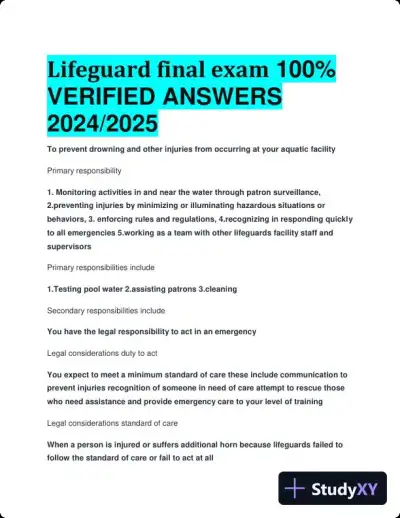 Past Exams
2024-2025 Lifeguard Final Exam with Answers (69 Solved Questions)
Other Exams & Certifications
11 pages137downloadsFeb 2025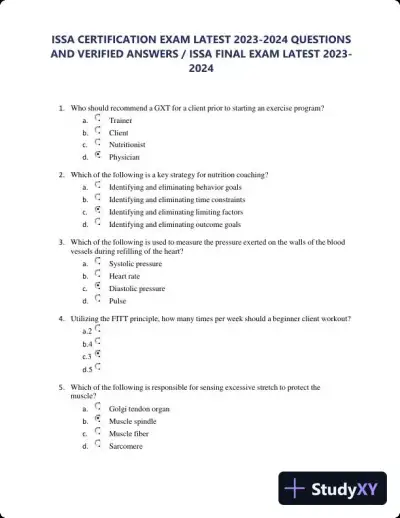 Past Exams
2023-2024 ISSA Certification Final Exam with Answers (200 Solved Questions)
Other Exams & Certifications
49 pages136downloadsFeb 2025
Study this document with CramX
Once it is in your library, every tool can work from it.