

CDFM Module 1 Practice Exam with Answers (156 Solved Questions)
- Other Exams & Certifications
- 13 pages
- Shared May 2025
CDFM Module 1 Practice Exam with Answers offers a set of real exam Q&As, helping you hone your skills before test day.
Preview 4 of 13 pages
See the first 4 pages exactly as they appear in the document.
Page 1 Read page 1 as text
CDFM Module 1 Questions And Answers 3 branches of federal government - Answer - executive (me), judicial, legislative 1.1.1 OMB Circular A - 11 - Answer - Preparation and Submission of Budget Estimates Comes out every summer. 1.1.2 Contains a section on reporting on employment and personnel compensation 1.2.4 Rules for calculating FTEs can be found here 1.2.13 Best place to find updated laws - Answer - Thomas.loc.gov/home/lawsmade.toc.html 1.1.2 Genesis of US Federal Legislative process can be traced to these events - Answer - Declaration of Independence, Articles of Confederation, Constitution ratified by 9 states, Constitution took effect 1.1.5 Declaration of Independence adopted (year) - Answer - 1776 1.1.5 Articles of Confederation ratified (year) - A nswer - 1781 1.1.5 Constitution ratified by 9 states (year) - Answer - 1788 1.1.5 Constitution went into effect - Answer - 1789 1.1.5 What was the first attempt to come up with a government? - Answer - Articles of Confederation 1.1.5 What did an amendment to the Articles of Confederation require? - Answer - Unanimous approval of all the states 1.1.5 What did the Constitution establish - Answer - 3 branches of government (judicial, executive, legislative) 1.1.6 What is the essential principle of the Constitu tion - Answer - Everything you do must be legal (purpose, time, amount) 1.1.6 What are the first 10 amendments to the Constitution called - Answer - Bill of Rights 1.1.6 What does Article 1, Section 8 of the Constitution state - Answer - Congress shall have the authority to make all laws which shall be necessary and proper for carrying into execution 1.1.7 Who heads the executive branch and what is its purpose - Answer - Led by the president and vice president, enforces/executes laws
Page 2 Page 3 Read page 3 as text
Who makes up the legisl ative branch and what is its purpose - Answer - Congress and it makes/passes our laws What are the two parts of Congress - Answer - Senate and House of Representatives Who leads the judicial branch and what is its purpose - Answer - Led by the Supreme Court and interprets our laws The organization of the Federal Government can be found where in the Constitution - Answer - In the first 3 articles 1.1.7 What does the preamble to the Constitution of the US begin with and how do we exercise its sentiment - Answ er - "We the People of the United States, in order to form a more perfect Union...."; we exercise this through the election process. 1.1.7 Which Article of the Constitution discusses the legislative branch? - Answer - Article 1 1.1.7 Which Articles support which branches of Government? - Answer - Article 1; Legislative, Article 2; Executive, Article 3, Judicial What are the law - making powers of the Legislative Brach per Article 1 - Answer - Raise taxes, borrow money, regulate commerce, conscript forces, decl are war, raise and support armies 1.1.8 How many years is a Senator's term? - Answer - 6 years 1.1.8 How many years is a House of Representative's term? - Answer - 2 years 1.1.8 Who elects state senators? - Answer - The people 1.1.8 Who is the President o f the Senate and when is he allowed to vote? - Answer - The Vice President is the President of the Senate, but is only allowed to vote when they are equally divided 1.1.8 Who budgets the Vice President's expenses? - Answer - The Senate 1.1.8 All bills for raising Revenue shall originate where? - Answer - In the House of Representatives 1.1.8 What happens when the President vetoes a bill? - Answer - It will go back to Congress. If 2/3 of the House and 2/3 of the Senate then approve the bill, it will become a law 1.1.8 What happens if the President does not return a bill to Congress within 10 days (Sundays excepted) - Answer - It will become a law 1.1.9
Page 4 Read page 4 as text
What is a temporary appropriation called? - Answer - Continued Resolution (CR) 1.1.9 Does the Constitution m andate the passage of a CR? - Answer - No 1.1.9 When does the President typically give to Congress information of the State of the Union? - Answer - Latter part of January 1.1.10 Will the Supreme Court get involved in State matters? - Answer - No 1.1.11 Wh ich Constitutional amendment is known as the states' rights? - Answer - Amendment 10 1.1.11 Who has the authority to establish inferior courts? - Answer - Congress (not the President) 1.1.11 Line item veto - Answer - Mid 1990's congress passed line item vet o in which the President can red line bills. It was declared unconstitutional. The term "I have been grieved" can be used to object the president's line item veto. 1.1.11 If a Bill is revenue - related, which side of the Congress must it originate? - Answer - House of Representatives 1.1.12 What is a Bill - Answer - Legislative proposal that begins in the House or Senate 1.1.12 What are the 3 types of resolutions? - Answer - Joint resolution, Concurrent resolution, Simple resolution 1.1.12 What are the 3 ori gins of Legislation? - Answer - Recommended by President, introduced by Member, introduced by a Committee 1.1.12 Characteristics of a joint resolution - Answer - Similar to a Bill, can originate in the House or the Senate, can also be used to propose an amendment to the Constitution, sent to President for signature (except for proposed amendments) 1.1.12 Characteristics of a concurrent resolution - Answer - Used for matters affecting the operations of BOTH the House and Senate, does not go to President. E xample is Concurrent Budget Resolution. 1.1.13 Characteristics of a simple resolution - Answer - Used for matters affecting EITHER the House or Senate, does not go to President. 1.1.13 How does the President recommend a Bill? - Answer - Through an annual b udget, a State of the Union address, and an Executive Branch Department submitting a proposed Bill - with approval of OMB on behalf of the President - to a Congressional committee or subcommittee. 1.1.13
9 more pages in the full document
Unlock it once and it stays in your library, ready to chat with or turn into flashcards.
Unlock the full documentMore Other Exams & Certifications study materials
See all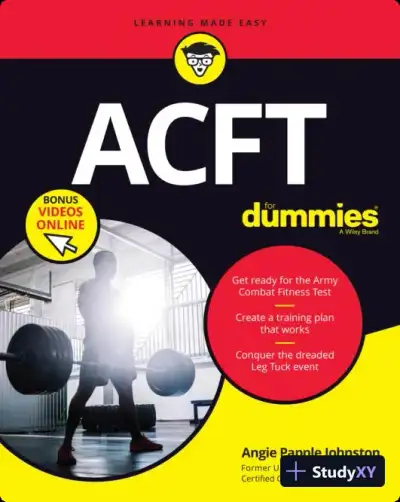 Certification Guides
ACFT For Dummies (2020)
Other Exams & Certifications
467 pages156downloadsFeb 2025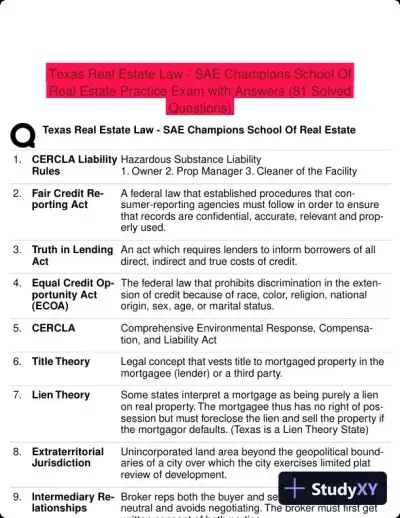 Past Exams
Texas Real Estate Law - SAE Champions School Of Real Estate Practice Exam with Answers (81 Solved Questions)
Other Exams & Certifications
9 pages153downloadsFeb 2025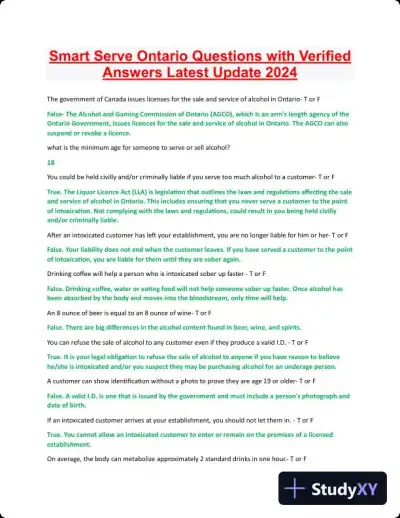 Past Exams
2024 Smart Serve Ontario Practice Exam with Answers (53 Solved Questions)
Other Exams & Certifications
6 pages153downloadsFeb 2025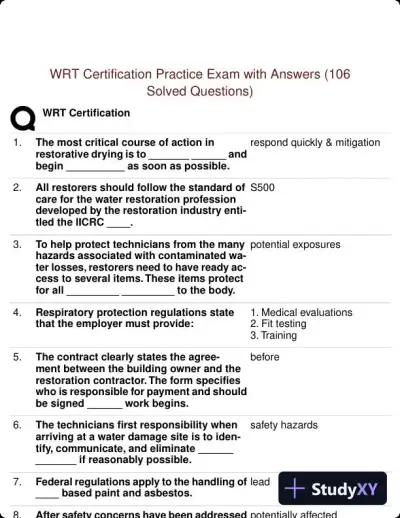 Past Exams
WRT Certification Practice Exam with Answers (106 Solved Questions)
Other Exams & Certifications
16 pages151downloadsFeb 2025 Past Exams
2024 Vivint SHP Practice Exam with Answers (35 Solved Questions)
Other Exams & Certifications
4 pages144downloadsFeb 2025 Past Exams
2024-2025 Wall Street Prep Premium Exam with Answers (50 Solved Questions)
Other Exams & Certifications
13 pages138downloadsFeb 2025 Past Exams
2024-2025 Lifeguard Final Exam with Answers (69 Solved Questions)
Other Exams & Certifications
11 pages137downloadsFeb 2025 Past Exams
2023-2024 ISSA Certification Final Exam with Answers (200 Solved Questions)
Other Exams & Certifications
49 pages136downloadsFeb 2025
Study this document with CramX
Once it is in your library, every tool can work from it.