

Champion Real Estate Finance Version 2 Exam With Answers (246 Solved Questions)
- Other Exams & Certifications
- 25 pages
- Shared May 2025
Champion Real Estate Finance Version 2 Exam With Answers is the key to mastering past exam topics effectively.
Preview 8 of 25 pages
See the first 8 pages exactly as they appear in the document.
Page 1 Read page 1 as text
Champions Real Estate Finance 2 Versions Exam With Perfect Questions And Answers The consummation of a real estate transaction in which all appropriate documents are signed and the proceeds of the mortgage loan are then disbursed by the lender. - Closing Includes collecting monthly payments, maintaining records of payments and balances, collecting and paying taxes and insurance ( and managing escrow and impound funds) remitting funds to the note holder, and following up on delinquencies. - Servicing an economic concept that states that the price of a good rises and falls depending on how many people want it and depending on how much of the good is available. - Supply and Demand The process of transferring funds to a title or escrow company for disbursement - Funding Designed to enhance consumer protection and reduce fraud. (Key component of HERA) - The Safe Act Is defined as the sum of currency held by the public and transaction deposits at depository institutions. - M1 Is defined as M1 plus saving deposits, small-denomination time deposits (those issued in amounts of less than $100,000) and retail money market mutual funds shares. - M2 Is currency that is not backed by any precious metals at all. - Fiat Money Is the maintenance of a stable money supply that provides for growth in the economy while keeping inflation in. The federal reserves is responsible for this policy in the United States. - Monetary Policy
Page 2 Page 3 Read page 3 as text
Federal Government spending. Approved by Congress. At the treasury level, funds can be raised to pay for government spending by raising taxes and increasing borrowing. - Fiscal Policy is the central bank of the United States - Federal Reserve (The Fed) When there is an excess of money supply in the market. - Monetary inflation When there is more money in the market and less goods for sale. - Demand-pull inflation Occurs when the cost of production and offering services increase, thereby causing manufacturers and tradespeople/vendors to rais their prices accordingly. - Cost-push inflation The interest rate charged member banks that borrow from the Federal Reserve Systems - Discount rate Is the rate that the Federal reserve charges banks for unsecured loans, most of which are for a very short term. - Federal Funds Rate The percentage of the lesser of the appraised value or sales price that the lender will lend. ex: If a borrower is approved for an 80% loan, it means that the lender will loan up to 80% of the sales price or appraised value, whichever is lower. - Loan-to-Value Ratio (LTV) Includes both real and personal property ( fixtures and furnishings) - Package Mortgage Covers more than one piece of property. - Blanket Mortgage Method of financing which preserves the low, existing interest rate on the original note. - Wraparound Mortgage Permits additional borrowing on the same note. This is sometimes called a credit card mortgage or a home equity line of credit - HELOC. - Open-End Mortgage
Page 4 Read page 4 as text
The monthly house payment includes principal, interest, taxes and insurance (known as PITI) - Budget Mortgage A hard money loan is a specific type of asset-based financing in which a borrower receives funds secured by the value of a parcel of real estate. - Collateral -Dependent Loans Is a measure of the willingness of a borrower to make on-time payments. Credit character is revealed in the borrower's credit report. - Character Is a measure of the borrower's ability to repay the debt, and is demonstrated through current earnings and job stability. - Capacity Is the sum of all assets that the borrower has accumulated. - Capital Is something of value that can be pledged as security for repayment. - Collateral Is the return that the investor recieves over the life of the loan. (Also known as profit) - Yield The process of creating a new mortgage loan, including all steps taken by a lender to attract and qualify a borrower. - Originator Typically functions as a middleman between the borrower and the lender, negotiating, selling or arranging loans to be delivered to larger investors. At one time originated up to 80% of all mortgage loans. (Back on the rise) - Mortgage Broker Entities which provide their own funds for the purpose of providing mortgage financing, as opposed to commercial banks/savings associations. (Held, or "Warehoused") - Mortgage Banker Usually smaller in scale than mortgage bankers or brokers, these lenders typically extend loans with their own funds, at their own risk. - Correspondent Lender Once application is complete the file moves into this phase. - Processing
Page 5 Read page 5 as text
The detailed process of evaluating a borrower's loan application to determine the risk involved for the lender. - Underwriting Was created to restore the nations financial stability and restart economic growth. - Trouble Asset Relief Program (TARP) Created by Congress in 1972 and became part of the Department of the Treasury in 1873. The primary mission is to serve the American people by manufacturing, distributing, and circulating precious metal coins, collecting coins and national medals. Also entrusted with providing security over assets. - United State Mint An agency created in 1933 to insure individuals' bank accounts, protecting people against losses due to bank failures (Insures deposits only) - The Federal Deposit Insurance Corporation (FDIC) A system of regional banks from which local lending institutions everywhere in America borrow funds to finance housing, economic development, infrastructure and jobs. - The Federal Home Loan Bank (FHLB) System Provides mortgage insurance on loans made by blank- approved lenders throughout the US and its territories. Insures mortgages on single-family and multifamily homes including manufactured homes and hospitals. It is the largest insurer of mortgages in the world, insuring over 34 million properties since its inception in 1934. - The Federal Housing Administration (FHA) Provides lenders with protection against losses as the result of homeowners defaulting on their mortgage loans. - FHA mortgage insurance To help communities with economic development, job opportunities and housing rehabilitation - Community Development Block Grants (CDBG) Block grants to develop and support affordable housing for low-income residents. - HOME Investment Partnership Program
Page 6 Read page 6 as text
In the form of section 8 certificates or vouchers for low-income households. - Rental assistance Was established in the U.S in 1968 to promote homeownership. It is wholly-owned government association that operates a mortgage-backed securities program designed to facilitate the flow of capital into housing industry. Does not issue, sell or buy pass-through mortgage-backed securities or purchases mortgages loans. It simply guarantees (insures). - Ginnie Mae (GNMA) An act prohibiting discrimination in the sale or rental of housing on the basis of race, color, religion or national origin sex, handicap and familial status. - Federal Fair Housing Act of 1968 A federal cabinet department is active in national housing programs. Its mission is to create strong, sustainable, inclusive communities and quality affordable homes. It prevents housing discrimination through public education and enforcement are administered by the Assistant Secretary for Fair Housing and Equal Opportunity (FHEO) - Department of Housing and Urban Development (HUD) All residential mortgage loan originators must now be registered with the Nationwide Mortgage Licensing System and Registry. - NMLSR Established by the Dodd-Frank Act. The Bureau has the authority to examine and enforce consumer protection regulations for all mortgage-related businesses, large non-bank financial companies, and banks and credit unions with assets greater than $10 billion. - Consumer Financial Protection Bureau (CFPB) A practice in which banks refuse to make loans to people living in certain geographic locations. - Redlining The federal law that prohibits discrimination in the extension of credit because of race, color, religion, national origin, sex, age, or marital status. Ensures that all consumers are given an equal chance to obtain credit. - Equal Credit Opportunity Act (ECOA)
Page 7 Read page 7 as text
A United States federal law that is designed to protect consumers in any credit transactions by requiring clear disclosure of key terms of lending arrangments all associated cost. - Truth in Lending Act (TILA) Specific credit terms that may not be advertised unless the advertisement includes other detailed information. - Trigger Terms Sometimes called the Fair Credit Reporting Dispute Act, is a federal law designed to protect consumers against unfair credit reporting practices and protect and credit privacy. To assure the consumer that these agencies are fair, accurate and exhibit confidentiality in their credit reporting methods. - The Federal Fair Credit Reporting Act (FCRA) Also referred to a "Section 502 loan" is insured by the U.S. Department of Agriculture. The program offers 100% financing (no down payment) for qualified borrowers. First time and repeat home buyers can obtain this loan. The program is for primary residence only; no second homes or investor financing is available under this program. The program is for purchases and refinancing only and cash-out refinances are Not allowed. - U.S. Department of Agriculture (USDA) Is an agency of the US Dept of Agriculture. Farm Loan Programs for a farmer or rancher who is unable to obtain credit elsewhere to start, purchase, sustain, or expand a family farm. - USDA Farm Loans (FSA) Regulates the credit industry and educates consumers and creditors. Agency efforts help produce a fair, lawful and healthy credit environment for social and economic prosperity in Texas. - Office of Consumer Credit Commissioner (OCCC) Is responsible for affordable housing, housing related and community service programs, and the regulation of the states manufactured housing industry. - Texas Department of Housing and Community Affairs (TDHCA)
Page 8 Read page 8 as text
a division of the General Land Office of Texas that administers three programs to assist Texas veterans in purchasing a principal residence and/or land and in financing home improvements - Texas Veterans Land Board (VLB) The Consumer Financial Protection Bureau's (CFPB)( Blank )which implement the Real Estate Settlement Procedures Act (RESPA) Ensures that consumers throughout the nation are provided with more helpful information about the cost of the mortgage settlement and protection from unnecessarily high settlement charges caused by certain abusive practices. - Regulation X Prohibits kickbacks, fee-splitting, and unearned fees. - RESPA Section 8 Form replaced the GFE form and the initial TILA disclosures and includes some new disclosures. The form must be provided by the mortgage broker or creditor upon receipt of an application. The creditor or broker must give the form to the consumer no later than 3 business days after the consumer applies for a mortgage loan. - Loan Estimate (LE) The TRID rule requires that the consumer receives the Closing Disclosure no later than 3 business days before consummation. - Closing Disclosure Delivery Requirement Exists for the purchase and sale of existing mortgages to investors. Designed to provide greater liquidity to the residential real estate market by providing for a steady supply of funds from investors. Wherein loan originators such as mortgage bankers and brokers can sell their loans and thus recover cash for originating more loans. - Secondary Market Plays a vital role in financing mortgages and increasing homeownership opportunities in the US. Began in 1938 as an agency of the federal government and was created to bring stability to the US housing market. In 1968, it became a privately owned and managed corporation. US Congress re-chartered it as a private company. Mandating that it operate with private capital on a self-sustaining basis to enhance the flow of funds through the secondary market home buyers.The largest investor in home mortgage today. - Federal National Mortgage Association (FNMA)
17 more pages in the full document
Unlock it once and it stays in your library, ready to chat with or turn into flashcards.
Unlock the full documentMore Other Exams & Certifications study materials
See all Certification Guides
ACFT For Dummies (2020)
Other Exams & Certifications
467 pages156downloadsFeb 2025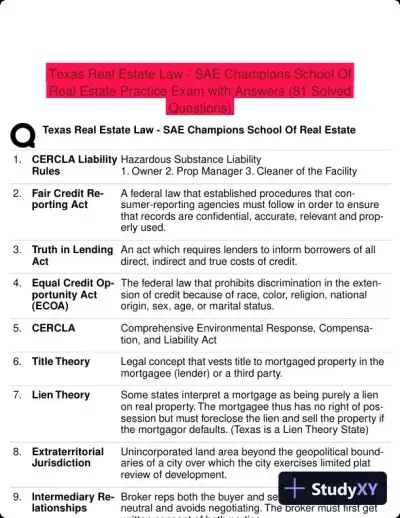 Past Exams
Texas Real Estate Law - SAE Champions School Of Real Estate Practice Exam with Answers (81 Solved Questions)
Other Exams & Certifications
9 pages153downloadsFeb 2025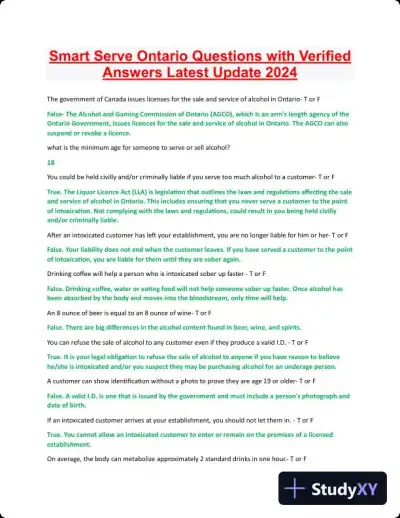 Past Exams
2024 Smart Serve Ontario Practice Exam with Answers (53 Solved Questions)
Other Exams & Certifications
6 pages153downloadsFeb 2025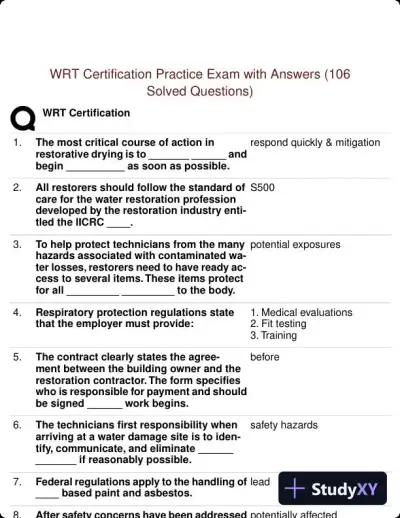 Past Exams
WRT Certification Practice Exam with Answers (106 Solved Questions)
Other Exams & Certifications
16 pages151downloadsFeb 2025 Past Exams
2024 Vivint SHP Practice Exam with Answers (35 Solved Questions)
Other Exams & Certifications
4 pages144downloadsFeb 2025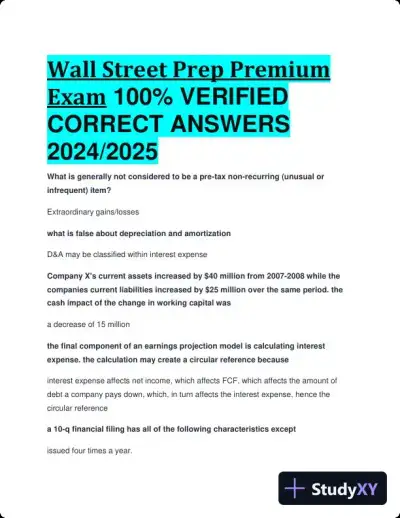 Past Exams
2024-2025 Wall Street Prep Premium Exam with Answers (50 Solved Questions)
Other Exams & Certifications
13 pages138downloadsFeb 2025 Past Exams
2024-2025 Lifeguard Final Exam with Answers (69 Solved Questions)
Other Exams & Certifications
11 pages137downloadsFeb 2025 Past Exams
2023-2024 ISSA Certification Final Exam with Answers (200 Solved Questions)
Other Exams & Certifications
49 pages136downloadsFeb 2025
Study this document with CramX
Once it is in your library, every tool can work from it.