

CSST Comp Practice Exam With Answers (164 Solved Questions)
- Other Exams & Certifications
- 18 pages
- Shared May 2025
CSST Comp Practice Exam With Answers prepares you for your exams with solved papers that reflect the format of real test questions.
Preview 6 of 18 pages
See the first 6 pages exactly as they appear in the document.
Page 1 Read page 1 as text
CSST Exam Study Prep Why was asbestos added to construction materials ? It was a great insulator and binder. It added strength and durability against weathering and use. It was non - corrosive, did not conduct electricity, and made spray - on products easier to apply. What are the two classes of asbestos and their associated types? The two classes of asbestos are Serpentine and Amphiboles. Serpentine consists of one type: Chrysotile. Amphiboles consists of five types: Amosite, Crocidolite, Anthophyllite, Trem olite, Actinolite. Of the different types of Amphiboles, which types were most commonly used commercially? Amosite and Crocidolite What is the predominant color and structure of Chrysotile asbestos ? white , long , curly , hollow What is the predominant co lor and structure of Amosite asbestos ? brown / tan ; long and straight What is the predominant color and structure of Crocidolite ? blue ; long and straight What is the definition of a Surfacing Material? means material that is sprayed - on, troweled - on, or otherwise applied to surfaces, such as acoustical plaster on ceilings and fireproofing materials on structural members, or other materials on surfaces for acoustical, fireproofing, or other purposes. What is the definition of Thermal Systems Insulation (T SI)? means material applied to pipes, fittings, boilers, breeching, tanks, ducts, or other interior structural components to prevent heat loss or gain, or water condensation, or for other purposes. What is the definition of a Miscellaneous Material? means interior building material that is not surfacing material or thermal system insulation. What is the definition of Friable? means that material, when dry, may be crumbled, pulverized, or reduced to powder by hand pressure, and includes previously nonfriable materials after such previously nonfriable material becomes damaged to the extent that when dry it may be crumbled, pulverized, or reduced to powder by hand pressure. What is the primary type of asbestos used in the U.S ? Chrysotile. List three building m aterials / locations where ACM is likely to be found There are over 3000 building products that may contain asbestos. A limited list of examples are: taping mud, flooring mastics/adhesives, popcorn ceilings, fireproofing, vinyl floor tiles, sheet flooring backing, transite, fire doors, fume hoods, felt under roofs or siding, kiln bricks and cement, lab equipment, fire safety equipment, auditorium curtains, gaskets, vibration joints, HVAC duct tape, and many many more. What are the 3 major diseases related to asbestos exposures ?
Page 2 Page 3 Read page 3 as text
Asbestosis, Lung Cancer, Mesot helioma. What is a latency period ? What is the latency period for asbestos related illnesses ? The time between exposure to asbestos and the time symptoms appear. 10 - 40 years. What asbestos - related disease normally appears only after prolonged, heavy, occ upational exposure to asbestos ? Asbestosis What asbestos related disease primarily affects those exposed to asbestos who smoke cigarettes? Lung cancer. There is a synergistic effect that increases the workers chances of getting lung cancer over 50 times. Who must participate in a medical surveillance program? 8 CCR1529 (m) (1). A. The employer shall institute a medical surveillance program for all employees who, for a combined total of 30 or more days per year, are engaged in Class I, II, and III work or a re exposed at or above the permissible exposure limit. For purposes of this paragraph, any day in which a worker engages in Class II or Class III operations or a combination thereof on intact material for one hour or less (taking into account the entire ti me spent on the removal operation, including cleanup) and, while doing so, adheres fully to the work practices specified in this standard, shall not be counted. B. For employees otherwise required by this standard to wear a negative pressure respirator, em ployers shall ensure employees are physically able to perform the work and use the equipment. This determination shall be made under the supervision of a physician. When are asbestos medical surveillance physical exams required ? 1. Prior to assignment of the employee to an area where negative - pressure respirators are worn; 2. When the employee is assigned to an area where exposure to asbestos may be at or above the permissible exposure limit for 30 or more days per year, or engage in Class I, II or III w ork for a combined total of 30 or more days per year, a medical examination must be given within 10 working days following the thirtieth day of exposure; 3. And at least annually thereafter. 4. If the examining physician determines that any of the examin ations should be provided more frequently than specified, the employer shall provide such examinations to affected employees at the frequencies specified by the physician. 5. Exception: No medical examination is required of any employee if adequate record s show that the employee has been examined in accordance with this subsection within the past 1 year period. 6. Employers shall provide a medical examination at the termination of employment for any employee who has been exposed to airborne concentrations of asbestos at or above the permissible exposure limit and/or excursion limit. The medical examination
Page 4 Read page 4 as text
shall be given within 30 calendar days before or after the date of termination of employment. What should be performed at an asbestos medical surveillan ce exam ? 1. A medical and work history with special emphasis directed to the pulmonary, cardiovascular, and gastrointestinal systems. 2. On initial examination, the standardized questionnaire contained in Part 1 of Appendix D in 8 CCR 1529, and, on annua l examination, the abbreviated standardized questionnaire contained in Part 2 in 8 CCR 1529. 3. A physical examination directed to the pulmonary and gastrointestinal systems, including a chest roentgenogram to be administered in accordance with Table 2 [8 CCR 1529 (m) (2)(B)3], and pulmonary function tests of forced vital capacity (FVC) and forced expiratory volume at one second (FEV(1)). Interpretation and classification of chest roentgenograms shall be conducted in accordance with Appendix E in 8 CCR 152 9 4. Any other examinations or tests deemed necessary by the examining physician. According to CalOSHA how often should you have a chest roentgenogram (X - ray) Years since first occupational exposure: 0 - 10 years - Once every three years if under 40 years o ld. Annually if 40 years old or over. 10+ years - Annually Is there a safe level of asbestos exposure ? No What are the 7 major components of the AHERA regulation? Originally, to whom did they apply ? inspection and reinspection requirements, sampling and inspection procedures, lab approval process, accredited and non accredited training programs, clearance air testing, management plan requirements, notification requirements. Originally applied to K through 12 schools. How many days is the required accredit ed training for a Building Inspector , Management Planner , Project Supervisor, Abatement Worker , Project Designer ? Building Inspector - 3 days Management Planner - 2 days Contractor Supervisor - 5 days Abatement Worker - 4 days Project Designer - 3 days When is unaccredited in - house training acceptable ? Class III (16 hours), Class IV (minimum 2 hours), and asbestos awareness trainings. What regulation and agency requires an asbestos inspection be done prior to renovations and demolitions and requires re moval of friable ACM prior to demolition ? National Emission Standards for Hazardous Air Pollutants (NESHAP) enforced by the EPA and it's delegated Air Quality Management Districts. CalOSHA also requires inspections for worker safety. What are the 3 categories of materials identified in a NESHAP building inspection ?
Page 5 Read page 5 as text
Friable Materials , Category 1 non friable, and Category 2 Non Friable What is a friable asbestos material according to NESHAP? Any material containing more than 1 percent asbestos as determined using the PLM method, that, when dry, can be crumbled, pulverized, or reduced to powder by hand pressure. What does NESHAP stand for? National Emissions Standards for Hazardous Air Pollutants What is a Category 1 nonfriable ACM, and Category 2 nonfriable ACM according to NESHAP? Category 1 nonfriable asbestos - containing material means asbestos - containing packings, gaskets, resilient floor coverings, and asphalt roofing products containing more than 1 percent asbestos as determined by PLM. Category 2 nonfriable ACM means any material, excluding Category 1 nonfriable ACM, containing more than 1 percent asbestos as determined by PLM. What is RACM? Regulated asbestos containing material (RACM) means (a) Friable asbestos material (b) Catego ry 1 nonfriable ACM that has become friable, (c) Category 1 nonfriable ACM that will be or has been subjected to sanding, grinding, cutting or abrading, or (D) Category 2 nonfriable ACM that has a high probability of becoming or has become crumbled, pulver ized, or reduced to powder by the forces expected to act on the material in the course of demolition or renovation operations regulated by the NESHAP. Is a NESHAP notification required for demolition of a facility even if no asbestos was found during the i nspection? Yes When is a FED EPA (NESHAP) notification required for asbestos abatement ? On renovation projects involving more than 160 square feet, 260 linear feet or 35 cubic feet of RACM. EXCEPTION: Local air quality management districts may have rules that supercede this requirement (i.e. Bay Area Air Quality Management District requires notification for greater than 100 square or linear feet of ACM) How many days prior notice is required for NESHAP notification of RACM removal? 10 working days Accordin g to NESHAP, what does 'adequately wet' mean? Means sufficiently mix or penetrate with liquid to prevent the release of particulates. if visible emissions are observed coming from the asbestos - containing material, then that material has not been adequately wetted. However, the absence of visible emissions is not sufficient evidence of being adequately wet. Is NESHAP notification required for the demolition of a single family residence? No. NESHAP applies to 'facilities'. A facility means any institutional, commercial, public, or industrial building, but does not include residential buildings that have four or fewer dwelling units. EXCEPTION: Local air quality management districts may have rules that supercede this requirement (i.e. Bay Area Air Quality Manag ement District does not have a residential exemption in their rule) According to NESHAP, what is the definition of 'demolition'?
Page 6 Read page 6 as text
means the wrecking or taking out of any load - supporting structural member of a facility together with any related handling oper ations or the intentional burning of any facility. (So, demolition doesn't necessarily mean a building is coming down. It could just be a load - bearing wall inside a building. The removal of a non - load bearing wall inside a facility would not be demolition, according to the regulation.) Is NESHAP notification required for the manual removal of asbestos - containing mastic? No. Is NESHAP notification required for the mechanical removal of more than 160 square feet of asbestos - containing mastic? Yes. Removal of otherwise nonfriable ACM by mechanical means will render it friable. Therefore, it is RACM and the AQMD must be notified prior to removal. What is the federal OSHA regulation that regulates asbestos exposure for construction? 29 CFR 1926.1101 What types of work are included in OSHA's 29 CFR 1926.1101 demolition, salvage, removal, encapsulation of ACM, construction, alteration of ACM or construction, alteration, repair, maintenance, renovation, or clean up of debris. What does PEL stand for? Wha t is the PEL for asbestos? What is an EL? What is the EL for asbestos? Permissible Exposure Limit. 0.1 f/cc for an 8 hour time weighted average (TWA). Excursion Limit 1.0 f/cc over 30 minutes at peak exposure time. What does f/cc mean? Fibers per cubic cen timeter What does PACM stand for? What materials are PACM ? Presumed Asbestos Containing Materials. PACM means thermal system insulation and surfacing material found in buildings constructed no later than 1980. What are the four classes of work defined by Cal OSHA 29 CFR 1926.1101 Class 1 , Class 2 , Class 3, and Class 4 Define Class 1 from 29 CFR 1926.1101 means activities involving the removal of TSI and surfacing ACM and PACM. (in amounts greater than 1 glove bag) Define Class 2 from 29 CFR 1926.1101 mea ns activities involving the removal of ACM which is not TSI or surfacing material. This includes, but is not limited to, the removal of asbestos - containing wallboard, floor tile and sheeting, roofing and siding shingles, and construction mastics. (in amoun ts greater than 1 glove bag) Define Class 3 from 29 CFR 1926.1101 means repair and maintenance operations, where "ACM", including TSI and surfacing material is likely to be disturbed. (in amounts no greater than 1 standard sized [60" x 60"] glove bag) Defi ne Class 4 from 29 CFR 1926.1101 means maintenance and custodial activities during which employees contact ACM and PACM and activities to clean up waste and debris containing ACM and PACM. What engineering controls are always required regardless of the cla ss of work?
12 more pages in the full document
Unlock it once and it stays in your library, ready to chat with or turn into flashcards.
Unlock the full documentMore Other Exams & Certifications study materials
See all Certification Guides
ACFT For Dummies (2020)
Other Exams & Certifications
467 pages156downloadsFeb 2025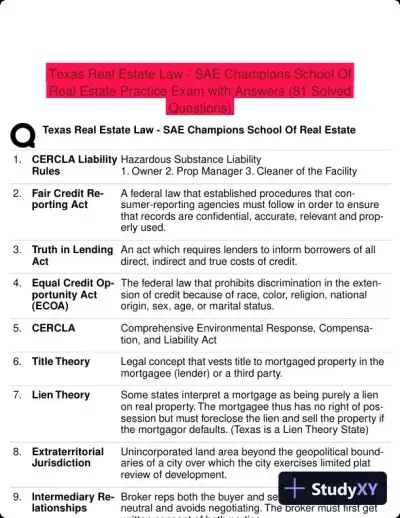 Past Exams
Texas Real Estate Law - SAE Champions School Of Real Estate Practice Exam with Answers (81 Solved Questions)
Other Exams & Certifications
9 pages153downloadsFeb 2025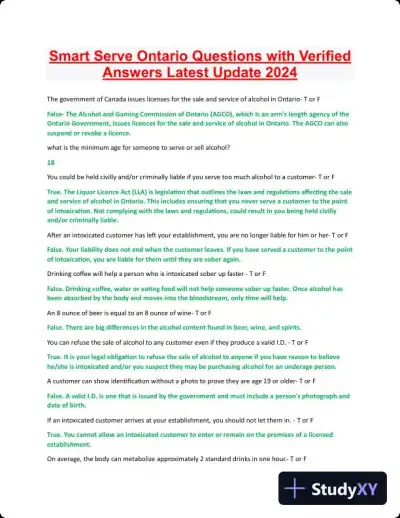 Past Exams
2024 Smart Serve Ontario Practice Exam with Answers (53 Solved Questions)
Other Exams & Certifications
6 pages153downloadsFeb 2025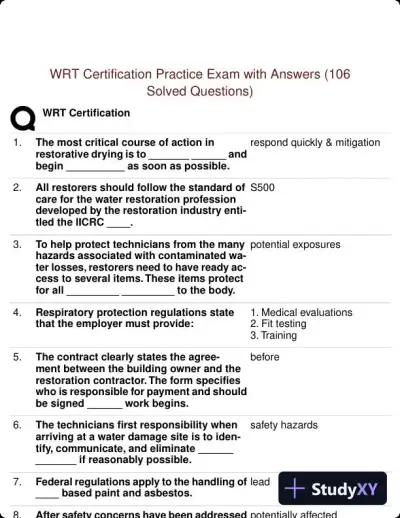 Past Exams
WRT Certification Practice Exam with Answers (106 Solved Questions)
Other Exams & Certifications
16 pages151downloadsFeb 2025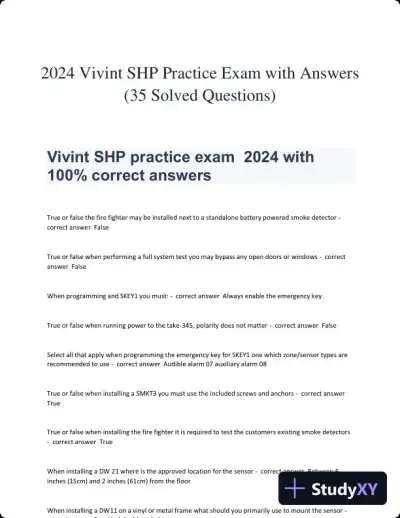 Past Exams
2024 Vivint SHP Practice Exam with Answers (35 Solved Questions)
Other Exams & Certifications
4 pages144downloadsFeb 2025 Past Exams
2024-2025 Wall Street Prep Premium Exam with Answers (50 Solved Questions)
Other Exams & Certifications
13 pages138downloadsFeb 2025 Past Exams
2024-2025 Lifeguard Final Exam with Answers (69 Solved Questions)
Other Exams & Certifications
11 pages137downloadsFeb 2025 Past Exams
2023-2024 ISSA Certification Final Exam with Answers (200 Solved Questions)
Other Exams & Certifications
49 pages136downloadsFeb 2025
Study this document with CramX
Once it is in your library, every tool can work from it.