

Rio Bio156 Biology Practice Exam With Answers (105 Solved Questions)
- Other Exams & Certifications
- 14 pages
- Shared May 2025
Rio Bio156 Biology Practice Exam With Answers helps you break down complex concepts using past exam questions.
Preview 5 of 14 pages
See the first 5 pages exactly as they appear in the document.
Page 1 Read page 1 as text
Rio Bio 156 Exam 1 1. List features that distinguish liv- ing organisms from nonliving matter. 1. Cellular basis - All living things consist of one or more cells 2. Requirement for energy and nutrients - Life is sustained by ongoing inputs of energy and nutrients 3. Homeostasis - Living things sense and respond to change 4. DNA is hereditary material - Genetic information in the form of DNA is passed to offspring 2. Describe the lev- els of organiza- tion in the living world. Atoms ’ cells ’ tissues ’ organs ’ organ systems ’ organism ’ population ’ community ’ ecosystem ’ the biosphere 3. List the three do- mains of life and distinguish be- tween each do- main. Prokaryotes are bacteria and archaea. Domain Bacteria: unicellular no nucleus Domain Archaea: unicellular no nucleus but closer to eukarya Domain Eukarya: have nucleus 4. List four king- doms within the domain Eukarya and distinguish between them. 1. Fungi can be single or multicellular but digest food outside their body. 2. Plants are multicellular and are photosynthetic. 3. Animals are multicellular and eat other organisms for nutrients. 4. Protists are the unicellular organisms that have a nu- cleus but do not fit any other category. 5. List and describe the steps in- volved in solv- ing a problem using hypothe- sis-based sci- ence observation hypothesis experimental conclusion 6. Describe the concept "an or- ganism is more organism is part of a more complex organization. These emergent properties go beyond itself. 1 / 14
Page 2 Page 3 Read page 3 as text
than the sum of its parts." 7. By definition, distinguish be- tween a popu- lation, a com- munity, and an ecosystem. 1. Population: multiple organisms in a single spot 2. community: is made up of populations of different or- ganisms 3. ecosystem: is the interactions between the community and the non-living environment that surrounds it 8. Distinguish be- tween a produc- er, a consumer and a decompos- er. producer:photosynthetic organisms that trap light and convert that light energy into chemical bond energy. such as some bacteria, protists, and all plants consumer: organisms that feed on already-stored food decomposer: bacteria and fungi recycle the dead mole- cules throughout the bioshpere. 9. Distinguish be- tween a hypothe- sis and a predic- tion. hypothesis: testable explanation of a natural phenome- non. prediction: statement based on hypothesis about a condi- tion that should exit if the hypothesis is correct. 10. What is meant by the phrase potentially falsifi- able hypothesis? a hypothesis can be proven that is false 11. Define the term control group and explain the value of a control group in an ex- periment. Group of individuals identical to an experimental group except for the independent variable under investigation To provide a basis of comparison to the experimental group 12. Define the term theory and ex- plain the point in which a hypoth- esis becomes a theory. Suppose a hypothesis stands even after years of tests. It is consistent with all data ever gathered, and it has helped us make successful predictions about other phe- nomena. 2 / 14
Page 4 Read page 4 as text
13. Explain how electron con- figuration influ- ences the chem- ical properties of an atom. Each cloud can hold a determinant number of electrons. When the electron number changes, ions are formed. The number of electrons influences the bonding between atoms. 14. hydrogen bond The electron from the hydrogen spends most of its time around the oxygen atom creating a partial positive charge on each hydrogen. The presence of additional electrons makes the oxygen partially negative. 15. covalent bond two atoms share a pair of electrons, so that each atom's vacancy becomes partially filled 16. ionic bond Type of chemical bond in which a strong mutual attraction links ions of opposite charge. 17. Describe how water con- tributes to the fitness of the environment that supports all life. 1. an excellent solvent 2. has cohesion (insect on water, water roots) 3. stabilize temperature (cool surface) 18. Explain the basis for the pH scale. The basis for the pH scale is the amount of H+ and OH- ions in a solution. More H+ ions means a solution is more acidic, while more OH- ions means the solution is more basic. 19. List and describe the four major classes of organ- ic compounds. carbohydrate lipid protein nucleic acids 20. Describe the structure of an atom protons neutrons electrons 3 / 14
Page 5 Read page 5 as text
21. Explain why ra- dioisotopes are important to biol- ogists. Atoms of a radioisotope have an unstable nucleus that breaks up spontaneously. radioisotopes can be used as or in tracers, which are substances with a detectable component. PET scan 22. Explain how an acid differs from a base. The more concentrated the hydrogen ions are, the lower the pH of the solution. 23. What is the cause and en- vironmental con- sequence of acid rain? Burning fossil fuels such as coal releases sulfur and nitrogen compounds that affect the pH of rain and other forms of precipitation. drastically changes the pH of water in soil, lakes, and streams. 24. Describe carbo- hydrates Simple sugars are called monosaccharides ( Glucose and fructose). sucrose is disaccharide. polysaccharides. provide energy and structural support for living systems. 25. Describe lipids can be divided into fats, phospholipids, steroids, and wax- es. part of it is hydrophobic. make up part of cell membranes and provide energy. 26. Describe pro- teins made up of amino acids. 27. Describe the molecular struc- ture and impor- tance of RNA. An RNA molecule is a chain of four kinds of nucleotide monomers, one of which is ATP. RNA molecules carry out protein synthesis 28. Describe the molecular struc- ture and impor- tance of DNA. A DNA molecule consists of two chains of nucleotides twisted into a double helix. Each cell starts life with DNA inherited from a parent cell. 4 / 14
9 more pages in the full document
Unlock it once and it stays in your library, ready to chat with or turn into flashcards.
Unlock the full documentMore Other Exams & Certifications study materials
See all Certification Guides
ACFT For Dummies (2020)
Other Exams & Certifications
467 pages156downloadsFeb 2025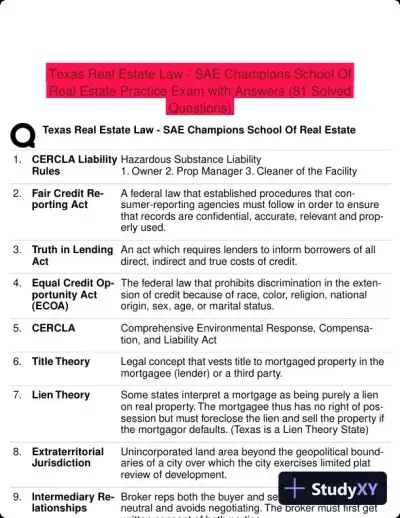 Past Exams
Texas Real Estate Law - SAE Champions School Of Real Estate Practice Exam with Answers (81 Solved Questions)
Other Exams & Certifications
9 pages153downloadsFeb 2025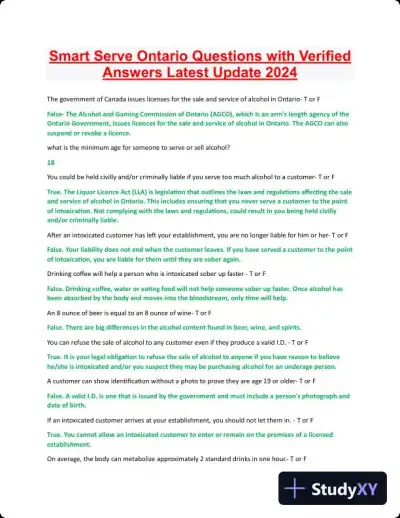 Past Exams
2024 Smart Serve Ontario Practice Exam with Answers (53 Solved Questions)
Other Exams & Certifications
6 pages153downloadsFeb 2025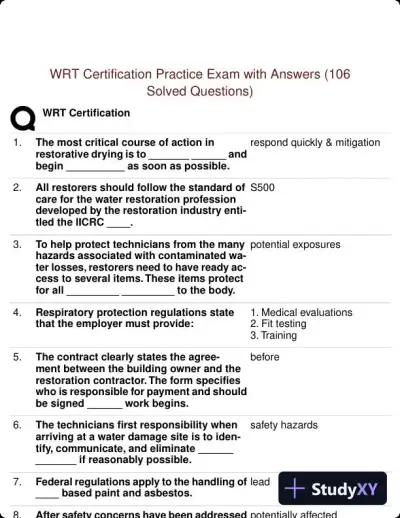 Past Exams
WRT Certification Practice Exam with Answers (106 Solved Questions)
Other Exams & Certifications
16 pages151downloadsFeb 2025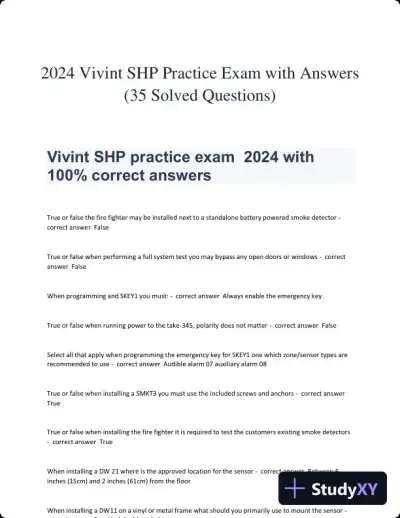 Past Exams
2024 Vivint SHP Practice Exam with Answers (35 Solved Questions)
Other Exams & Certifications
4 pages144downloadsFeb 2025 Past Exams
2024-2025 Wall Street Prep Premium Exam with Answers (50 Solved Questions)
Other Exams & Certifications
13 pages138downloadsFeb 2025 Past Exams
2024-2025 Lifeguard Final Exam with Answers (69 Solved Questions)
Other Exams & Certifications
11 pages137downloadsFeb 2025 Past Exams
2023-2024 ISSA Certification Final Exam with Answers (200 Solved Questions)
Other Exams & Certifications
49 pages136downloadsFeb 2025
Study this document with CramX
Once it is in your library, every tool can work from it.