

Class Notes for Financial Accounting, 10th Edition
- Physics
- 208 pages
- Shared February 2025
- 139 downloads
Class Notes for Financial Accounting, 10th Edition makes studying easier with well-organized, concise notes.
Preview 31 of 208 pages
See the first 31 pages exactly as they appear in the document.
Page 1 Read page 1 as text
1 - 1 Chapter 1: T he Financial Statements Learning Objectives 1. Explain why account ing is the language of business 2. Explain and apply underlying accounting concep ts, assumptions, and principles 3. Apply the accounting equation to business organizations 4. Evaluate business operations t hrough the financial statements 5. Construct financial statements and analyze the relationships among them 6. Evaluate business decisions ethically Questions You Should Be Able To Answer Learning Objective Question(s) Answer For practice 1. Explain why accounting is the language of business Why is accounting considered the language of business? What are the ways businesses can be organized? Accounting communicates economic information. The better you understand accounting, the better you can understand and communicate in business terms. Proprietorship: sole owner with personal liability Partnership: more than one owner, often with personal liability Corporation: more than one owner, with limited liability S1 - 7, S1 - 8, S1 - 9 S1 - 3 2. Explain and apply underlying concepts, assumptions and principles of accounting Explain the following concepts, assumptions, and principles: (1) Entity assumption (2) Continuity assumption (3) Historical cost principle (1) Each organization is separate (2) Entity will remain in business (3) Assets recorded at actual cost S1 - 4, S1 - 5, S1 - 15
Page 2 Page 3 Read page 3 as text
1 - 2 (4) Stable monetary unit assumption (4) Ignore effects of inflation 3. Apply the accounting equation to business organizations What is the fundamental accounting equation? What is: (1) An asset? (2) A liability? (3) Stockholders’ (owners’) equity What are some examples of: (1) Assets (2) Liabilities (3) Stockholders’ equity (4) Revenue (5) Expenses Assets = Liabilities + Stockholders’ Equity (1) Economic resources expected to benefit the entity in the future (2) Economic obligations, debts (3) Claims held by owners Cash, accounts receivable, inventories, property and equipment Accounts payable, notes payable Common stock, retained earnings Sales, service revenue Cost of sales, operating expenses S1 - 1; S1 - 6 S1 - 8 S1 - 8 4. Evaluate business operations through the financial statements What information is shown in the: (1) Income statement (2) Statement of retained earnings (3) Balance sheet (4) Cash flow statement (1) Results of operations (revenue – expenses) (2) What a company did with its earnings (3) Financial position (assets = liabilities + stockholders’ equity) (4) The sources of cash inflow (receipts) and outflow (payments) S1 - 7, S1 - 15
Page 4 Read page 4 as text
1 - 3 5. Construct financial statements and analyze the relationships among them What is the most logical order of preparation of the financial statements? (1) Income statement (2) Statement of retained earnings (3) Balance sheet (4) Statement of cash flows S1 - 10, S1 - 11, S1 - 12, S1 - 13, S1 - 14 6. Evaluate business decisions ethically What is the proper way to evaluate business decisions ethically? (1) What is the issue? (2) Who are the stakeholders? (3) What are the alternatives? (4) What are the consequences of the decision ? S1 - 2 Chap ter 1 Outline I. Accounting – The Language of Business A. Users of financial i nformation 1. Individuals 2. Investors and c reditors 3. Regulatory b odies 4. Nonprofit o rganizations B. Financial accounting vs. management a ccounting C. Organizing a b usiness 1. Proprietorship 2. Partnership 3. Limited - liability c ompany 4. Corporation II. Underlying Accounting Concepts, Assumptions, and Principles A. Financial Accounting Standards Board (FASB)/Generally Accepted Accounting Principles (GAAP) B. International Accounting Standards Board (IASB)/International Financial Reporting Standard (IFRS) C. Fundamental qualitative c haracteristics 1. Relevance 2. Faithful r epresentation D. Enhancing qualitative c haracteristics 1. Comparability 2. Verifiability
Page 5 Read page 5 as text
1 - 4 3. Timeliness 4. Understandability E. Cost/b enefit F. Entity a ssumption G. Continui ty (going - concern) a ssumption H. Historical cost p rinciple I. Stable - monetary - unit a ssumption III. Application of the Accounting Equation (Assets = Liabilities + Equity) A. Assets – economic resources with future b enefit B. Liabilities – “outsider c laims” C. Owners’ e quity – “insider c laims” 1. Paid - in capital 2. Retained earnings IV. Evaluate Business Operations Using the Financial Statements A. The Income Statement (Revenues – Expenses = Net Income (Net Loss)) 1. Revenues 2. Gain s 3. Expense s 4. Losses B. Statement of Retained Earnings (Beginning Retained Earnings + Net Income – Dividends = Ending Retained Earnings) C. Balance Sheet (Assets = Liabilities + Equity) 1. Assets a. Current a ssets b. Non - current a ssets 2. Liabilities a. Current l iabilities b. Long - term l iabilities 3. Stockholders’ e quity D. Statement of Cash Flows (Net cash flow from (Operating Activities + or – Investing Activities + or – Financin g Activities) + Beginning Cash balance = Ending Cash b alance) V. Financial Statement Preparation and Analysis of R elationships A mong Them VI. Evaluate Business Decisions Ethically A. The r ole of j udgment B. Economic f actors C. Legal f actors D. Ethical f actors
Page 6 Read page 6 as text
1 - 5 Chapter Activities 1. Chapter Opener Chapter 1 spotlights The Gap, Inc. and details the products the corporation sells, its network of stores, and financial informatio n for the year ended January 28, 2012 . Additionally, the section introduces the terms “ net sales ” and “net income.” Discuss with the stude nts the products that The Gap sells and the prices related to those items. Visit www.gap.com and review pricing of those particular products on the company’s website. Explain how these items, once sold, are sales to the company. From the company’s website, you can also download the most current annual report. Use this report to explain the flow of product sales to the financial statements, as well as how that equates to net income. Additionally, ask the students what information they would need from the financial statements if they had $5,000 to invest. How would they decide if The Gap was a good investment? 2. Accounts Activity On slips of paper, list accounts and distribute one slip of paper to each student. You can use the following chart of accounts as an example: Cash Accounts Receivable Inventory Prepaid Rent Office Supplies Land Automobiles Buildings Patents Copyrights Trademark Accounts Payable Income Taxes Payable Interest Payable Notes Payable Salaries and Wages Payable Bonds Payable Common Stock Retained Earnings Sales Revenue Interest Revenue Rent Revenue
Page 7 Read page 7 as text
1 - 6 Advertising Expense Commissions Expense Cost of Goods Sold Depreciation Expense Income Tax Expense Insurance Expense Interest Expense Salary and Wage Expense Supplies Expense Dividends Dividends Payable Divide the room up into five areas: assets, liabilities, stockholders’ equity, revenues, and expenses. Ask the students to move to their particular area of the room depending on what account types they have been assigned. Quiz each student to confirm that he or she is in the correct section of the room. Move the students accordingly if they are in the wrong section. Repeat the exercise by dividing the room into a balance sheet section and an income statement section. Again, quiz the students to confirm that they are in the correct area for that particular financial statement and move them, if necessary. Difficult Topics • Statement of Cash Flows
Page 8 Read page 8 as text
1 - 7 Chapter 1: Assignment Grid (Will have an X if available) Assignment Topic(s) L.O. Estimated Time (minutes) Level of Difficulty Excel Templates General Ledger Templates S1 - 1 Apply the accounting equation 3 5 Easy S1 - 2 Evaluate business decisions ethically 6 5 Easy S1 - 3 Explain and differentiate between business organizations 1 10 Easy S1 - 4 Explain underlying accounting concepts, assumptions, and principles of accounting 2 5 Easy S1 - 5 Apply underlying accounting concepts, assumptions, and principles 2 5 - 10 Easy S1 - 6 Apply the accounting equation 3 5 Easy S1 - 7 Explain accounting language; evaluate business operations 1,4 5 Easy S1 - 8 Explain accounting language 1 5 - 10 Easy S1 - 9 Explain accounting language 1 5 Easy S1 - 10 Construct an income statement 5 5 Easy S1 - 11 Construct a statement of retained earnings 5 5 Easy S1 - 12 Construct a balance sheet 5 10 Easy S1 - 13 Construct a statement of cash flows 5 10 - 15 Medium S1 - 14 Explain accounting language; construct financial statements 1,5 10 Easy S1 - 15 Apply accounting concepts; evaluate business activity 2,4 15 - 20 Easy
Page 9 Read page 9 as text
1 - 8 Assignment Topic(s) L.O. Estimated Time (minutes) Level of Difficulty Excel Templates General Ledger Templates E1 - 16A Apply the accounting equation; evaluate business operations 3,4 10 - 15 Medium E1 - 17A Apply the accounting equation; evaluate business operations 3,4 10 - 15 Medium E1 - 18A Apply the accounting equation; evaluate business operations 3,4 10 - 20 Medium E1 - 19A Identify financial statement by type of information 5 10 - 15 Medium E1 - 20A Apply the accounting equation; construct a balance sheet 3,5 10 - 20 Medium E1 - 21A Construct an income statement and a statement of retained earnings 5 15 - 25 Medium E1 - 22A Construct an income statement and a statement of retained earnings 5 15 - 20 Medium X E1 - 23A Construct a balance sheet 5 15 - 20 Medium X E1 - 24A Construct a statement of cash flows 5 15 - 20 Medium E1 - 25A Evaluate business operations through the financial statements 4 10 - 15 Medium E1 - 26B Apply the accounting equation; evaluate business operations 3,4 10 - 15 Medium E1 - 27B Apply the accounting equation; evaluate business operations 3,4 10 - 15 Medium E1 - 28B Apply the accounting equation; evaluate business operations 3,4 10 - 20 Medium E1 - 29B Identify financial statement by type of information 5 10 - 15 Medium
Page 10 Read page 10 as text
1 - 9 Assignment Topic(s) L.O. Estimated Time (minutes) Level of Difficulty Excel Templates General Ledger Templates E1 - 30B Apply the accounting equation; construct a balance sheet 3,5 10 - 20 Medium E1 - 31B Construct an income statement and a statement of retained earnings 5 15 - 25 Medium X E1 - 32B Construct an income statement and a statement of retained earnings 5 15 - 20 Medium X E1 - 33B Construct a balance sheet 5 15 - 20 Medium E1 - 34B Construct a statement of cash flows 5 15 - 20 Medium E1 - 35B Evaluate business operations through the financial statements 4 10 - 15 Difficult Q1 - 36 to Q1 - 50 Practice quiz questions All 10 - 20 Medium P1 - 51A Apply the accounting equation; evaluate business operations 3,4 30 Medium P1 - 52A Explain accounting language; apply the accounting equation; evaluate business operations; construct a balance sheet 1,3, 4,5 20 - 25 Medium X P1 - 53A Apply underlying accounting concepts; evaluate business operations; construct a balance sheet 2,4,5 20 - 25 Difficult P1 - 54A Construct and analyze an income statement, a statement of retained earnings, and a balance sheet; evaluate business operations 4,5 30 - 45 Medium X P1 - 55A Construct a statement of cash flows; evaluate business operations 4,5 20 Medium
Page 11 Read page 11 as text
1 - 10 Assignment Topic(s) L.O. Estimated Time (minutes) Level of Difficulty Excel Templates General Ledger Templates P1 - 56A Construct financial statements 5 40 - 50 Medium P1 - 57B Apply the accounting equation; evaluate business operations 3,4 30 Medium P1 - 58B Explain accounting language; apply the accounting equation; evaluate business operations; construct a balance sheet 1,3, 4,5 20 - 25 Medium X P1 - 59B Apply underlying accounting concepts; evaluate business operations; construct a balance sheet 2,4,5 20 - 25 Difficult P1 - 60B Construct and analyze an income statement, a statement of retained earnings, and a balance sheet; evaluate business operations 4,5 30 - 45 Medium X P1 - 61B Construct a statement of cash flows; evaluate business operations 4,5 20 Medium P1 - 62B Construct financial statements 5 40 - 50 Medium Decision Case 1 Explain accounting language; evaluate business operations through financial statements 1,4 30 - 40 Medium Decision Case 2 Correct errors; construct financial statements; evaluate business operations through financial statements 4,5 20 - 30 Medium Ethical Issue Evaluate ethical decisions 6 30 - 40 Medium Focus on Financials — Amazon.com Apply the accounting equation; evaluate business operations 3,4 20 - 30 Medium
Page 12 Read page 12 as text
1 - 11 Assignment Topic(s) L.O. Estimated Time (minutes) Level of Difficulty Excel Templates General Ledger Templates Focus on Analysis — Yum! Brands, Inc. Apply the accounting equation; evaluate business operations 3,4 30 Medium Group Project 1 Bank Loan All 45 - 60 Difficult Group Project 2 Going Public All 45 - 60 Difficult
Page 13 Read page 13 as text
1 - 12 A nswer Key to Chapter 1 Quiz (Quiz on following pages.) 1. A 2. C 3. B 4. C 5. B 6. D 7. A 8. A 9. D 10. C
Page 14 Read page 14 as text
1 - 13 Name____________________________________ Date_________________ Section_______________ CHAPTER 1 10 - MINUTE QUIZ Circle the letter of the best response. 1. The e quation for the Statement of Cash Flows is: A. Net cash f l ow f rom (Operating Activities + or – Investing Activities + or – Financing Activities) + Beginning Cash balance = Ending Cash b alance B. Net cash f l ow f rom (Operating Activities – Investing Activities – Financing Activities) + Beginning Cas h b alance = Ending Cash b alance C. Net cash f l ow f rom (Operating Activities + I nvesting Activities + Financing Activities) – Beginning Cas h balance = Ending Cash b alance D. Net cash flow f rom (Operating Activities – Investing Activities + Financing Activities) + End i ng Cash balance = Beginning Cash b alance 2. Which item is an asset? A. Long - Term Debt B. Accounts Payable C. Accounts Receivable D. Notes Payable 3. If total liabilities decreased by $75,000 and total assets decreased by $90,000 during the same accounting time period, what happened to total owners’ equity during this period? A. $15,000 increase B. $15,000 decrease C. $90,000 increase D. $90,000 decrease 4. Assuming an entity will continue to operate long enough to sell i ts inventories and convert any receivables to cash is : A. Stable - m onetary - unit a ssumption. B. Entity a ssumption. C. Continuity (going - concern) a ssumption. D. Historical cost p rinciple. 5. W hich financial statement report s net income and dividends? A. Income Statement B. Statement of Retained Earnings C. Balance Sheet D. Statement of Cash Flows
Page 15 Read page 15 as text
1 - 14 6. The __________________ states that assets should be recorded at their actual cost. A. Stable - monetary - unit a ssumption B. Continu ity (going - concern) a ssumption C. Entity a ssumption D. Historical cost p rinciple 7. Which financial statement reports revenues and expenses? A. Income Statement B. Statement of Retained Earnings C. Balance Sheet D. Statement of Cash Flows 8. Mr. Ronald Smith is the owner of a small business. He has decided to save money during his initial years of operation by not hiring a professional accountant. He makes inflation adjustments to accounting information to make it comparable over time. Which accounting principle, concept, or assumption does this violate? A. Stable - m onetary - unit a ssumption B. Continuity (going - concern) a ssumption C. Entity a ssumption D. Historical cost p rinciple 9. Listed below are the account bal ances of the Arthur Frank Corporation : Accounts Payable $ 75,000 Cash 100,000 Common Stock 500,000 Dividends 50,000 Land 60,000 Miscellaneous Expense 3,000 Service Revenue 250,000 Equipment 40,000 Note Payable due in 60 days 125,000 Long - Term Debt 13,000 Salary Expense 120,000 Total Liabilities are: A. $ 100,000. B. $338,000. C. $278,000. D. $213,000.
Page 16 Read page 16 as text
1 - 15 10. Listed below are the account bal ances of the Arthur Frank Corporation : Accounts Payable $ 75,000 Cash 100,000 Common Stock 500,000 Dividends 50,000 Land 60,000 Miscellaneous Expense 3,000 Service Revenue 250,000 Equipment 40,000 Note Payable due in 60 days 125,000 Long - Term Debt 13,000 Salary Expense 120,000 Net Income is: A. $263 ,000. B. $150,000. C. $127 ,000. D. $120,000.
Page 17 Read page 17 as text
2 - 1 Chapter 2 : Transaction Analysis Learning Objectives 1. Explain what a transaction is 2. Define “account” and list and differentiate between different types of accounts 3. Show the impact of business transactions on the accounting equation 4. Analyze the impact of business transactions on accounts 5. Record (journalize and post) transactions in the books 6. Construct and use a trial balance Questions You Should Be Able To Answer Learning Objective Question(s) Answer For practice 1. Explain what a transaction is What is a business transaction? A transaction is any event that has a financial impact on the business and can be measured reliably. S2 - 3, S2 - 5 2. Define “ account ,” and list and differentiate between different types of accounts What is an account? Describe the following accounts: (1) Assets (2) Liabilities (3) Stockholders’ equity (4) Revenues An account, the basic summary device of accounting, is the record of all the changes in a particular asset, liability, or stockholders’ equity during a period. (1) Economic resources that provide a future benefit for a business (2) Debts of the business, due in cash or goods/services (3) The owners’ claims to the assets of the corporation, including common stock and retained earnings (4) Increases in stockholders’ equity that result from delivering goods or services to customers S2 - 1, S 2 - 12
Page 18 Read page 18 as text
2 - 2 (5) Expenses (6) Dividends (5) Decreases in stockholders’ equity that result from costs of operating a business (6) Distributions to shareholders, usually in cash, from profitable operations; dividends decrease retained earnings 3. Show the impact of business transactions on the accounting equation S2 - 4, S2 - 5, S2 - 7 4. Analyze the impact of business transactions on accounts What is the double - entry system of accounting? What is a T - account? What are the rules of debit and credit? Every transaction affects at least two accounts The letter, T; the name of the account is written on the top. Debit entries are on the left side with credit entries on the right side of the T - account. Assets increase with a debit and decrease with a credit. Liabilities and stockholders’ equity increase with a credit and decrease with a debit. (Note that the rules are the opposite on opposite sides of the accounting equation.) Revenues increase with a credit and expenses increase with a debit. S2 - 4 S2 - 2, S2 - 3, S2 - 13
Page 19 Read page 19 as text
2 - 3 Dividends increase with a debit. (Note that revenues increase retained earnings and expenses and dividends decrease retained earnings.) 5. Record (journalize and post) transactions in the books What is a journal? What is the ledger? What occurs during posting? A chronological record of business transactions; the first place a transaction is recorded A grouping of the T - accounts, along with their balances Transactions are posted or copied from the journal to the ledger (always in that order). A balance is calculated for each account in the ledger. S2 - 6, S2 - 7, S2 - 8 6. Construct and use a trial balance What is a trial balance? What does a trial balance prove? A l ist of all accounts with their balances — assets first, then liabilities and stockholders’ equity (including revenue and expense accounts). Account balances are listed in either the debit column or the credit column, and the columns are totaled. They should be equal. That equal debits and credits have been recorded S2 - 9, S2 - 10, S2 - 11
Page 20 Read page 20 as text
2 - 4 How can the trial balance be used? How can accounting errors be detected? To facilitate preparation of financial statements (although they will be more accurate after adjusting entries are added in the next chapter) (1) Search for missing amounts (2) If the two columns of the trial balance are not equal, search for an entry of that amount (3) Divide the difference between the two columns by 9 to determine if there is a slide or transposition error Chapter 2 Outline I. A Business Transaction A. Any event that has a financial impact on the business and can be measured reliably B. Giving something C. Receiving something in return II. Account A. Record of all the changes in a particular asset, liability, or stock holders’ equity during a period B. Categories 1. Assets (Examples: Cash, Accounts Receivable, Inventory) 2. Liabilities (Examples: Accounts Payable, Notes Payable, Accrued Liabilities) 3. Stockholders’ (Owners’) Equity (Examples: Common Stock, Retained Earnings, Dividends , Revenues, Expenses ) III. Transaction Examples A. Impact on the a ccounting e quation (the equation always stays in balance) B. Impact on the financial s tatements IV. Impact of Business Transactions on Accounts A. Double - entry accounting s ystem
Page 21 Read page 21 as text
2 - 5 B. T - account : ACCOUNT TITLE Debit Credit 1. Debit – “ left or left - hand side” 2. Credit – “ right or right - hand side ” C. Rules of debit and c redit 1. Debit – Increases in assets , expenses , and dividends; decreases in liabilities, stockholders’ equity, and revenues 2. Credi t – I ncreases in liabilities, stockholders’ equity, and revenues ; decreases in assets , expenses , and dividends D. Balance = amount remaining in an account E. Revenues (Examples: Sales Revenue, Legal Fees Earned, Service Revenue) F. Expenses (Examples: Cost of Goods Sold, Salaries Expense, Utilities Expense) V. Record Transactions in the Books A. Journal – A chronological record of transactions B. Journalizing e xample: Account and Explanation Debit Credit Cash 50,000 Common Stock 50,000 Issued common s tock C. Ledger – Grouping of all the T - accounts, with their balances D. Posting – Data must be copied from the journal to the ledger E. Posting e xample : Account and Explanation Debit Credit Cash 50,000 Common Stock 50,000 Issued common s tock Cash Common Stock 50,000 50,000
Page 22 Read page 22 as text
2 - 6 F. Flow of accounting d ata VI. Construct and Use a Trial Balance A. Analyzing a ccounts B. Correcting accounting e rrors C. Chart of a ccounts D. Normal account balances: E. Account formats F. How to analyze transactions from T - accounts Chapter Activities 1. Chapter Opener Chapter 2 spotlights Whole Foods Market, Inc. and explains that the company is the world’s leading retailer of natural and organically grown groceries. Have the students review Whole Foods’ statement of operations at the company’s website ( www.wholefoodsmarket.com .) and discuss what items might make up the company’s net sales. Additionally, discuss the items that could be included in the expense figures for the corporation. This could lead to a discussion about how a company determines its net income or net loss. 2. Transactions Activity Use the game Monopoly as an example of a business that would engage in transactions for a particular period. Examples of transactions that a player of the game might encounter include: 1) Receive $1,500 in cash t o be used as capital investment 2) Bank pays you a dividend of $50 3) Purchase Park Place for $35 Account Type Normal Balance Increase Decrease Asset Debit Debit Credit Liability Credit Credit Debit Stockholders’ Equity Credit Credit Debit Revenue Credit Credit Debit Expense Debit Debit Credit Common Stock Credit Credit Debit Retained Earnings Credit Credit Debit Dividends Debit Debit Credit
Page 23 Read page 23 as text
2 - 7 4) Pay poor tax of $15 5) Purchase house for property on Park Place for $200 6) Pay rent on Baltic Avenue of $4 7) Receive for services $25 8) From sale of common stock, you get $45 9) Pay school tax of $150 10) Collect rent on Park Place of $175 11) Pay rent on Pennsylvania Railroad of $25 12) Pay Water Works $60 13) Mortgage Park Place for $175 Place the students into groups and use the chart of accounts below. Have the students put each of the transactions in journal entry form. Cash Dividen d Revenue Common Stock House Investment Revenue Land Mortgage Payable Rent Expense Rent Revenue Tax Expense Service Revenue Utilities Expense Difficult Topics • Rules of debit and credit
Page 24 Read page 24 as text
2 - 8 Chapter 2: Assignment Grid (Will have an X if available) Assignment Topic(s) L.O. Estimated Time (minutes) Level of Difficulty Excel Templates General Ledger Templates S2 - 1 Differentiate between different types of accounts 2 5 Easy S2 - 2 Analyze the impact of business transactions on accounts 4 5 Easy S2 - 3 Explain what a transaction is; analyze the impact of business transactions on accounts 1,4 5 - 10 Easy S2 - 4 Show the impact of business transactions on the accounting equation; Analyze the impact of business transactions on accounts 3,4 5 Easy S2 - 5 Explain what a transaction is; show the impact of business transactions on the accounting equation 1,3 5 - 10 Easy S2 - 6 Record (journalize) transactions 5 10 Medium S2 - 7 Show the impact of business transactions on the accounting equation; record (journalize and post) transactions in the books 3,5 10 - 15 Easy S2 - 8 Record (journalize and post) transactions in the books 5 10 - 15 Easy S2 - 9 Construct and use a trial balance 6 10 Medium X S2 - 10 Use a trial balance 6 10 Easy X S2 - 11 Use a trial balance 6 10 Medium
Page 25 Read page 25 as text
2 - 9 Assignment Topic(s) L.O. Estimated Time (minutes) Level of Difficulty Excel Templates General Ledger Templates S2 - 12 Define accounting terms 2 10 Medium S2 - 13 Analyze the impact of business transactions on accounts 4 5 Medium E2 - 14A Explain what a transaction is; analyze the impact of transactions on accounts 1,4 10 - 15 Easy E2 - 15A Analyze the impact of business transactions on accounts 4 10 - 15 Easy E2 - 16A Show the impact of business transactions on the accounting equation 3 10 - 20 Medium E2 - 17A Record (journalize) transactions in the books 5 10 - 15 Medium X E2 - 18A Analyze the impact of business transactions on accounts; record (post) transactions in the books; construct and use a trial balance 4,5,6 20 - 30 Easy E2 - 19A Explain what a transaction is; analyze the impact of business transactions on the accounts; record (journalize) transactions 1,4,5 10 - 15 Medium E2 - 20A Construct and use a trial balance 6 10 - 20 Medium X E2 - 21A Construct and use a trial balance 6 15 - 25 Medium X E2 - 22A Analyze the impact of business transactions on accounts 4 10 - 15 Medium
Page 26 Read page 26 as text
2 - 10 Assignment Topic(s) L.O. Estimated Time (minutes) Level of Difficulty Excel Templates General Ledger Templates E2 - 23A Construct and use a trial balance 6 10 - 20 Medium E2 - 24B Explain what a transaction is; analyze the impact of transactions on accounts 1,4 10 - 15 Medium E2 - 25B Analyze the impact of transactions on accounts 4 10 - 15 Easy E2 - 26B Show the impact of business transactions on the accounting equation 3 10 - 20 Medium E2 - 27B Record (journalize) transactions in the books 5 10 - 20 Easy E2 - 28B Analyze the impact of business transactions on accounts; record (post) transactions in the books; construct and use a trial balance 4,5,6 20 - 30 Medium E2 - 29B Explain what a transaction is; analyze the impact of business transactions on accounts; record (journalize) transactions in the books 1,4,5 10 - 15 Medium E2 - 30B Construct and use a trial balance 6 10 - 20 Medium X E2 - 31B Construct and use a trial balance 6 15 - 25 Medium X E2 - 32B Analyze the impact of business transactions on accounts 4 10 - 15 Medium E2 - 33B Construct and use a trial balance 6 10 - 20 Medium
Page 27 Read page 27 as text
2 - 11 Assignment Topic(s) L.O. Estimated Time (minutes) Level of Difficulty Excel Templates General Ledger Templates E2 - 34 Explain what a transaction is; analyze the impact of business transactions on accounts; record (journalize and post) transactions in the books; construct and use a trial balance 1,4, 5,6 20 - 30 Medium Q2 - 35 to Q2 - 54 Quiz Exercises All 30 - 50 Medium P2 - 55A Construct and use a trial balance 6 15 - 30 Medium P2 - 56A Show the impact of business transactions on the accounting equation; analyze the impact of business transactions on accounts 3,4 45 - 60 Medium P2 - 57A Analyze the impact of business transactions on accounts; record (journalize and post) transactions in the books 4,5 30 - 40 Medium P2 - 58A Analyze the impact of business transactions on accounts; record (journalize and post) transactions in the books; construct and use a trial balance 4,5,6 50 - 60 Medium X P2 - 59A Analyze the impact of business transactions on accounts; construct and use a trial balance 4,6 40 - 50 Medium P2 - 60B Construct and use a trial balance 6 15 - 30 Medium
Page 28 Read page 28 as text
2 - 12 Assignment Topic(s) L.O. Estimated Time (minutes) Level of Difficulty Excel Templates General Ledger Templates P2 - 61B Show the impact of business transactions on the accounting equation; analyze the impact of business transactions on accounts 3,4 45 - 60 Medium P2 - 62B Analyze the impact of business transactions on accounts; record (journalize and post) transactions in the books 4,5 30 - 40 Medium P2 - 63B Analyze the impact of business transactions on accounts; record (journalize and post) transactions in the books; construct and use a trial balance 4,5,6 50 - 60 Medium P2 - 64B Analyze the impact of business transactions on accounts; construct and use a trial balance 4,6 40 - 50 Medium E2 - 65 Analyze the impact of business transactions on accounts 4 20 - 40 Medium E2 - 66 Analyze the impact of business transactions on accounts; construct and use a trial balance 4,6 20 - 30 Medium E2 - 67 Analyze the impact of business transactions on account 4 10 - 15 Medium P2 - 68 Analyze the impact of errors and compute correct amounts 3,4,5 20 Medium
Page 29 Read page 29 as text
2 - 13 Assignment Topic(s) L.O. Estimated Time (minutes) Level of Difficulty Excel Templates General Ledger Templates Decision Case 1 Analyze the impact of transactions on business accounts; construct and use a trial balance; measure net income or loss; decide whether to continue a business 4,6 40 - 50 Medium Decision Case 2 Analyze the impact of transactions on business accounts; correct erroneous financial statements; decide whether to expand a business 4 20 - 30 Medium Ethical Issue 1 Scruffy’s Bar All 20 - 30 Medium Ethical Issue 2 Academic Honesty All 20 Medium Focus on Financials - Amazon.com Record transactions; compute net income 3,4 20 - 30 Medium Focus on Analysis - Yum! Brands, Inc. Analyze financial statements 4 20 - 30 Medium Group Project 1 Rock Concert All 45 - 60 Difficult Group Project 2 Local Business All 45 - 60 Difficult
Page 30 Read page 30 as text
2 - 14 Answer Key to Chapter 2 Quiz (Quiz on following pages) 1. B 2. A 3. C 4. D 5. A 6. C 7. D 8. A 9. B 10. C
Page 31 Read page 31 as text
2 - 15 Name____________________________________ Date_________________ Section_______________ CHAPTER 2 10 - MINUTE QUIZ Circle the letter of the best response. 1. The j ournal is: A. A listing of all open accounts and their balances . B. A chronological record of transactions . C. A listing of all accounts used to record the business transactions . D. Not necessary to record transactions . 2. Which of the following accounts is decreased with a debit? A. Accounts Payable B. Equipment C. Cash D. Payroll Expense 3. Which of the following accounts is decreased with a credit? A. Rent Revenue B. Accounts Payable C. Accounts Receivable D. Service Revenue 4. The XYZ Company received $1,000 for a customer on account. The entry to record this transaction is: A. Cash 1,000 Accounts Payable 1,000 B. Cash 1,000 Accounts Payable 1,000 C. Accounts Receivable 1,000 Cash 1,000 D. Cash 1,000 Accounts Receivable 1,000 5. The l edger is: A. A grouping of all T - accounts, with their balances . B. An event that has an economic impact on the business . C. Always expected to have a debit balance . D. None of the above
177 more pages in the full document
Unlock it once and it stays in your library, ready to chat with or turn into flashcards.
Unlock the full documentMore Physics study materials
See all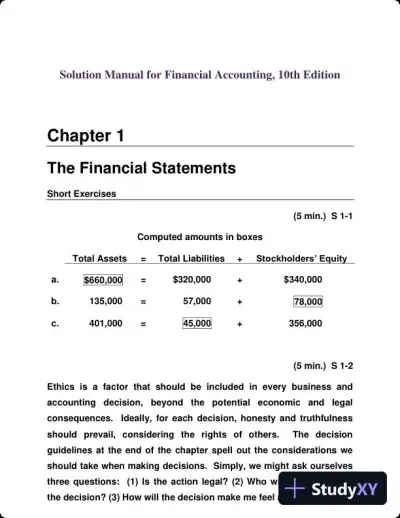 Textbook Guides
Solution Manual for Financial Accounting, 10th Edition
Physics
1061 pages107downloadsFeb 2025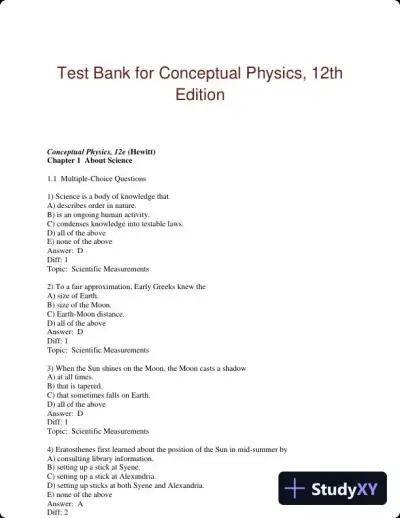 Exam Guides
Test Bank for Conceptual Physics, 12th Edition
Physics
581 pages71downloadsFeb 2025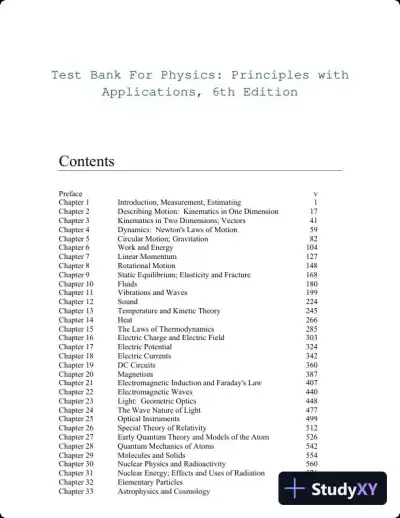 Exam Guides
Test Bank For Physics: Principles with Applications, 6th Edition
Physics
606 pages160downloadsFeb 2025 Textbook Guides
Solution Manual for Modern Physics, 2nd Edition
Physics
187 pages141downloadsFeb 2025 Textbook Guides
Solution Manual for Physics: for Scientists and Engineers with Modern Physics, 3rd Edition
Physics
1291 pages136downloadsFeb 2025 Textbook Guides
Solution Manual for E and M TIPERs Electricity And Magnetism: Electricity And Magnetism Tasks: Inspried By Physics Education Research, 1st Edition
Physics
257 pages118downloadsFeb 2025 Textbook Guides
Solution Manual For College Physics With Masteringphysics, 7th Edition
Physics
536 pages37downloadsFeb 2025 Solved Assignments
Distance Time Velocity Gizmo Handout-2
Physics
7 pagesJun 2025
Study this document with CramX
Once it is in your library, every tool can work from it.