

American Government - Civil Liberties
- Political Science
- Texas A&M University
- 14 pages
- Shared March 2026
Preview 5 of 14 pages
See the first 5 pages exactly as they appear in the document.
Page 1 Read page 1 as text
Study Guide American Government – Civil Liber Ɵ es 1. Perspec Ɵ ve on Civil Liber Ɵ es Many people confuse civil liberties and civil rights , thinking they mean the same thing. But they are different. • Civil liberties are personal freedoms guaranteed to every citizen. They come from the Bill of Rights and the due process clause of the Fourteenth Amendment . These rights include: o Freedom of religion, speech, and the press o Legal protections for people accused of crimes • Over time, civil liberties have expanded to include issues like privacy, abortion, and even the right to die . • Civil rights , on the other hand, protect citizens from discrimination based on race, ethnicity, gender, or disability. These protections come from amendments added after the Bill of Rights. A Simple Way to Remember • Civil liberties = protection from government interference. • Civil rights = protections the government provides to ensure equality, such as: o Voting rights o Equal job opportunities o Equal access to housing and education Sometimes the line between civil liberties and civil rights isn’t clear. Many issues involve both. 1.1 How Civil Liber Ɵ es Developed Our current understanding of civil liberties developed over time , mainly through decisions made by the Supreme Court .
Page 2 Read page 2 as text
Study Guide The Bill of Rights At first, the Bill of Rights was seen as protecting citizens only from the federal government , not the states. • The Founding Fathers wanted to prevent government abuse. For example, the Third Amendment , which bans soldiers from staying in private homes without permission, was very important after the Revolution, even if it seems less relevant today. • In 1798, the Sedition Act made it illegal to say or print anything “false, scandalous, or malicious” about the government. Federalists used this law to jail opponents of President John Adams. Today, this law would be unconstitutional, but the courts at the time supported it. At this point, most states had their own Bills of Rights, but protections were applied inconsistently across the country. 1.2 The Fourteenth Amendment The Fourteenth Amendment (1868) extended civil liberties to citizens at the state level . • Early Supreme Court interpretations were limited . States could not take away fundamental rights without following due process , meaning fair legal procedures. • Over time, some judges pushed to use the Fourteenth Amendment to apply the Bill of Rights to the states . This led to selective incorporation : • Instead of applying all of the first eight amendments at once, the Court applied them one by one as “fundamental freedoms.” • By 1937, most rights in the Bill of Rights were considered applicable to the states . Some rights still have limited or unclear application : • Second Amendment (right to bear arms) – still debated • Third Amendment (quartering soldiers) – mostly obsolete • Seventh Amendment (trial by jury in civil cases) – similar state laws exist • Eighth Amendment (excessive bail, cruel punishment) – also reflected in state laws Even with these exceptions, selective incorporation greatly increased the federal government’s role in protecting individual civil liberties.
Page 3 Read page 3 as text
Study Guide 2. The First Amendment: Freedom of Religion The First Amendment lists some of the most important rights Americans enjoy. These include: • Freedom of religion • Freedom of speech • Freedom of the press • The right to assemble peacefully • The right to petition the government Among these, freedom of religion has often raised challenging questions for the courts. 2.1 Religion and the U.S. Government The framers of the Constitution believed religion should be a matter of personal choice . Unlike some countries, the U.S. does not have an official religion . The First Amendment says: "Congress shall make no law respecting an establishment of religion..." Despite this, questions keep arising, such as: • Should religious organizations get tax exemptions? • Can public schools allow prayer or hold Christmas pageants? These issues have led to complex court decisions. 2.2 “Wall of Separa Ɵ on” vs. Government Accommoda Ɵ on Thomas Jefferson believed in a strict “ wall of separation ” between government and religion. This means government should stay out of religious matters completely. Others argue for government accommodation , which allows some support for religion as long as it is neutral — not favoring one religion or religion in general over non - religion. To find a middle ground, the Supreme Court created the Lemon test in Lemon v. Kurtzman (1971) . According to this test, a law is constitutional if:
Page 4 Read page 4 as text
Study Guide 1. It has a secular (non - religious) purpose 2. It does not advance or inhibit religion 3. It does not excessively entangle government with religion The Lemon test has been applied in many cases, although justices often disagree on how strictly to follow it. In recent years, the Court has leaned toward government accommodation , for example: • Upholding school voucher programs that allow public funds to be used at religious schools 2.3 Free Exercise of Religion The First Amendment also guarantees the free exercise of religion , meaning individuals can practice their own beliefs freely. This creates a tricky balance: • Too much accommodation risks establishing religion • Too strict a separation can limit deeply held religious practices The Supreme Court tries to avoid both extremes. Current rules include: • Laws that target a specific religion (like banning animal sacrifice for one group) are unconstitutional • Neutral laws that serve a general government purpose (like drug laws) cannot be ignored just because of religious beliefs For example, someone cannot use religious beliefs to justify breaking neutral drug laws. In 1993, Congress passed the Religious Freedom Restoration Act , which required the government to accommodate religious practice unless there was a compelling reason not to. It also required the least restrictive action if limitations were necessary. However, the Supreme Court declared this law unconstitutional. 2.4 Ongoing Religious Issues Religious freedom cases continue to be complex. Some examples include: • Religious groups refusing medical treatment or immunizations • Ceremonies involving animal sacrifice or mind - altering drugs • Violations of restrictions on prayer in public schools The Court supports religious freedom , but enforcing a strict “wall of separation” is extremely difficult in practice.
Page 5 Read page 5 as text
Study Guide 3. The First Amendment: Freedom of Speech The First Amendment guarantees Americans the right to freedom of speech , but an important question arises: what counts as “speech”? • Some people separate public or political speech from private speech . Private speech can sometimes be limited to protect the rights of others. • The Supreme Court has protected some types of speech , but not all. • There are two main limits on free speech: it cannot threaten public order and it cannot be obscene . 3.1 Poli Ɵ cal Speech Political speech is at the heart of the First Amendment. The courts have often given it strong protection. • In Schenck v. United States (1919) , Justice Oliver Wendell Holmes said that speech could be limited if it posed a “clear and present danger.” o Example: You cannot shout “Fire!” in a crowded theater when there is no fire. • During the early Cold War, this test was used to restrict the speech of socialists and communists. o The Smith Act (1940) made it a crime to advocate overthrowing the government by force, and the Supreme Court upheld it. • Later, under Chief Justice Earl Warren , the Court strengthened political speech protections: o Speech is protected unless it incites imminent lawless action or is likely to produce such action . 3.2 Public Speech Not all public speech is political, and some statements can be limited. • Fighting words , or speech likely to provoke immediate violence, are not protected . • People have been arrested for speech that could cause a riot or harmful disturbance . • When evaluating laws restricting public speech, the Supreme Court tends to:
9 more pages in the full document
Unlock it once and it stays in your library, ready to chat with or turn into flashcards.
Unlock the full documentMore Political Science study materials
See all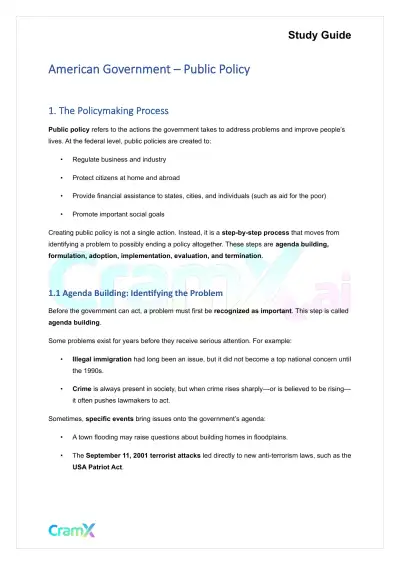 Quick Guides
American Government - Public Policy
Political Science
11 pagesMar 2026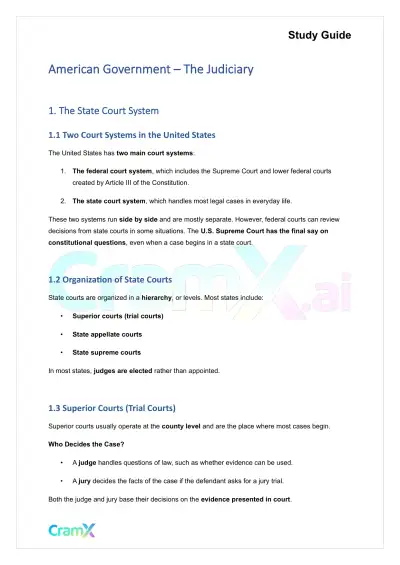 Quick Guides
American Government - The Judiciary
Political Science
16 pagesMar 2026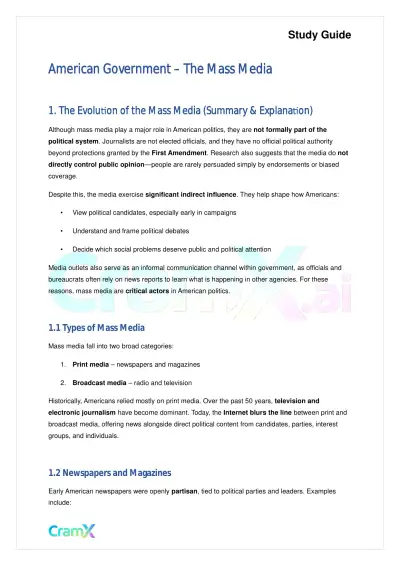 Quick Guides
American Government - The Mass Media
Political Science
11 pagesMar 2026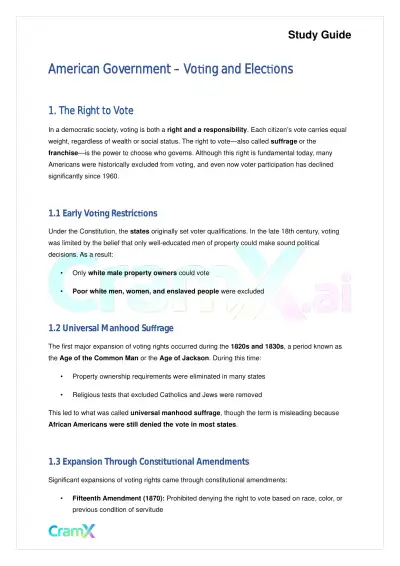 Quick Guides
American Government - Voting and Elections
Political Science
11 pagesMar 2026 Quick Guides
American Government - Economic Policy
Political Science
13 pagesMar 2026 Quick Guides
American Government - Civil Rights
Political Science
18 pagesMar 2026 Quick Guides
American Government - The Bureaucracy
Political Science
11 pagesMar 2026 Quick Guides
American Government - Congress
Political Science
9 pagesMar 2026
Study this document with CramX
Once it is in your library, every tool can work from it.