

The Challenge of Democracy 12th Edition Test Bank
- Political Science
- 818 pages
- Shared May 2025
The Challenge of Democracy 12th Edition Test Bank provides a complete breakdown of important topics, helping you study efficiently and effectively.
Preview 16 of 818 pages
See the first 16 pages exactly as they appear in the document.
Page 1 Read page 1 as text
CHAPTER 1: Freedom, Order, or Equality? Student: ___________________________________________________________________________ 1. Please define the following term. globalization 2. Please define the following term. government 3. Please define the following term. national sovereignty
Page 2 Page 3 Read page 3 as text
4. Please define the following term. order 5. Please define the following term. liberalism 6. Please define the following term. communism
Page 4 Read page 4 as text
7. Please define the following term. public goods 8. Please define the following term. freedom of 9. Please define the following term. freedom from
Page 5 Read page 5 as text
10. Please define the following term. police power 11. Please define the following term. political equality 12. Please define the following term. social equality
Page 6 Read page 6 as text
13. Please define the following term. equality of opportunity 14. Please define the following term. equality of outcome 15. Please define the following term. rights
Page 7 Read page 7 as text
16. Please define the following term. political ideology 17. Please define the following term. totalitarianism 18. Please define the following term. socialism
Page 8 Read page 8 as text
19. Please define the following term. democratic socialism 20. Please define the following term. capitalism 21. Please define the following term. libertarianism
Page 9 Read page 9 as text
22. Please define the following term. libertarians 23. Please define the following term. laissez faire 24. Please define the following term. anarchism
Page 10 Read page 10 as text
25. Please define the following term. conservatives 26. Please define the following term. liberals 27. Please define the following term. communitarians 28. In 2006, __________ became the first state to require its citizens to buy health insurance or face a penalty. A. Texas B. New York C. Massachusetts D. Wisconsin E. California
Page 11 Read page 11 as text
29. In 2010, Congress passed the Affordable Health Care Act that A. required nearly all Americans to buy health coverage or pay a penalty. B. nationalized health care into a government - run model. C. gave uninsured Americans a $10,000 voucher to help purchase private health insurance. D. created a government - funded public health plan to compete with private insurers. E. mandated that no private health plan cost more than $20,000. 30. The broad, basic definition of politics given by the text is A. the restriction of human freedom in the name of national sovereignty. B. the authoritative allocation of values for a society. C. the struggle for economic self - interest. D. rule by the people. E. the manipulation of public opinion by government. 31. When the authors say that we live in an era of “ globalization, ” they mean that citizens and nations are increasingly A. peace loving. B. industrialized. C. commercialized. D. belligerent. E. interdependent. 32. The broad, basic definition of government given by the text is A. the use of force to benefit an elite. B. legitimate use of force within specified geographic boundaries to control human behavior. C. citizens participating in community decisions. D. taking from each according to his or her ability and giving to each according to need. E. leaders controlling power and authority. 33. Globalization can be seen as a threat to A. commercial activity. B. national sovereignty. C. capitalism. D. liberalism. E. socialism.
Page 12 Read page 12 as text
34. When NATO established a no - fly zone over Libya in 2011, Libyan dictator Moammar Gadhafi protested that NATO had violated Libya ’ s A. politics. B. national supremacy. C. self - control. D. domestic rule. E. national sovereignty. 35. As an example of globalization affecting higher education, in 2010 there were over _________ foreign students in American college classrooms. A. 100,000 B. 300,000 C. 700,000 D. one million E. three million 36. The United States now imports more goods from _________ than from France and Britain combined. A. Saudi Arabia B. Russia C. Brazil D. Australia E. China 37. The United States opposed an international court because A. international law is nothing like U.S. law. B. the judges for the court would, in most instances, be very opposed to applying Western values. C. it would be impossible to enforce judgments rendered by the court. D. U.S. soldiers stationed abroad might be arrested and tried in an international court. E. executions in other countries are unconstitutionally cruel and unusual punishment in the United States. 38. The oldest objective of government is A. preserving the state of nature. B. supporting economic growth. C. maintaining order. D. promoting social equality. E. guaranteeing the security of citizens.
Page 13 Read page 13 as text
39. According to Thomas Hobbes, author of Leviathan , the proper objective of government is to ensure A. freedom. B. order. C. a functioning economy. D. public goods. E. free and fair elections. 40. The state of nature refers to A. order without equality. B. regulation without leadership. C. order without conflict. D. government without values. E. society without government. 41. Thomas Hobbes ’ s ideal form of government was A. a representative democracy. B. democratic socialism. C. the absence of any strong central authority. D. a global council of world leaders. E. a single ruler with unquestioned authority. 42. John Locke ’ s views on government are expressed in A. Leviathan. B. The Social Contract. C. Two Treatises on Government. D. Common Sense. E. Utopia. 43. According to John Locke, the fundamental purpose of government is the protection of A. life. B. liberty. C. property. D. Options A, B, and C are true. E. None of the above is true.
Page 14 Read page 14 as text
44. Which political philosopher inspired the phrase “ life, liberty, and the pursuit of happiness ” in the Declaration of Independence? A. Thomas Jefferson B. Adam Smith C. Karl Marx D. Boris Yeltsin E. John Locke 45. In communist political systems, property is A. not a concern of the government. B. in private hands and not actively protected by the state. C. held privately but protected by government authority. D. held by the state in the name of the people. E. subject to government seizure at any time. 46. Two nations with deep ties to the principle of communism that have moved in the direction of more private property are A. Brazil and Argentina. B. Japan and South Korea. C. Germany and France. D. Russia and China. E. South Africa and Ethiopia. 47. Examples of public goods are A. social welfare programs. B. nonprofit organization programs. C. police protection. D. education, sanitation, and parks. E. the armed forces. 48. Services that benefit all citizens and are not likely to be produced by the voluntary acts of individuals are known as A. public goods. B. communism. C. social welfare. D. private benefits. E. volunteered materials.
Page 15 Read page 15 as text
49. Public goods can best be described as benefits and services A. provided by a particular segment of society for its own benefit. B. provided by government to benefit all citizens. C. voluntarily performed by citizens for the benefit of all. D. produced by a free - market economic system. E. created through public taxation. 50. Who said that the ultimate principle of the state should be, “ from each according to his ability, to each according to his needs ” ? A. Thomas Hobbes B. Karl Marx C. John Locke D. Jean Jacques Rousseau E. Milton Friedman 51. During the early nineteenth century administration of James Monroe, Americans disagreed whether it was a proper function of government to A. provide universal health care. B. maintain a navy. C. tax private goods. D. build interstate roads. E. ban abortion. 52. __________ became a major objective of government after industrialization and urbanization. A. Freedom B. Unity C. Order D. Relative disparity E. Equality 53. Of the following major objectives of government, the most recent one is A. providing public goods. B. maintaining order. C. defending order. D. maintaining defense against external enemies. E. promoting equality.
Page 16 Read page 16 as text
54. Government policies aimed at redistributing wealth A. are strongly favored by communists. B. are still considered a radical idea for most governments. C. are associated with the philosopher John Locke. D. are generally applauded by people of all ideological persuasions. E. are generally associated with libertarianism. 55. An example of a government policy that promotes social equality without redistributing income is A. Vermont ’ s civil unions. B. raising the minimum wage. C. redefining the welfare eligibility cut - off income. D. defense spending. E. financial aid determination. 56. The government ’ s role in redistributing income to promote economic equality has been a major source of debate in the United States ever since A. the Constitution. B. the Great Depression. C. the Civil War. D. the 1960s. E. World War I. 57. Franklin Roosevelt ’ s four freedoms included all of the following except A. freedom of speech. B. freedom from fear. C. freedom from inequality. D. freedom of religion. E. freedom from want. 58. According to the text, the concept of order encompasses A. preserving life. B. protecting property. C. maintaining patterns of social relationships. D. Options A, B, and C are true. E. None of the above is true.
802 more pages in the full document
Unlock it once and it stays in your library, ready to chat with or turn into flashcards.
Unlock the full documentMore Political Science study materials
See all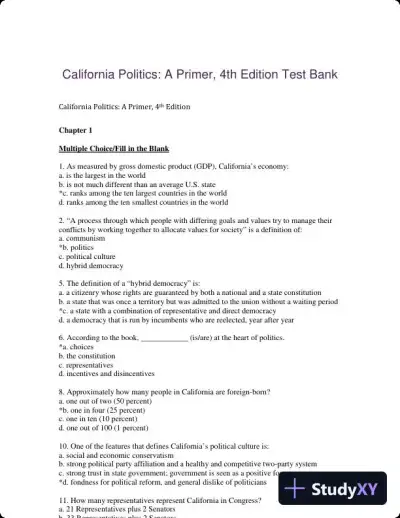 Exam Guides
California Politics: A Primer, 4th Edition Test Bank
Political Science
118 pages147downloadsFeb 2025 Exam Guides
Test Bank for Political Science: An Introduction, 14th Edition
Political Science
389 pages136downloadsFeb 2025 Exam Guides
Test Bank for Revel for Political Science: An Introduction , 14th Edition
Political Science
389 pages132downloadsFeb 2025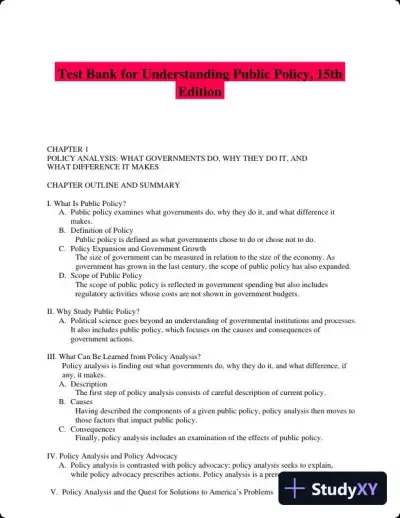 Exam Guides
Test Bank for Understanding Public Policy, 15th Edition
Political Science
233 pages47downloadsFeb 2025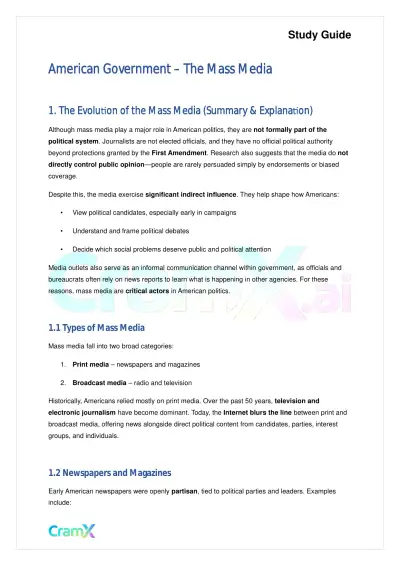 Quick Guides
American Government - The Mass Media
Political Science
11 pagesMar 2026 Solved Assignments
International Insecurity and the Use of Force in Darfur
Political Science
9 pagesMay 2025 Solved Assignments
Pieces of Legislation: Key Legislation Shaping the Union-Management Relationship
Political Science
8 pagesMay 2025 Solved Assignments
PAD-510 Position Paper Strayer University
Political Science
8 pagesMay 2025
Study this document with CramX
Once it is in your library, every tool can work from it.