

PHR and SPHR Professional in Human Resources Certification Complete Study Guide (2019)
- Senior Professional in Human Resources
- 860 pages
- Shared February 2025
- 45 downloads
PHR and SPHR Professional in Human Resources Certification Complete Study Guide (2019) is your shortcut to certification success—start preparing today!
Preview 31 of 860 pages
See the first 31 pages exactly as they appear in the document.
Page 1 Page 2 Page 3 Read page 3 as text
Table of Contents Title Page Copyright Publisher's Note Dedication Acknowledgments About the Authors About the Technical Editors Introduction About Human Resource Certification Why Become Certified? How This Book Is Organized How to Use This Book and the Additional Study Tools Assessment Test Answers to Assessment Test Chapter 1: Certifying Human Resource Professionals The Human Resource Profession Development of the Human Resource Body of Knowledge The Test
Page 4 Read page 4 as text
Summary Chapter 2: Core Knowledge Requirements for HR Professionals Needs Assessment and Analysis Third-Party Contract Management Communication Skills and Strategies Documentation Requirements Adult Learning Processes and Learning Styles Motivation Concepts Leadership Concepts Project Management Concepts Diversity Concepts Human Relations Concepts HR Ethics and Professional Standards Human Resource Technology Qualitative and Quantitative Analysis Change Management Job Analysis and Description Employee Records Management Interrelationships Among HR Activities Organizational Structures Environmental Scanning Concepts Employee Attitude Assessment Basic Budgeting and Accounting Risk Management Summary Exam Essentials Review Questions
Page 5 Read page 5 as text
Chapter 3: Business Management and Strategy Organizations Strategy Strategic Management Legislative and Regulatory Processes Corporate Governance HR Metrics: Measuring Results Global Considerations Summary Exam Essentials Review Questions Chapter 4: Workforce Planning and Employment Federal Employment Legislation Strategic Workforce Planning Staffing Programs Organization Exit/Off-Boarding Processes Metrics: Measuring Results Global Considerations Summary Exam Essentials Review Questions Chapter 5: Human Resource Development Federal Employment Legislation Organization Development Talent Management Performance-Management Programs Performance Appraisal
Page 6 Read page 6 as text
Unique Employee Needs Metrics: Measuring Results Global Considerations Summary Exam Essentials Review Questions Chapter 6: Compensation and Benefits Total Rewards Defined Compensation Benefits Payroll Communicating Compensation and Benefits Programs Executive Compensation Metrics: Measuring Results Global Considerations Summary Exam Essentials Review Questions Chapter 7: Employee and Labor Relations Federal Employment Legislation Employee Relations Dispute Resolution Labor Relations Union Organization Union Avoidance Strategies Metrics: Measuring Results Global Considerations
Page 7 Read page 7 as text
Summary Exam Essentials Review Questions Chapter 8: Risk Management Risk Identification Risk Assessment Risk Management Metrics: Measuring Results Global Considerations Summary Exam Essentials Review Questions Appendix A: Answers to Review Questions Chapter 2: Core Knowledge Requirements for HR Professionals Chapter 3: Business Management and Strategy Chapter 4: Workforce Planning and Employment Chapter 5: Human Resource Development Chapter 6: Compensation and Benefits Chapter 7: Employee and Labor Relations Chapter 8: Risk Management Appendix B: Case Study: Where the Green Glass Grows The Company The Customer Exercises
Page 8 Read page 8 as text
Answer Key and Additional Exercise Appendix C: Federal Employment Legislation and Case Law Legislation and Case Law Summary Additional Cases Appendix D: Resources Business Management and Strategy Workforce Planning and Employment Human Resource Development Compensation and Benefits Employee and Labor Relations Risk Management Appendix E: About the Additional Study Tools Additional Study Tools System Requirements Using the Study Tools Troubleshooting Index About the Additional Study Tools Exam Objectives Map Wiley End User License Agreement
Page 9 Page 10 Read page 10 as text
Senior Acquisitions Editor: Jeff Kellum Development Editor: Kim Wimpsett Technical Editors: Brenda Budke and Tamra Aguinaldo Production Editor: Christine O'Connor Copy Editor: Tiffany Taylor Editorial Manager: Pete Gaughan Production Manager: Tim Tate Vice President and Executive Group Publisher: Richard Swadley Vice President and Publisher: Neil Edde Media Project Manager 1: Laura Moss-Hollister Media Associate Producer: Shawn Patrick Media Quality Assurance: Marilyn Hummel Book Designers: Judy Fung and Bill Gibson Proofreader: Josh Chase, Word One New York Indexer: Robert Swanson Project Coordinator, Cover: Katherine Crocker Cover Designer: Ryan Sneed Copyright © 2012 by John Wiley & Sons, Inc., Indianapolis, Indiana Published simultaneously in Canada ISBN: 978-1-118-28917-4 ISBN: 978-1-118-42430-8 (ebk.) ISBN: 978-1-118-33169-9 (ebk.) ISBN: 978-1-118-33501-7 (ebk.) No part of this publication may be reproduced, stored in a retrieval system or transmitted in any form or by any means, electronic, mechanical, photocopying, recording, scanning or otherwise, except as permitted under Sections 107 or 108 of the 1976 United States Copyright Act, without either the prior written permission of the Publisher, or authorization through
Page 11 Read page 11 as text
payment of the appropriate per-copy fee to the Copyright Clearance Center, 222 Rosewood Drive, Danvers, MA 01923, (978) 750-8400, fax (978) 646- 8600. Requests to the Publisher for permission should be addressed to the Permissions Department, John Wiley & Sons, Inc., 111 River Street, Hoboken, NJ 07030, (201) 748-6011, fax (201) 748-6008, or online at http://www.wiley.com/go/permissions. Limit of Liability/Disclaimer of Warranty: The publisher and the author make no representations or warranties with respect to the accuracy or completeness of the contents of this work and specifically disclaim all warranties, including without limitation warranties of fitness for a particular purpose. No warranty may be created or extended by sales or promotional materials. The advice and strategies contained herein may not be suitable for every situation. This work is sold with the understanding that the publisher is not engaged in rendering legal, accounting, or other professional services. If professional assistance is required, the services of a competent professional person should be sought. Neither the publisher nor the author shall be liable for damages arising herefrom. The fact that an organization or Web site is referred to in this work as a citation and/or a potential source of further information does not mean that the author or the publisher endorses the information the organization or Web site may provide or recommendations it may make. Further, readers should be aware that Internet Web sites listed in this work may have changed or disappeared between when this work was written and when it is read. For general information on our other products and services or to obtain technical support, please contact our Customer Care Department within the U.S. at (877) 762-2974, outside the U.S. at (317) 572-3993 or fax (317) 572- 4002. Wiley publishes in a variety of print and electronic formats and by print-on- demand. Some material included with standard print versions of this book may not be included in e-books or in print-on-demand. If this book refers to media such as a CD or DVD that is not included in the version you purchased, you may download this material at http://booksupport.wiley.com. For more information about Wiley products, visit www.wiley.com. Library of Congress Control Number: 2012935365 TRADEMARKS: Wiley, the Wiley logo, and the Sybex logo are trademarks
Page 12 Read page 12 as text
or registered trademarks of John Wiley & Sons, Inc. and/or its affiliates, in the United States and other countries, and may not be used without written permission. PHR and SPHR are registered trademarks of Human Resource Certification Institute. All other trademarks are the property of their respective owners. John Wiley & Sons, Inc. is not associated with any product or vendor mentioned in this book.
Page 13 Read page 13 as text
Dear Reader, Thank you for choosing PHR/SPHR: Professional in Human Resources Certification Study Guide , Fourth Edition . This book is part of a family of premium-quality Sybex books, all of which are written by outstanding authors who combine practical experience with a gift for teaching. Sybex was founded in 1976. More than 30 years later, we're still committed to producing consistently exceptional books. With each of our titles, we're working hard to set a new standard for the industry. From the paper we print on, to the authors we work with, our goal is to bring you the best books available. I hope you see all that refl ected in these pages. I'd be very interested to hear your comments and get your feedback on how we're doing. Feel free to let me know what you think about this or any other Sybex book by sending me an email at nedde@wiley.com. If you think you've found a technical error in this book, please visit http://sybex.custhelp.com. Customer feedback is critical to our efforts at Sybex.
Page 14 Read page 14 as text
To my husband Chris, whose three little words never fail to inspire me: “Go for it.” To my children, Calvin and Clara, because the best part of me will eternally be each of you. I am filled with love and gratitude for having the three of you in my life.
Page 15 Read page 15 as text
Acknowledgments Any acknowledgement in the updating of this book must begin by recognizing the professionalism and intellect of Anne Bogardus. Her thoroughness and attention to detail represented in the previous editions of this work made writing these updates an absolute career highlight. To the editors Jeff Kellum, Kim Wimpsett, Pete Gaughan, Brenda Budke, Christine O'Connor and Tim Tate, thank you for your professionalism, encouragement, superior organizational skills and insightful additions to the expanded version of this work — it absolutely made for a better final product. A book like this requires a great deal of time and thought, and nobody felt that more than my clients, co-workers, and support staff who watched me attempt to juggle it all. To TAGS, VWC, and my clients at SBDC, thank you for allowing me a peek into your business, for letting me rattle your cage with strategic “leaps,” for picking up the slack when I went underground, and for supporting my crazy schedule—I quite literally could not have done it without you. Finally, to the students, a brief mention of my own testing experience: I remember sitting in my hotel room the night before my SPHR exam, trying to cram in a few more details, desperate to figure out what I didn't already know. It was around Christmas time, and my youngest child was just 2 years old. Feeling guilty for being away from my family and with my confidence at an all-time low, I wondered if I was really up for the challenge. Then, surrounded by my books and flashcards, I suddenly “got” it. The pieces starting fitting together, the processes had rationale, and the big picture came into clear focus. The next morning, I took a 4-hour exam in just 2 hours and passed it on the first go-round. My excitement about being a part of this project is a reflection of that one “a-ha” moment, representing for me when HR crosses over from just being a job to an intelligent, strategic career choice. My hope is that with each pass through this material, you will get closer to your own enlightened moment when suddenly, you just get it. Many thanks, and good luck in your career—this absolutely can happen for you!
Page 16 Read page 16 as text
About the Authors Sandra M. Reed , SPHR, has more than 17 years of experience in human resources, the last ten of which have been spent in training and instruction. Prior to teaching, she spent much of her work career in the recruiting and risk-management functions of human resources, which evolved into a passion for training through on-boarding and OSHA compliance activities. She obtained her PHR and her SPHR designations through the Human Resource Certification Institute and received her teaching credential in adult vocational education from California State University, San Bernardino. As an independent contractor, she has conducted onsite training for California State University Stanislaus, University of the Pacific, the Small Business Development Center of Stanislaus County, and private employers throughout Northern California. She has authored learning modules and case studies for the Society for Human Resource Management, focusing on educating the emerging workforce and future human resource professionals. She currently is owner of Epoch Resources, a consulting firm located in the Central Valley of California that specializes in the unique HR needs of small businesses. Find her on the Web at http://epochresources.com. Anne M. Bogardus , SPHR, began her human resources career in compensation at a public multinational corporation, Castle & Cooke, owner of the Dole food brand, and later at First Nationwide Bank. She also founded and was principal of S.T.A.R. HR in northern California, which specialized in building human resource functions that serve strategic business needs. Her practice included small to medium-sized businesses in a wide range of industries including biotechnology, mortgage lending, high technology, public relations, retail, nonprofit, and construction. Ms. Bogardus is also the author of an introductory book for non-HR business professionals, Human Resource Jumpstart , as well as the previous three editions of this book, all published by John Wiley & Sons, Inc. About the Technical Editors
Page 17 Read page 17 as text
Brenda G. Budke is the executive director for Sierra HR Partners, Inc., an HR consulting and outsourcing service located in Fresno, California. She is a certified SPHR with over 20 years experience in the human resource field. Prior to joining Sierra HR Partners, Brenda served as the human resources manager for a national communications company, overseeing employment, employee relations, and training. She is founder and dean of a corporate university and has developed curriculum and presented performance-based training at all levels. Ms. Budke holds a Bachelor of Science degree in organizational behavior with a concentration in Human Resource Management from the University of San Francisco. She currently serves on the board of the Central California Employment Round Table (CCERT), working in conjunction with DFEH to prevent harassment and discrimination in the workplace; she is a member of the Society of Human Resource Management (SHRM) and past-president of the Human Resource Association of Central California (HRACC). Most recently she served as deputy director for the California State Council for SHRM. Tamra Aguinaldo has a background in human resources and education and currently works as an HR consultant in Northern California. She has a Master of Arts degree in Education with an emphasis in Guidance Counseling. Prior to becoming a consultant, she was Director of Professional Development for the Northern California Human Resources Association in San Francisco. HR is a dynamic profession requiring practitioners to keep up-to-date with current trends and changes to employment law. The PHR/SPHR exams are updated annually to reflect these trends and changes. For information about updates between revisions of this study guide, log on to http://epochresources.com, and click PHR/SPHR Certification to view changes or ask questions about content.
Page 18 Read page 18 as text
Introduction Congratulations on taking the first step toward achieving your Professional in Human Resources (PHR) or Senior Professional in Human Resources (SPHR) certification! The process you're embarking on is rewarding and challenging, and as more than 100,000 of your fellow human resource colleagues have already discovered, it's an excellent opportunity to explore areas of HR management with which you may not work every day. In the next few pages, you'll find some general information about HR certification, some suggestions for using this book, information about what to expect in the following chapters, and a discussion of the organizations involved in certification. Before we begin, a word about what you should already know. This study guide was designed to serve as a refresher for experienced professionals who have practiced for several years or have been educated in human resources. We assume that those who are pursuing certification have the basic HR knowledge that comes not only from education in human resources but also, more importantly, from exempt-level experience. If your daily work is truly generalist in nature, you likely have touched on many of the topics I cover, but you may not have in-depth knowledge in all of them. Conversely, if you specialize in one or two areas of HR, you probably have extensive experience in those areas but may need to refresh your knowledge in other areas. The goal of this study guide is to provide enough information about each of the functional areas of HR management to enable candidates in either situation to find what they need to prepare themselves for successfully completing the exam. More than 22,000 books related to human resources are listed on Amazon.com alone, and there is obviously no way we can cover all the aspects of HR in a single book. So, we've organized the information around the test specifications (test specs) established by the Human Resource Certification Institute (HRCI), the certifying body for our profession. We'll talk more about the test specs in Chapter 1, “Certifying Human Resource Professionals,” but for now, suffice it to say that the key to success on the exam is a thorough understanding of and ability to apply the test specs when
Page 19 Read page 19 as text
answering questions on the exams. About Human Resource Certification What exactly is human resource certification? Briefly, let's just say that certification is a way of acknowledging individuals who have met the standard of competency established by HR practitioners as that which is necessary to be considered a fully competent HR professional. To understand whether this book is for you, you'll want to know why you should become certified and how the certification process works. Who Certifies HR Professionals? Three organizations are involved in the certification of HR professionals: the Human Resource Certification Institute (HRCI), the Society for Human Resource Management (SHRM), and the Professional Examination Service (PES). The Human Resource Certification Institute HRCI is the certifying body for the HR profession. It was formed by the American Society of Personnel Administrators (ASPA) in 1972, when it was known as the ASPA Accreditation Institute (AAI). In its early stages, HRCI was financially dependent on SHRM, but it's now financially independent. Both HRCI and SHRM have individual boards of directors that govern their operations. Although HRCI and SHRM have a long history of affiliation and mutual support, the certification process is a separate and distinct function of HRCI, and SHRM has no more control over or access to the certification process than does anyone else in the profession. You can find HRCI's organizational mission statement at www.hrci.org/Page.aspx? id=31&terms=mission.
Page 20 Read page 20 as text
The Society for Human Resource Management SHRM is the largest organization of HR professionals in the world, representing more than 250,000 members worldwide, with more than 900 affiliated professional and student chapters. From its beginning in 1948 as the American Society for Personnel Administrators (ASPA), SHRM has been a leader in the endeavor to gain recognition for the HR profession. Today's certification program is a direct result of efforts by the first volunteer members of SHRM, who recognized the need for a defined body of knowledge and set about to develop it along with a certification process that evaluates the abilities of practitioners in the field. Professional Examination Service PES is a nonprofit organization that conducts license and credential examinations for a wide variety of professions, including psychology, pharmacy, real-estate appraisal, security management, as well as human resources. PES maintains the database of test items developed by HRCI and is responsible for ensuring that applicants for the PHR and SPHR exams meet the eligibility requirements, administering and scoring the tests, and notifying candidates of the results. PES conducts a practice analysis study to ensure the continued relevance of the credentialing process to current business practice. We'll refer to these organizations frequently in Chapter 1 as we discuss the body of knowledge and the certification process. Why Become Certified? Over time, the certification offered by HRCI has become the industry standard for determining competence in the field of human resources. There are many reasons that individuals may decide to seek professional certification. Let's talk about just a few of them. First, certification is an acknowledgement that you have met the standards of excellence determined by other HR professionals to be those that are necessary to be fully competent in the field. Because the standards are developed by working professionals, not just by those who teach and consult in the field, this credential demonstrates that you're a fully competent HR
Page 21 Read page 21 as text
practitioner based on a standard set by your peers. Second, certification is a way to increase your marketability. In difficult economic times, when there is tough competition for jobs, certification provides an edge that can be advantageous in your job search. With an abundance of job seekers for a limited number of jobs, whatever you can do to set yourself apart from the crowd can give you the edge when potential employers are making the final hiring decision. Third, those who spend the time to advance their own knowledge and achieve certification have demonstrated their ability to continue learning and growing as times and business needs change. A person who is willing and able to set a significant goal and do what is necessary to achieve it demonstrates characteristics that are in great demand in business today: results orientation, technical competence, commitment, and excellence. Finally, certification enhances your credibility with co-workers and customers by demonstrating to the people you encounter during your workday that you have proven competence in the field. Whether your reason for seeking certification falls into one of these categories or you're motivated to do so for some other reason, it can be a great opportunity to validate how much you already know about the practice of human resources as a profession. How to Become Certified To become a certified HR professional, you must pass either the PHR or SPHR exam, both of which have been developed by HRCI in a comprehensive process described in Chapter 1. HRCI uses a computer-based testing (CBT) process during two time periods each year: between the beginning of May and the end of June, and from mid-November through mid-January. One advantage of the CBT process is that exam candidates know before they leave the testing center whether they are certified. Each exam, PHR and SPHR, consists of 225 questions. Of these questions, 200 are scored to determine whether you pass the exam. The additional 25 questions are being “pretested” in order to determine their reliability and validity for inclusion in future test cycles. You can find a detailed discussion
Page 22 Read page 22 as text
of how the questions are developed and scored in the HR Certification Institute's 2012 Certification Policies and Procedures Handbook , which can be viewed and/or downloaded at the HRCI website (www.hrci.org), or you can request a hard copy from HRCI by calling (866) 898-4724. The handbook is an essential guide to all aspects of the exams and includes test dates, application deadlines, fee information, and answers to frequently asked questions about the certification process, as well as the full list of test specifications. Chapter 1 explains in greater detail how much and what kinds of experience are required for each exam level and how the questions differ on each level.
Page 23 Read page 23 as text
How This Book Is Organized We've talked a little about Chapter 1, which provides information about requirements for certification and the testing process. Chapter 1 also provides some suggestions on the best ways to study for the exam. Chapter 2, “Core Knowledge Requirements for HR Professionals,” provides a brief discussion of knowledge with implications in multiple functional areas. Reading this chapter first gives exam candidates a base for understanding topics covered in subsequent chapters. Chapters 3.1–8.1 get down to the specifics of each functional area and discuss the test specifications in detail. Each of these chapters consists of a list of objectives, an overview of the functional area, the federal employment laws applicable to that area, and a discussion of the test specs, including the appropriate court cases. We have also provided five appendices to facilitate your study. Appendix A, “Answers to Review Questions,” provides all of the answers to the questions at the end of every chapter. Appendix B, “Case Study,” gives you an opportunity to pull information from multiple functional areas to solve typical HR challenges in a fictitious company. Appendix C, “Federal Employment Legislation and Case Law,” is a chronological listing of the federal legislation appearing throughout the book, as well as significant court decisions with implications for human resources. This appendix also includes additional court decisions that were not discussed in the chapters but have significance for HR practice and with which you should be familiar, so be sure to review them. They are included in a separate section of the appendix. Appendix D, “Resources,” is just that: a list of additional sources of information about each of the functional areas of human resources. Appendix E, “About the Additional Study Tools,” provides a listing of all the material you can find on the book's companion web site. Finally, we've included some additional study tools including the Sybex test engine, electronic flashcards, and a PDF of a glossary of terms: an
Page 24 Read page 24 as text
alphabetical listing of all the key terms throughout the book with their corresponding definitions. For up-to-the-minute updates please see www.epochresources.com; and for directions on where to get the study tools, visit www.sybex.com/go/phr4e. The Elements of a Study Guide You'll see many recurring elements as you read this study guide. Here's a description of some of those elements: Assessment Test At the end of this introduction is an assessment test that you can use to check your readiness for the exam. Take this test before you start reading the book; it will help you determine the areas on which you may need to brush up. The answers to the assessment test questions appear on a separate page after the last question of the test. Each answer includes an explanation and a note telling you the chapter in which the material appears. Objective Map and Opening List of Objectives On the inside front cover of this book is a detailed exam-objective map showing you where each of the exam objectives is covered in this book. In addition, each chapter opens with a list of exam objectives that are covered in that chapter. Use these to see exactly where each of the exam topics is covered. Summary The summary is a brief review of the chapter to sum up what was covered. Exam Essentials The “Exam Essentials” section at the end of each chapter highlights topics that could appear on one or both of the exams in some form. Although we obviously don't know exactly what will be included in a particular exam, these sections reinforce significant concepts that are key to understanding the functional area and the test specs HRCI has
Page 25 Read page 25 as text
developed. Chapter Review Questions Each chapter includes 20 practice questions designed to measure your knowledge of key ideas discussed in the chapter. After you finish each chapter, answer the questions; if some of your answers are incorrect, it's an indication that you need to spend more time studying that topic. The answers to the practice questions can be found in Appendix A. The chapter-review questions are designed to help you measure how much information you retained from your reading and are different from the kinds of questions you'll see on the exam. The assessment test and chapter-review questions can also be taken via the Sybex test engine. The next section tells you where to get the additional study tools, including the test engine. Additional Study Tools We've included a number of additional study tools that can be found on the book's companion site at www.sybex.com/go/phr4e. All of the following gear should be loaded on your computer when you're studying for the test. The Sybex Test Preparation Software The test-preparation software helps prepare you to pass the PHR/SPHR exams. In this test engine, you'll find all the chapter-review and assessment questions from the book, plus two additional bonus practice exams that appear exclusively on the test engine: one specifically for PHR candidates and one for SPHR candidates. You can take the assessment test, test yourself by chapter, or take the bonus practice exams. Just as on the certification exams, the practice exam questions draw on your experience as an HR professional. Be on the lookout for questions based on your everyday activities in HR and not just on the material in the PHR/SPHR Study Guide .
Page 26 Read page 26 as text
Electronic Flashcards Sybex's electronic flashcards include more than 200 PHR questions and more than 200 SPHR questions designed to challenge you further for the PHR and SPHR exams. Between the review questions, practice exams, and flashcards, you'll have a wide variety of materials to help you prepare! Glossary of Terms in PDF Sybex offers an exclusive glossary of terms in PDF format as part of the additional study tools. Now you can review key terms on your computer or e- reader if you travel and don't want to carry a book or if you just like to read from the computer screen. You can get the additional study tools by visiting www.sybex.com/go/phr4e. Here, you'll get instructions on how to download the files to your hard drive.
Page 27 Read page 27 as text
How to Use This Book and the Additional Study Tools This book has a number of features designed to guide your study efforts for either the PHR or the SPHR certification exam. All of these features are intended to assist you in doing the most important thing you can do to pass the exam: understand and apply the test specs in answering questions. This book helps you do that by listing the current test specs at the beginning of each chapter and by ensuring that each of them is fully discussed in the chapter. The practice questions at the end of each chapter and the practice exams included with the study tools (which can be found on the companion site at www.sybex.com/go/phr4e) are designed to assist you in testing your retention of the material you've read to make you aware of areas on which you should spend additional study time. We've provided web links and other resources to assist you in mastering areas where you may require additional study materials. Here are some suggestions for using this book and study tools: Take the assessment test before you start reading the material. These questions are designed to measure your knowledge and will look different from the questions you'll see on the exam. They will give you an idea of the areas on which you need to spend additional study time, as well as those areas for which you may just need a brief refresher. Review the test specs at the beginning of each chapter before you start reading. Make sure you read the associated knowledge requirements in the HR Certification Institute's 2012 Certification Policies and Procedures Handbook because these may help you in your study process. After you've read the chapter, review the requirements again to be sure you understand and are able to apply them. Answer the review questions after you've read each chapter. If you miss any of them, go back over the chapter and review the topic, or use one of the additional resources if you need more information. Make sure you understand the laws that apply to each functional area, the information covered in each of them, and to which companies or
Page 28 Read page 28 as text
government agencies they apply. Download the flashcards, and review them when you have a few minutes during the day. Take every opportunity to test yourself. In addition to the assessment test and review questions, there are bonus practice exams. Take these exams without referring to the chapters, and see how well you've done—go back and review any topics you've missed until you fully understand and can apply the concepts. Finally, find a study partner if possible. Studying for, and taking, the exam with someone else will make the process more enjoyable, and you'll have someone to help you understand topics that are difficult for you. You'll also be able to reinforce your own knowledge by helping your study partner in areas where they are weak.
Page 29 Read page 29 as text
Assessment Test 1 . According to the WARN Act, an employer with 200 employees is required to provide 60 days' notice of a mass layoff when which of the following is true? A . The employer is seeking additional funding and will lay off 70 employees if the funding falls through. B . A major client unexpectedly selects a new vendor for the company's products, and the company lays off 75 employees. C . The employer lays off 5 employees a week for 3 months. D . A flood requires that one of the plants be shut down for repairs, and 55 employees are laid off. 2 . An employee has come forward with an allegation of quid pro quo harassment by her supervisor. As the HR manager, you are responsible for investigating the complaint. The supervisor in question is someone with whom you have become quite friendly. In this case, who is the best person to conduct the investigation? A . You B . The corporate attorney C . The direct manager of the accused supervisor D . A third-party investigator 3 . As of July 24, 2009, the federal minimum wage is set at which of the following? A . $5.15 per hour B . $7.25 per hour C . $5.75 per hour D . $6.55 per hour 4 . During the union-organizing process, how is the bargaining unit determined? A . By the union organizers B . Jointly, by the union and the employer
Page 30 Read page 30 as text
C . By the National Labor Relations Board D . By the employees during the election 5 . The motivation theory that suggests people are motivated by the reward they will receive when they succeed and that they weigh the value of the expected reward against the effort required to achieve it is known as what? A . Vroom's expectancy theory B . Adams' equity theory C . McClelland's acquired needs theory D . McGregor's Theory X and Theory Y 6 . What is the most effective method of performance evaluation? A . A field-review process B . A continuous-feedback process C . A forced-ranking process D . A behaviorally anchored rating-scale process 7 . Which of the following is an example of a nonqualified deferred- compensation plan? A . An excess-deferral plan B . A target-benefit plan C . A money-purchase plan D . A cash-balance plan 8 . Which of the following is an example of a passive training method? A . Vestibule training B . Demonstration C . Distance learning D . Self-study 9 . What is the purpose of the OSHA consulting service? A . Helps employers identify the OSHA standards that apply to their workplace B . Fines employers for violating OSHA safety standards C . Does not require compliance with OSHA standards D . Acts as a one-time service 10 . One purpose of a diversity initiative is to do what?
Page 31 Read page 31 as text
A . Increase workplace creativity B . Increase the effectiveness of the workforce C . Increase the organization's ability to attract customers D . All of the above 11 . What is an employer's responsibility when workplace conditions pose a threat to an unborn child? A . Do nothing. It is up to employees to protect their unborn children. B . Move the employee into a different job that does not pose a threat to the unborn child. C . Advise the employee of the potential threat, and allow the employee to make the decision. D . Allow only sterile employees to work in jobs that pose a threat to unborn children. 12 . What does the Health Insurance Portability and Accountability Act do? A . Prevents HR from investigating claims issues B . Requires continuation of health benefits C . Establishes EPO networks D . Limits preexisting condition restrictions 13 . The concept that recognizes that businesses are social organizations as well as economic systems and that productivity is related to employee job satisfaction is known as what? A . Human resource management B . Strategic management C . Human relations D . Human resource development 14 . Before selecting an HRIS system, which of the following questions should be answered? A . What information will be converted to the HRIS? B . Who will have access to the information stored in the HRIS? C . How will the HRIS be accessed? D . All of the above. 15 . The correlation coefficient is a statistical measurement that is useful for which of the following?
829 more pages in the full document
Unlock it once and it stays in your library, ready to chat with or turn into flashcards.
Unlock the full documentMore Senior Professional in Human Resources study materials
See all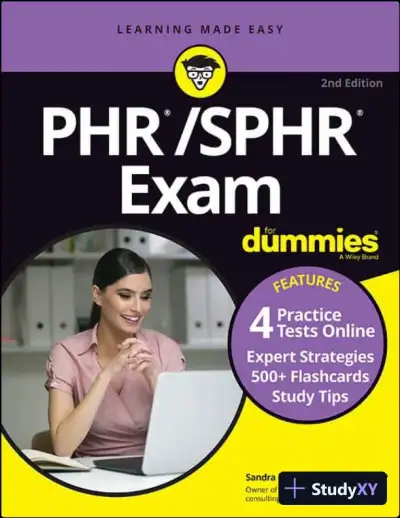 Certification Guides
PHR/SPHR Exam For Dummies with Online Practice, 2nd Edition (2021)
Senior Professional in Human Resources
638 pages173downloadsFeb 2025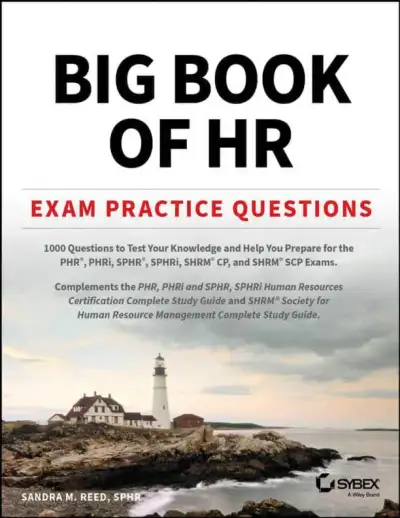 Certification Guides
Big Book of HR Exam Practice Questions: 1000 Questions PHR, PHRi, SPHR, SPHRi and SHRM CP/SCP Certification Exams (2024)
Senior Professional in Human Resources
1003 pagesMay 2025
Study this document with CramX
Once it is in your library, every tool can work from it.