

Canadian Income Taxation : Planning And Decision Making, 2013-2014 Edition Test Bank
- Taxation
- 175 pages
- Shared May 2025
Maximize your score with Canadian Income Taxation : Planning And Decision Making, 2013-2014 Edition Test Bank, offering structured content, solved examples, and test-taking tips.
Preview 16 of 175 pages
See the first 16 pages exactly as they appear in the document.
Page 1 Read page 1 as text
Canadian Income Taxation: Planning and Decision Making- 2013-2014 Edition Chapter One Multiple Choice 1. Which of the following entities is not taxed directly on its income? A) Individuals B) Proprietorships C) Corporations D) Trusts Ans: B Difficulty: Knowledge recall Page Ref: 5 2. Which of the following attitudes and actions will help decision-makers develop an efficient approach to taxation? A) Cash flows should be considered from a before-tax perspective when making decisions. B) Functional managers should not be held responsible for the tax effects of decisions within their divisions. C) Tax costs to a business should be regarded as controllable expenses, much like product costs and selling costs. D) All managers should own a copy of the Income Tax Act. Ans: C Difficulty: Comprehension Page Ref: 3 3. Which of the following statements is true? A) Payment of the return on equity is deductible by the corporation and is a form of property income for the individual. B) Payment of the return on equity is deductible by the corporation and is a form of business income for the individual. C) Payment of the return on equity is not deductible by the corporation and is a form of business income for the individual. D) Payment of the return on equity is not deductible by the corporation and is a form of property income for the individual. Ans: D Difficulty: Knowledge Page Ref: 5 4. When assessing the value of a corporation, the most relevant information that decision-makers normally consider is A) the potential for before-tax profits.
Page 2 Page 3 Read page 3 as text
B) the potential for after-tax profits. C) the current rate of corporate tax. D) cash flow before-tax. Ans: B Difficulty: Comprehension Page Ref: 4 5. Income tax is calculated for which of the following jurisdictional groups? A) Municipal, provincial, and federal B) Municipal, federal, and international C) Provincial, federal, and international D) Municipal, provincial, and international Ans: C Difficulty: Comprehension Page Ref: 5 6. Two investor corporations may not enter jointly into which of the following? A) Joint venture B) Partnership C) Separate corporation D) Proprietorship Ans: D Difficulty: Knowledge Page Ref: 5 7. Which of the following statements is false? A) Cash flow should be calculated on an after-tax basis. B) The tax cost to a business should not be regarded as a cost of doing business. C) Income tax should be considered a controllable cost. D) The value of an enterprise should not be based on pre-tax cash flow. Ans: B Difficulty: Knowledge and Comprehension Page Ref: 2 Problems 8. The text book lists four fundamental tax variables that a manager needs to consider when making business decisions. These variables are: 1) primary types of income; 2) entities subject to taxation on income; 3) alternative forms of business and investing structures used by taxable entities structure; and 4) tax jurisdictions. List the relevant variables within these four categories.
Page 4 Read page 4 as text
Ans: Income: Business, Property, Employment, Capital Gains Entities: Individuals, Corporations, Trusts Forms of business: Proprietorship, Corporation, Partnership, Limited Partnership, Joint Venture, Income Trusts Tax Jurisdictions: Provincial, Federal, Foreign Difficulty: Knowledge Page Ref: 5 9. ABC Corporation is in a 25% income tax bracket. John Adams is an employee at ABC. He is in a 40% tax bracket. The company has offered John a 10% pay raise. His current salary is $50,000. Required: A) Calculate the actual cost (after-tax) of the raise to the corporation. B) Calculate the actual value (after-tax) of the raise for John. Show all calculations. Ans: A) Actual cost to ABC: ($50,000 x 10%) x (1 - .25) = $3,750 B) Actual value for John: ($50,000 x 10%) x (1 - .4) = $3,000 Difficulty: Application, Comprehension Page: 4 10. Explain what is meant by the principle that tax should be treated as a ‘controllable cost’. Ans: Just as decision makers in business must control costs such as product, occupancy, selling, and many others, so should tax costs be regarded as controllable. The actions and activities of the organization must be analyzed at all levels, and across departments, to determine the impact on the overall tax cost. Difficulty: Comprehension Page Ref: 2
Page 5 Read page 5 as text
Canadian Income Taxation: Planning and Decision Making- 2013-2014 Edition Chapter Two Multiple Choice 1. The manager at Big Company Corporation has decided to sell a piece of capital equipment after the company’s year-end, in order to avoid paying capital gains tax this year. Which tax planning method has the manager used? A) Transferring income to another entity. B) Converting the nature of income from one type to another. C) Shifting income from one time period to another. D) This is a form of tax evasion and is not allowed. Ans: C Difficulty: Comprehension Page Ref: 10 2. Which of the following scenarios illustrates a potential tax avoidance scheme? A) Property transferred between arm’s-length parties is valued at fair market value. B) Dividends received from shares transferred from a wife to her husband are taxed in the hands of the wife. C) A shareholder owns two corporations and undertakes legal steps in order to permit loss utilization between the two companies. D) A man transfers property to his child at a value less than fair market value. Ans: D Difficulty: Comprehension Page Ref: 19 3. The manager of Little Company Ltd. has decided to sell a piece of capital equipment after the company’s year-end in order to avoid paying tax on capital gains this year. The manager is engaging in A) tax evasion. B) tax planning. C) GAAR. D) a Section 18 restriction. Ans: B Difficulty: Knowledge Page Ref: 8 4. Certain skills are necessary for successful tax planning. One of these skills is applying the time value of money. Which of the following is FALSE regarding this skill? A) Applying the time value of money is a tool used for wealth accumulation. B) If a taxpayer invests $1,000 at 8% and subsequently earns $48 in after-tax income on the investment at the end of the first year, the taxpayer’s tax rate is 40%.
Page 6 Read page 6 as text
C) If a taxpayer earns an annual return of 12% and is subject to a 40% tax rate, the annual after- tax return is 4.8%. D) If a taxpayer invests $1,000 for one year at a rate of return of 14% and is subject to a 45% tax rate, the compounded after-tax value of the investment will be $1,077. Ans: C (12% x [1-.4]) = 7.2% after-tax return Difficulty: Comprehension, Application Page Ref: 17 5. Which of the following statements regarding GAAR is false? A) When an avoidance transaction takes place, the anti-avoidance rule is automatically applied. B) A transaction is not seen as an avoidance transaction if it is undertaken primarily for bona- fide business purposes. C) A transaction is not seen as an avoidance transaction if it is undertaken primarily for investment purposes. D) A transaction is not seen as an avoidance transaction if it is undertaken primarily for family purposes. Ans: A Difficulty: Comprehension Page Ref: 20 Problems 6. Steven James earned $150,000 this year in profits from his proprietorship, which placed him in a 45% tax bracket. The rate of tax for Canadian-controlled private corporations in his province is 15% on the first $500,000 of income. Personal tax rates (federal plus provincial) in James’ province are: On the first $43,000 24% On the next $44,000 32% On the next $48,000 40% On income over $135,000 45% ( All rates are assumed for this question. ) Steven requires $3,000 of after-tax withdrawals per month for his personal living expenses. All remaining profits are used to pay taxes and to expand the business. Steve expects the same profits before living expenses next year. Steven is considering incorporating his business next year. If he incorporates, he will pay himself a gross salary of $48,000. Required:
Page 7 Read page 7 as text
A. Determine the increase in Steven’s cash flow if he incorporates his company? Show all calculations. B. Name the type of tax planning that Steve would be engaging in if he incorporated his company. Ans: A) Excess cash as a proprietorship: Profits $150,000 Tax: 24% x 43,000 $10,320 32% x 44,000 14,080 40% x 48,000 19,200 45% x 15,000 6,750 (Assumed federal plus provincial rates) (50,350) $ 99,650 Living expenses (36,000) Available for expansion $ 63,650 Excess cash as a corporation: Profits $150,000 Salary (48,000) Corporate business profits 102,000 Tax: 15% x 100,424 (15,300) Available for expansion $86,700 Excess cash ($86,700 - $63,650) $23,050 B) Transferring income to another entity Difficulty: Application/Comprehension Page Ref: 13-14 7. List the three key factors of cash flow and three factors that require speculation for decision making in tax planning. Ans: Three key factors of cash flow 1. Amount of money coming in 2. Amount of money going out 3. Timing
Page 8 Read page 8 as text
Three factors requiring speculation (Several examples are provided here, and students may list other relevant factors, also.) 1. Appropriate discount rate 2. Future tax rates 3. Available cash on hand 4. Predicted rates of growth 5. Future environmental conditions 6. Future business plans Difficulty: Knowledge Page Ref: 17-19 8. Andrew has $10,000 to invest. He can put his money into an investment earning an annual rate of 12% interest, which is paid at the end of the year. His annual tax rate is 42%. Required: a) Calculate the value of Andrew’s investment, after-tax, at the end of the year. b) Calculate the amount of taxes Andrew will have to pay on his investment. Ans: a) ($10,000 x .12) x (1-.42) = $696 $696 + $10,000 = $10,696 b) $10,000 x .12 x .42 = $504 Difficulty: Application Page Ref: 18 9. Match each of the following terms with the most accurate example. Use each example only once. TERMS: Tax evasion Tax planning Tax avoidance EXAMPLES: A. An individual is seeking a beneficial outcome, and therefore, applies an application that is not specifically prohibited by law. B. A business is seeking a beneficial outcome, and therefore, does not report a portion of revenue earned during the year. C. Two unrelated companies take steps to become related in order to shift income from the profitable business to the company with losses. Ans: An individual is seeking a beneficial outcome, and therefore, applies an application that is not specifically prohibited by law. Tax planning A business is seeking a beneficial outcome, and therefore, does not report a portion of
Page 9 Read page 9 as text
revenue earned during the year. Tax evasion Two unrelated companies take steps to become related in order to shift income from the profitable business to the company with losses. Tax avoidance Difficulty: Comprehension Page Ref: 8-10 10. For each of the examples listed below, state which of the three categories of tax planning (shifting income from one time period to another; shifting income from one entity to another; shifting income from one type of income to another) has been applied. A. Jack has run a successful proprietorship for the past four years, and has now decided to incorporate his company. B. Karen has decided not to pay herself a dividend from her corporation, (of which she is the sole shareholder), but has chosen to sell a portion of her shares to an associate instead. C. XYZ Corporation has chosen to delay the recognition of a discretionary reserve until the following year. Ans: A. Shifting income to another entity B. Converting income from one type to another C. Shifting income from one time period to another Difficulty: Comprehension Page Ref: 10-17
Page 10 Read page 10 as text
Canadian Income Taxation: Planning and Decision Making- 2013-2014 Edition Chapter Three Multiple Choice 1. Joe is a Canadian citizen. In March of 20X1, Joe was transferred to the United States with his company. His wife and child moved with him at that time. Joe chose not to sell his house, and instead, lends it to his family during the winter months when they visit Canada from overseas. Joe has five weeks of vacation each summer, at which time he and his family return to Canada and stay in their house. Joe did not cancel his country club membership in order that he could golf with his friends on his vacations. He did close his bank accounts, however. Which of the following statements is true? A) Joe is a Canadian citizen, and will therefore, automatically be considered a Canadian resident for tax purposes. B) Joe no longer resides in Canada, and will therefore, automatically be considered a non- resident of Canada. C) Joe is considered a part-time resident of Canada for the five weeks he vacations in the country. D) Joe might be considered to have a continuing state of relationship with Canada. Ans: D Difficulty: Knowledge Page Ref: 26 2. Of the following individuals, which would not be considered a resident of Canada for the entire 20XX taxation year? A) John had lived in Canada all of his life, prior to moving to Germany in 20XX, where he was assigned to a seven-month assignment to set up the international operations for his Canadian employer. He did not sell his home on Vancouver Island, as his wife and children remained in Canada for work and schooling reasons. B) Marie is a Swiss citizen who lived in Canada from February to October of 20XX. While in Canada, she joined the local fitness club, gained part-time employment, and opened an account in a Canadian bank. C) Prasham is a citizen of India, where he lived his entire life prior to moving to Canada on April 30 th , 20XX. Upon arriving in Canada, he began full-time work and purchased a home. D) June moved to Canada three years ago from the United States, and has maintained her American citizenship. Ans: C Difficulty: Knowledge and Comprehension Page Ref: 26 3. Segment A of the aggregate formula includes which of the following? A) Income from employment, income from property, and income from capital transactions. B) Income from employment, income from property, income from business, and income from capital transactions.
Page 11 Read page 11 as text
C) Income from business, ‘other’ income, and income from capital transactions. D) Income from employment, income from property, income from business, and ‘other’ income. Ans: D Difficulty: Knowledge Page Ref: 36 4. Which of the following type of payment is NOT subject to Canadian withholding tax when paid to a non-resident? A) Dividends B) Interest paid to an arm’s length party C) Pension benefits D) Registered retirement income fund payments Ans: B Difficulty: Knowledge Page Ref: 29 5. Regarding taxation years, which of the following statements is TRUE? A) Corporate taxpayers must use the calendar year as their taxation year. B) The taxation year for an individual taxpayer ends on April 30 th . C) An individual taxpayer can choose any twelve month period as their taxation year. D) A corporation may have a taxation year less than twelve months during a year the corporation is formed, dissolved, or is granted a change in its year end. Ans: D Difficulty: Knowledge Page Ref: 41-42 Problems 6. Your neighbor, Mrs. White, has heard that you are studying personal tax. She has come to you with her financial information for 20XX. In 20XX, Mrs. White had employment income of $40,000, property income of $3,000, a business loss of $22,000, an allowable business investment loss of $5,000, income from an RRSP withdrawal of $2,000, and a capital loss of $40,000 on the sale of shares in a public corporation. Mrs. White hopes that her losses will result in a net income for tax purposes of $0. Required: A) Determine Mrs. White’s net income for tax purposes in accordance with the aggregating formula. B) Based on your answer in Part A, explain to Mrs. White why she will or will not have a tax liability this year. C) How would your answer change in Part A if Mrs. White realized a taxable capital gain of $30,000 in 20XX?
Page 12 Read page 12 as text
Ans: A) Segment A: $40,000 3,000 2,000 Segment B: 0 Segment C: 0 Segment D: (22,000) (5,000) Net Income for Tax Purposes: $18,000 B) Mrs. White does not have a $0 balance for tax purposes as she is unable to use the capital loss since she had no capital gains in the year. C) If Mrs. White had realized a taxable capital gain of $30,000 in 20XX she would have been able to apply the allowable capital loss of $20,000 ($40,000 x .5). This would add $10,000 to her income, however, resulting in $28,000 in net income for tax purposes. Difficulty: Application Page Ref: 36-40 7. George and Gina Anderson, (Canadian citizens), moved to Europe on August 15 th , 20X1 to open a café in a small Italian village. The restaurant was called ‘Gina’s Italian Eatery Inc.’. Prior to moving, George earned $65,000 in 20X1 as a computer programmer and Susan earned $67,000 in 20X1 as a registered nurse. They are both in their 60s and plan to retire in Italy, which is Gina’s birthplace. They were able to sell their home in time to invest the proceeds prior to leaving for Europe. As they only expect to return to Canada every second year, they cancelled their bank accounts and driver’s licenses. Their café was successful in 20X1 and earned a pre- tax profit of $25,000 by year’s end. Required: Determine the residency status of George and Gina and their café for Canadian tax purposes in 20X1 and discuss the Canadian tax treatment, if any, of their personal and business income. Ans: George and Gina would be considered ‘part-time’ residents (or ‘residents until August 15 th’ ) since they severed their ties with Canada prior to leaving. When filing their Canadian tax returns, they would only be liable for tax on their Canadian earnings in 20X1. The café is not a Canadian resident. It was not incorporated in Canada, and its central
Page 13 Read page 13 as text
management and control is not exercised from within Canada. Therefore, the café is not required to file a Canadian tax return. The income would be subject to Italian tax laws. Difficulty: Application Page Ref: 26-27 8. Allison Hill moved to Canada on April 30 th of this year. She was born and raised in Belgium, and moved to Canada to start a career in architecture. She earned $45,000 from May to December of this year from her new employer. Prior to leaving Belgium, Allison earned $10,000. She received $1,000 in dividends in March and $1,000 in dividends in September from stocks in a European corporation. Allison’s parents sent her a cheque for $2,000 as a gift for her 25 th birthday in August. Required: Determine Allison’s residency status for Canadian tax purposes for the current year. How much income is Allison required to report on her T1 tax return? Explain why any items have not been included in your calculations. Ans: ‘Part-time resident’ or ‘Resident as of April 30 th ’ $45,000 + $1,000 = $46,000 The following items have been omitted: • Income from employer in Belgium prior to Allison becoming a Canadian resident • Dividends received prior to becoming a Canadian resident • Birthday gift from parents is not taxable Difficulty: Comprehension, Application Page Ref: 26 9. Answer the following questions which pertain to the administration of the Canadian Income Tax system. 1. Individuals (who do not carry on a business) must file an income tax return for the most recent calendar year by what date? 2. Individuals who carry on an unincorporated business must file an income tax return for the most recent calendar year by what date? 3. Who is responsible for the filing of a deceased taxpayer's tax return? 4. What is the taxation year for an inter vivos trust? 5. What is the taxation year for a testamentary trust? 6. A trust must file an income tax return within how many days of its taxation year-end? 7. What is the taxation year for a corporation (other than a professional corporation)? 8. A corporation is required to file an income tax return within how many months of its taxation year-end? Ans: 1. April 30 2. June 15
Page 14 Read page 14 as text
3. The deceased's legal representative 4. The calendar year 5. A chosen fiscal period 6. 90 days 7. A chosen fiscal period, not exceeding 53 weeks 8. 6 months Difficulty: Knowledge Page Ref: 41-42 10. ABC Corporation purchased inventory from Galaxy Wholesalers. The cost on the invoice was $25,000. The inventory was marked up by 35% and sold to a retailer. The retailer subsequently marked the goods up 45% and sold the products to its consumers. (Pre-GST costs were used to calculate marked up prices.) Required: Calculate how much GST was collected and remitted by both the wholesaler and the retailer. Ans: Wholesaler: Sale price to retailer $33,750 ($25,000 x 1.35) x 5% = $1,687.50 Cost from manufacturer (25,000) x 5% = (1,250.00) Gain $ 8,750 437.50 Remitted to CRA 437.50 GST cost -0- Retailer: Sale price to consumer $48,937.50 ($33,750 x 1.45) x 5% = $2446.88 Cost from wholesaler (33,750) x 5% = (1,687.50) Gain $15,187.50 $ 759.38 Remitted to CRA 759.38 GST cost -0- Difficulty: Comprehension and Application Page Ref: 48
Page 15 Read page 15 as text
Canadian Income Taxation: Planning and Decision Making- 2013-2014 Edition Chapter Four Multiple Choice 1. Susan was provided with a company car to drive during March to December of the current year. The car cost the company $22,000 plus GST and PST totalling 11%. Susan drove the car a total of 15,000 kilometres during the year. 11,000 kilometres were for business purposes and the other 4,000 kilometres were for personal use. Susan’s employer pays for all of the vehicle’s operating costs which totaled $1,100. What is the minimum amount that Susan can report as her total taxable benefit for the use of the car during the year? (Round your answer.) A) $1,172 B) $1,758 C) $2,252 D) $5,964 Ans: B Standby Charge: [($22,000 x 1.11) x .02 x 10] x 4,000/(1,667 x 10) = 1,172 Operating Benefit: Lessor of: 4,000 x .27 = 1,080 and 1,172 x .5 = 586 1,172 + 586 = 1,758 Difficulty: Application Page Ref: 70 2. Which of the following factors are used by the courts in order to determine a taxpayer’s status as an employee or a self-employed contractor? A) control test, ownership of tools test, chance of lawsuit, integration test B) control test, employer test, chance of lawsuit, integration test C) control test, ownership of tools test, chance of profit and loss, integration test D) control test, employer test, chance of profit and loss, integration test Ans: C Difficulty: Knowledge Page Ref: 64 3. Cindy works for Sky Manufacturers, a public corporation. In 20X1 she was offered an option to purchase shares at $15 per share from her employer. The fair market value on that day was $17 per share. The option had a four year exercise time-limit. Cindy exercised her option in 20X3 and purchased 500 shares. The fair market value at that time was $21 per share. What is Cindy’s tax treatment of this option in the year 20X3? A) $1,000 taxable benefit B) $2,000 taxable benefit
Page 16 Read page 16 as text
C) $3,000 taxable benefit D) Not taxable until the shares are sold. Ans: C 500 x ($21-$15) = $3,000. The benefit is taxable in the year she exercises her option. Difficulty: Knowledge, Application Page Ref: 74-76 4. Which of the following, when provided by an employer, is NOT a tax-deferred or tax-free benefit for the employee? A) Premiums for private health care plans. B) Counselling services to prepare the employee for retirement. C) Contributions to the employee’s registered pension plan. D) A near-cash gift for the employee’s wedding. Ans: D Difficulty: Knowledge Page Ref: 77 5. Sarah borrowed $25,000 from her employer at a rate of 1% interest. At the time the loan was made, the CRA's prescribed rate of interest was 3%. Sarah is in a 40% income tax bracket. The actual cost of Sarah's loan is which of the following? (Assume there are no fluctuations in the prescribed rate of interest.) A) 1% B) 1.2% C) 1.8% D) 2% Ans: C Prescribed interest $750 ($25,000 x 3%) Actual interest paid 250 ($25,000 x 1%) Benefit $500 Tax cost $200 ($500 x 40%) Actual interest $250 Tax cost 200 Total cost $450 Effective rate 1.8% (450/25,000) Difficulty: Comprehension and Application Page Ref: 72
159 more pages in the full document
Unlock it once and it stays in your library, ready to chat with or turn into flashcards.
Unlock the full documentMore Taxation study materials
See all Textbook Guides
Canadian Income Taxation 2016/2017 Edition Solution Manual
Taxation
884 pages56downloadsFeb 2025 Exam Guides
Canadian Income Taxation 2016/2017 Edition Test Bank
Taxation
139 pagesMay 2025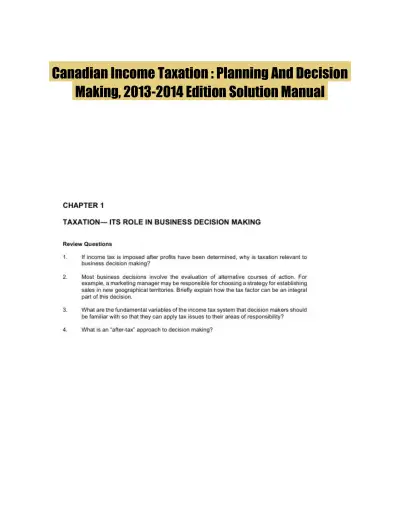 Textbook Guides
Canadian Income Taxation : Planning And Decision Making, 2013-2014 Edition Solution Manual
Taxation
894 pagesMay 2025 Textbook Guides
Solution Manual for Canadian Income Taxation 2019/2020 , 22nd Edition
Taxation
939 pagesMay 2025 Textbook Guides
Canadian Income Taxation 2017/, 2017/, 2017/2018 Edition Solution Manual
Taxation
819 pagesMay 2025 Exam Guides
Test Bank for Pearson's Federal Taxation 2020 Comprehensive, 33rd Edition
Taxation
1355 pagesMay 2025 Practice Problems
Tax Implications Of The Sale Of Rental Property: A Case Study On T. Terri's Apartment Sale
Taxation
9 pagesMay 2025 Exam Guides
Pearson�s Federal Taxation 2020 Comprehensive 33rd Edition Test Bank
Taxation
1355 pagesMay 2025
Study this document with CramX
Once it is in your library, every tool can work from it.