

Canadian Income Taxation : Planning And Decision Making, 2013-2014 Edition Solution Manual
- Taxation
- 894 pages
- Shared May 2025
Canadian Income Taxation : Planning And Decision Making, 2013-2014 Edition Solution Manual provides expertly crafted summaries and insights to boost retention.
Preview 16 of 894 pages
See the first 16 pages exactly as they appear in the document.
Page 1 Read page 1 as text
CHAPTER 1 TAXATION― ITS ROLE IN BUSINESS DECISION MAKING Review Questions 1. If income tax is imposed after profits have been determined, why is taxation relevant to business decision making ? 2. Most business decisions involve the evaluation of alte rnative courses of action. For example, a marketing manager may be responsible for choosing a strategy for establishing sales in new geographical territories. Briefly explain how the tax factor can be an integral part of this decision. 3 . What are the fundamental variables of the income tax system that decision makers should be familiar with so that they can apply tax issues to their areas of responsibility? 4 . What is an “after - tax” approach to decision making?
Page 2 Page 3 Read page 3 as text
Solutions to Review Questions R1 - 1 O nce profit is determined, the amount of income tax that results is determined by the Income Tax Act . However, at all levels of management, alternative courses of action are evaluated and decided upon. In many cases, the choice of one alternative over the other may affect both the amount and the timing of future taxes on income generated from that activity. Therefore, the person making those decisions has a direct input into future after - tax cash flow. Obviously , decisions that reduce or postpone the payment of tax affect the ultimate return on investment and, in turn, the value of the enterprise. Including the tax variable as a part of the formal decision process will ultimately lead to improved after - tax cash flow. R1 - 2 Expansion can be achieved in new geographic areas through direct selling, or by establishing a formal presence in the new territory with a branch office or a separate corporation. The new territories may also cross provincial or international boundaries. Provincial income tax rates vary amongst the provinces. The amount of income that is subject to tax in the new province will be different for each of the three alternatives mentioned above. For example, with direct selling , none of the income is taxed in the new province, but with a separate corporation , all of the income is taxed in the new province. Because the tax cost is different in each case, taxation is a relevant part of the decision and must be included in any cost - benefit analysis that compares the three alternatives [ Reg . 400 - 402. 1 ]. R1 - 3 A basic understanding of the following variables will significantly strengthen a decision maker 's ability to apply tax issues to their area of responsibility. Types of Income - Employment, B usiness , P roperty , C apital gains Taxable Entities - Individual s, C orporations , T rusts Alternative Business - Corporation, P roprietorship , P artnership , L imited Structures partnership, J oint ventures , I ncome trusts Tax Jurisdictions - Federal, P rovincial , F oreign R1 - 4 All cash flow decisions , whether relate d to revenues, expenses, asset acquisitions or divestitures, or debt and equity restructuring, will im pact the amount and timing of the tax cost. Therefore, cash flow exists only on an after tax basis , and , the tax impact s whether or not the ultimate result of the decision is successful. An after - tax approach to decision - making requires each decision - maker to think "after - tax" for every decision at the time the decision is being made , and , to consider alternative courses of action to minimize the tax cost, in the same way that decisions are made regarding other types of costs. Failure to apply an after - tax approach at the time decisions are made may provide inaccurate information for evaluation , and, result in a permanently inefficient tax structure.
Page 4 Read page 4 as text
CHAPTER 2 FUNDAMENTALS OF TAX PLANNING R eview Q uestions 1. “Tax planning and tax avoidance mean the same thing.” Is this statement true? Explain. 2. What distinguishes tax evasion from tax avoidance and tax planning? 3. Does the Canada Revenue Agency deal with all tax avoidance activities in the same way? Explain. 4. The purpose of tax planning is to reduce or defer the tax costs associated with financial transactions. What are the general types of tax planning activities? Briefly explain how each of them may reduce or defer the tax cost. 5. “It is always better to pay tax later rather than sooner.” Is this statement true? Explain. 6. When corporate tax rates are 1 5 % and tax rates for individuals are 40%, is it always better for the individual to transfer his or her business to a corporation? 7. “As long as all of the income tax rules are known, a tax plan can be developed with certainty.” Is this statement true? Explain. 8. What basic skills are required to develop a good tax plan? 9. An entrepreneur is developing a new business venture and is planning to raise equity capital from individual investors. Her advisor indicates that the venture could be structured as a corporation (i.e., shares are issued to the investors) or as a limited partnership (i.e., partnership units are sold). Both structures provide limited liability for the investors. Should the entrepreneur consider the tax positions of the individual investors? Explain. Without dealing with specific tax rules, what general tax factors should an investor consider before making an investment? 10. What is a tax avoidance transaction? 11. “If a transaction (or a series of transactions) that results in a tax benefit was not undertaken primarily for bona fide business, investment, or family purposes, the general anti - avoidance rule will apply and eliminate the tax benefit.” Is this statement true? Explain.
Page 5 Read page 5 as text
Solutions to R eview Q uestions R2 - 1 There is a distinction between tax planning and tax avoidance. Tax planning is the process of arranging financial transactions in a manner that reduces or defers the tax cost and that arrangement is clearly provided for in the Income Tax Act or is not specifically prohibited. In other words, the arrangement is chosen from a reasonably clear set of options within the Act . In contrast, tax avoidance involves a transaction or series of transactions , the main purpose of which is to avoid or reduce the tax otherwise payable. While each transaction in the process may be legal by itself, the series of transactions cause a result that was not intended by the tax system. R 2 - 2 Both tax planning and tax avoidance activities clearly present the full facts of each transaction, allowing them to be scrutinized by CRA . In comparison, tax evasion involves knowingly excluding or altering the facts with the intention to deceive. Failing to report an amount of revenue when it is known to exist or deducting a false expense are examples of tax evasion. R2 - 3 CRA does not deal with all tax avoidance transactions in the same way. In general terms, CRA attempts to divide tax avoidance transactions between those that are an abuse of the tax system and those that are not. When an action is considered to be abusive, CRA will attempt to deny the resulting benefits by applying one of the anti - avoidance rules in the Income Tax Act . R2 - 4 There are three general types of tax planning activities: Shifting income from one time period to another. Transferring income to another entity. Converting the nature of income from one type to another. Shifting income to another time period can be a benefit if it results in a l ower rate of tax applying to the income . Even if a lower rate of tax is not achieved, a benefit may be gained from delaying the payment of tax to a future time period. S hifting income to an alternate taxpayer (for example, from an individual to a corporation), the amount and timing of the tax may be beneficially altered. There are several types of income within the tax system such as employment income, business income, capital gains and so on. Each type of income is governed by a different set of rules. For some types of income , the timing , the amount of income recognized , and the effective tax rate is different from other types. By converting one type of income to another, a benefit may be gained if the timing of income recognition , the amount recognized , and/or the effective tax rate is favorable. R2 - 5 The statement is not true. Paying tax later may be an advantage because it delays the tax cost and frees up cash for other purposes. However, the delay may result in a higher rate of tax in the future year compared to the current year. In such circumstances there is a trade off between the timing of the tax and the amount of tax payable. R2 - 6 There is not always an advantage to transfer income to a corporation when the corporate tax rate is lower than that of the individual shareholder. While an immediate lower tax rate results, remember that the corporation may be required to distribute some or all of its after - tax income to the shareholder which causes a second level of tax. Whether or not an advantage is achieved depends on the amount of that second level of tax and when it occurs. Other factors may also be relevant such as the tax treatment of a possible business failure or sale.
Page 6 Read page 6 as text
R2 - 7 The statement is not true. Knowing the tax rules is, of course, a major element in the tax planning process , but , it does not guarantee the expected outcome. Planning means that certain steps are taken now in preparation for certain activities that may occur in the future. However, those anticipated activities might not occur and the desired tax result may not be achieved. Tax planning also requires that one must anticipate and speculate on possible future scenarios and relate them to the current tax planning steps. Those scenarios are never certain. R2 - 8 To develop a good tax plan, one must be able to: Understand the fundamentals of the income tax system. Anticipate the complete cycle of transactions. Develop optional methods of achieving the desi red business result and analyze each of their tax implications. Speculate on possible future scenarios and assess their likelihood. Measure the time value of money. Place the tax issue in perspective by applying common sense and sound business judgement. Understand the tax position of other parties involved in the transaction. R2 - 9 Yes, the entrepreneur should consider the tax position of the potential investors. They will be taking a risk in accepting the investment. If the entrepreneur knows the tax effect on the investors , of each alternative organization structure, the entrepreneur can choose the one that provides investors the most favorable tax treatment (i.e., one that reduces their after - tax loss if the investment fails, or increases their after - tax income if it succeeds ) . Before making the investment the investor should determine the tax impact on: i ncome earned by the venture , i ncome distributed to the investor , losses incurred by the venture , t he loss of the investment if the venture fails , and t he gain on the investment when it is eventually sold. R2 - 10 A tax avoidance transaction is a term used within the general anti - avoidance rule (GAAR) of the Income Tax Act . An avoidance transaction is a transaction or series of transactions that results in a tax benefit and was not undertaken primarily for bona fide business, investment or family purposes [ ITA 245 ]. R2 - 11 The statement is not true. In order for the tax benefit to be denied under the general anti - avoidance rule (GAAR) , the transaction, in addition to not being primarily for bona fide business, investment or family purposes, must be considered to be a misuse or abuse of the income tax system as a whole. What constitutes a misuse or abuse is not always clear. However, certain avoidance transactions are permitted and others are not [ ITA 245(3) , IC 88 - 2 ]. ___________________________________________________________
Page 7 Read page 7 as text
Key Concept Q uestions QUESTION ONE The Income Tax Act contains a general anti - avoidance rule (GAAR) in section 245. Consider each of the following situations and determine whether the GAAR will likely apply. Income tax reference: ITA 245( 1 ) , (2),(3) , (4) ; IC 88 - 2. 1. Chris transferred her consulting business to a corporation primarily to obtain the benefit of the low corporate tax rate. 2. Paul owns 100% of the shares of P Ltd. Paul provides services to P Ltd. In the current year he received no remuneration for his services because the payment of a salary to Paul would increase the amount of the loss that P Ltd. will incur in the year. 3. A Canadian - controlled private corporation pays its shareholder/manager a bonus that will reduce the corporation’s income to the amount eligible for the low tax rate. The bonus is not in excess of a reasonable amount. 4. A profitable Canadian corporation has a wholly owned Canadian subsidiary that is sustaining losses and needs additional capital to carry on its business. The subsidiary could borrow the funds from its bank but could not obtain any tax saving in the current year by deducting the interest expense due to its loss situation. Therefore, the parent corporation borrows the funds from its bank and subscribes for additional common shares of the subsidiary. The parent corporation reduces its taxable income by deducting the interest expense. The subsidiary uses the funds to earn income from its business. QUESTION TWO John has owned all of the shares of Corporation A and Corporation B since their inception. In the current year, John had Corporation A transfer, on a tax - deferred basis, property used in its business to Corporation B. The reason for the transfer is to enable Corporation B to apply the income earned on the transferred assets against its non - capital losses. Will the GAAR in ITA 245(2) apply to disallow the tax benefit? Income tax reference: ITA 245 ( 1 ) ,(2),(3),(4) ; IC 88 - 2.
Page 8 Read page 8 as text
S olutions to K ey C oncept Q uestions KC 2 - 1 [ITA: 245(2) – GAAR] The GAAR provision in ITA 245(2) is to be used when specific anti - avoidance provisions do not suffice. For the GAAR to apply, the following four conditions must be met: 1) A tax benefit results from a transaction or part of a series of transactions [ITA 245(1) – “tax benefit” definition] , 2) The transaction is an avoidance transaction, in that , it was not undertaken primarily for bona fide purposes other than to obtain the tax benefit [ITA 245(3) – “Avoidance transaction” definition] , 3) No other provision of the Act stops the taxpayer from achieving the intended tax advantage, and 4) The transaction is an abusive transaction, i n that , it can reasonably be concluded that the tax benefit would result in a misuse or abuse of the Act, read as a whole [ITA 245(4)] . The transactions described in each of the four situations : A tax benefit results in each case , The transactions have been undertaken primarily to obtain a tax benefit and are, for that reason, avoidance transactions , and Are not subject to any other anti - avoidance rule in the Act, Therefore, the issue to be determined is whether th e tax benefit would result in a misuse or abuse of the Act, read as a whole. Situation 1 : There is nothing in the Act that prohibits Chris from incorporating her b usiness. The incorporation is consistent with the Act read as a whole and, therefore, the GAAR would not apply. Situation 2 : There is no provision in the Act requiring a salary to be paid to Paul and the failure to pay a salary is , therefore , not contrary to the scheme of the Act read as a whole. The GAAR would not apply to deem a salary to be paid by P Ltd. or received by Paul. Situation 3 : The Act recognizes the deductibility of reasonable business expenses which include bonuses. The payment of the bonus is not an abusive transaction and, therefore, the GAAR should not apply to the payment. Situation 4 : The borrowing by the parent corporation is for the purpose of gaining or producing income as required by paragraph 20(1)(c) of the Act. The GAAR should, therefore, not apply. In fact, CRA has indicated, in comfort letters, that where one corporation (A Ltd.) borrows from a financial institution to invest in shares of another corporation (B Ltd.) and B Ltd. re - loans the funds back to A Ltd. and charges interest at a reasonable rate, thus, shifting income from A Ltd. to B Ltd., the transaction s are permissible and will not be challenged.
Page 9 Read page 9 as text
KC 2 - 2 [ITA: 245(2) – GAAR] The GAAR provision in ITA 245(2) is to be used when specific anti - avoidance provisions do not suffice. For the GAAR to apply, the following four conditions must be met: 1) A tax benefit results from a transaction or part of a series of transactions, 2) The transaction is an avoidance transaction, in that , it was not undertaken primarily for bona fide purposes other than to obtain the tax benefit, 3) No other provision of the Act stops the taxpayer from achieving the intended tax advantage, and 4) The transaction is an abusive transaction, in that, it can reasonably be concluded that the tax benefit would result in a misuse or abuse of the Act, read as a whole. In the case o f John and his two corporations: The transaction does result in a tax benefit as using the losses will reduce tax , It appears that the transaction was undertaken primarily for the tax benefit , and There is no provision in the Income Tax Act prohibiting the transfer of the property on a tax - deferred basis to a related corporation nor the deduction of the losses by Corporation B, So, the question that remains is whether the transaction is an abusive transaction. Since the Act contains specific provisions permitting the transfer of losses between related corporations, the transfer in question is consistent with the scheme of the Act and, therefore, is not an abusive transaction. Thus , the GAAR should not apply. However, had the transfer of a property been undertaken to avoid a specific rule, such as a rule designed to preclude the deduction of losses after the acquisition of control of a corporation by an arm's length person, such a transfer would be a misuse of the provisions of the Act and be subject to the GAAR [IC88 - 2]. Where the GAAR applies, the tax benefit that results from an avoidance transaction will be denied. In order to determine the amount of the tax benefit that will be denied, the provision indicates that the tax consequences of the transaction to a person will be determined as is reasonable in the circumstances.
Page 10 Read page 10 as text
CHAPTER 3 LIABILITY FOR TAX, INCOME DETERMINATION, AND ADMINISTRATION OF THE INCOME TAX SYSTEM R eview Q uestions 1. Which of the following entities are subject to income tax? (a) proprietorship (b) individual (c) joint venture (d) trust (e) limited partnership (f) corporation (g) partnership 2. Describe how the income earned by any of the non - taxable entities listed above is included in the Canadian tax system. 3. How and when does income earned by a corporation affect the tax position of an i ndividual who is a shareholder? 4. In describing who is liable for tax in Canada, the Income Tax Act simply states, “An income tax shall be paid , as required by this Act, on the taxable income for each taxation year of every person resident in Canada at any time in the year.” Accepting that “person” includes both an individual and a corporation, briefly discuss the meaning and ramifications of this statement. 5. In what circumstances are non - residents subject to Canadian income tax? 6. Can a Canadian resident be subject to tax in Canada as well as in a foreign country on the same earned income? If yes, explain how. Also, what mechanism is available to minimize double taxation? 7. Explain the difference between net income for tax purposes and taxable income for the taxable entities. 8. Explain what is meant by the statutory scheme, and describe the scheme’s relevance to the Canadian income tax system. 9. For tax purposes, would you prefer that a financial loss be a capital loss or a business loss? Explain. 10. Explain the difference between income from property and a gain on the sale of capital property .
Page 11 Read page 11 as text
11. One often hears that “corporations are entitled to more deductions for tax purposes than individuals.” Based on your reading of Chapter 3, is this statement true? Explain. 12. If an individual earns a living as a lawyer, what possible categories of income, for tax purposes, may he or she generate? Describe the circumstances for each possible classification. 13. What types of income for tax purposes may result when a profit is achieved on the sale of property (e.g., land)? 14. Individual A, a Canadian resident, owns and operates a profitable small farm in North Dakota, U.S.A. He also has a large amount of money earning interest in an American bank. Individual B, also a Canadian resident, owns 100% of the shares of an American corporation that operates a profitable small farm in North Dakota. The corporation also has a large amount of money earnin g interest in an American bank. Describe and compare the tax positions of these two individuals who conduct the same activities but use different organizational structures. 15. Jane Q owned an apple orchard for 20 years. During that time, she had cultivated a unique brand of apple that was popular with health food fans. Toward the end of the 20X0 growing season, Q became seriously ill and put the orchard up for sale. Q’s neighbour agreed to purchase the entire orchard for $250,000. It upset Q to have to sell at that time of year because that year’s crop was of high quality and in three weeks wo uld have been ripe for picking. What types of property might have been included in the total purchase price of $250,000? For tax purposes, what types of income might have been generated from the sale of the orchard? Explain your answer.
Page 12 Read page 12 as text
S olutions to R eview Q uestions R3 - 1 Of the seven entities listed the following are subject to tax: individuals corporations trusts R3 - 2 Proprietorships, partnerships, joint ventures and limited partnerships can all earn income as separate entities. However, for tax purposes the income is allocated annually to the owners of the entities and included in their income for tax purpos es. The owners are normally one of the taxable entities, individuals, corporations or trusts. R 3 - 3 A corporation is a separate legal entity distinct from its owners - the shareholders. Consequently a corporation is taxed on its income earned in each taxation year. However, the after - tax corporate profits may be distributed as a dividend to the individual shareholder. Upon receipt of the dividend the individual shareholder has earned property income (return on the share capital) and is subject to tax consequences at that time [ ITA 12(1)(j),(k) ]. Alternatively, if the corporation does not distribute the after - tax profits but retains them for corporate use, the value of the shares owned by the shareholder will increase in value. If and when the shareholder disposes of the shares a capital gain may result due to the increased share value caused by the corporate earnings retained [ ITA 40(1)(a)(i) ]. R3 - 4 This statement is important because it establishes the basic framework of the income tax system, who is liable for tax, and on what income. The statement indicates that tax is calculated on the taxable inco me of resident persons for each taxation year. By defining each of the relevant terms in the statement the general scope of the tax system is apparent. It is , therefore , necessary to define the terms person, resident, taxable income , and taxation year [ ITA 2(1) ]. As stated in the question, both individuals and corporations are considered to be persons for tax purposes. Therefore , resident individuals and resident corporations are liable for Canadian tax [ ITA 248(1) ]. Individuals are resident of Canada if they maintain a continuing state of relationship with the country. Whether or not an individual has a continuing state of relationship is a question of fact determined from the facts of each situation. To establish this relationship the courts consider the time spent in Canada, motives for being present or absent, the maintenance of a dwelling place, the origin and background of the individual, the routine of life, and the existence of social and financial connections. If an individual does not have a continuing state of relationship , the individual may be deemed to be a resident if the individual is present in Canada for 183 days or more in a particular year [ ITA 250(1)(a) ]. A corporation is a resident of Canada if it has been incorporated in Canada [ ITA 250(4) ].
Page 13 Read page 13 as text
Taxable income is defined as the person's net income for tax purposes minus a limited number of de ductions. Net income for tax purposes consists of world income derived from five specific s our c es: employment, business, property, capital gains, and other sources. These sources are combined in a basic formula known as the statutory scheme. If income does not fit one of the above five categories, it is not taxable. Both individuals and corporations determine net income for tax purposes using the same set of rules. Tax is calculated on taxable income for each taxation year. The taxation year of an individual is the calendar year. The taxation year for a corporation is the fiscal period chosen by the corporation, which cannot exceed one year , 53 weeks to be exact [ ITA 249(1), 249.1(1) ]. Professional corporations ( a corporation that carries on the professional practice of an accountant, dentist, lawyer, medical doctor, veterinarian or chiropractor [ITA 248(1)] ) are required to have a fiscal period that coincides with the calendar year [ITA 249.1(1)(b)]. R3 - 5 A non - resident individual or corporation is subject to Canadian income tax in a manner similar to a Canadian resident on taxable income earned in Canada if they are employed in Canada, carry on business in Canada, or dispose of taxable Canadian property [ ITA 2( 3 )]. In addition, a non - resident who does not have any of the above activities in Canada may be subject to a special withholding tax (a flat tax) on income which has its source in Canada [ ITA 212]. ( For example, dividends, rents royalties, certain management fees , and so on .) R3 - 6 Yes. The resident of Canada is taxed on world income and the foreign country, which is the source of that income, may also impose tax. For example, a Canadian corporation which operates a business branch location in a foreign country will be taxable on the branch profits in both countries. In order to avoid double taxation, the Canadian tax calculation permits a reduction of Canadian taxes for foreign taxes paid on the same income [ ITA 126(1) , (2)]. R3 - 7 Net income for tax purposes consists of a taxpayer ’ s combined net income from employment, business, property, capital gains and other sources. The separate sources of income are combined in accordance with an aggregating formula which takes into account any losses from the above sources. Net income for tax purposes is determined by the same set of rules for individuals and corporations. Taxable income is the base amount upon which the rates of tax are applied, and is determined by reducing a taxpayer's net income for tax purposes (above) by a limited number of specific deductions. While individuals and corporations use the same formula for determining net income, the calculation of taxable income is different. Deductions for individuals include a capital gain s deduction on qualified properties, and unused losses of other years. Deductions for corporations include charitable donations, dividends f r om Canadian corporations and foreign affiliates, and unused losses of other years.
Page 14 Read page 14 as text
R3 - 8 The statutory scheme is the fundamental base of the income tax system. It is simply an aggregating formula which establishes the concept of a taxpayer's income for tax purposes in comparison to other concepts of income. The formula defines what types of income are subject to tax and how any related losses affect a taxpayer's income. As the formula is restricted to five basic types of income activities, the scope of the tax system is established. The formula establishes that, although a taxpayer may carry on several separate activities, each separate type of income is not taxed separately but rather forms part of a total concept of income. As a result, with the exception of capital losses, a loss from one activity within a specified time period may be offset against the income derived from other activities. In spite of the fact tha t the formula combines several types of income into a single income amount, each type of income is determined in accordance with its own sets of rules. The formula then binds them together and establishes their relationships. R3 - 9 A taxpayer would normally prefer that a loss incurred be a business loss as opposed to a capital loss. In accordance with the aggregating formula for computing net income , a business loss can be deducted from any other source of income which increases the opportunity to reduce taxes payable as soon as possible. A capital loss, on the other hand, can only be deducted against a capital gain and , therefore , its ability to reduce taxes payable is considerably restricted. In addition, only one - half of a capital loss is included as part of the aggregating formula [ ITA 3(b) ]. For example, a taxpayer who has employment income of $30,000 and a business loss of $30,000 has no net income under the aggregating formula and , therefore , no tax liability. However, if the same taxpayer has employment income of $30,000 and a capital loss of $30,000, a tax liability would be incurred because the net income for tax purposes would be $30,000 (from employment) and the capital loss would remain unused. R3 - 10 Income from property is the return that is earned on invested capital. For example, dividends earned on shares of a corporation are property income because they represent the return from the ownership of capital property (the shares). On the other hand, a gain derived from the sale of capital property is considered to be a capital gain. Using the previous example, if the shares were sold at a profit the gain from that property would be a capital gain and not property income. R3 - 11 Based on the determination of net income for tax purposes, the statement is not true. Both individuals and corporations determine net income for tax purposes in accordance with the same aggregating formula. In addition, an individual who earns business income determines that income in accordance with the same set of rules as a corporation that earns business income. With respect to the conversion of net income for tax purposes to taxable income, individuals are entitled to a capital gain s deduction whereas a corporation is not. In this context an in dividual receives preferential treatment. In arriving at taxable income, a corporation can reduce its net income by dividends received from other Canadian corporations , whereas , individuals cannot. However, corporate income is ultimately
Page 15 Read page 15 as text
distributed to shareholders who are individuals and , therefore , this corporate advantage is temporary [ ITA 110.6, 112(1) ]. R3 - 12 Working as a lawyer, an individual may earn either employment income or business income. If the lawyer provides services to a law firm as an employee in return for a salary, bonus, and fringe benefits, the income would constitute employment income. If the lawyer independently provides services directly to clients on a fee - for - service basis, the income derived is business income [ ITA 5(1), 9(1) ]. R3 - 13 A profit derived from the sale of property may be classified as either business income or capital gain. Using the example of property that is land, business income will occur if the land was acquired for the purpose of reselling it at a profit. Alternatively, if the land was acquired, not for resale, but for long term use to generate income or for personal enjoyment, the profit on the sale w ill be a capital gain. R3 - 14 All Canadian residents are taxed on their world income. The world income of individual A includes the business profits from the U.S. farm plus the interest earned from the U.S. bank account. These amounts are , therefore , taxable in Canada in the year earned. The income would also be taxable in the U.S. but Canadian taxes may be reduced by U.S. taxes on that income. In comparison, individual B's world income does not include the U.S. farm profits and the U.S. interest. This income belongs to the U.S. corporation and is , therefore , taxed only in the U.S. The foreign corporation is not a resident of Canada and is not subject to Canadian tax. The after - tax profits of the foreign corporation may be distributed to individual B in the form of dividends at some future time. Such foreign dividends would then be part of B's world income and taxed a second time. Although both A and B conduct the same activities, the organization structure alters the amount and the timing of the related taxes on the income. R3 - 15 The sale of the entire orchard for a total price of $250,000 may include the following separate properties: land the permanent stock of trees the almost mature crop of apples ( The student may also recognize the possibility of including equipment and the intangible property of goodwill.) The sale of the land may result in a capital gain because it is property that was acquired and used to generate income. Similarly the sale of the trees is capital property because the trees are used to produce a regular crop of apples.
Page 16 Read page 16 as text
The profit on the sale of apples would constitute business income because the apples are being produced for the purpose of resale at a profit. Even though the apples are not mature, they represent inventory in process. ___________________________________________________________
878 more pages in the full document
Unlock it once and it stays in your library, ready to chat with or turn into flashcards.
Unlock the full documentMore Taxation study materials
See all Textbook Guides
Canadian Income Taxation 2016/2017 Edition Solution Manual
Taxation
884 pages56downloadsFeb 2025 Exam Guides
Canadian Income Taxation 2016/2017 Edition Test Bank
Taxation
139 pagesMay 2025 Exam Guides
Canadian Income Taxation : Planning And Decision Making, 2013-2014 Edition Test Bank
Taxation
175 pagesMay 2025 Textbook Guides
Solution Manual for Canadian Income Taxation 2019/2020 , 22nd Edition
Taxation
939 pagesMay 2025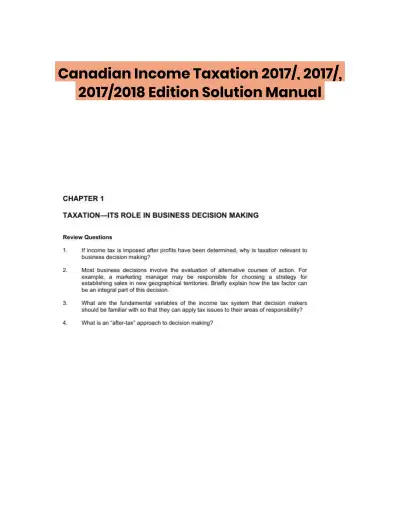 Textbook Guides
Canadian Income Taxation 2017/, 2017/, 2017/2018 Edition Solution Manual
Taxation
819 pagesMay 2025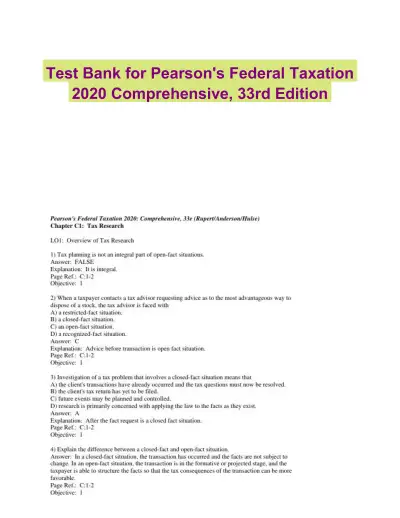 Exam Guides
Test Bank for Pearson's Federal Taxation 2020 Comprehensive, 33rd Edition
Taxation
1355 pagesMay 2025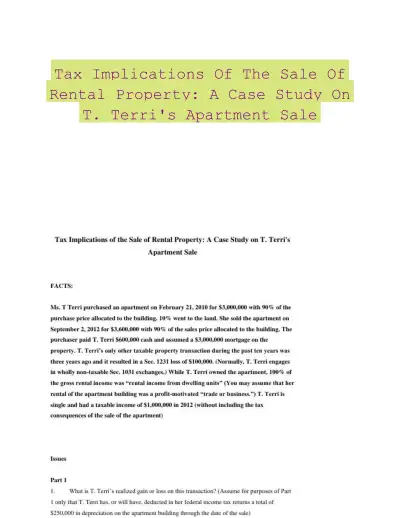 Practice Problems
Tax Implications Of The Sale Of Rental Property: A Case Study On T. Terri's Apartment Sale
Taxation
9 pagesMay 2025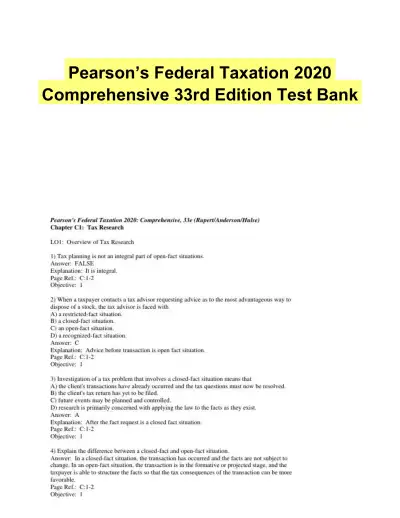 Exam Guides
Pearson�s Federal Taxation 2020 Comprehensive 33rd Edition Test Bank
Taxation
1355 pagesMay 2025
Study this document with CramX
Once it is in your library, every tool can work from it.