

TEAS 7 Chemistry Review
- Test of Essential Academic Skills
- 10 pages
- Shared June 2025
Master TEAS 7 Chemistry with key topics: states of matter, bonds, reactions, solutions, acids/bases & balancing equations. Great for reinforcing core chemistry concepts
Preview 3 of 10 pages
See the first 3 pages exactly as they appear in the document.
Page 1 Read page 1 as text
TEAS 7 CHEMISTRY REVIEW AREAS COVERED 1. Understanding States of Matter. 2. Understanding Changes in States of Matter. 3. Understanding Properties of Matter 4. Understanding Chemical Bonds. 5. Understanding Chemical Solutions. 6. Understanding Chemical Reactions. 7. Understanding Acid Base Balance. 8. Understanding Balancing Chemical Equations. NB: Questions related to chemistry test your knowledge of chemical properties and processes. You may be asked questions about states of matter, properties of matter, phase changes, chemical bonds, chemical solutions, chemical reactions, and acids and bases. You may be asked to balance chemical equations. Let's get started in understanding how chemistry is important on the ATI TEAS.
Page 2 Read page 2 as text
UNDERSTANDING STATES OF MATTER Matter is made up of microscopic particles that move different speeds depending on the energy they are exposed to. We measure this energy as temperature. The molecules can move either quickly and randomly or hardly at all. When the energy is high, matter take the form of a gas, in which molecules are moving about quickly and are far apart. Gases have no fixed form. Molecules are free to move at random past each other, and they tend to fill any container that holds then. If a gas is not contained, its molecules will disperse. Lower temperatures result in a liquid, in which molecules cohere but are fluid. Coherence means that the molecules remain close together, but they can change position by sliding over one another. In liquids, molecules move less freely than in a gaseous state, sliding past cne another. They have a fixed volume but will flow freely unless they fill a portion of a container. When the temperature is low, matter takes the form of a solid, in which molecules are packed closely together and retain their positions. Solid matter is rigid, and molecules retain a uniform spacing. A solid has a defined form, which is brittle. It can be broken into pieces but tends to stay together. A somewhat unusual state of matter is plasma, w r hich is like a gas in many of its properties but carries an electric charge. The TEAS focus on solids, liquids, and gases. UNDERSTANDING CHANGES INSTATE OF MATTER The state of matter depends on temperature and pressure. Higher temperatures cause molecules to energize and move farther apart. Increasing pressure forces molecules closer together. Melting is the phase change from solid to liquid and boiling is the phase change from liquid to gas. There
Page 3 Read page 3 as text
is also a direct change from solid to gas known as sublimation. The phase change from gas to liquid is condensation and the change from liquid to solid is freezing. A direct change from gas to solid is deposition. All types of matter can be described in terms of the physical and chemical properties each substance has. Physical properties are observable and there is an extensive list of physical properties that one could observe about a substance. A few examples are density. the temperatures at which the substance undergoes phase changes, malleability, conductivity specific heat capacity, mass, volume, color, and many other properties. Physical properties are further divided into intensive and extensive properties. An intensive property does not depend on the size or amount of matter in the object, while an extensive property! does depend on the amount of matter in the object. For example, mass is extensive because the measurement would change the size of the sample. Boiling point is intensive because the temperature at which the object boils is not dependent on its volume. Understanding properties of matter- WATER Water is a polar inorganic compound that is transparent, and nearly colorless. H2O is a covalent compound because oxygen and tnidrogen are nonmetals. It has 8 total valence electrons (6 from oxygen and 1 from each fgidrogen). Breaking rhe bonds requires a lot of energy, so water has a very high specific heat and hear of vaporization. The molar mass of water is 18.02 g/mol. It
7 more pages in the full document
Unlock it once and it stays in your library, ready to chat with or turn into flashcards.
Unlock the full documentMore Test of Essential Academic Skills study materials
See all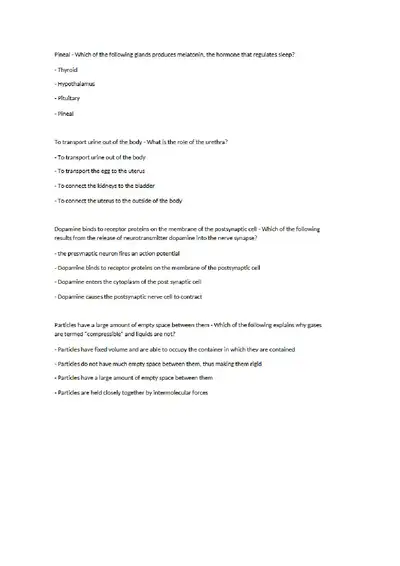 Past Exams
ATI TEAS Practice Questions
Test of Essential Academic Skills
23 pagesJun 2025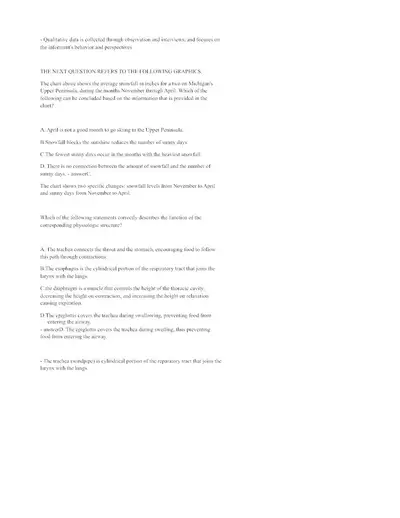 Past Exams
ATI TEAS 2024 Updated Exam Science
Test of Essential Academic Skills
66 pagesJun 2025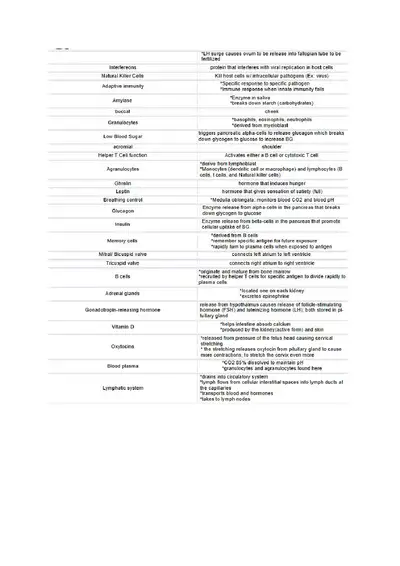 Past Exams
ATI TEAS 7
Test of Essential Academic Skills
10 pagesJun 2025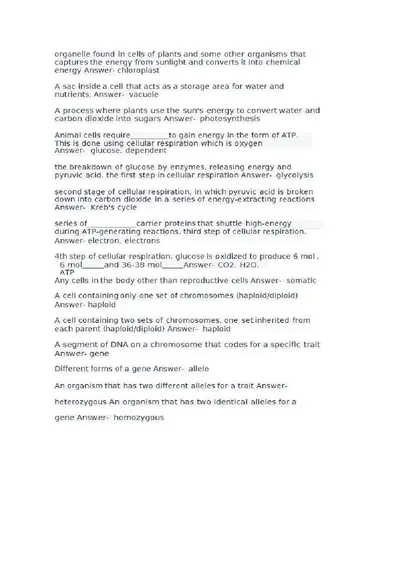 Past Exams
2023 BIOL ATI TEAS
Test of Essential Academic Skills
14 pagesJun 2025 Past Exams
Teas Math Study Guide
Test of Essential Academic Skills
13 pagesJun 2025 Past Exams
ATI TEAS Test Science Questions and Answers
Test of Essential Academic Skills
23 pagesJun 2025 Past Exams
TEAS 7 Math Practice Test Edition 3
Test of Essential Academic Skills
64 pagesJun 2025 Past Exams
ATI TEAS 7 Comprehensive Practice Exam
Test of Essential Academic Skills
62 pagesJun 2025
Study this document with CramX
Once it is in your library, every tool can work from it.