

2024 WGUC233 Law Practice Exam With Answers (179 Solved Questions)
- Western Governors University
- 35 pages
- Shared May 2025
Learn from previous exams with 2024 WGUC233 Law Practice Exam With Answers, covering key topics and test formats.
Preview 11 of 35 pages
See the first 11 pages exactly as they appear in the document.
Page 1 Read page 1 as text
pg. 1 professoraxe l WGU C233 Employment Law Exam With 100% Correct Answers 2024 Intrusion Upon Seclusion - Correct Answer - A type of tort in which an employer intrudes upon an employee's private information. Age Discrimination in Employment Act (ADEA) - Correct Answer - Enacted in 1967, it protects employees who are 40 years of age and older. Fair Labor Standards Act (FLSA) - Correct Answer - Enacted in 1938, it protects workers from unfair wages, limits abusive overtime practices, and prevents child labor. Course of Employment - Correct Answer - Any action by an employee that furthers an employer's business. National Labor Relations Board - Correct Answer - A federal administrative agency that administers the provisions of the NLRA.
Page 2 Page 3 Read page 3 as text
pg. 2 professoraxe l Federal Whistleblower Statute - Co rrect Answer - Enacted in 1982, it protects contractor employees from employment discrimination or retaliation for reporting company violations of the law. Americans with Disabilities Act (ADA) - Correct Answer - Employers with 15 or more employees are prohib ited from discriminating against people with disabilities. In general, the employment provisions of the ADA require equal opportunity in selecting, testing, and hiring qualified applicants with disabilities; job accommodation for applicants and workers wit h disabilities when such accommodations would not impose "undue hardship;" and equal opportunity in promotion and benefits. Collective Bargaining - Correct Answer - The negotiation process between unions and employers. Quota - Correct Answer - An official li mit on the number or amount of people or things that are allowed. E - Verify - Correct Answer - An online tool administered through the U.S. Citizenship and Immigration Services (USCIS) and
Page 4 Read page 4 as text
pg. 3 professoraxe l used by employers to verify the validity of documents presented by ne w hires. Continual Training Requirement - Correct Answer - A mandate that all employers provide training to workers on a periodic basis and whenever an employee is hired or assigned to a new job. Serious Health Condition - Correct Answer - An incapacitating illness, injury, or impairment that requires overnight care or continuing treatment from a health care provider. Sherman Anti - Trust Act - Correct Answer - Enacted in 1890, it prevents businesses from combining together to restrain trade and seeking monopoly business power. Vicarious Liability - Correct Answer - A form of secondary liability that comes from the doctrine of respondeat superior - "let the master answer for the servant". Worker's Compensation - Correct Answer - A form of insurance that provides wa ge replacement and medical benefits for employees injured while at work in exchange for
Page 5 Read page 5 as text
pg. 4 professoraxe l relinquishment of the right to sue the employer for negligence. Opportunity Wage - Correct Answer - An exception to the minimum wage law that applies to employees under twenty years old. Free Riders - Correct Answer - An employee who does not belong to a union, but benefits from union representation Unfair Labor Practices Strike - Correct Answer - A stoppage of work in order to pressure management to follow the law Public - policy Exception - Correct Answer - A rule of exception to the employment at - will doctrine that states that an employer cannot terminate an employee for reasons that violate public policy. Reduction in Force (RIF) - Correct Answer - Occurs when a business eli minates one or more positions as part of a strategic business plan to realign operations or reduce cost.
Page 6 Read page 6 as text
pg. 5 professoraxe l Remedies - Correct Answer - A desired action resulting from a successful lawsuit. Customer Discriminatory Preference - Correct Answer - An unacceptable p retext of discrimination in which an employer uses race as the basis for a business decision in order to please customers. Arbitration - Correct Answer - A procedure for resolving collective bargaining impasses by which an arbitrator (third party) choose a solution to the dispute. Conglomerate - Correct Answer - A highly diversified firm that has multiple businesses with no relationships. Permissive Bargaining Subject - Correct Answer - A bargaining subject that either party may bring to the table, but over wh ich the other party is not required to bargain Four - fifths Rule - Correct Answer - The simplest and most common way of estimating adverse impact by ruling a screening device as discriminatory if its selection rates of a protected class are less than 80% of the majority.
Page 7 Read page 7 as text
pg. 6 professoraxe l Mandatory Bargaining Subject - Correct Answer - A required bargaining subject that involves wages, benefits, hours, and layoff procedures. Reasonable Accommodation - Correct Answer - A reasonable change to the work environment that allows a religious individual to perform job functions Federal Injunction - Correct Answer - A legal remedy that allows a court to order individuals to refrain from harmful acts Vietnam Era Veteran Readjustment Assistance Act - Correct Answer - Passed in 1974, it req uires contractors to take affirmative action toward veterans Vesting - Correct Answer - The conveying of an employee's rights to benefits or contributions after a certain amount of time. Workweek - Correct Answer - Any consecutive seven - day period.
Page 8 Read page 8 as text
pg. 7 professoraxe l Impasse - Correct Answer - A deadlock reached by two bargaining parties whereby an issue cannot be resolved. Wildcat Strike - Correct Answer - A strike by a portion of workers that is not authorized by the union. Labor - Management Reporting and Disclosure Act of 1959 (LMRDA) - Correct Answer - Enacted in 1959, it creates a union member "bill of rights" in order to empower union members and reduce union corruption Undue Hardship - Correct Answer - An accommodation to the work environment that places a significant burden o r expense on the employer Economic Strike - Correct Answer - A stoppage of work based upon a union's frustration that management will not meet its demands for improvements in wages, hours, and benefits Closed Union Shop - Correct Answer - An illegal requirem ent that an employee be a union member
Page 9 Read page 9 as text
pg. 8 professoraxe l Plant Closing - Correct Answer - A single site of employment that is permanently or temporarily shut down for 6 months, or with a 50% reduction in hours over a 6 - month period, and impacts 50 or more full - time employees for a 30 - day period. Comparable Worth Theory - Correct Answer - The notion that men and women should receive equal pay when they perform work that requires comparable skills and responsibilities. ADA Amendments Act - Correct Answer - Passed in 2008, it amen ds the ADA by adding new protections for employees with disabilities Civil Law - Correct Answer - Laws that deal with the rights of people rather than with crimes Illegal Bargaining Subject - Correct Answer - A bargaining subject that cannot legally be implemented into a collective bargaining agreement Common Law - Correct Answer - Principles developed over centuries as a result of legal decisions made by judges in individual cases.
Page 10 Read page 10 as text
pg. 9 professoraxe l Whistleblowing - Correct Answer - The action of an employee to report the wrongdoings of an employer Title VII of the Civil Rights Act of 1964 - Correct Answer - Protects all races from discrimination Exempted Employee - Correct Answer - Employees who are fully or partially free from FLSA provisions Case Law - Correct Answer - The law as laid down in the decisions of the courts (distinct from statutes or other sources of law). Conciliation - Correct Answer - Process where a third party acts as an intermediary between the parties to a labor dispute, helping them to reach a settlement. Polygraph Testing - Correct Answer - A method of testing for an employer to measure an employee's heart, respiratory, and skin reactions while he or she is asked a serious of questions in order to determine if he or she is lying
Page 11 Read page 11 as text
pg. 10 professoraxe l Defamation - Correct Answe r - Communicating false statements that harm a person's reputation Integrated Enterprise - Correct Answer - A business environment in which operations of two or more employers are so intertwined that they can be considered as a single employer for purposes of federal statutory coverage and liability Reverse Discrimination - Correct Answer - Discrimination that occurs when an employer, acting under an affirmative action plan, favors one race or gender in an employment decision. Underutilization - Correct Answer - A discrepancy between the number of women and minorities in a particular position and the number of qualified women and minorities in the constituent market. Pregnancy Discrimination Act (PDA) - Correct Answer - This Act recognizes pregnancy as a temporary disability and prohibits applicants from being discriminated against in the recruitment process because of pregnancy, childbirth, or related medical conditions (Amendment to Title VII).
24 more pages in the full document
Unlock it once and it stays in your library, ready to chat with or turn into flashcards.
Unlock the full documentMore Western Governors University study materials
See all Past Exams
2024-2025 WGU Math D125 Exam with Answers (68 Solved Questions)
Western Governors University
8 pages145downloadsFeb 2025 Past Exams
2024-2025 WGU D199 Introduction to Physical and Human Geograph with Answers (203 Solved Questions)
Western Governors University
26 pages135downloadsFeb 2025 Past Exams
2022-2023 WGU D236 Pathophysiology Exam - Study Guide with Answers (108 Solved Questions)
Western Governors University
27 pages128downloadsFeb 2025 Past Exams
WGU D152 OA Study set with Answers (76 Solved Questions)
Western Governors University
19 pages93downloadsFeb 2025 Past Exams
WGU C840 Digital Forensics in Cybersecurity (1 Completed Essay)
Western Governors University
10 pages81downloadsFeb 2025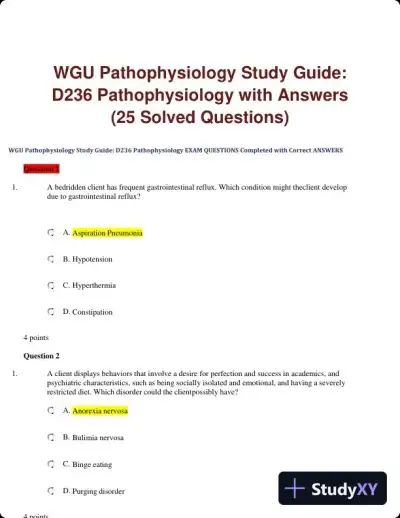 Past Exams
WGU Pathophysiology Study Guide: D236 Pathophysiology with Answers (25 Solved Questions)
Western Governors University
12 pages75downloadsFeb 2025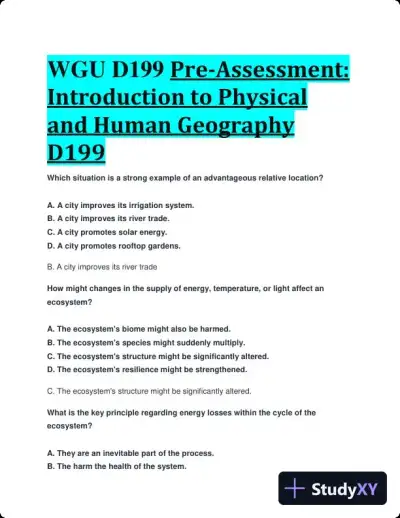 Past Exams
WGU D199 Pre-Assessment: Introduction to Physical and Human Geography with Answers (55 Solved Questions)
Western Governors University
18 pages68downloadsFeb 2025 Past Exams
2023-2024 WGU C175/D426 Data Management Foundations OA Exam with Answers (531 Solved Questions)
Western Governors University
94 pages65downloadsFeb 2025
Study this document with CramX
Once it is in your library, every tool can work from it.