
WGU D152 OA Study set with Answers (76 Solved Questions)

WGU D152 OA Study set with Answers offers a collection of past exams to help you prepare effectively.

Ava Martinez
Contributor
4.1
93
about 1 year ago
Preview (6 of 19 Pages)
100%
Log in to unlock

Page 1

WGU D152 OA Study set with Answers (76 Solved Questions) - Page 1 preview image

Loading page ...

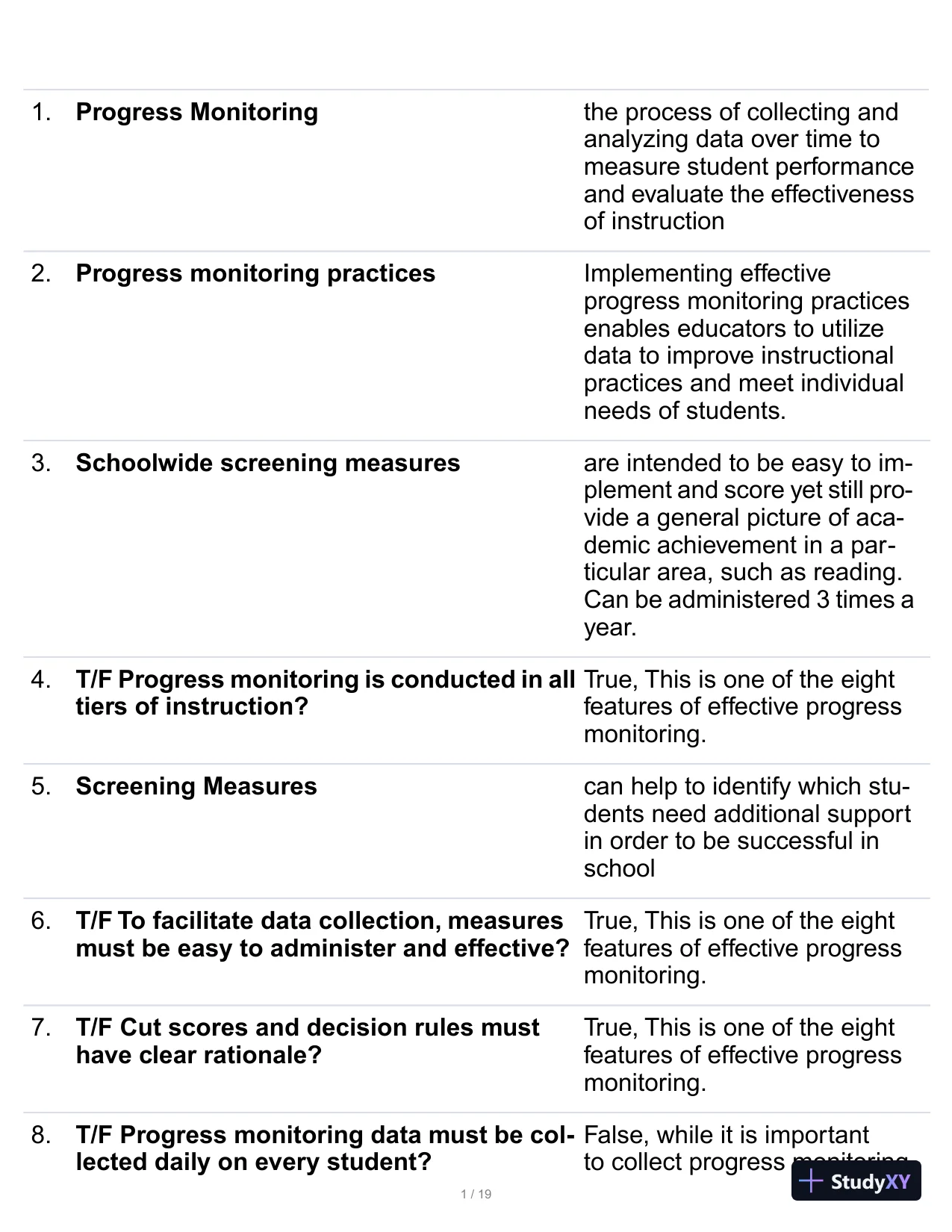
1.Progress Monitoringthe process of collecting andanalyzing data over time tomeasure student performanceand evaluate the effectivenessof instruction2.Progress monitoring practicesImplementing effectiveprogress monitoring practicesenables educators to utilizedata to improve instructionalpractices and meet individualneeds of students.3.Schoolwide screening measuresare intended to be easy to im-plement and score yet still pro-vide a general picture of aca-demic achievement in a par-ticular area, such as reading.Can be administered 3 times ayear.4.T/F Progress monitoring is conducted in alltiers of instruction?True, This is one of the eightfeatures of effective progressmonitoring.5.Screening Measurescan help to identify which stu-dents need additional supportin order to be successful inschool6.T/F To facilitate data collection, measuresmust be easy to administer and effective?True, This is one of the eightfeatures of effective progressmonitoring.7.T/F Cut scores and decision rules musthave clear rationale?True, This is one of the eightfeatures of effective progressmonitoring.8.T/F Progress monitoring data must be col-lected daily on every student?False, while it is importantto collect progress monitoring1 / 19

Page 2

WGU D152 OA Study set with Answers (76 Solved Questions) - Page 2 preview image

Loading page ...

Page 3

WGU D152 OA Study set with Answers (76 Solved Questions) - Page 3 preview image

Loading page ...

data often, daily is not alwaysrequired. measures must becollected frequently enough toinform instructional and place-ment decisions.9.T/F Rules for decision-making must be de-termined for all aspects of progress-mon-itoring data, including cut scores for lev-el (performance score), slope (change inperformance over time), and percentage ofmastery?True, This is one of the eightfeatures of effective progressmonitoring.10.T/F Progress monitoring data are oftenhard to interpret, so teachers must be ex-tensively trained on how to display andinterpret progress monitoring data?False, Results should be dis-played in a manner that makesinterpretation simple and effi-cient, for example, in charts orline graphs.11.Tier 1 InstructionEncompasses whole-schoolquality differentiated instruc-tion and support for all stu-dents.12.Tier 2 Instructionsmall groups are typically usedin tier 2 of RTI, as they allowfor targeted interventions forstruggling students.13.Tier 3 Instructionone on one. Require individu-alized goals. Their progress to-ward goals requires more fre-quent measuring to determinethe effectiveness of the inter-vention14.Data-based Individualization (DBI)A means of using evi-dence-based methods to indi-vidualize interventions for stu-2 / 19

Page 4

WGU D152 OA Study set with Answers (76 Solved Questions) - Page 4 preview image

Loading page ...

dents who do not demonstrateadequate progress15.Sara was identified with a low level of per-formance in mathematics and has beenreceiving tier 1 supports. Her weeklyprogress monitoring showed that she con-tinued to have a reduced rate of progress.What happens next with Sara, based onthis result?Student should be consideredfor tier 2 supports.16.T/F Curriculum-based measurements arean appropriate means to conduct progressmonitoring.True, Curriculum-based mea-surements allow teachers totrack skills from an entireyear's curriculum and monitorprogress.17.Progress Monitoring1. Easy to implement2. Indicate how students areperforming3.Designed to be administeredfrequently18.Diagnostic Assessment1. Determine why students arestruggling to make progress2. Determine the type ofchange that needs to be made3. Make intervention adapta-tions that align with studentneeds19.How do you establish baseline data whencreating a graph for progress monitoring?Administer three probes or tri-als, select the median (themiddle number), and thenmark the score by placing adot on the vertical axis (e.g.,words correct per minute).20.Sophia was given a reading fluency probe.She read up to 84 words in the pas-True, Omitted words andadded words are considered3 / 19

Page 5

WGU D152 OA Study set with Answers (76 Solved Questions) - Page 5 preview image

Loading page ...

sage. However, she made several mistakes.Her mistakes included omitting two words,adding one word, and misreading sever-al words: "can" instead of "come," "dri-ve" instead of "driving," "lean" instead of"learn," and "also" instead of "too."True or FalseThe two words that Sophia omitted and theword that Sophia added count as errors onthis fluency probe.mistakes in assessing read-ing fluency. If students self-cor-rect their mistakes, then theseare not considered errors. So,if the student makes one ormore attempts but finally cor-rects the word, there is no er-ror.21.Sophia was given a reading fluency probe.She read up to 84 words in the pas-sage. However, she made several mistakes.Her mistakes included omitting two words,adding one word, and misreading sever-al words: "can" instead of "come," "dri-ve" instead of "driving," "lean" instead of"learn," and "also" instead of "too."What did Sophia score in this reading flu-ency probe?77 words read correctly inone minute. You count the to-tal number of words and countthe number of mistakes. Takethe number of words minus thenumber of mistakes, and thatequals the number of wordsread correctly. Make sure youonly count one error per word.22.T/F If most of the four most recent datapoints are on or above the goal line, the stu-dent is demonstrating improved outcomes.The teacher should continue with the cur-rent instructional program.True, If most of the four mostrecent data points are onor above the goal line, thestudent is demonstrating im-proved outcomes. The teachershould continue with the cur-rent instructional program. Ifmost of the four most re-cent data points are belowthe goal line and data indicatethat the student will not meetthe benchmark, performanceis not improving. It is time forthe teacher to make an instruc-tional change.4 / 19

Page 6

WGU D152 OA Study set with Answers (76 Solved Questions) - Page 6 preview image

Loading page ...

23.T/F It is important to systematically recordthe errors and analyze the types of errorsthe student makes, so teachers can makeinstructional adaptations to the student'sreading intervention.True, It is important that theteacher uses the data todescribe academic strengthsand weaknesses and to helpalign intervention adaptationswith student need.24.SCREAMS-structure (your lessons)C-clarity (promote clarity inpresentations)R-redundancy (employ redun-dancy effectively)E-enthusiasm (teach with en-thusiasm!)A-appropriate rate (use appro-priate rate of presentation)M-maximized engagement(maximize academic engage-ment/student time on task)25.Systematic InstructionA carefully planned sequencefor instruction, similar to abuilder's blueprint for a house.A blueprint is carefully thoughtout and designed before build-ing materials are gathered andconstruction begins. The planfor instruction that is system-atic is carefully thought out,strategic, and designed be-fore activities and lessons areplanned. Instruction is acrossthe five components (phone-mic awareness, phonics, flu-ency, vocabulary, and com-prehension). For systematicinstruction, lessons build onpreviously taught information,from simple to complex.5 / 19
Preview Mode

This document has 19 pages. Sign in to access the full document!