

ACC 291: Final Exam Study Guide - Key Concepts and Solutions
- Accounting
- University of Phoenix
- 7 pages
- Shared May 2025
Final Exam Study Guide covering key accounting concepts and solutions.
Preview 3 of 7 pages
See the first 3 pages exactly as they appear in the document.
Page 1 Read page 1 as text
ACC 291: Final Exam Study Guide - Key Concepts and Solutions ACC 291 Final Exam New 1. An aging of a company’s accounts receivable indicates that $4,500 are estimated to be uncollectible. If Allowance for Doubtful Accounts has a $1,200 credit balance, the adjustment to record bad debts for the period will require a a. debit to Bad Debt Expense for $3,300. b. credit to Allowance for Doubtful Accounts for $4,500. c. debit to Bad Debt Expense for $4,500. d. debit to Allowance for Doubtful Accounts for $3,300. 2. The financial statements of the Melton Manufacturing Company reports net sales of $300,000 and accounts receivable of $50,000 and $30,000 at the beginning of the year and end of year, respectively. What is the average collection period for accounts receivable in days? a. 36.5 b. 60.8 c. 96.1 d. 48.7 3. Stine Company purchased machinery with a list price of $64,000. They were given a 10% discount by the manufacturer. They paid $400 for shipping and sales tax of $3,000. Stine estimates that the machinery will have a useful life of 10 years and a residual value of $20,000. If Stine uses straight - line depreciation, annual depreciation will be a. $4,100. b. $4,072. c. $6,100. d. $3,760. 4. On January 1, a machine with a useful life of five years and a residual value of $40,000 was purchased for $120,000. What is the depreciation expense for year 2 under the double - declining - balance method of depreciation? a. $28,800. b. 23,040. c. 48,000. d. 38,400. 5. As a recent graduate of State University you’re aware that IFRS requires component depreciation for plant assets. A friend has asked you to succinctly explain what component depreciation means. Which of the following correctly describes component depreciation? a. The method used to prorate annual depreciation on a time basis. b. The method of depreciation recommended for an asset that is expected to be significantly more productive in the first half of its useful life. c. The method used to ensure that the depreciation rate remains constant from year to year. d. The method that requires that significant parts of a plant asset with different useful lives be depreciated separately. 6. Given the following account balances at year end, compute the total intangible assets on the balance sheet of Janssen Enterprises.
Page 2 Page 3 Read page 3 as text
Cash $1,500,000 Accounts Receivable 4,000,000 Trademarks 1,000,000 Goodwill 2,500,000 Research & Development Costs 2,000,000 a. $3,500,000. b. $5,500,000. c. $7,500,000. d. $9,500,000. 7. Bonds with a face value of $300,000 and a quoted price of 97¼ have a selling price of a. $291,006. b. $291,750. c. $291,075. d. $292,500 300,000×0.9725= 291,750 8. Sparks Company received proceeds of $423,000 on 10 - year, 8% bonds issued on January 1, 2013. The bonds had a face value of $400,000, pay interest annually on December 31st, and have a call price of 102. Sparks uses the straight - line method of amortization. What is the carrying value of the bonds on January 1, 2015? a. $418,400 b. $400,000 c. $381,600 d. $420,700 9. S. Lawyer performed legal services for E. Corp. Due to a cash shortage, an agreement was reached whereby E. Corp. would pay S. Lawyer a legal fee of approximately $15,000 by issuing 8,000 shares of its common stock (par $1). The stock trades on a daily basis and the market price of the stock on the day the debt was settled is $1.80 per share. Given this information, the best journal entry for E. Corp. to record for this transaction is a. Legal Expense 18,000 Common Stock 18,000 b. Legal Expense 20,000 Common Stock 20,000 c. Legal Expense 20,000 Common Stock 10,000 Paid - in Capital in Excess of Par - Common 10,000 d. Legal Expense 18,000 Common Stock 10,000 Paid - in Capital in Excess of Par - Common 8,000 10. Logan Corporation issues 50,000 shares of $50 par value preferred stock for cash at $60 per share. The entry to record the transaction will consist of a debit to Cash for $3,000,000 and a credit or credits to a. Preferred Stock for $2,500,000 and Paid - in Capital in Excess of Par Value — Preferred Stock for $500,000. b. Preferred Stock for $2,500,000 and Retained Earnings for $500,000. c. Preferred Stock for $3,000,000. d. Paid - in Capital from Preferred Stock for $3,000,000.
4 more pages in the full document
Unlock it once and it stays in your library, ready to chat with or turn into flashcards.
Unlock the full documentMore Accounting study materials
See all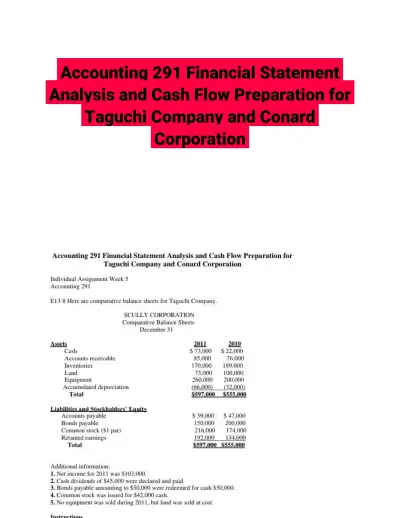 Solved Assignments
Accounting 291 Financial Statement Analysis and Cash Flow Preparation for Taguchi Company and Conard Corporation
Accounting
4 pagesMay 2025 Solved Assignments
ACC/291 Unethical Behavior Article Analysis University of Phoenix
Accounting
3 pagesMay 2025 Document
HW4_Solution
Electrical Engineering & Electronics
17 pagesFeb 2026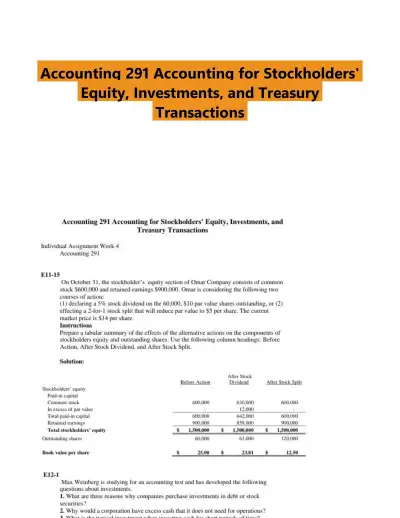 Solved Assignments
Accounting 291 Accounting for Stockholders' Equity, Investments, and Treasury Transactions
Accounting
4 pagesMay 2025 Solved Assignments
ACC/291 Reflection on Week 2: Learning Team C's Progress and Understanding of Accounting Concepts University of Phoenix
Accounting
4 pagesMay 2025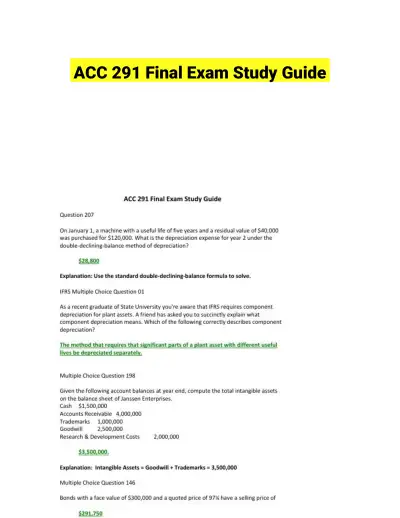 Solved Assignments
ACC 291 Final Exam Study Guide
Accounting
9 pagesMay 2025 Solved Assignments
ACC 291 Principles of Accounting II � University of Phoenix
Accounting
6 pagesMay 2025 Textbook Guides
Introduction to Financial Accounting, 11th Edition Solution Manual
Accounting
524 pages173downloadsFeb 2025
Study this document with CramX
Once it is in your library, every tool can work from it.