

Study Notes For Intermediate Accounting Volume 1, Seventh Canadian Edition
- Accounting
- 140 pages
- Shared May 2025
Get the edge on your exam prep with Study Notes For Intermediate Accounting Volume 1, Seventh Canadian Edition, offering chapter summaries and key revision papers.
Preview 16 of 140 pages
See the first 16 pages exactly as they appear in the document.
Page 1 Read page 1 as text
Intermediate Accounting , 7 th edition 1 CHAPTER 1 THE FRAMEWORK FOR FINANCIAL REPORTING Learning Objectives After you have studied this chapter, you should: LO - 1 Understand the various accounting standards used by Canadian entities. LO - 2 Understand the objectives of financial reporting. LO - 3 Understand the financial reporting needs of external users of financial information. LO - 4 Understand the motivations of preparers of financial information. Lecture Notes 1. ACCOUNTING STANDARDS IN CANADA Authoritative Source of Canadian Standards The accounting standard - setting body in Canada is the Accounting Standards Board (AcSB). The AcSB is pa rt of the Canadian Chartered Professional Accountants of Canada (CPA Canada) . The authority of CPA Canada comes from the corporation acts of the federal and provincial governments. The GAAP requirement for public companies is enforceable by the provincial securities commissions. The commissions are responsible for enforcing the reporting standards for companies that are traded in their province. The AcSB had for many decades maintained standards by regular revisions and additions to the CPA Canada Handbook. Currently the AcSB has a two - pronged approach for Canadian enterprises: For public companies or publicly accountable enterprises, I nternational F inancial R eporting S tandards ( IFRS ) is required for financial reporting for all reporting periods beginning on or after January 1, 2011. All the IFRS standards are included in the CPA Canada Handbook as Part 1. Private nonpublicly accountable enterprises have a choice betwe en using full IFRS or Canadian Accounting Standards for P rivate Enterprises ( ASPE ) as prescribed in the CPA Canada Handbook, Part II. AS PE is somewhat less complex, is based more on historical - cost accounting, and has far fewer disclosure requirements.
Page 2 Page 3 Read page 3 as text
Intermediate Accounting , 7 th edition 2 I FRS Overview International Financial Reporting Standards Overview International standards are developed and issued by the Internat ional Accounting Standards Board (IASB) . Canada accepts IFRS as an adopter, integrating the standards as written by the IASB without modification into the CPA Canada Handbook. The authoritative language for IFRS internationally is English although the standard is translated into many other languages. In Canada, however, there is an authoritative French version, since the standards must say the same thing in both English and French. Accounting Standards for Canadian Publicly - Accountable Enterprises Publicly accountable enterprise (PAE) is a ny company that has securities (debt or equity or both) issued to the public or that is in the process of issuing debt or equity to the public or a for - profit private enterprise that holds assets in a fiduciary capacity for a broad group of outsiders as one of its primary businesses. A fiduciary enterprise is any organization that acts in a trusteeship capacity for members of the general public. (e.g. a mutual fund, a privately owned bank, pension funds, credit unions). Government business enterprises must disclose their financial performance and thus are PAEs. Reporting in U.S. GAAP In order to enhance the acceptability of its shares in the U.S. financial markets, a Canadian company m a y choose to follow U.S. GAAP, but it is rare for a Canadian company to do so. Legal and Regulatory Requirements In some special industries such as banks, the normal provisions of IFRSs may be su pplemented by legal conditions such as requirements from Canada’s Bank Act. Reporting Currency Canadian companies do not always prepare their financial statements in Canadian dollars. In general, IFRS requires a company to use another presentation currency when its financial environment is other than the currency of its home country. The company should report in its functional currency which is the currency in which most of a company’s transactions are conducted.
Page 4 Read page 4 as text
Intermediate Accounting , 7 th edition 3 Accounting Standards for Canadian Private Enterprises A private enterp rise is one that does not issue debt or equi t y securities to the public nor is in the process of doing so and also does not hold assets in a fiduciary capacity. All shares are held privately and not offered for sale on the open market. Users are limited and generally have access to the information they need, either as owners and /or managers or as bankers/creditors. Private companies can use IFRS, ASPE or tailored accounting policies known as a disclosed basis of accounting. A private company is often referred to internationally a s a SME , which is a small to medium sized enterprise. Internationally, many countries follow IFRS for SMEs for appropriate private corporations; Canada chose instead to develop Canadian ASPE . The choice between following IFRS versus Canadian ASPE is unaffected by a Canadian private corporation’s size. Using IFRS A private company may use IFRS instead of ASPE because it is in competition with public companies for capital, and wants to be comparable. Despite the inability to sell shares to the public, private corporations can obtain substantial capital through private placements. A private placement is arranged by direct negotiation between the company seeking capital and one or more suppliers of capital. Other reasons for private companies to use IFRS: The company is a subsidiary of a parent that reports on the b asis of IFRS. The company may issue shares to the public in the future and wants to establish a pattern of IFRS compliance. The company’s controlling shareholders may intend to sell t he company in the near future and the use of IFRS may enhance credibility. Using ASPE The ACSB simplified the pre - existing standards in the CPA Canada Handbook, by stripping out requirements that are less appropriate for private companies. ASPE is based more on historical cost and less on fair values, and the disclosure requirements are less onerous. As a result of the continuing use of the CPA Canada Handbook instead of IFRS for SME s , many private companies found little change in their reports upon adoption of ASPE .
Page 5 Read page 5 as text
Intermediate Accounting , 7 th edition 4 Using a Disclosed Basis of Accounting In practice, private enterprises are not bound by GAAP unless an external user ( such as a major lender) requires the company to use GAAP. When non - GAAP accounting policies are used, the company is said to be reporting on a disclosed basis of accounting ( DBA ). A company cannot toss out all of GAAP. Deviations from GAAP usually are limited to just certain policies (e.g. using tax based CCA instead of accounting depreciation ) . Learning Multiple Sets of Standards Canada is using different accounting standards for public and private enterpri ses. Although these are two different sets of GAAP, they are very similar and use the same general principles and practices. Thus, Canadian ASPE can be regarded mainly as simplifying exceptions to IFRS rather than as a substantially different body of standards. The Issue of Comparability The point of establishing IFRS is not only to promote multiple exchange listings, but also to greatly improve comparability between companies based in different countries. However, international comparisons of financia l statements can be fraught with hazard because of differences between legal requirements, the political environment and ways of doing business . 2. OBJECTIVES FOR FINANCIAL REPORTING Management’s choice of accounting policy and disclosure are constrained by the requirements of IFRS and Canadian ASPE. To exercise judgement, the accountant must have criteria against which to measure the suitability of alternatives. The most fundamental criteria for deciding on policies, estimates, and disclosures are the objectives of financial reporting for the organization. To establish each enterprise’s financial objectives management must consider many aspects of the company and the users of its financial statements. See Exhibit 1 - 1 in the text which show the forces that shape a company’s financial reporting objectives (facts, constraints, prepare r motivations, user needs and user power). WATCH !
Page 6 Read page 6 as text
Intermediate Accounting , 7 th edition 5 3. GENERAL PURPOSE FINANCIAL REPORTING Financial reporting for public companies is “general purpose” because the potential interest group is large and diverse. A public company’s financial statements’ users can be anyone, anywhere. The information needs of investors , lenders and other creditors take priority over other groups such as employees and regulatory agencies for accounting standard - setting when the IASB is setting accounting standards. 4. ENTERPRISE PREPORTING OBJECTIVES In practice, “general purpose” is too general to guide specific enterprises. Identifying an entity’s specific reporting objectives is the first step for establishing the criteria by which accounting policies are chosen and accounting estimates are made. Users can be either external users or preparers (managers and accountants). Ethical Issues: Accountants are part of the preparer group because they carry out the accounting and reporting decisions of management. An accountant must be prepared to resist management’s potential pressure to deliberately misstate financial results, even if it leads to dismissal. 5. EXTERNAL USER OBJECTIVES Assessing and Predicting Cash Flows Cash flow assessment and prediction, especially by investors and creditors , is an important financial reporting objective. Assessment versus Prediction An a ssessment of cash flows is done by the financial statement user to understand the cash inflows and outflows of the enterprise in the current period, normally emphasizing cash flows from operating activities. Cash flow prediction requires extrapolating current cash flow into future years. Earnings Quality If there is a high degree of correlation between the operating cash flow per share and the earnings per share, the company is thought to have a high quality earnings. The perceived quality of earnings is good when the relationship between operating cash flow and net income is fairly stable. Effect on Financial Reporting Choices When cash flow assessment and prediction is the primary objective, financial reporting policies are chosen that provide the clearest indication of the cash flows underlying reported earnings. WATCH !
Page 7 Read page 7 as text
Intermediate Accounting , 7 th edition 6 Income Tax Deferral is a common objective for private companies . Financial reporting versus Income Tax Reporting Canada Revenue Agency (CRA) does not require a corporation to use the same reporting principles for tax as for accounting or vice versa. Tax - Book Conformity When corporations adopt the same accounting practices for financial reporting as for tax reporting, this is known as tax - book conformity. There is no requirement to do so in Canada. Tax Deferral versus Tax Evasion The use of legitimate options for reducing a company’s current taxable income is known as tax deferral or tax minimization . In contrast, deliberate misstatement on the tax return is tax evasion , which is fraud. Effect on Financial Reporting Choices Delaying recognition of revenue and speeding payment of expenses to the extent permitted by the Income Tax Act will minimize taxes. Accounting policies that reduce taxable income also reduce net income and may or may not be an issue for managers, depending on if their compensation is tied to book income. Contract Compliance External users often use financial statements as the basis for assessing whether an enterprise has complied with contract provisions (e.g. a debt - to - equity ratio). These provisions are known as covenants. If a company fails to meet them, le n ders have the right to call the loan and force immediate payment. Shareholders’ agreements in private corporations also usually have provisions that affect the valuation of shares if a shareholder decides to sell their shares. Effect on Fina n cial Reporting Choices Ratios in debt agreements and for share valuation in shareholders’ agreements are affected by accounting policy choices and estimates. Some agreements specify what accounting policies must be used for calculating ratios. Stewardship reporting focuses on showing the financial statement reader just how the res o urces entrusted to ma nagement’s care were managed, therefore t ransparency of accounting policy and measurement choices is important. Effect on Financial Reporting Choices The objective of stewardship is reflected in two ways: (1) minimization of interperiod allocations and (2) full disclosure. Performance Evaluation Financial statement readers often use the statements to evaluate management performance.
Page 8 Read page 8 as text
Intermediate Accounting , 7 th edition 7 Effect on Financial Reporting Choices In order to be useful for performance evaluation, financial statements should reflect the basis on which management decisions are made. Managers have strong motivations to select accounting policies that will enhance their apparent performance. Role of Auditor The auditor is not a user of the financial statements. Because they are independent from the company, they are able to provide an unbiased assessment of the financial statements and their conformity to GAAP. 6. PREPARE R MOTIVATIONS Preparer (management) motivations often conflict with external users’ objectives and may dominate the accounting choice process if external users lack the power to enforce the dominance of their objectives. Earnings Management Income Smoothing Widely fluctuating earnings are an indication of business risk, and mangers often don’t want to investors or creditors to perceive the company as being risky. Income can be smooth ed through spreading both revenues and cost s over several periods and by edging various accounting estimates up and down within a feasible range . Maximizing Earnings Maximization of net income is one of the most common motivations, particular l y in public companies where share price is affected by reported earnings. Common motivations to maximize earnings: To comply with debt covenants by creditors. To assist in positive management performance evaluations. To preserve or increase management compensation. The “Big Bath” A corporation may elect to maximize a loss in one year as part of a longer - run strategy to maximize earnings. If there is an operating loss any way, it is an opportunity to load as many losses into that year as possible (“taking a big bath ”) , and enjoy the benefits of recovery in a subsequent period. Minimizing Earnings Management may wish to minimize reported earnings to minimize income taxes, to avoid attracting competitors into a very profitable business, or to avoid negative scrutiny from the public, regulators or employees .
Page 9 Read page 9 as text
Intermediate Accounting , 7 th edition 8 Minimum Compliance refers to the motivation of managers to reveal the least amount of information that is possible while still complying with GAAP , which reduces the cost of producing the statements . Managers may wish to maintain confidentiality about their business activities in order to keep competitors in the dark. Expanded Disclosure The motivation for expanded disclosure may simply be to indicate that the company and its management are “good citizens ” that have nothing to hide. 7. CONFLICTING OBJECTIVES Once a company’s objectives have been identified, they then must be prioritized as often they are conflicting. Accounting requires the constant exe rcise of professional judgement and a clear ethical orientation to deal with the impact of conflicting objectives . 8. REQUIRED FINANCIAL STATEMENTS Under IFRS a complete set of financial statements consist of : 1. Statement of financial position 2. Statement of comprehensi ve income (including statement of profit or loss and statement of other comprehensive income) 3. Statement of changes in equity 4. Statement of cash flows 5. Disclosure notes: A set of notes comprising a summary of significant accounting policies and other explanatory information Under IFRS, financial statement titles are variable based on relevance to the users so variations in the statement titles are acceptable. Canadian Accounting Standards for Private E nterprises (ASPE) have a somewhat simpler set of financial statements: 1. Balance sheet 2. Income statement 3. Statement of changes in retained earnings 4. Statement of cash flows 5. Disclosure notes
Page 10 Read page 10 as text
Intermediate Accounting , 7 th edition 1 CHAPTER 2 Accounting Judgements Learning Objectives : After you have studied this chapter, you should: 1 Understand the c oncepts involved in constructing financial statements. 2 Explain the role of ethical professional judgement in accounting. 3 Apply the universal and entity specific assumptions underlying the foundation of GAAP. 4 Apply the fundamental and enhancing qualities and pervasive constraints of financial reporting. 5 Describe the measurement methods available within GAAP. 6 Discuss the criteria for recognizing business events and transactions in the financial records. 7 Describe the measurement methods used in the accounting standards for private enterprises. Lecture Notes Accounting is often a matter of making choices among possible alternatives. This chapter discusses the financial statement concepts and principles that guide standard setters and that accountants use to make those choices. These concepts and principles are the basis for professional judgement. Chapters 6 to 11 illustrate how those concepts and principles are applied to specific accounting issues. 1. CATEGORIES OF ACCOUNTING CONCEPTS The generally accepted body of accounting principles consists of three different types of concepts. The types of concepts are: 1. Underlying assumptions, which form the basic foundation for which accounting measurement rests . The accounting principle of continuity (going concern) is an underlying assumption.
Page 11 Read page 11 as text
Intermediate Accounting , 7 th edition 2 2. Qualitative criteria, which in conjunction with the organization’s reporting objectives , facts and constraints , are used to evaluate the possible measurement options and select the most appropriate measurement methods for a given situation . The principles of comparability and understandability are examples of qualitative criteria. 3. Measurement methods , which are the various ways in which financial position and the results of operations can be reported. These methods are how transactions and events are measured and reported. The accounting principles of fair value and realizable value are examples of measurement methods, and are both based on the underlying continuity assumption. Limitations of the Concepts There are limitations to the use of accounting concepts. They focus on generalities because they determine po licies for a wide application and on producing general purpose financial statements. Therefore, there are e xceptions to the applicability of the concepts and conclusions . Structure of Accounting Policy Choice In constructing the financial statements for an enterprise, you must determine the objectives of the financial reporting, make sure the underlying assumptions are valid, measure the elements of financial statements for the situation that satisfy the qualitative criteria and finally prepare the financial statements . This process is illustrated in Exhibit 2 - 1 of the textbook and follows this order of consideration: 1. Underlying assumptions 2. Qualitative criteria 3. Accounting choices a. Financial statement elements b. Recognition and realization c. Measurement methods In selecting accounting policies, an accountant must first evaluate the facts in the situation including reporting constraints . If the facts allow a choice, then the users and objectives are considered in selecting the appropriate accounting policy. Decisions cannot be made strictly according to which policy is best for the users and objectives while ignoring the facts in the situation. WATCH !
Page 12 Read page 12 as text
Intermediate Accounting , 7 th edition 3 2. ETHICAL PROF ESSIONAL JUDGEMENT – PART 1 The process of making choices in accounting is the process of exercising profes sional judgement. An accountant exercises professional judgement to be fair to all stakeholders. Judgement is used in many aspects of accounting that are not specifically dealt with in the accounting standards. This is done by taking into account several factors: • The users of financial statements and their specific information needs ; • The motivations of managers ; • The nature of the organization’s operations ; and • The organization’s reporting constraints. Accounting policy choices and estimates must be made taking these factors in to account. 3. UNDERLYING ASSUMPTIONS Underlying assumptions provide the foundation of GA AP for for - profit enterprises, but only the going - concern assumption is discussed specifically in the IFRS conceptual framework. There are six basic assumptions affect the recording, measuring, and reporting of account ing information. These are divided into 2 general categories (1) universal assumptions and (2) entity - specific assumptions. Universal a ssumptions: 1. Time - period. 2. Separate entity . 3. Unit of measure . Entity - specific a ssumptions (depend on an individual entity’s reporting circumstances) : 1. Proprietary . 2. Continuity . 3. Stable currency . GAAP changes in response to changes in the environment but the underlying assumptions are assumed to be constant. If any of these assumptions are not valid , then GAAP is not appropriate . Universal Assumptions The time - period assumption recognizes that information needs to be provided to users for a time period less than the enterprise’s life span and states that it is feasible to provide useful information in shorter periods while the enterprise is in operation . The standard reporting period is one year; ho wever, s ome companies use a calendar year - end that coincides with the low point in business activity over a 12 - month period. Other companies report summarized information on an interim basis (quarterly for public
Page 13 Read page 13 as text
Intermediate Accounting , 7 th edition 4 companies, monthly for internal purposes). Although the reporting period varies, one year is the standard. The separate entity assumption considers an accounting unit or identifiable business enterprise as separate and apart from its owners and from other entities. This concept does not necessarily correspond with legal and tax status of an entity. A corporation is an entity that is legally distinct. Partnerships and proprietorships are not legally distinct but the separate en tity assumption still applies; f or accounting purposes they are considered separate from their owners. All accounting records and reports are developed from the poi nt of view of a single entity with the assumption that an individual’s transactions are distinguishable from those of the busi ness. The unit - of - measure assumption refers to the results of the business’s economic activities. The assumption is that these can be reported in terms of a single stan dard monetary unit and, further, that everything of relevance can be measured using the dollar as the unit of measure. Thus, something that can’t be measured can’t be reported. Therefore, information that may be relevant to decision makers may not be reported, such as: • The value of in - house intellectual capital. • The impact of the company’s operations. • The value of customer goodwill and “human capital” (i . e . employees). Entity - Specific Assumptions The proprietary concept considers that the results of an enterprise’s opera tions should be reported from the point of view of the owners. This concept is applied to all types of business enterprises and has nothing to do with the form of the enterprise (i.e., proprietorship, partnership, or corporation). This concept follows the accounting equation with assets discharging liabilities and residual wealth to the owners. The continuity assumption is also known as the going - concern assumption. The assumption is that the enterprise will continue operating for the foreseeable future and not be liquidated. It assumes that the business will continue long enough to recover the assets and repay its outstanding liabilities. This assumption provides the conceptual basis for measuring and classifying assets and liabilities in current and non - current classifications . There are two instances where this assumption is not valid - a limited life venture, and a business in financial difficulty that is expected to be shut down. If this assumption is in doubt because of financial difficulty, the historical costs of assets are not relevant and liquidation accounting is appropriate.
Page 14 Read page 14 as text
Intermediate Accounting , 7 th edition 5 A common problem is the misuse of the term going concern . A company that is considered to be a going concern is expected to continue in operation. If there is a going concern issue or going concern problem, then this assumption is no longer valid. An example would be where the company is undergoing financial re structuring. The stable currency assumption assumes constant purchasing power and tha t the value of the dollar does not change significantly from year to year. The reason for this assumption is that inflation in most developed countries has been relati vely modest. It also assumes the dollar is constant in relation to the value of other currencies (its exchange rate). Two other concepts are related to the stable currency assumption. The concept of capital maintenance explains that to keep operating successfully , an entity must preserve its capital investment . This assumption also includes the use of a nominal dollar , which is not adjusted for inflation. The nominal dollar assumption is still dominant universally, due to the reliance on historical cost methods in the measurement of assets. As we move more to fair value accounting, alternative perspectives are gaining strength. Alternative Capital Maintenance Approaches Financial capital maintenance is measure d in nominal monetary units or in units of constant purchasing power. Constant dollar capital maintenance says that not all dollars are created equally. Therefore, if prices are rising then the enterprise needs to keep more nominal dollars invested in capital to stay even. Physical capital maintenance concept recognizes that the prices of different goods and services change at different rates. The key is the company needs to maintain the same level of productive capacity in its assets. This is the perspective that supports the use of fair - value reporting. 4. QUALITATIVE CRITERIA Qualitative criteria are criteria that, in conjunction with the organization’s reporting objectives, are used to evaluate possible measurement options and to choose the most appropriate accounting policies. The qualitative criteria are summarized in a tabl e on the next page . WATCH!
Page 15 Read page 15 as text
Intermediate Accounting , 6 th edition 15 CRITERIA COMPONENTS DESCRIPTION FUNDAMENTAL QUALITIES (both qualitative characteristics must be present to represent an economic event and cannot be traded of) 1. Relevance Capacity of accounting information to make a difference to the external decision - makers who use financial reports. Theoretically , relevance is the most important qualitative characteristic . Predictive value Confirmatory or Feedback value Accounting information should be helpful to external decision makers by increasing their ability to make decisions about the outcome of future events (predictive value). Accounting information should be helpful to external decision makers who are confirming or adjusting past predictions. 2. Faithful representation The information is a sufficient ly accurate measure of what it is intended to measure. Although currently not a specific component of faithful representation, substance over form, represents the economic rather than legal impact of a transaction, is included as an element of faithfully portraying a transaction. Faithful representation is closely related to reliability. Completeness Information must give a faithful picture of the economic events or financial elements . The information must not mislead or deceive . Neutrality Financial reports are neutral if they do not influence a user’s decisions . It is also known as free from bias . Freedom from material error If the statements are free from bias, overstatements and understatements must not exist . Faithful representation does not imply “accuracy” in that it is completely free from error, but rather free from material error. ENHANCING QUALITIES (the order of these qualities is not a hierarchy, as these characteristics are traded off as needed in support of the fundamental qualities) 3. Comparability Enables users to identify simi larities and differences between two sets of financial statements. Consistency Entails using the same accounting policies from period to period within the firm. If consistency is carried too far, it adversely affects relevance, so a change of policy is permitted if applied appropriately. Uniformity Companies with similar transactions and similar circumstances use the same accounting treatments. 4. Verifiability The accounting measure is a reasonable measure of the economic event, without material error or bias; and
Page 16 Read page 16 as text
Intermediate Accounting , 6 th edition 16 CRITERIA COMPONENTS DESCRIPTION If knowledgeable and independent observers using the same measurement metho ds can measure an economic event and arrive at generally the same result, the measurement is verifiable. 5. Timeliness Accounting information should be reported soon enough for it to be useful for decision making (within economic context) . Lack of timeliness reduces relevance. 6. Understandability Based on the assumption that investors and creditors have a reasonable understanding of business and economic activities — and of accounting. Information must be understandable to be useful. PERVASIVE CONSTRAINTS 7. Materiality Materiality is used to describe the significance of an item. Information is material if its omissio n or misstatement would be likely to change or impact the user’s decision. Materiality is related to both relevance and faithful representation. 8. Cost/benefit tradeoff Any accounting measurement or disclosure should result in greater benefits to the users than its cost to prepare and present. Benefits should exceed costs. It is for this reason the AcSB provides for a somewhat simpler version of GAAP called A ccounting S tandards for P rivate E nterprises (ASPE) which enables private companies to follow simpler accounting policies in some areas.
124 more pages in the full document
Unlock it once and it stays in your library, ready to chat with or turn into flashcards.
Unlock the full documentMore Accounting study materials
See all Exam Guides
Intermediate Accounting Volume 2 Seventh Canadian Edition Test Bank
Accounting
312 pagesMay 2025 Exam Guides
Intermediate Accounting, 10th Edition Test Bank
Accounting
450 pagesMay 2025 Exam Guides
Intermediate Accounting Volume 2, Seventh Canadian Edition Test Bank
Accounting
605 pagesMay 2025 Textbook Guides
Solution Manual For Intermediate Accounting Volume 1, Seventh Canadian Edition
Accounting
690 pagesMay 2025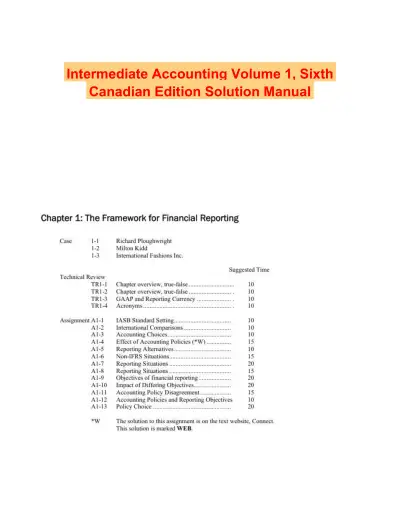 Textbook Guides
Intermediate Accounting Volume 1, Sixth Canadian Edition Solution Manual
Accounting
603 pagesMay 2025 Class Notes
Revision Notes for Intermediate Accounting, 2nd Edition
Accounting
65 pagesMay 2025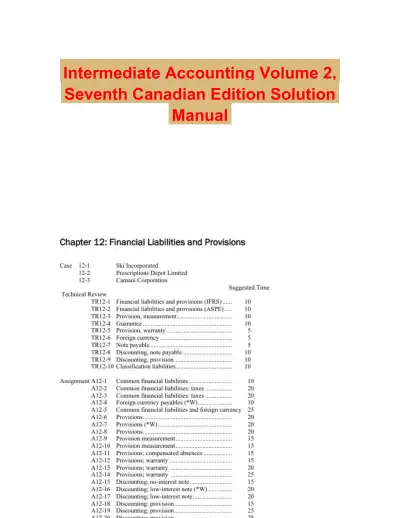 Textbook Guides
Intermediate Accounting Volume 2, Seventh Canadian Edition Solution Manual
Accounting
704 pagesMay 2025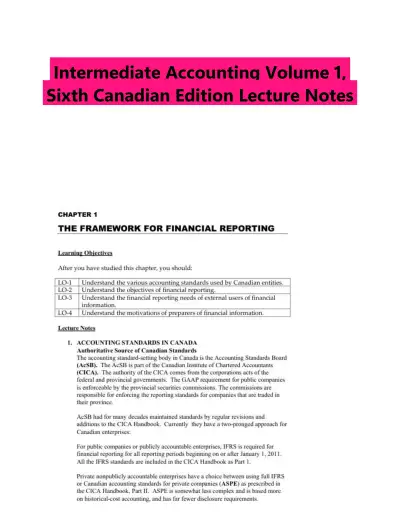 Class Notes
Intermediate Accounting Volume 1, Sixth Canadian Edition Lecture Notes
Accounting
126 pagesMay 2025
Study this document with CramX
Once it is in your library, every tool can work from it.