

Accounting Principles II – Traditional Cost Systems
- Accounting
- Texas A&M University
- 31 pages
- Shared March 2026
Preview 10 of 31 pages
See the first 10 pages exactly as they appear in the document.
Page 1 Read page 1 as text
Study Guide Accounting Principles II – Traditional Cost Systems 1. Job Order Cost System 1. Types of Manufacturing Processes Manufacturing companies generally use two basic production approaches : • Job order production – Each order is unique and made to customer specifications. • Mass (process) production – Products are identical and produced continuously. To track costs for these approaches, companies use two traditional cost accounting systems: • Job Order Cost System • Process Cost System These systems help managers understand how much it costs to produce products or services . 2. What Is a Job Order Cost System? A job order cost system is used when products or services are made to order . • Each customer order is treated as a separate job • Costs are tracked by job • Services can also be treated as jobs Examples of service jobs: • A financial plan prepared by a certified financial planner • An estate plan created by an attorney In manufacturing, each job includes three types of costs :
Page 2 Read page 2 as text
Study Guide 1. Direct materials 2. Direct labor 3. Manufacturing (factory) overhead 3. Job Cost Sheet The job cost sheet is the main document used in a job order cost system. It records: • Job number and customer information • Dates the job started, completed, and shipped • Direct materials used • Direct labor costs • Manufacturing overhead applied • Total cost of the job This document allows managers to see the full cost of each individual job .
Page 3 Read page 3 as text
Study Guide 4. Materials Requisition Form When raw materials are taken from storage and used in production, a materials requisition form is completed. This form: • Ensures materials costs are charged to the correct job • Transfers material costs from Raw Materials Inventory to Work - in - Process Inventory • Helps maintain accurate inventory records
Page 4 Read page 4 as text
Study Guide 5. Time Tickets and Direct Labor Labor costs are assigned to jobs using time tickets . A time ticket shows: • Which employee worked • Which job they worked on • Hours worked • Hourly wage • Total labor cost Using time tickets ensures that direct labor costs are properly assigned to each job .
Page 5 Read page 5 as text
Study Guide 6. Predetermined Overhead Rate Manufacturing overhead cannot be traced directly to jobs, so it is allocated using a predetermined overhead rate . How the rate is calculated: Example: • Estimated overhead costs = $300,000 • Estimated direct labor costs = $250,000
Page 6 Read page 6 as text
Study Guide This means overhead is applied at 120% of direct labor cost . 7. Applying Overhead to Jobs If direct labor for the month is $20,000: • Overhead applied = $20,000 × 120% = $24,000 Overhead is then assigned to each job based on its share of direct labor. Example: • Job 45 has $9,000 in direct labor • Overhead applied = $9,000 × 120% = $10,800 8. Flow of Job Costs Once production progresses, costs move through inventory accounts: 1. Work - in - Process Inventory – Accumulates materials, labor, and overhead 2. Finished Goods Inventory – Receives costs when a job is completed 3. Cost of Goods Sold – Receives costs when the job is sold
Page 7 Read page 7 as text
Study Guide This flow ensures costs are matched to revenue in the correct period.
Page 8 Read page 8 as text
Study Guide 9. Factory Overhead: Under - and Over - Applied The Factory Overhead account compares: • Actual overhead incurred • Overhead applied to jobs
Page 9 Read page 9 as text
Study Guide Possible outcomes: • Debit balance → Under - applied overhead (not enough applied) • Credit balance → Over - applied overhead (too much applied) The factory overhead account must have a zero balance at year - end . Most companies close any remaining balance to Cost of Goods Sold . If the amount is small (such as $2,600), it is usually transferred entirely to cost of goods sold. 10. Journal Entry to Close Under - Applied Overhead To close under - applied overhead: • Debit Cost of Goods Sold • Credit Factory Overhead This adjusts expenses to reflect actual costs.
Page 10 Read page 10 as text
Study Guide
21 more pages in the full document
Unlock it once and it stays in your library, ready to chat with or turn into flashcards.
Unlock the full documentMore Accounting study materials
See all Quick Guides
Accounting Principles II – Current Liabilities
Accounting
15 pagesMar 2026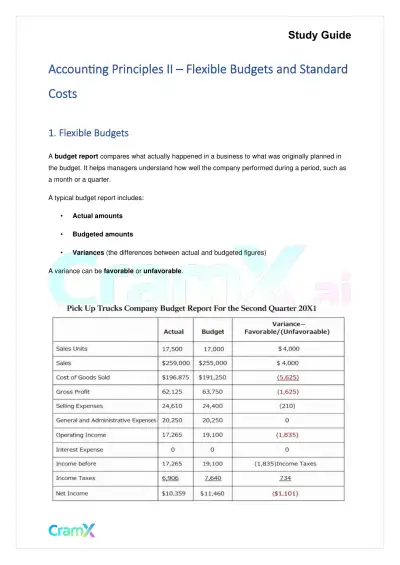 Quick Guides
Accounting Principles II – Flexible Budgets and Standard Costs
Accounting
23 pagesMar 2026 Quick Guides
Accounting Principles II – Activity-Based Costing
Accounting
13 pagesMar 2026 Quick Guides
Accounting Principles II – Cost-Volume-Profit Relationships
Accounting
20 pagesMar 2026 Quick Guides
Accounting Principles II – Capital Budgeting
Accounting
13 pagesMar 2026 Quick Guides
Accounting Principles II – Managerial and Cost Accounting Concepts
Accounting
20 pagesMar 2026 Quick Guides
Accounting Principles II – Partnerships
Accounting
23 pagesMar 2026 Quick Guides
Accounting Principles II – Investments
Accounting
19 pagesMar 2026
Study this document with CramX
Once it is in your library, every tool can work from it.