

Accounting Principles II – Statement of Cash Flows
- Accounting
- Texas A&M University
- 33 pages
- Shared March 2026
Preview 10 of 33 pages
See the first 10 pages exactly as they appear in the document.
Page 1 Read page 1 as text
Study Guide Accounting Principles I I – Statement of Cash Flows 1. Statement Sections Why Cash Management Matters Cash management is a key part of running any business. A company must know how much cash it expects to receive and how much cash it needs to pay out . This information helps managers decide whether the business has extra cash to invest or whether it will need more cash to cover daily needs — such as paying employees or suppliers. What Is the Statement of Cash Flows? The statement of cash flows is a financial statement that shows how cash and cash equivalents move in and out of a business over a specific period of time. Cash equivalents are short - term, highly liquid investments that usually mature within three months of purchase. Common examples include: • U.S. Treasury bills • Money market funds • Commercial paper Throughout this chapter, the word “cash” means cash plus cash equivalents . 1. Main Sections of the Statement of Cash Flows The statement of cash flows is divided into four main sections : 1. Operating activities 2. Investing activities 3. Financing activities 4. Cash reconciliation
Page 2 Read page 2 as text
Study Guide The first three sections explain where cash came from and how it was used , while the fourth section shows how total cash changed during the period . 2. Format of the Statement of Cash Flows Like all financial statements, the statement of cash flows begins with a three - line heading : • Name of the company • Name of the statement • Time period covered (such as a month, quarter, or year) 3. Operating Activities What Are Operating Activities? The operating activities section comes first. It shows whether the company generated enough cash from its normal, day - to - day business operations . Typical operating cash flows include: • Cash collected from customers • Payments to employees and suppliers • Payments for operating expenses
Page 3 Read page 3 as text
Study Guide • Payments for taxes • Interest received • Dividends received • Interest paid There are two acceptable methods for reporting operating activities. These methods are explained later in the section titled “Preparing the Statement of Cash Flows.” 4. Investing Activities Purpose of Investing Activities The investing activities section shows how a company uses cash to grow or maintain its business . It focuses on changes in long - term assets . This section includes cash transactions related to: • Land • Buildings • Equipment • Intangible assets • Investments (excluding cash equivalents) Special Note on Notes Receivable • If a note receivable comes from selling goods or services to a customer, cash collected is reported as an operating activity . • If the note was created for another purpose, the cash collected is reported as an investing activity . Common investing activities include:
Page 4 Read page 4 as text
Study Guide • Buying and selling equipment • Buying and selling securities • Making loans and collecting loan repayments 5. Financing Activities What Financing Activities Show The financing activities section explains how the company pays for its operations and growth . It reports changes in: • Long - term liabilities • Stockholders’ equity Typical financing activities include: • Borrowing money • Repaying loans • Issuing company stock • Paying dividends • Repurchasing company stock 6. Reporting Cash Inflows and Outflows Separately In both the investing and financing sections, each cash inflow and outflow must be reported separately . For example: • If equipment is sold for $7,000 and new equipment is purchased for $50,000, both transactions are listed separately. • If the company borrows $1,000,000 and repays $150,000 during the same period, each transaction is shown individually.
Page 5 Read page 5 as text
Study Guide 7. Cash Reconciliation How Cash Is Reconciled The cash reconciliation section is the final part of the statement. It explains how cash changed from the beginning to the end of the period. The process works like this: 1. Start with the net increase or decrease in cash , calculated from operating, investing, and financing activities. 2. Add the beginning cash balance . 3. The result is the ending cash balance . The ending cash balance must match the cash reported on the balance sheet at the end of the period.
Page 6 Read page 6 as text
Study Guide Non - Cash Transactions Some important business activities do not involve cash. These non - cash transactions are not included in the statement of cash flows. However, if they are significant, they must be disclosed: • Below the statement, or • In the notes to the financial statements 2. Preparing the Statement of Cash Flows To prepare a statement of cash flows, accountants can choose one of two acceptable methods : 1. The Direct Method 2. The Indirect Method The difference between these two methods appears only in the operating activities section . Even though the format is different, both methods always result in the same total cash provided by operating activities . Overview of the Two Methods Both methods report: • Cash from operating activities • Cash from investing activities • Cash from financing activities However, they explain operating cash flows in different ways.
Page 7 Read page 7 as text
Study Guide 1. Direct Method What Is the Direct Method? The direct method reports cash flows by listing actual cash receipts and cash payments related to daily business operations. Instead of starting with net income, this method focuses on where cash actually came from and where it went . Common Cash Inflows and Outflows Under the direct method, operating activities include: • Cash collected from customers • Cash paid to suppliers • Cash paid for operating expenses • Cash paid for interest
Page 8 Read page 8 as text
Study Guide • Cash paid for income taxes These clear labels make the statement easy to read and easy to understand , especially for students and non - accountants. 2. Indirect Method What Is the Indirect Method? The indirect method begins with net income from the income statement. It then adjusts net income to convert it from an accrual basis to a cash basis . Why Most Companies Use the Indirect Method Although the Financial Accounting Standards Board (FASB) prefers the direct method, most companies choose the indirect method because: • It is easier to prepare • It reveals less detailed information to competitors Adjustments Made Under the Indirect Method Net income is adjusted for: • Non - cash expenses , such as depreciation and amortization • Gains and losses from asset sales • Changes in current assets and current liabilities Examples of common adjustments: • Depreciation expense is added back • A loss on sale of equipment is added back • Increases and decreases in working capital accounts are adjusted to reflect actual cash flow
Page 9 Read page 9 as text
Study Guide Using Financial Statements to Prepare the Cash Flow Statement To demonstrate both methods, information from Brothers’ Quintet, Inc. is used. The following financial statements provide the data needed. Balance Sheets (20X1 and 20X0)
Page 10 Read page 10 as text
Study Guide
23 more pages in the full document
Unlock it once and it stays in your library, ready to chat with or turn into flashcards.
Unlock the full documentMore Accounting study materials
See all Quick Guides
Accounting Principles II – Current Liabilities
Accounting
15 pagesMar 2026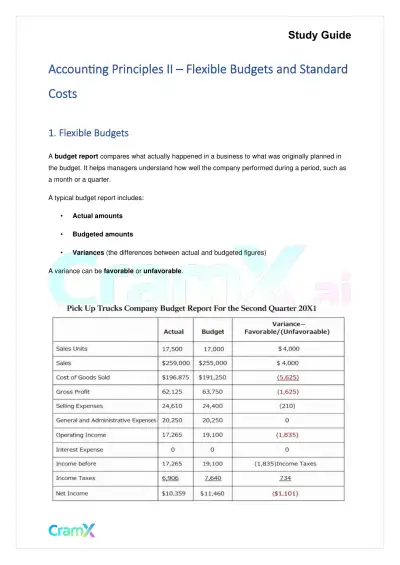 Quick Guides
Accounting Principles II – Flexible Budgets and Standard Costs
Accounting
23 pagesMar 2026 Quick Guides
Accounting Principles II – Activity-Based Costing
Accounting
13 pagesMar 2026 Quick Guides
Accounting Principles II – Cost-Volume-Profit Relationships
Accounting
20 pagesMar 2026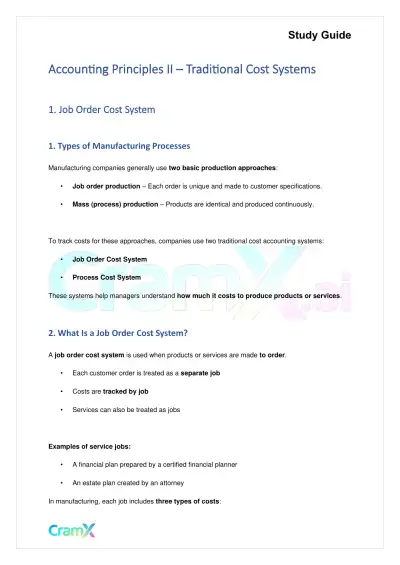 Quick Guides
Accounting Principles II – Traditional Cost Systems
Accounting
31 pagesMar 2026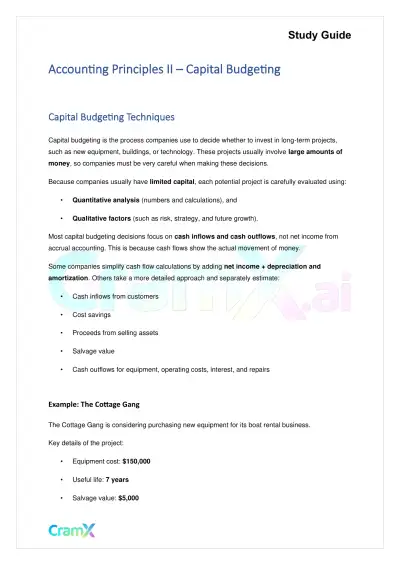 Quick Guides
Accounting Principles II – Capital Budgeting
Accounting
13 pagesMar 2026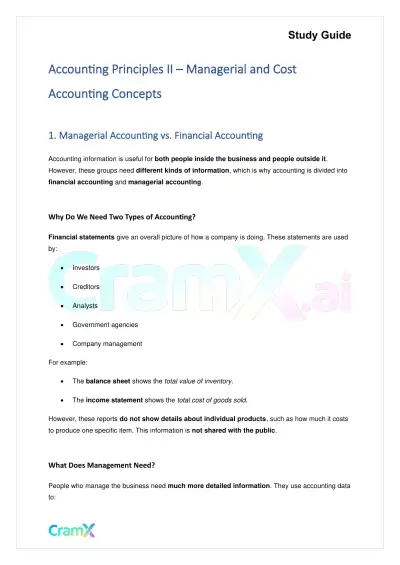 Quick Guides
Accounting Principles II – Managerial and Cost Accounting Concepts
Accounting
20 pagesMar 2026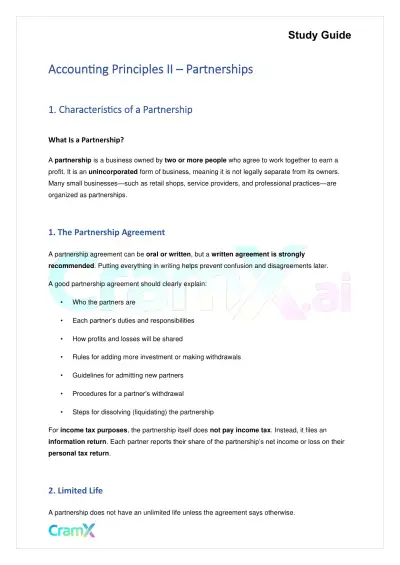 Quick Guides
Accounting Principles II – Partnerships
Accounting
23 pagesMar 2026
Study this document with CramX
Once it is in your library, every tool can work from it.