
QQuestionAnatomy and Physiology
QuestionAnatomy and Physiology
Name Date
Angle Relationships Worksheet #2
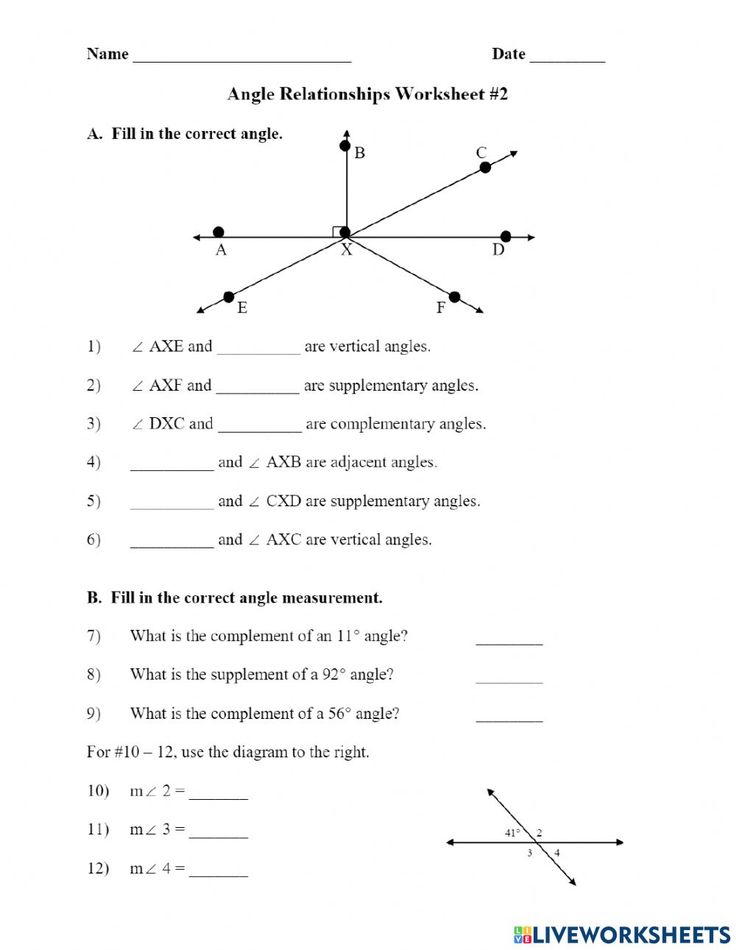
A. Fill in the correct angle.
I c
A X D
E F
1) <AXEand are vertical angles.
2) ZAXFand are supplementary angles.
3) ~DXCand are complementary angles.
4) and 2 AXB are adjacent angles
5) and 2 CXD are supplementary angles.
6) and 2 AXC are vertical angles.
B. Fill in the correct angle measurement.
7) What is the complement of an 11° angle?
8) Whats the supplement of a 92° angle?
9) What is the complement of a 56° angle?
For #10 - 12, use the diagram to the right.
10) ms^2 =_
1) med=__ Ng
NG
12) mz^4 =__
SaLIVEWORKSHEETS
Attachments
3 months agoReport content
Answer
Full Solution Locked
Sign in to view the complete step-by-step solution and unlock all study resources.
Step 1:: Identify the angles that are vertical angles in question 1.
Vertical angles are angles that have the same measure and are formed by two intersecting lines. In this case, angles AXE and DXC are vertical angles.
Step 2:: Write the equation for vertical angles.
mangle{AXE} = mangle{DXC}
Step 3:: Fill in the given angle measurement for AXE.
mangle{AXE} = 50^\circ
Step 4:: Since these angles are equal, mangle{DXC} is also 50^\circ.
Final Answer
Step 5: Identify the angles that are supplementary in question 2. Supplementary angles are angles that add up to 180 degrees. In this case, ZAXF and AXB are supplementary angles. Step 6: Write the equation for supplementary angles. mangle{AXF} + mangle{AXB} = 180^\circ Step 7: Fill in the given angle measurement for AXB. mangle{AXB} = 50^\circ Step 8: Solve for mangle{AXF}. mangle{AXF} = 180^\circ - mangle{AXB} mangle{AXF} = 180^\circ - 50^\circ Step 9: Simplify the equation. mangle{AXF} = 130^\circ Step 10: Identify the angles that are complementary in question 3. Complementary angles are angles that add up to 90 degrees. In this case, DXC and EXF are complementary angles. Step 11: Write the equation for complementary angles. mangle{DXC} + mangle{EXF} = 90^\circ Step 12: Fill in the given angle measurement for DXC. mangle{DXC} = 50^\circ Step 13: Solve for mangle{EXF}. mangle{EXF} = 90^\circ - mangle{DXC} mangle{EXF} = 90^\circ - 50^\circ Step 14: Simplify the equation. mangle{EXF} = 40^\circ Step 15: Identify the adjacent angles in question 4. Adjacent angles are angles that have a common vertex and a common side. In this case, angles AXB and CXD are adjacent angles. Step 16: Write the equation for adjacent angles. mangle{AXB} + mangle{CXD} = mangle{AXD} Step 17: Fill in the given angle measurement for AXB. mangle{AXB} = 50^\circ Step 18: Solve for mangle{CXD}. mangle{CXD} = mangle{AXD} - mangle{AXB} mangle{CXD} = 130^\circ - 50^\circ Step 19: Simplify the equation. mangle{CXD} = 80^\circ Step 20: Identify the adjacent angles in question 5. Adjacent angles are angles that have a common vertex and a common side. In this case, angles AXC and CXD are adjacent angles. Step 21: Write the equation for supplementary angles. mangle{AXC} + mangle{CXD} = 180^\circ Step 22: Fill in the given angle measurement for AXC. mangle{AXC} = 50^\circ Step 23: Solve for mangle{CXD}. mangle{CXD} = 180^\circ - mangle{AXC} mangle{CXD} = 180^\circ - 50^\circ Step 24: Simplify the equation. mangle{CXD} = 130^\circ Step 25: Identify the complement of an 11° angle in question 7. The complement of an angle is the angle that, when added to the angle, makes a right angle (90°). Step 26: Write the equation for the complement of an angle. mangle{complement} + mangle{11^\circ} = 90^\circ Step 27: Solve for mangle{complement}. mangle{complement} = 90^\circ - mangle{11^\circ} Step 28: Simplify the equation. mangle{complement} = 79^\circ Step 29: Identify the supplement of a 92° angle in question 8. The supplement of an angle is the angle that, when added to the angle, makes a straight angle (180°). Step 30: Write the equation for the supplement of an angle. mangle{supplement} + mangle{92^\circ} = 180^\circ Step 31: Solve for mangle{supplement}. mangle{supplement} = 180^\circ - mangle{92^\circ} Step 32: Simplify the equation. mangle{supplement} = 88^\circ Step 33: Identify the complement of a 56° angle in question 9. The complement of an angle is the angle that, when added to the angle, makes a right angle (90°). Step 34: Write the equation for the complement of an angle. mangle{complement} + mangle{56^\circ} = 90^\circ Step 35: Solve for mangle{complement}. mangle{complement} = 90^\circ - mangle{56^\circ} Step 36: Simplify the equation. mangle{complement} = 34^\circ Step 37: Find the measure of angle AXD in question 10. We can find the measure of angle AXD by adding the measures of angles AXB and CXD. Step 38: Fill in the given angle measurements. mangle{AXD} = mangle{AXB} + mangle{CXD} mangle{AXD} = 50^\circ + 80^\circ Step 39: Simplify the equation. mangle{AXD} = 130^\circ Step 40: Find the measure of angle NG in question 11. We can find the measure of angle NG by subtracting the measures of angles SAL and AXB from the measure of angle SALI. Step 41: Fill in the given angle measurements. mangle{NG} = mangle{SALI} - mangle{SAL} - mangle{AXB} mangle{NG} = 180^\circ - 30^\circ - 50^\circ Step 42: Simplify the equation. mangle{NG} = 100^\circ Step 43: Find the measure of angle Z^4 in question 12. We can find the measure of angle Z^4 by adding the measures of angles SAL and AXB. Step 44: Fill in the given angle measurements. mangle{Z^4} = mangle{SAL} + mangle{AXB} mangle{Z^4} = 30^\circ + 50^\circ Step 45: Simplify the equation. mangle{Z^4} = 80^\circ
Need Help with Homework?
Stuck on a difficult problem? We've got you covered:
- Post your question or upload an image
- Get instant step-by-step solutions
- Learn from our AI and community of students