

Comprehensive Art History: Key Concepts And Artistic Movements
- Art
- 23 pages
- Shared May 2025
This Assignment Solution covers key artistic movements and concepts. Download now!
Preview 7 of 23 pages
See the first 7 pages exactly as they appear in the document.
Page 1 Read page 1 as text
Comprehensive Art History: Key Concepts and Artistic Movements The study of arts and their history is beneficial because: A. artists and their work tend to be the most accurate reflection of the times in which they lived. B. they teach us about our own creative expressions and those of our past. C. they visually express our natural impulse to advance scientifically. D. artists advance in form and content as civilizations advance technologically. Answer: B. they teach us about our own creative expressions and those of our past. A primary motivation for artistic expression is the natural human desire for: A. decoration. B. appreciation. C. recognition. D. immortality. Answer: D. immortality. A carnival sideshow that exhibits a wax - and - fur replica of a giant ape as genuine is engaging in: A. trompe - l'oeil. B. abstraction. C. illusionism. D. naturalism. Answer: C. illusionism. Artists have been associated with gods, and vice versa, because both are said to have the power of: A. immortality. B. inspiration. C. creation. D. divinity. Answer: C. creation. Film director Alfred Hitchcock once said, "My concern [about content in my films] is the same as that of an artist painting a bowl of fruit's concern about whether they're sweet or sour. Who cares?" This is an example of which methodology of art - history analysis? A. Iconography B. Iconology C. Deconstruction
Page 2 Page 3 Read page 3 as text
D. Formalism Answer: D. Formalism. __________ is an illusion of three - dimensional space. A. Area B. Volume C. Mass D. Depth Answer: D. Depth. The primary colors are: A. red, yellow, blue, and green. B. red, blue, and green. C. blue, red, and yellow. D. black, gray, and white. Answer: C. blue, red, and yellow. Which color is used to produce happiness? A. Yellow B. Blue C. Red D. Orange Answer: A. Yellow The Betrayal of Images (p. 5) would most likely be described stylistically as: A. nonrepresentational. B. realistic. C. expressive. D. illusionistic. Answer: A. nonrepresentational. The diorite sculpture of the head of Lagashian king Gudea (p. 39) is an example of __________ artwork. A. idealized B. naturalistic C. stylized D. nonfigurative
Page 4 Read page 4 as text
Answer: C. stylized A good example of a Paleolithic sculpture - in - the - round is: A. Stonehenge. B. the Tuc d' Audoubert Bison. C. the Venus of Willendorf. D. the Wandjina. Answer: C. the Venus of Willendorf. Paleolithic paintings of animals are usually found: A. in the uninhabited depths of caves. B. at the mouths of caves. C. in Neolithic shelters. D. on rock faces open to the light of day. Answer: A. in the uninhabited depths of caves. The megaliths of Western Europe regularly occur in which three types? A. Paleoliths, mesoliths, and neoliths B. Menhir, dolmen, and cromlech C. High relief, low relief, and sunken D. Post - and - lintel, tenon, and trilithon Answer: B. Menhir, dolmen, and cromlech __________ are purported to be "phallic fertilizers of Mother Earth." A. Megaliths B. Menhirs C. Tenons D. Sarsens Answer: B. Menhirs Stonehenge is regarded as the most famous of the European: A. monoliths. B. sculptures - in - the - round. C. cromlechs. D. mesoliths. Answer: C. cromlechs. An artistic convention characteristic of ancient Near Eastern art is:
Page 5 Read page 5 as text
A. two - dimensional figures on a flat space. B. symmetrical, frontal view of the human form. C. no indication of space extending behind the figures. D. figures and objects walking on flat, extended plane. Answer: B. symmetrical, frontal view of the human form. A ziggurat is a: A. pyramid. B. fort. C. building made by Gudea. D. Mesopotamian temple platform. Answer: D. Mesopotamian temple platform. Mesopotamian cylinder seals were used for what type of printing? A. Intaglio B. Offset C. Cuneiform D. Calligraphy Answer: A. Intaglio The earliest known writing is called: A. cuneiform. B. hieroglyphics. C. the alphabet. D. Assadian. Answer: A. cuneiform. Cuneiform literally means: A. cone - shaped. B. cylindrical. C. wedge - shaped. D. rectangular. Answer: C. wedge - shaped. The Seated Statue of Khafre dates to around: A. 3000 B.C. B. 2500 B.C.
Page 6 Read page 6 as text
C. 2000 B.C. D. 3500 B.C. Answer: B. 2500 B.C. Menkaure and Khamerenebty are: A. sculptures - in - the - round. B. wall paintings. C. architects. D. sculptures in very high relief. Answer: A. sculptures - in - the - round. Egyptian paintings of royal figures are generally: A. naturalistic. B. stylized. C. colossal. D. colorful. Answer: B. stylized. The source of Egyptian columns is generally: A. human forms. B. animal forms. C. plant forms. D. architectural forms. Answer: C. plant forms. Styles under Akhenaton were more __________ than before his reign. A. stylized B. hieratic C. conventional D. naturalistic Answer: D. naturalistic The modern name for Thera is: A. Knossos. B. Cairo. C. Anatolia. D. Santorini.
Page 7 Read page 7 as text
Answer: D. Santorini. Which is NOT a Theran fresco? A. The Ship Fresco B. The Boxing Children C. The Griffins D. The Crocus Gatherer Answer: C. The Griffins The column flanked by lions at the entrance to Mycenae symbolized: A. a phallus. B. a tree. C. a goddess. D. a building. Answer: C. a goddess. Tholos is Greek for: A. a tomb. B. round building. C. chamber. D. temple. Answer: B. round building. Corbeling is used to make a(n): A. temple. B. relief sculpture. C. arch. D. grave circle. Answer: C. arch. Which is NOT part of the Parthenon plan? A. Naos B. Treasury C. Pronaos D. Propylaea Answer: D. Propylaea Which is found in the Parthenon sculptures?
16 more pages in the full document
Unlock it once and it stays in your library, ready to chat with or turn into flashcards.
Unlock the full documentMore Art study materials
See all Class Notes
Class Notes for Understanding Movies, 14th Edition
Art
122 pages134downloadsFeb 2025 Exam Guides
Test Bank for Understanding Movies, 14th Edition
Art
168 pages109downloadsFeb 2025 Exam Guides
Test Bank For Business Essentials, Eighth Canadian Edition 8th Edition
Art
1103 pages46downloadsFeb 2025 Practice Problems
The Power Of Self-Portrait Photography: A Reflection Of Identity And Expression
Art
4 pagesMay 2025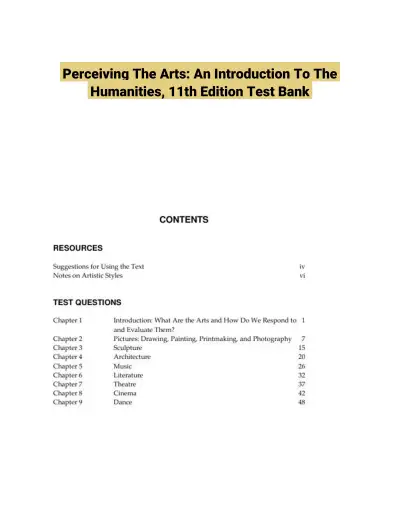 Exam Guides
Perceiving The Arts: An Introduction To The Humanities, 11th Edition Test Bank
Art
69 pagesMay 2025 Solved Assignments
Architectural and Sculptural Masterpieces: A Comparative Analysis of Hagia Sophia, Chartres Cathedral, and the Two Davids
Art
4 pagesMay 2025 Solved Assignments
Abstract Expressionism and Pop Art
Art
5 pagesMay 2025 Class Notes
Unusual Normality, by Ishmael Beah
Art
4 pagesJun 2025
Study this document with CramX
Once it is in your library, every tool can work from it.