
Past Exams
ATI PN Pediatrics Proctored Exam Version 8 with Answers (166 Solved Questions)
- Assessment Technologies Institute
- 40 pages
- Shared February 2025
- 126 downloads
ATI PN Pediatrics Proctored Exam Version 8 with Answers is a valuable resource to understand question trends and difficulty levels.
Preview · 13 of 40 pages
100%
Page 1
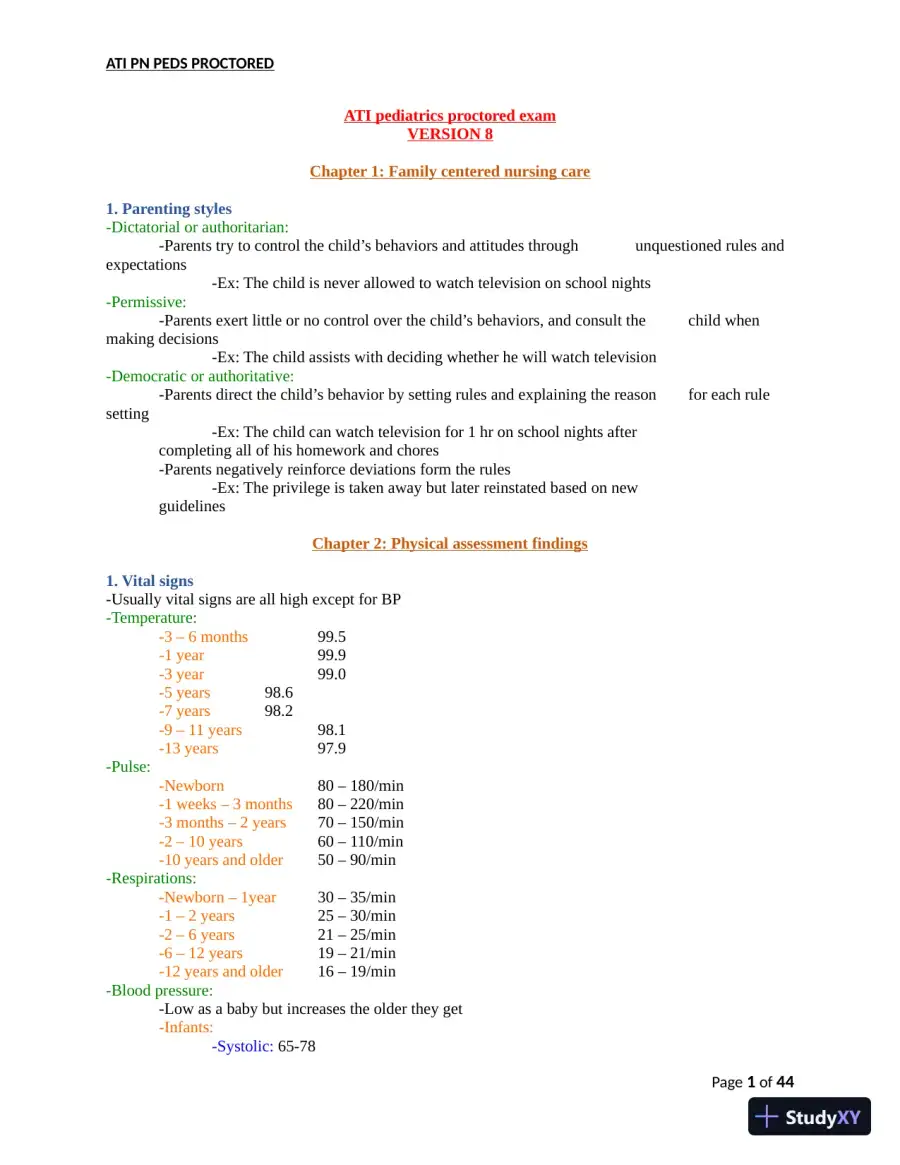 ATI PN PEDS PROCTOREDATI pediatrics proctored examVERSION 8Chapter 1: Family centered nursing care1. Parenting styles-Dictatorial or authoritarian:-Parents try to control the child’s behaviors and attitudes throughunquestioned rules andexpectations-Ex: The child is never allowed to watch television on school nights-Permissive:-Parents exert little or no control over the child’s behaviors, and consult thechild whenmaking decisions-Ex: The child assists with deciding whether he will watch television-Democratic or authoritative:-Parents direct the child’s behavior by setting rules and explaining the reasonfor each rulesetting-Ex: The child can watch television for 1 hr on school nights aftercompleting all of his homework and chores-Parents negatively reinforce deviations form the rules-Ex: The privilege is taken away but later reinstated based on newguidelinesChapter 2: Physical assessment findings1. Vital signs-Usually vital signs are all high except for BP-Temperature:-3 – 6 months99.5-1 year99.9-3 year99.0-5 years98.6-7 years98.2-9 – 11 years98.1-13 years97.9-Pulse:-Newborn80 – 180/min-1 weeks – 3 months80 – 220/min-3 months – 2 years70 – 150/min-2 – 10 years60 – 110/min-10 years and older50 – 90/min-Respirations:-Newborn – 1year30 – 35/min-1 – 2 years25 – 30/min-2 – 6 years21 – 25/min-6 – 12 years19 – 21/min-12 years and older16 – 19/min-Blood pressure:-Low as a baby but increases the older they get-Infants:-Systolic: 65-78Page1of44
Page 2

Page 3
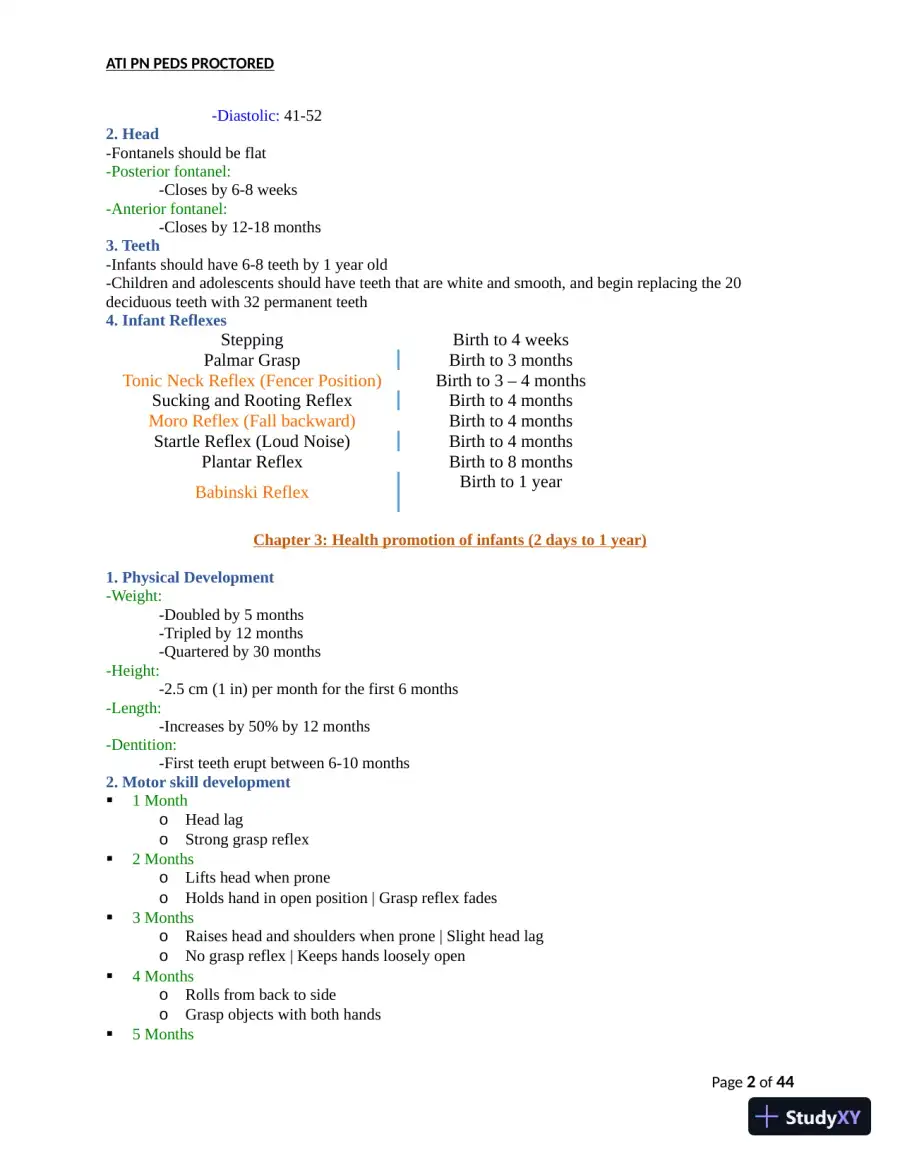 ATI PN PEDS PROCTORED-Diastolic: 41-522. Head-Fontanels should be flat-Posterior fontanel:-Closes by 6-8 weeks-Anterior fontanel:-Closes by 12-18 months3. Teeth-Infants should have 6-8 teeth by 1 year old-Children and adolescents should have teeth that are white and smooth, and begin replacing the 20deciduous teeth with 32 permanent teeth4. Infant ReflexesSteppingBirth to 4 weeksPalmar GraspBirth to 3 monthsTonic Neck Reflex (Fencer Position)Birth to 3 – 4 monthsSucking and Rooting ReflexBirth to 4 monthsMoro Reflex (Fall backward)Birth to 4 monthsStartle Reflex (Loud Noise)Birth to 4 monthsPlantar ReflexBirth to 8 monthsBabinski ReflexBirth to 1 yearChapter 3: Health promotion of infants (2 days to 1 year)1. Physical Development-Weight:-Doubled by 5 months-Tripled by 12 months-Quartered by 30 months-Height:-2.5 cm (1 in) per month for the first 6 months-Length:-Increases by 50% by 12 months-Dentition:-First teeth erupt between 6-10 months2. Motor skill development1 MonthoHead lagoStrong grasp reflex2 MonthsoLifts head when proneoHolds hand in open position | Grasp reflex fades3 MonthsoRaises head and shoulders when prone | Slight head lagoNo grasp reflex | Keeps hands loosely open4 MonthsoRolls from back to sideoGrasp objects with both hands5 MonthsPage2of44
Page 4
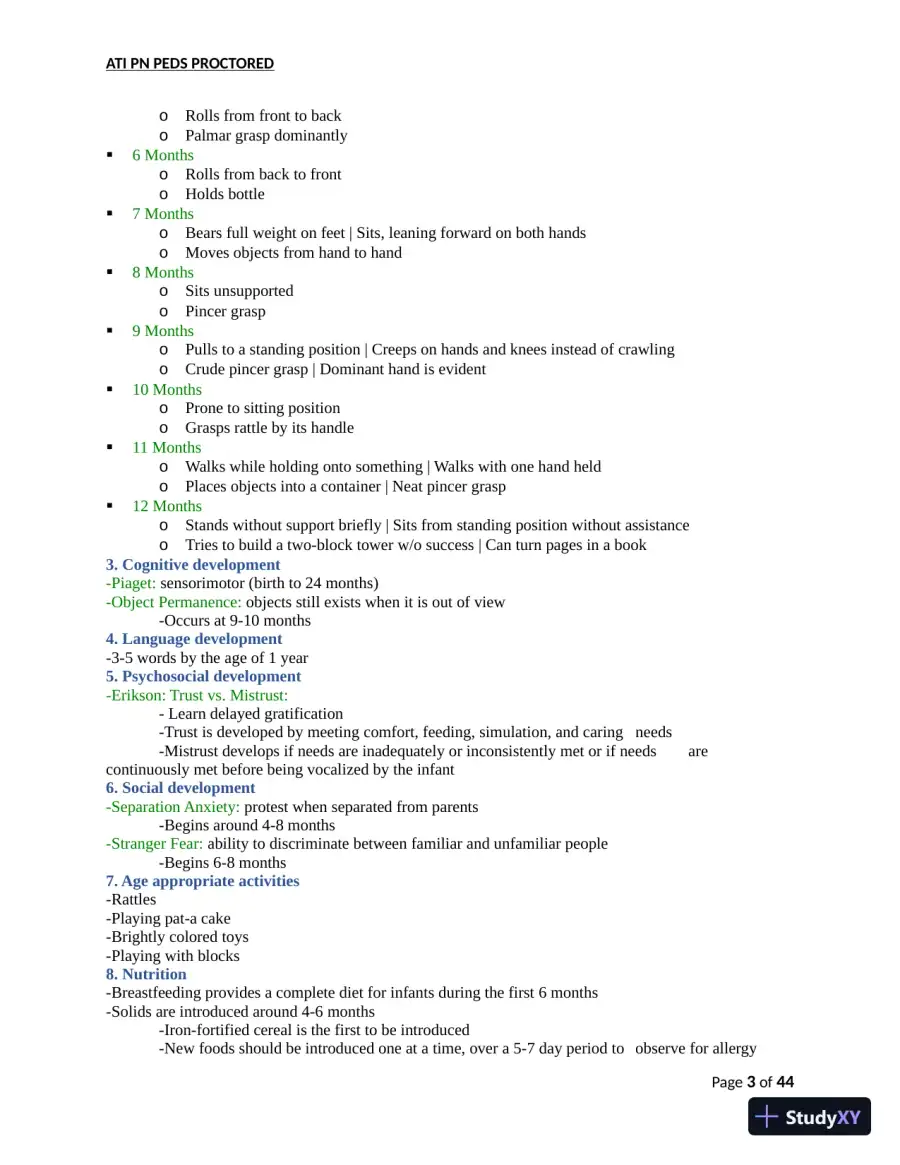 ATI PN PEDS PROCTOREDoRolls from front to backoPalmar grasp dominantly6 MonthsoRolls from back to frontoHolds bottle7 MonthsoBears full weight on feet | Sits, leaning forward on both handsoMoves objects from hand to hand8 MonthsoSits unsupportedoPincer grasp9 MonthsoPulls to a standing position | Creeps on hands and knees instead of crawlingoCrude pincer grasp | Dominant hand is evident10 MonthsoProne to sitting positionoGrasps rattle by its handle11 MonthsoWalks while holding onto something | Walks with one hand heldoPlaces objects into a container | Neat pincer grasp12 MonthsoStands without support briefly | Sits from standing position without assistanceoTries to build a two-block tower w/o success | Can turn pages in a book3. Cognitive development-Piaget: sensorimotor (birth to 24 months)-Object Permanence: objects still exists when it is out of view-Occurs at 9-10 months4. Language development-3-5 words by the age of 1 year5. Psychosocial development-Erikson: Trust vs. Mistrust:- Learn delayed gratification-Trust is developed by meeting comfort, feeding, simulation, and caringneeds-Mistrust develops if needs are inadequately or inconsistently met or if needsarecontinuously met before being vocalized by the infant6. Social development-Separation Anxiety: protest when separated from parents-Begins around 4-8 months-Stranger Fear: ability to discriminate between familiar and unfamiliar people-Begins 6-8 months7. Age appropriate activities-Rattles-Playing pat-a cake-Brightly colored toys-Playing with blocks8. Nutrition-Breastfeeding provides a complete diet for infants during the first 6 months-Solids are introduced around 4-6 months-Iron-fortified cereal is the first to be introduced-New foods should be introduced one at a time, over a 5-7 day period toobserve for allergyPage3of44
Page 5
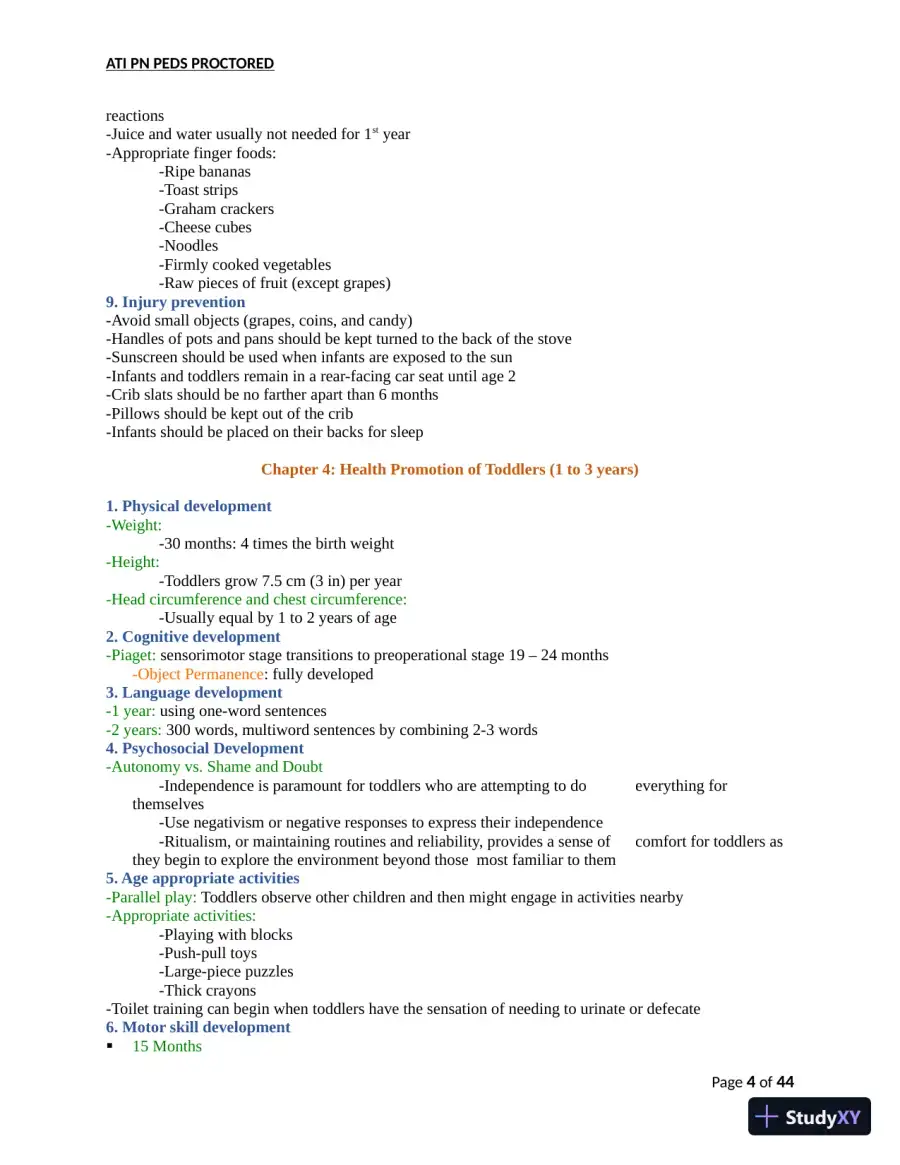 ATI PN PEDS PROCTOREDreactions-Juice and water usually not needed for 1styear-Appropriate finger foods:-Ripe bananas-Toast strips-Graham crackers-Cheese cubes-Noodles-Firmly cooked vegetables-Raw pieces of fruit (except grapes)9. Injury prevention-Avoid small objects (grapes, coins, and candy)-Handles of pots and pans should be kept turned to the back of the stove-Sunscreen should be used when infants are exposed to the sun-Infants and toddlers remain in a rear-facing car seat until age 2-Crib slats should be no farther apart than 6 months-Pillows should be kept out of the crib-Infants should be placed on their backs for sleepChapter 4: Health Promotion of Toddlers (1 to 3 years)1. Physical development-Weight:-30 months: 4 times the birth weight-Height:-Toddlers grow 7.5 cm (3 in) per year-Head circumference and chest circumference:-Usually equal by 1 to 2 years of age2. Cognitive development-Piaget: sensorimotor stage transitions to preoperational stage 19 – 24 months-Object Permanence: fully developed3. Language development-1 year: using one-word sentences-2 years: 300 words, multiword sentences by combining 2-3 words4. Psychosocial Development-Autonomy vs. Shame and Doubt-Independence is paramount for toddlers who are attempting to doeverything forthemselves-Use negativism or negative responses to express their independence-Ritualism, or maintaining routines and reliability, provides a sense ofcomfort for toddlers asthey begin to explore the environment beyond those most familiar to them5. Age appropriate activities-Parallel play: Toddlers observe other children and then might engage in activities nearby-Appropriate activities:-Playing with blocks-Push-pull toys-Large-piece puzzles-Thick crayons-Toilet training can begin when toddlers have the sensation of needing to urinate or defecate6. Motor skill development15 MonthsPage4of44
Page 6
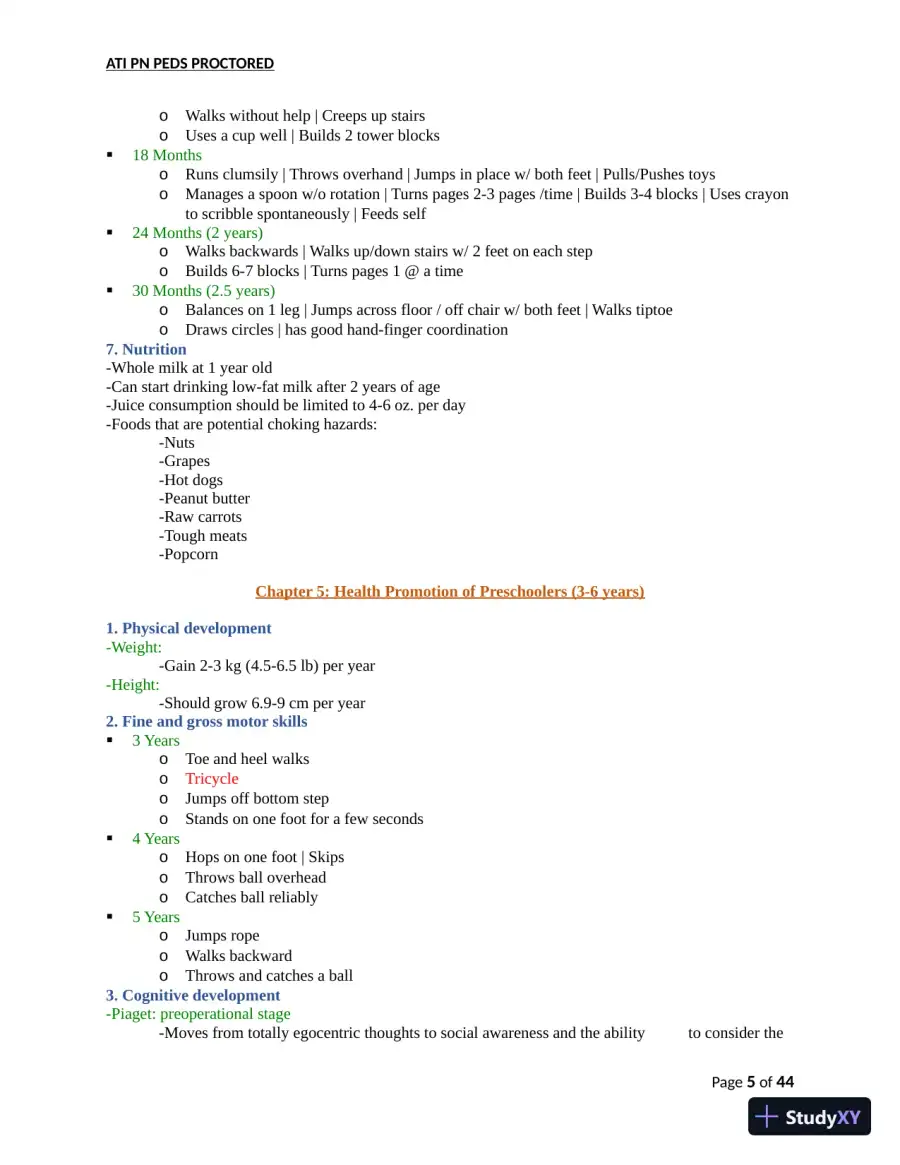 ATI PN PEDS PROCTOREDoWalks without help | Creeps up stairsoUses a cup well | Builds 2 tower blocks18 MonthsoRuns clumsily | Throws overhand | Jumps in place w/ both feet | Pulls/Pushes toysoManages a spoon w/o rotation | Turns pages 2-3 pages /time | Builds 3-4 blocks | Uses crayonto scribble spontaneously | Feeds self24 Months (2 years)oWalks backwards | Walks up/down stairs w/ 2 feet on each stepoBuilds 6-7 blocks | Turns pages 1 @ a time30 Months (2.5 years)oBalances on 1 leg | Jumps across floor / off chair w/ both feet | Walks tiptoeoDraws circles | has good hand-finger coordination7. Nutrition-Whole milk at 1 year old-Can start drinking low-fat milk after 2 years of age-Juice consumption should be limited to 4-6 oz. per day-Foods that are potential choking hazards:-Nuts-Grapes-Hot dogs-Peanut butter-Raw carrots-Tough meats-PopcornChapter 5: Health Promotion of Preschoolers (3-6 years)1. Physical development-Weight:-Gain 2-3 kg (4.5-6.5 lb) per year-Height:-Should grow 6.9-9 cm per year2. Fine and gross motor skills3 YearsoToe and heel walksoTricycleoJumps off bottom stepoStands on one foot for a few seconds4 YearsoHops on one foot | SkipsoThrows ball overheadoCatches ball reliably5 YearsoJumps ropeoWalks backwardoThrows and catches a ball3. Cognitive development-Piaget: preoperational stage-Moves from totally egocentric thoughts to social awareness and the abilityto consider thePage5of44
Page 7
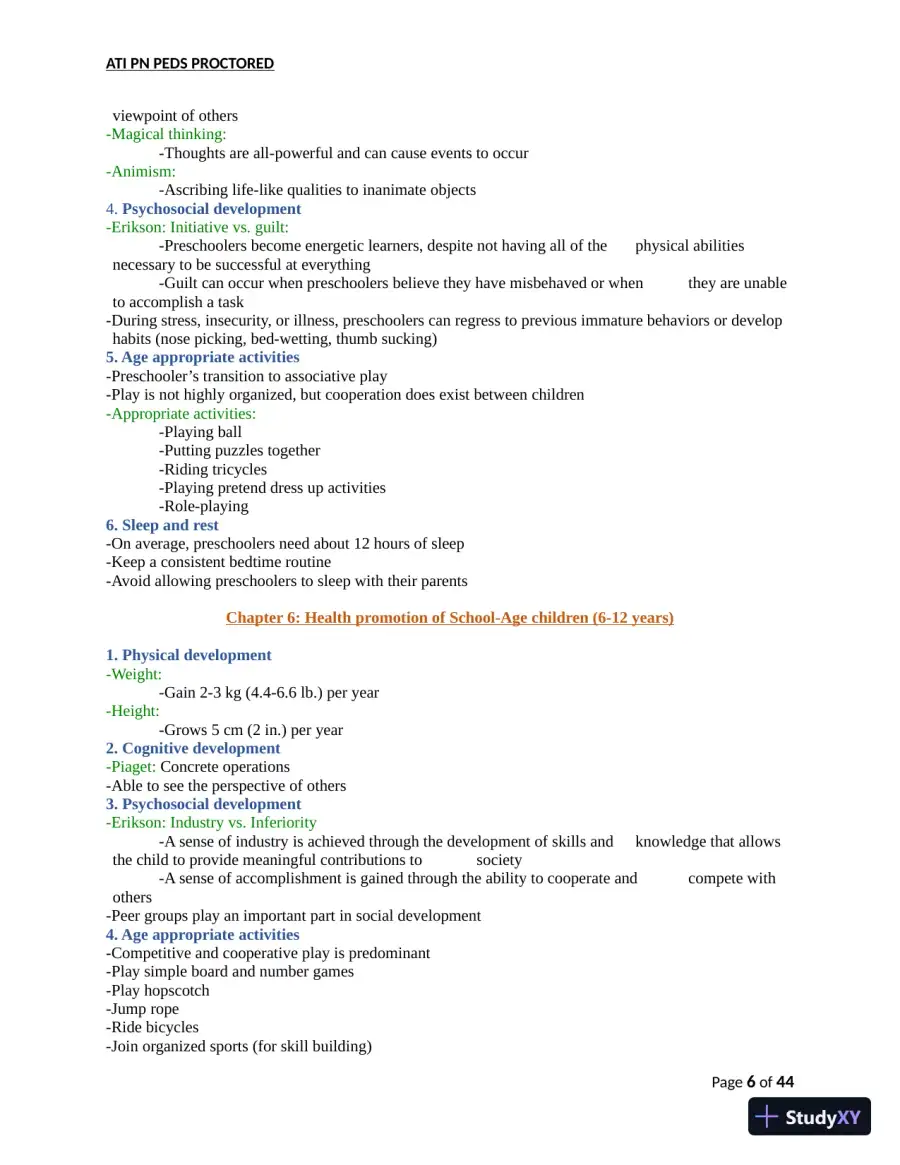 ATI PN PEDS PROCTOREDviewpoint of others-Magical thinking:-Thoughts are all-powerful and can cause events to occur-Animism:-Ascribing life-like qualities to inanimate objects4.Psychosocial development-Erikson: Initiative vs. guilt:-Preschoolers become energetic learners, despite not having all of thephysical abilitiesnecessary to be successful at everything-Guilt can occur when preschoolers believe they have misbehaved or whenthey are unableto accomplish a task-During stress, insecurity, or illness, preschoolers can regress to previous immature behaviors or develophabits (nose picking, bed-wetting, thumb sucking)5. Age appropriate activities-Preschooler’s transition to associative play-Play is not highly organized, but cooperation does exist between children-Appropriate activities:-Playing ball-Putting puzzles together-Riding tricycles-Playing pretend dress up activities-Role-playing6. Sleep and rest-On average, preschoolers need about 12 hours of sleep-Keep a consistent bedtime routine-Avoid allowing preschoolers to sleep with their parentsChapter 6: Health promotion of School-Age children (6-12 years)1. Physical development-Weight:-Gain 2-3 kg (4.4-6.6 lb.) per year-Height:-Grows 5 cm (2 in.) per year2. Cognitive development-Piaget: Concrete operations-Able to see the perspective of others3. Psychosocial development-Erikson: Industry vs. Inferiority-A sense of industry is achieved through the development of skills andknowledge that allowsthe child to provide meaningful contributions tosociety-A sense of accomplishment is gained through the ability to cooperate andcompete withothers-Peer groups play an important part in social development4. Age appropriate activities-Competitive and cooperative play is predominant-Play simple board and number games-Play hopscotch-Jump rope-Ride bicycles-Join organized sports (for skill building)Page6of44
Page 8
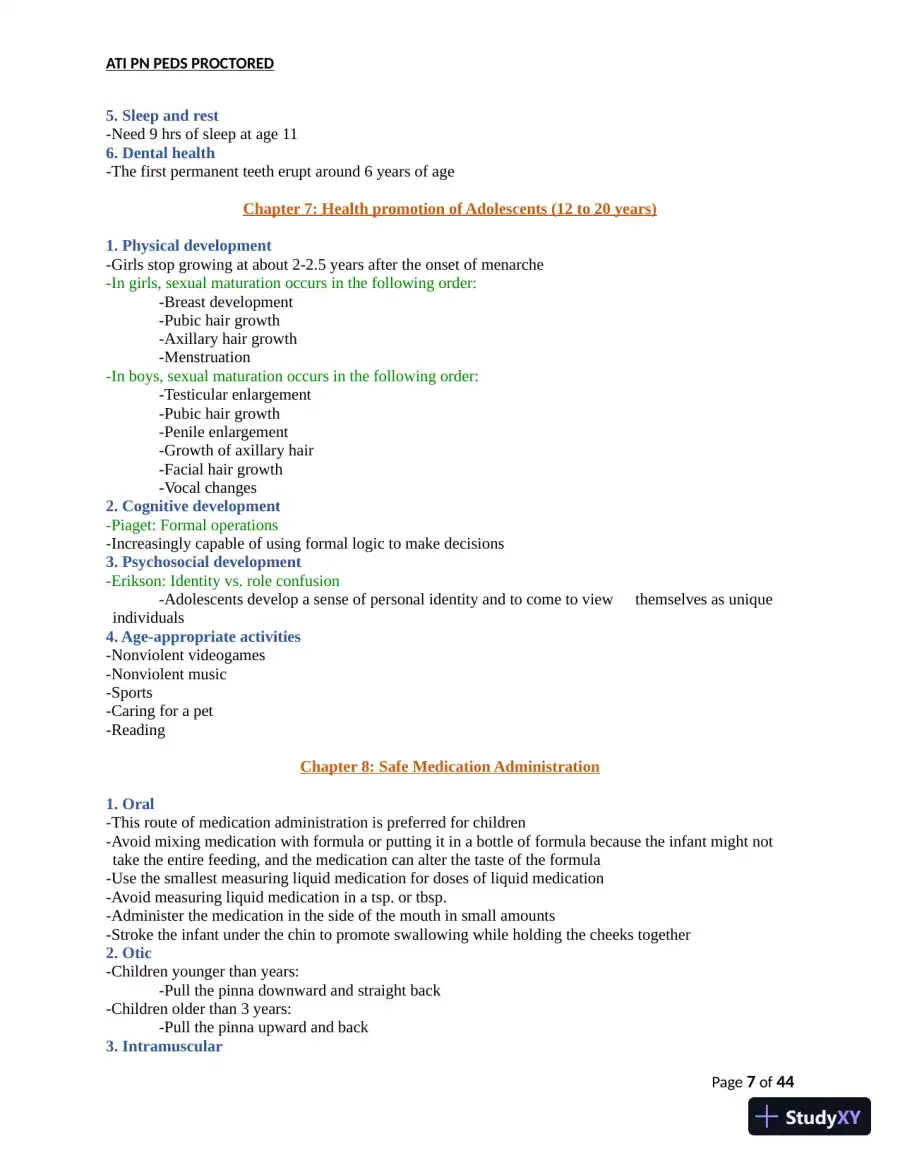 ATI PN PEDS PROCTORED5. Sleep and rest-Need 9 hrs of sleep at age 116. Dental health-The first permanent teeth erupt around 6 years of ageChapter 7: Health promotion of Adolescents (12 to 20 years)1. Physical development-Girls stop growing at about 2-2.5 years after the onset of menarche-In girls, sexual maturation occurs in the following order:-Breast development-Pubic hair growth-Axillary hair growth-Menstruation-In boys, sexual maturation occurs in the following order:-Testicular enlargement-Pubic hair growth-Penile enlargement-Growth of axillary hair-Facial hair growth-Vocal changes2. Cognitive development-Piaget: Formal operations-Increasingly capable of using formal logic to make decisions3. Psychosocial development-Erikson: Identity vs. role confusion-Adolescents develop a sense of personal identity and to come to viewthemselves as uniqueindividuals4. Age-appropriate activities-Nonviolent videogames-Nonviolent music-Sports-Caring for a pet-ReadingChapter 8: Safe Medication Administration1. Oral-This route of medication administration is preferred for children-Avoid mixing medication with formula or putting it in a bottle of formula because the infant might nottake the entire feeding, and the medication can alter the taste of the formula-Use the smallest measuring liquid medication for doses of liquid medication-Avoid measuring liquid medication in a tsp. or tbsp.-Administer the medication in the side of the mouth in small amounts-Stroke the infant under the chin to promote swallowing while holding the cheeks together2. Otic-Children younger than years:-Pull the pinna downward and straight back-Children older than 3 years:-Pull the pinna upward and back3. IntramuscularPage7of44
Page 9
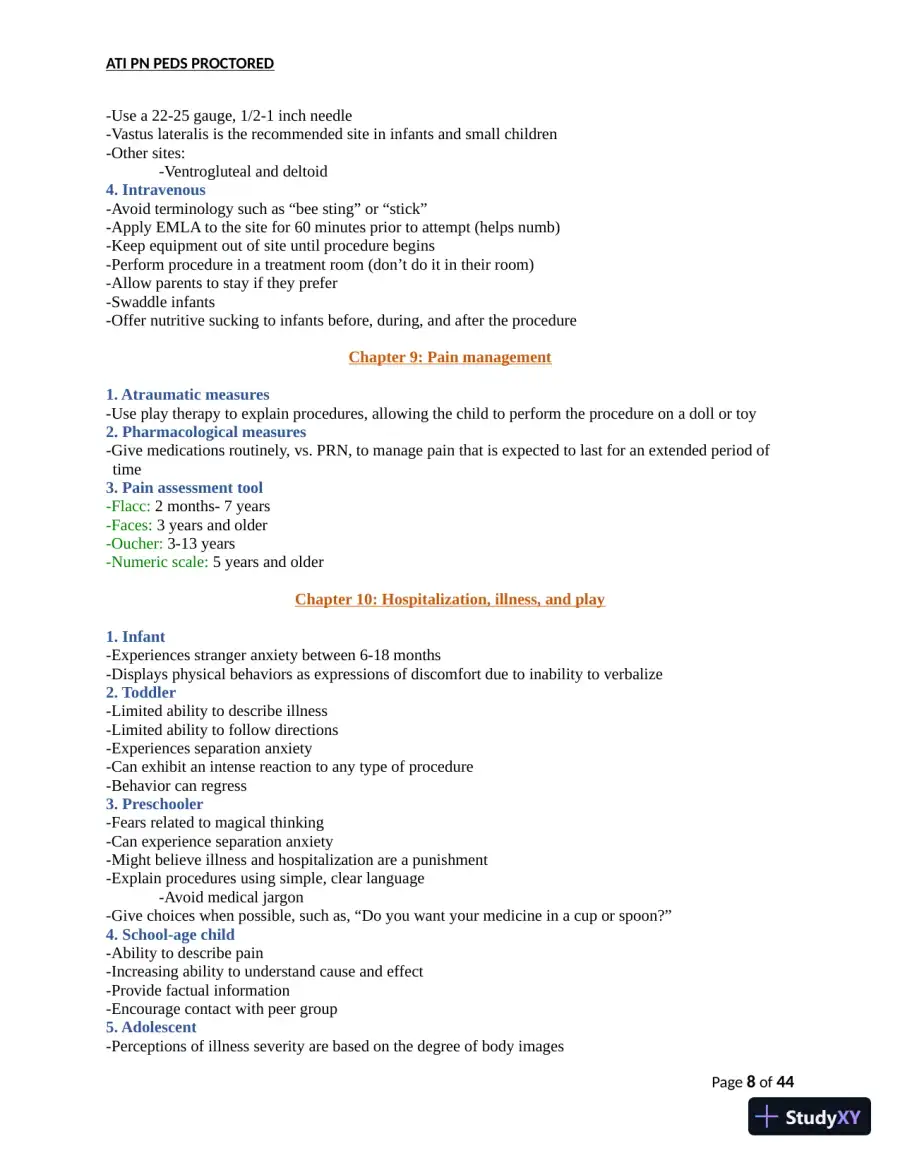 ATI PN PEDS PROCTORED-Use a 22-25 gauge, 1/2-1 inch needle-Vastus lateralis is the recommended site in infants and small children-Other sites:-Ventrogluteal and deltoid4. Intravenous-Avoid terminology such as “bee sting” or “stick”-Apply EMLA to the site for 60 minutes prior to attempt (helps numb)-Keep equipment out of site until procedure begins-Perform procedure in a treatment room (don’t do it in their room)-Allow parents to stay if they prefer-Swaddle infants-Offer nutritive sucking to infants before, during, and after the procedureChapter 9: Pain management1. Atraumatic measures-Use play therapy to explain procedures, allowing the child to perform the procedure on a doll or toy2. Pharmacological measures-Give medications routinely, vs. PRN, to manage pain that is expected to last for an extended period oftime3. Pain assessment tool-Flacc: 2 months- 7 years-Faces: 3 years and older-Oucher: 3-13 years-Numeric scale: 5 years and olderChapter 10: Hospitalization, illness, and play1. Infant-Experiences stranger anxiety between 6-18 months-Displays physical behaviors as expressions of discomfort due to inability to verbalize2. Toddler-Limited ability to describe illness-Limited ability to follow directions-Experiences separation anxiety-Can exhibit an intense reaction to any type of procedure-Behavior can regress3. Preschooler-Fears related to magical thinking-Can experience separation anxiety-Might believe illness and hospitalization are a punishment-Explain procedures using simple, clear language-Avoid medical jargon-Give choices when possible, such as, “Do you want your medicine in a cup or spoon?”4. School-age child-Ability to describe pain-Increasing ability to understand cause and effect-Provide factual information-Encourage contact with peer group5. Adolescent-Perceptions of illness severity are based on the degree of body imagesPage8of44
Page 10
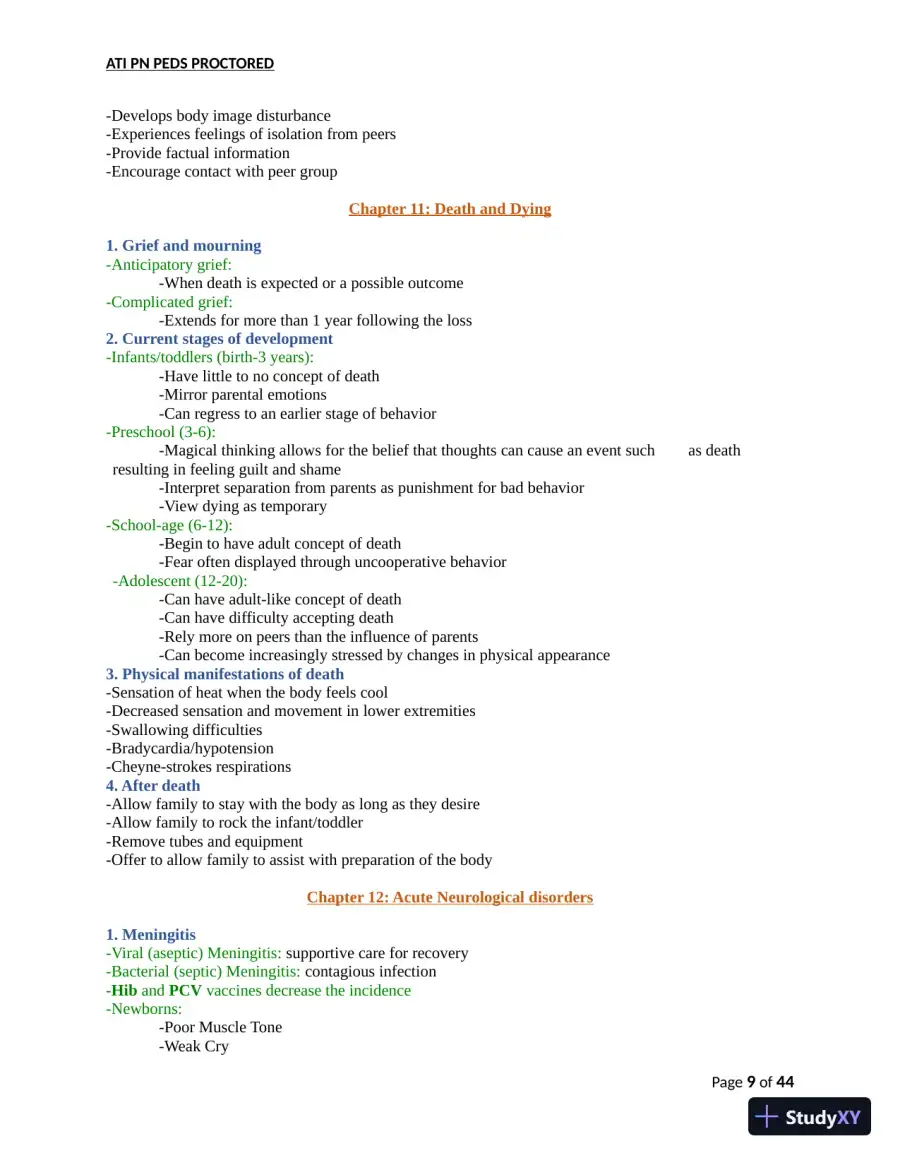 ATI PN PEDS PROCTORED-Develops body image disturbance-Experiences feelings of isolation from peers-Provide factual information-Encourage contact with peer groupChapter 11: Death and Dying1. Grief and mourning-Anticipatory grief:-When death is expected or a possible outcome-Complicated grief:-Extends for more than 1 year following the loss2. Current stages of development-Infants/toddlers (birth-3 years):-Have little to no concept of death-Mirror parental emotions-Can regress to an earlier stage of behavior-Preschool (3-6):-Magical thinking allows for the belief that thoughts can cause an event suchas deathresulting in feeling guilt and shame-Interpret separation from parents as punishment for bad behavior-View dying as temporary-School-age (6-12):-Begin to have adult concept of death-Fear often displayed through uncooperative behavior-Adolescent (12-20):-Can have adult-like concept of death-Can have difficulty accepting death-Rely more on peers than the influence of parents-Can become increasingly stressed by changes in physical appearance3. Physical manifestations of death-Sensation of heat when the body feels cool-Decreased sensation and movement in lower extremities-Swallowing difficulties-Bradycardia/hypotension-Cheyne-strokes respirations4. After death-Allow family to stay with the body as long as they desire-Allow family to rock the infant/toddler-Remove tubes and equipment-Offer to allow family to assist with preparation of the bodyChapter 12: Acute Neurological disorders1. Meningitis-Viral (aseptic) Meningitis: supportive care for recovery-Bacterial (septic) Meningitis: contagious infection-HibandPCVvaccines decrease the incidence-Newborns:-Poor Muscle Tone-Weak CryPage9of44
Page 11
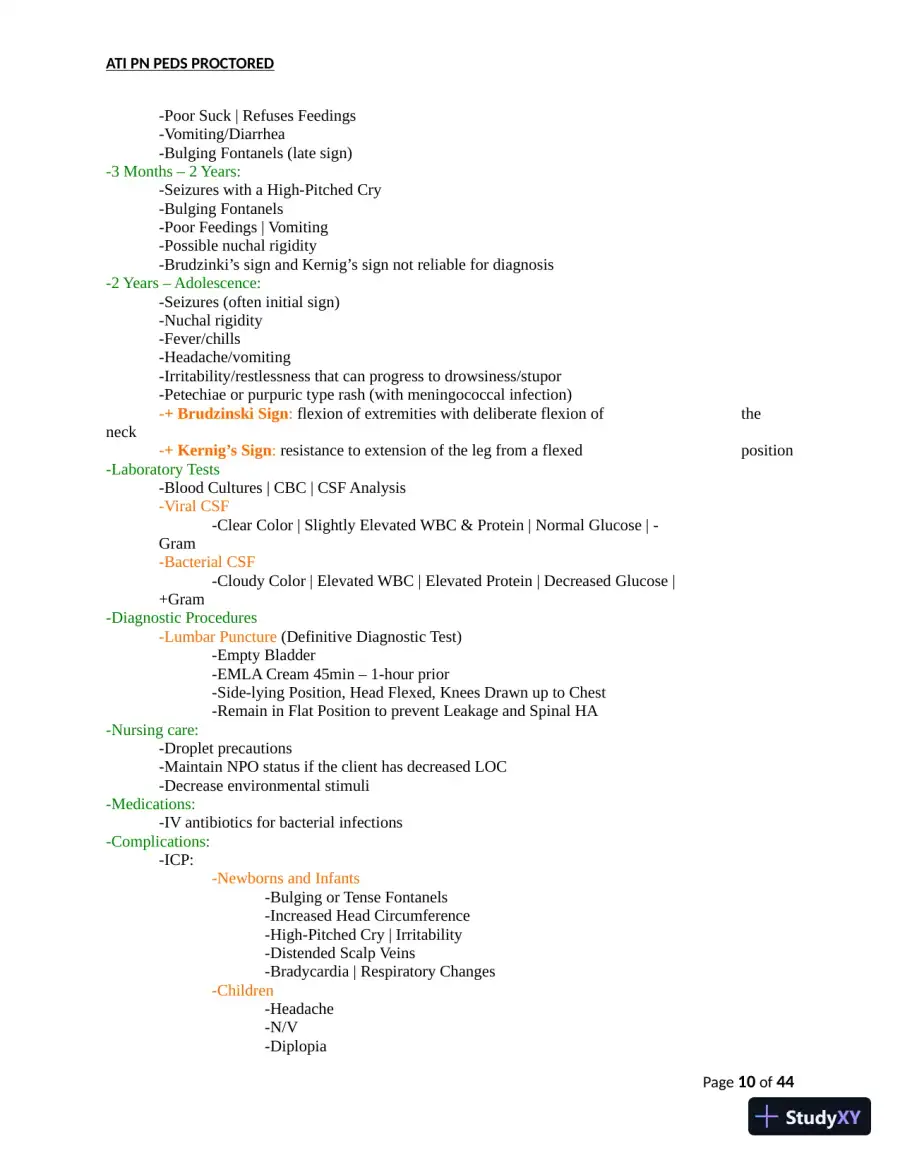 ATI PN PEDS PROCTORED-Poor Suck | Refuses Feedings-Vomiting/Diarrhea-Bulging Fontanels (late sign)-3 Months – 2 Years:-Seizures with a High-Pitched Cry-Bulging Fontanels-Poor Feedings | Vomiting-Possible nuchal rigidity-Brudzinki’s sign and Kernig’s sign not reliable for diagnosis-2 Years – Adolescence:-Seizures (often initial sign)-Nuchal rigidity-Fever/chills-Headache/vomiting-Irritability/restlessness that can progress to drowsiness/stupor-Petechiae or purpuric type rash (with meningococcal infection)-+ Brudzinski Sign: flexion of extremities with deliberate flexion oftheneck-+ Kernig’s Sign: resistance to extension of the leg from a flexedposition-Laboratory Tests-Blood Cultures | CBC | CSF Analysis-Viral CSF-Clear Color | Slightly Elevated WBC & Protein | Normal Glucose | -Gram-Bacterial CSF-Cloudy Color | Elevated WBC | Elevated Protein | Decreased Glucose |+Gram-Diagnostic Procedures-Lumbar Puncture (Definitive Diagnostic Test)-Empty Bladder-EMLA Cream 45min – 1-hour prior-Side-lying Position, Head Flexed, Knees Drawn up to Chest-Remain in Flat Position to prevent Leakage and Spinal HA-Nursing care:-Droplet precautions-Maintain NPO status if the client has decreased LOC-Decrease environmental stimuli-Medications:-IV antibiotics for bacterial infections-Complications:-ICP:-Newborns and Infants-Bulging or Tense Fontanels-Increased Head Circumference-High-Pitched Cry | Irritability-Distended Scalp Veins-Bradycardia | Respiratory Changes-Children-Headache-N/V-DiplopiaPage10of44
Page 12
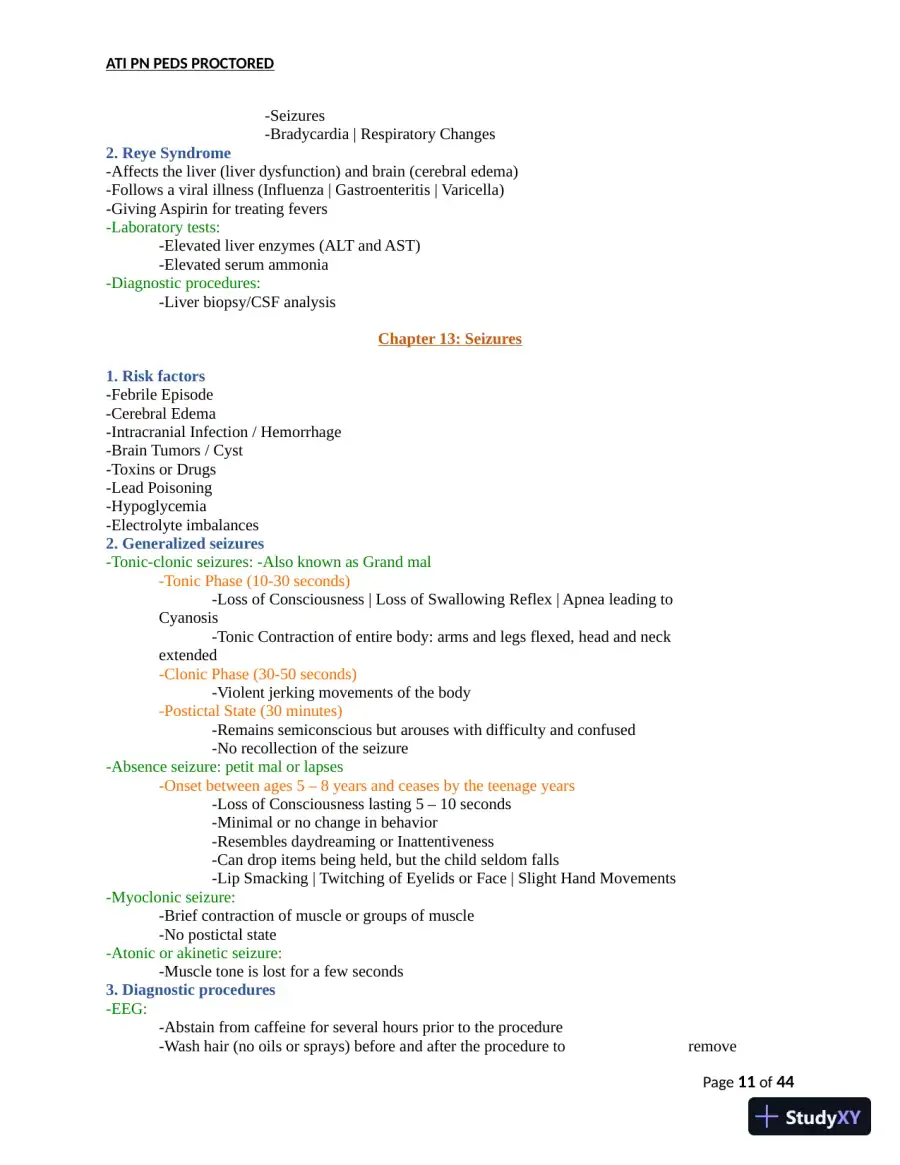 ATI PN PEDS PROCTORED-Seizures-Bradycardia | Respiratory Changes2. Reye Syndrome-Affects the liver (liver dysfunction) and brain (cerebral edema)-Follows a viral illness (Influenza | Gastroenteritis | Varicella)-Giving Aspirin for treating fevers-Laboratory tests:-Elevated liver enzymes (ALT and AST)-Elevated serum ammonia-Diagnostic procedures:-Liver biopsy/CSF analysisChapter 13: Seizures1. Risk factors-Febrile Episode-Cerebral Edema-Intracranial Infection / Hemorrhage-Brain Tumors / Cyst-Toxins or Drugs-Lead Poisoning-Hypoglycemia-Electrolyte imbalances2. Generalized seizures-Tonic-clonic seizures: -Also known as Grand mal-Tonic Phase (10-30 seconds)-Loss of Consciousness | Loss of Swallowing Reflex | Apnea leading toCyanosis-Tonic Contraction of entire body: arms and legs flexed, head and neckextended-Clonic Phase (30-50 seconds)-Violent jerking movements of the body-Postictal State (30 minutes)-Remains semiconscious but arouses with difficulty and confused-No recollection of the seizure-Absence seizure: petit mal or lapses-Onset between ages 5 – 8 years and ceases by the teenage years-Loss of Consciousness lasting 5 – 10 seconds-Minimal or no change in behavior-Resembles daydreaming or Inattentiveness-Can drop items being held, but the child seldom falls-Lip Smacking | Twitching of Eyelids or Face | Slight Hand Movements-Myoclonic seizure:-Brief contraction of muscle or groups of muscle-No postictal state-Atonic or akinetic seizure:-Muscle tone is lost for a few seconds3. Diagnostic procedures-EEG:-Abstain from caffeine for several hours prior to the procedure-Wash hair (no oils or sprays) before and after the procedure toremovePage11of44
Page 13
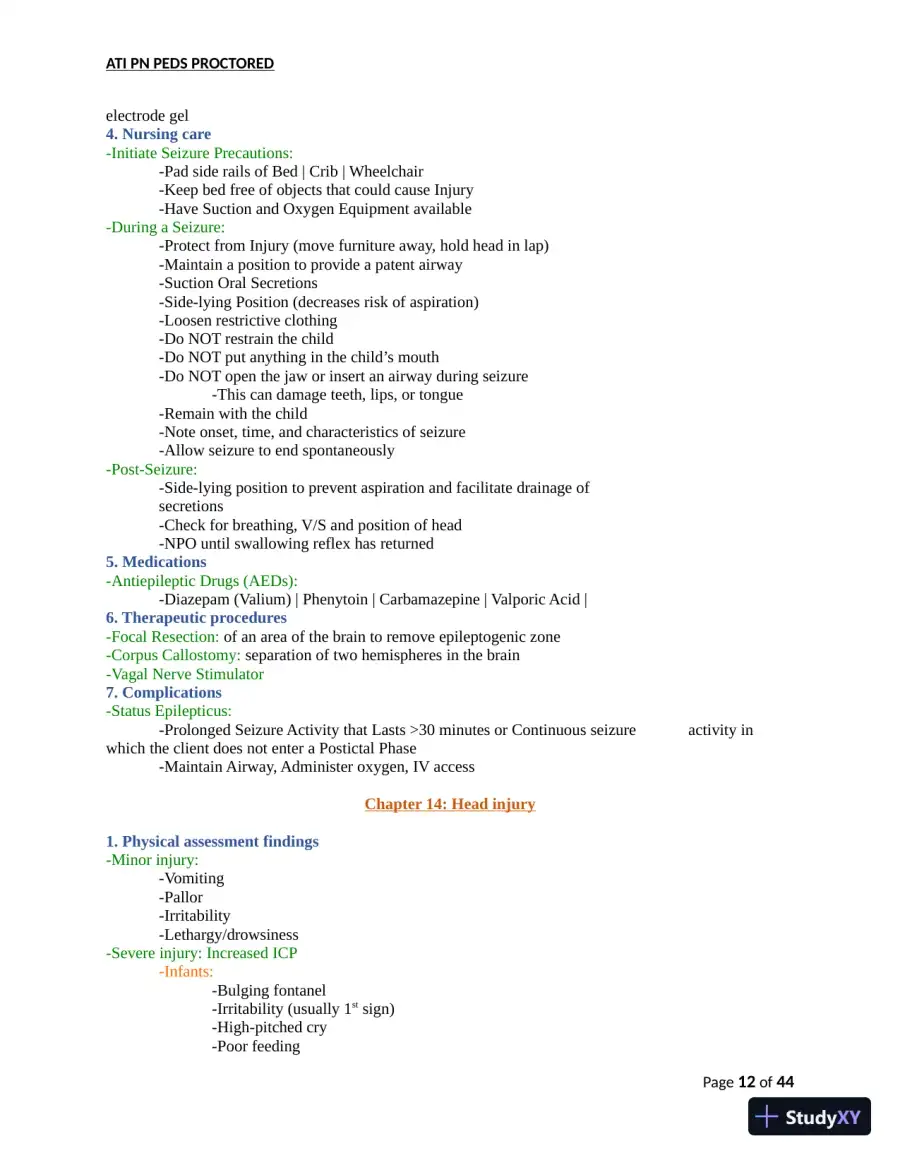 ATI PN PEDS PROCTOREDelectrode gel4. Nursing care-Initiate Seizure Precautions:-Pad side rails of Bed | Crib | Wheelchair-Keep bed free of objects that could cause Injury-Have Suction and Oxygen Equipment available-During a Seizure:-Protect from Injury (move furniture away, hold head in lap)-Maintain a position to provide a patent airway-Suction Oral Secretions-Side-lying Position (decreases risk of aspiration)-Loosen restrictive clothing-Do NOT restrain the child-Do NOT put anything in the child’s mouth-Do NOT open the jaw or insert an airway during seizure-This can damage teeth, lips, or tongue-Remain with the child-Note onset, time, and characteristics of seizure-Allow seizure to end spontaneously-Post-Seizure:-Side-lying position to prevent aspiration and facilitate drainage ofsecretions-Check for breathing, V/S and position of head-NPO until swallowing reflex has returned5. Medications-Antiepileptic Drugs (AEDs):-Diazepam (Valium) | Phenytoin | Carbamazepine | Valporic Acid |6. Therapeutic procedures-Focal Resection: of an area of the brain to remove epileptogenic zone-Corpus Callostomy: separation of two hemispheres in the brain-Vagal Nerve Stimulator7. Complications-Status Epilepticus:-Prolonged Seizure Activity that Lasts >30 minutes or Continuous seizureactivity inwhich the client does not enter a Postictal Phase-Maintain Airway, Administer oxygen, IV accessChapter 14: Head injury1. Physical assessment findings-Minor injury:-Vomiting-Pallor-Irritability-Lethargy/drowsiness-Severe injury: Increased ICP-Infants:-Bulging fontanel-Irritability (usually 1stsign)-High-pitched cry-Poor feedingPage12of44
27 more pages in the full document
Unlock it once and it stays in your library, ready to chat with or turn into flashcards.
Unlock the full documentMore Assessment Technologies Institute study materials
See all Past Exams
ATI Maternal Newborn Practice Exam with Answers (210 Solved Questions)
Assessment Technologies Institute
114 pages141downloadsFeb 2025 Past Exams
2023 ATI NGN Comprhensive Exit Exam with Answers (87 Solved Questions)
Assessment Technologies Institute
40 pages115downloadsFeb 2025 Past Exams
2021 ATI Medical/Surgical Neurosensory AH1 with Answers (80 Solved Questions)
Assessment Technologies Institute
19 pages106downloadsFeb 2025 Past Exams
2024-2025 ATI Leadership Proctored Focus Practice Exam with Answers (63 Solved Questions)
Assessment Technologies Institute
27 pages99downloadsFeb 2025 Past Exams
2024-2025 ATI Comprehensive Exit Exam with Answers (13 Solved Questions)
Assessment Technologies Institute
6 pages77downloadsFeb 2025 Past Exams
2023 ATI RN Adult Medical Surgical For NGN Form A, B, C with Answers (21 Solved Questions)
Assessment Technologies Institute
9 pages71downloadsFeb 2025 Past Exams
2022-2023 ATI Med Surg Proctored Exam Retake with Answers (111 Solved Questions)
Assessment Technologies Institute
37 pages68downloadsFeb 2025 Past Exams
2023-2024 ATI TEAS 7 Science Versions 1-3 Actual Exam with Answers (44 Solved Questions)
Assessment Technologies Institute
38 pages64downloadsFeb 2025
Study this document with CramX
Once it is in your library, every tool can work from it.