
Lecture Notes for Auditing and Assurance Services: A Systematic Approach, 11th Edition

Lecture Notes for Auditing and Assurance Services: A Systematic Approach, 11th Edition provides clear, structured notes that transform lecture content into an easy-to-study format.

Caleb Patterson
Contributor
4.7
43
10 months ago
Preview (16 of 147 Pages)
100%
Log in to unlock

Page 1

Lecture Notes for Auditing and Assurance Services: A Systematic Approach, 11th Edition - Page 1 preview image

Loading page ...

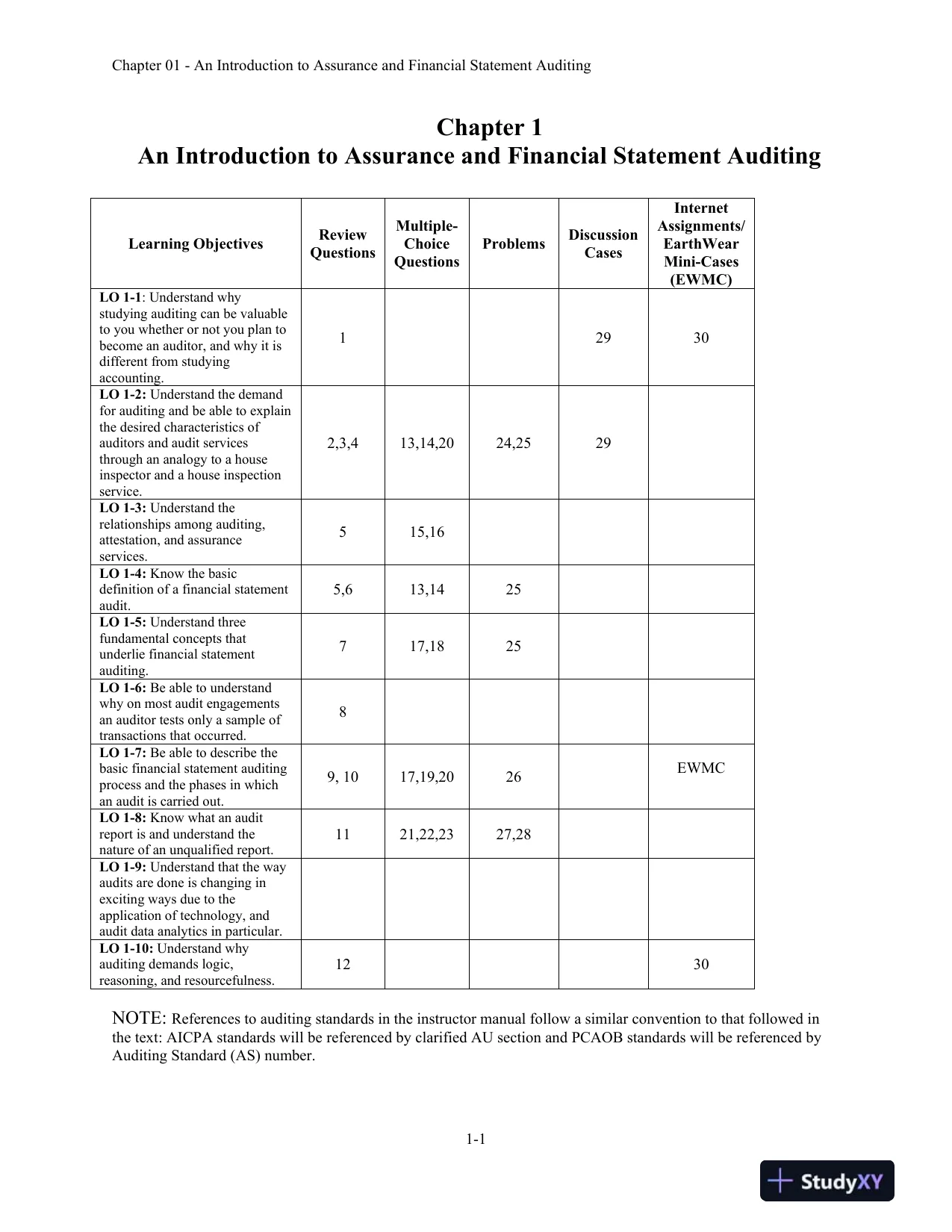
Chapter01-An Introduction to Assurance and Financial Statement Auditing1-1Chapter 1An Introduction to Assurance and Financial Statement AuditingLearning ObjectivesReviewQuestionsMultiple-ChoiceQuestionsProblemsDiscussionCasesInternetAssignments/EarthWearMini-Cases(EWMC)LO1-1: Understand whystudying auditing canbevaluableto youwhether or not you plan tobecome an auditor,and why it isdifferent from studyingaccounting.12930LO1-2:Understand the demandfor auditing andbe able to explainthe desiredcharacteristicsofauditors and audit servicesthrough an analogy to a houseinspector and a house inspectionservice.2,3,413,14,2024,2529LO1-3:Understand therelationships among auditing,attestation,and assuranceservices.515,16LO1-4:Knowthe basicdefinition of a financial statementaudit.5,613,1425LO1-5:Understand threefundamental concepts thatunderlie financial statementauditing.717,1825LO 1-6:Be able to understandwhy on most audit engagementsanauditor tests only a sample oftransactions that occurred.8LO 1-7:Be able to describethebasic financial statement auditingprocess and the phases in whichan audit is carried out.9, 1017,19,2026EWMCLO 1-8:Knowwhat an auditreport is andunderstandthenature of an unqualified report.1121,22,2327,28LO1-9:Understand that the wayaudits are done is changing inexciting ways due to theapplication of technology, andaudit data analytics inparticular.LO 1-10:Understand whyauditing demands logic,reasoning,and resourcefulness.1230NOTE:References to auditing standards in the instructor manual follow a similar convention to that followed inthe text: AICPA standards will bereferenced by clarified AU section and PCAOB standards will be referenced byAuditing Standard (AS) number.

Page 2

Lecture Notes for Auditing and Assurance Services: A Systematic Approach, 11th Edition - Page 2 preview image

Loading page ...

Page 3

Lecture Notes for Auditing and Assurance Services: A Systematic Approach, 11th Edition - Page 3 preview image

Loading page ...

Chapter01-An Introduction to Assurance and Financial Statement Auditing1-2END OF CHAPTER MATERIALS COMPARISON CHARTNumberin10theditionComparisonNumberin11thedition1-1Unchanged1-11-2Unchanged1-21-3Unchanged1-31-4Unchanged1-41-5Unchanged1-51-6Unchanged1-61-7Unchanged1-71-8Revised1-111-9Unchanged1-81-10Unchanged1-91-11Revised1-101-12Revised1-121-13Unchanged1-131-14Unchanged1-141-15Unchanged1-151-16Unchanged1-161-17Unchanged1-171-18Unchanged1-181-19Unchanged1-191-20Unchanged1-201-21Unchanged1-211-22Revised1-221-23Unchanged1-231-24Unchanged1-241-25Unchanged1-251-26Revised1-261-27Revised1-271-28Unchanged1-281-29Unchanged1-291-30Revised1-30When students enter the first introductory class,they seldomunderstandwhat assurance orauditing entails. Generally, they will not have read Chapter 1 before class, so it’s important tospend the time necessary during the first class to capture students’ attention andstimulatetheirinterest in auditing.

Page 4

Lecture Notes for Auditing and Assurance Services: A Systematic Approach, 11th Edition - Page 4 preview image

Loading page ...

Chapter01-An Introduction to Assurance and Financial Statement Auditing1-3IntroductionAfter going over the class expectations, we spend the first part of class discussing andillustrating the demand for auditing and the role of auditing in society.If students are to beinterested and excited to dig in and learn this daunting new material, they need to be convincedthat it is important and useful.Thus, we also emphasize that the concepts underlying auditing areuseful in many contexts other than auditing, including consulting and management.Later in the class, we might ask the students how they would audit the automobile revenues(say $100 billion) of alarge automobile manufacturer.We tell them that each car and truck hasan invoice on the window and in the company's computer system, and that 8 million cars andtrucks were sold. We then ask them how many invoices out of 8 million they want to examine inorder to verify the $100 billion of revenues in the financial statements. Of course, you will getsome outlandish answers (e.g., 400,000 invoices).We eventually tell them that you may not lookat any invoices and that you may rely solely on the company’s internal controls in conjunctionwith a careful ratio analysis or other type of analytical procedure. This type of example quicklygets the students' attention that auditing involves a substantial amount of judgment and commonsense.[LO 1-1] Tips for Learning AuditingWe spend a few minutes on this section emphasizing the differences between the study ofaccounting (which they are very familiar with) and the study ofauditing (which they are not).We try to make sure they understand what auditing focuses on and how it is much moreconceptual than their other accounting courses. We introduce the idea of a “tool kit” and how itrelates to what we will be covering during the course.[LO 1-2] The Demand for Auditing and AssuranceWe spend a reasonable amount of time during the first lecture discussing why there is ademand for auditing and assurance services.Many students think that the demand for auditing isdriven by the requirements of the Securities laws.It is important that the students have somebasic understanding of the agency relationship that leads to the demand for auditing. Figure 1-1provides a good framework for this discussion. We then bring in how the CPA fits this need withthe qualities of independence, integrity, and objectivity.Sometimes we do role-plays, askingstudents tocome to the front of the room.One is selling a car, while the other is interested inbuying it.We let them discuss their concerns, what information they want, what the incentives ofthe two parties are, what informationasymmetries might exist, etc.We then tie this scenario,which most students are somewhat familiar with or at least can relate to, back to the idea of thedemand for auditing.Use Figure 1-1

Page 5

Lecture Notes for Auditing and Assurance Services: A Systematic Approach, 11th Edition - Page 5 preview image

Loading page ...

Chapter01-An Introduction to Assurance and Financial Statement Auditing1-4An Assurance Analogy: The Case of the House InspectorSometimes it is difficult for students to grasp the theoretical perspective of the roleaccounting and auditing play in the principal-agentrelationship, so we use a practical analogy toaid their understanding. We go over how a house inspection is similar to a financial statementaudit including who the players are and how their roles relate to what we just discussed.We askthe students what is similar and different between the house inspection and the financialstatement audit beginning with Table 1-1. Lastly, we ask the students for other examples ofassurance services and again try to relate the specifics of each to the characteristics listed inTable 1-1.Use Table 1-1We then introduce the concept of “management assertions” by asking the students whatspecific assertions the company is making about specific financial statement items (for example:cash or inventory).They usually can comeup with the most obvious ones:existence, fairly andaccurately recorded, and all items are included.They might need to be pushed for some of theothers.They may also fail to distinguish between assertionsintermsofaccountbalancesandassertions in terms of transactions.It is useful to help them understand the differences betweenassertions for transactions and balances but also how they are related.Then we ask them how, asan auditor, you might go about collecting evidence on the cash account, bringing in whatassertions are most importantand why. We like toemphasizethe differences between assertionsaboutthe account balanceat the end of the periodand the transactionsposted to the accountduring the period,relatingtheseconcepts to each other andto the idea of riskfrom an auditperspective.Use Table 1-2Next, we talk about what else the prospective investor would want to know besides thequality of management’s assertions. Finally, we relate all of this back to Table 1-1.Problem 24could be covered here.[LO 1-3, 1-4] Auditing, Attest, and Assurance Services DefinedHere we introduce the definitions for auditing, attest, and assurance services.We show howthe attributes of independence, integrity, and competence that led to the historical demand forfinancial statement audits have resulted in requests for auditors to provide additional services.We briefly provide examples ofattest and assurance services.Figure 1-2 can be used to present acomparison of auditing, attestation, and assurance.Use Figure 1-2In discussing the definitions for the various services, we focus on the general definition of“auditing” fromA Statement of Basic Auditing Concepts(ASOBAC).We emphasize thefollowing phrases in the definition:Systematic process.

Page 6

Lecture Notes for Auditing and Assurance Services: A Systematic Approach, 11th Edition - Page 6 preview image

Loading page ...

Chapter01-An Introduction to Assurance and Financial Statement Auditing1-5Objectively obtaining and evaluating evidence.Assertions about economic actions and events.Degree of correspondence between those assertions and established criteria.Communicating the results to interested users.We then discuss how the definitions for attest and assuranceservices are broader in nature.Indiscussing assurance services, we focus on improving the quality of information.[LO 1-5] Fundamental Concepts in Conducting a Financial Statement AuditIn this section, we discuss examples of the fundamental concepts in a financial statementaudit: materiality, audit risk, and evidence.Our philosophy is that it is much better for students tograsp the fundamental principles and concepts of auditing early on, rather than immerse them inthe details of reporting, ethics,or legal liability too soon.We use Figure 1-3 to present a simpleoverview of the audit process and then introduce the three fundamental concepts and theconceptual and procedural details that a financial statement audit is built on: materiality, auditrisk, and evidence relating to management assertions.Use Figure 1-3This is an extremely important section as much of the rest of the course is built around thesethree concepts.It is imperative for the students to begin to understand that the auditor’s judgmentof materiality and audit risk impact the auditor’s decision about the nature, timing, and extent ofevidence to be gathered.[LO 1-6] Sampling: Inferences Based on Limited ObservationsManystudentshavetheimpressionthatauditorslookatallormostofanentity’stransactions.This is a good time to introduce the idea behind sampling: auditors make inferencesbased on a limited (small) number of transactions.Additionally, be sure to highlight the idea thatalthough emerging technologies like AI and big data will enable auditors to review entirepopulationsin some situations, sampling will remain animportantaudittoolfor the foreseeablefuture,for exampleinauditing physicalinventorycounts.[LO 1-7] The Audit ProcessWe begin this section by asking the students how they might go about the audit process andlisting steps on the board.Before we begin, we talk about how an auditor should plan andconduct an audit so that audit risk (the risk the auditor may unknowingly fail to appropriatelymodify his/her opinion on financial statements that are materially misstated) will be limited to anacceptable level.We think about the end result (an opinion) and what information is needed todevelop and support that opinion.We try to get something down like this:Obtain an understanding of the company, its business and industry.Assess risks the company faces and how it deals with those risks.Identify risks that may be likely to lead to material misstatement in the financials.

Page 7

Lecture Notes for Auditing and Assurance Services: A Systematic Approach, 11th Edition - Page 7 preview image

Loading page ...

Chapter01-An Introduction to Assurance and Financial Statement Auditing1-6Design audit tests to address those risks.Carry out audit tests and gather evidence.Evaluate the evidence.Issue a report.We then talk about how this process is carried out in seven phases, using Figure 1-4 toillustrate the process. Thisprovides students with a basic framework for what occurs in an auditand whatwill be covered in the course.When discussing Figure 1-4, we refer the students to thechapters in the book that will cover each phase.Problem 26could be covered here.Use Figure 1-4[LO 1-8] Evaluate Results and Issue Audit ReportWe reiterate that the purpose of an audit is to issue the audit report and the importance of theevaluation process in choosing the appropriate report to issue. We use Exhibit 1-1 to introducethe “unqualified” opinion and review the components of theupdated auditor’s report. We notethat an unqualified opinion is sometimes referred to as a “clean” opinion. We discuss thestandards surrounding “scope limitations” and “departures from GAAP”tointroduce the othertypes of audit reports that may be issued (qualified and adverse).Note that the text does notdiscuss a disclaimer of opinion in this chapter, though itis covered later in the text.We alsohighlight the newly added section of the report relating to critical audit matters (CAMs) and theauditor’s response to CAMs. This addition represents the first major change to the auditor’sreport in over 50 years!Again, our view is that it is best not to overwhelm students with largeamounts of detail before they understand the basic concepts of auditing, so keep discussions ofauditor reporting as basic as possible at this point.Use Exhibit 1-1[LO 1-9]Audit Data AnalyticsHere we discuss data analytics and other emerging technologies and their impact on theaudit. Often, studentshave heard all kinds of speculative rumorsand maybelievethat AI andrelated advancements will one daycost them their jobs. Although this is a possibility,companiesare currently hiring more finance and accounting professionals (including auditors) even as theyadopt new technologies. Further, most knowledgeable observers believe the demand for well-trained auditors and financial professionals will continue to remain strong, though the nature oftheir jobs may change...mostly in positive ways! Welike tohighlight ways in which emergingtechnologies augment and redefine the auditor’s responsibility, instead of replacing them. Bylearning to skillfully interact with and interpret the data provided by these technologies, as wellas make professional judgements using new systems, students will be well prepared for theircareersandfuturetechnologicaladvancements.Itisimportanttoemphasizethatnewtechnologies will make understanding fundamental accounting and auditing concepts, as well assound professional judgment, even more important...not less![LO 1-10] Conclusion

Page 8

Lecture Notes for Auditing and Assurance Services: A Systematic Approach, 11th Edition - Page 8 preview image

Loading page ...

Chapter01-An Introduction to Assurance and Financial Statement Auditing1-7We discuss the logic, reason, and resourcefulness (including imagination and innovation)needed by an auditor. We leave this chapter reminding the students not to memorize details butrather to try to gain an understanding of the basic underlying concepts: why financial statementaudits are so important, what auditingis,and the basic process through which it is carried out.This is a great opportunity to get your students excited about and motivated to work hardstudying auditing!Discussion CaseWe believe that using discussion cases help the students expand their understanding of thebasictopics covered in the chapter.If you want your students tobe able to articulate the value ofan audit, we would useDiscussion Case 1-29.Internet AssignmentIf you wish to familiarize your students with Internet sites that have accounting or auditingresources (e.g., the PCAOB’s website), you may want to assignInternet Assignment 1-30.Practice InsightPractice Insights provide real-world integration. Practice Insight scenariosare included ineach chapter to highlight important and interesting real-world trends and practices. These self-containedinsightsorscenariosfocusoncurrentevents,studentdecision-making,andprofessional problem solving.Hands-On CasesEarthWear Mini-CasesThe Chapter 1 mini-case can be assigned as a stand alone case and gives students theopportunity to familiarize themselves with the EarthWearMini-Case website.This is especiallyuseful if you plan to make use of EarthWear mini-cases in subsequent chapters!Students areasked to find severaldifferent pieces of information pertaining to EarthWear and its auditor,Willis & Adams, CPAs.Please visit Connect for the EarthWear Mini-Case assignment.IDEAand TABLEAUThe Chapter 1IDEAandTABLEAUproblems are an excellent hands-on supplement to thetextbook material. Please go to Connect for chapter assignments.

Page 9

Lecture Notes for Auditing and Assurance Services: A Systematic Approach, 11th Edition - Page 9 preview image

Loading page ...

Chapter02-The Financial Statement Auditing Environment2-1Chapter 2The Financial Statement Auditing EnvironmentLearning ObjectivesReviewQuestionsMultiple-ChoiceQuestionsProblemsDiscussionCasesInternetAssignmentsLO 2-1:Be familiar with thedifferent types ofauditors.1152428LO 2-2:Be familiar with thevarioustypes of audit, attest, andassuranceservices offered byaccounting professionals.216,17242628LO 2-3:Understand theorganizationofpublic accountingfirmsand the composition of auditteams.LO2-4: Understandthesignificantchanges that have taken place inthe auditing profession over thepasttwodecades.3,418LO 2-5:Know that management isprimarily responsible for theentity’sfinancial statements andunderstand the auditor’sresponsibility for detecting errors,material fraud, and illegal acts.519LO 2-6:Recognize thatanauditisshaped by theauditee’s business,industry, and economicenvironmentand understandessential components andprocesses characteristicofmostbusiness entities.6,720LO2-7: Be familiar with a modelof businessprocesses used toorganize an audit.LO 2-8:Identify and be familiarwith the major organizations thataffect thepublic accountingprofession’senvironment.8,9,10,112128,29,30LO2-9:Understand that auditingstandards are established by bothU.S. and international standardsetters.22LO 2-10:Be familiar withthe“principles underlying an auditconducted in accordance withgenerally accepted auditingstandards.”12,132325,2626,27LO 2-11:Understand the nature ofauditingstandards.

Page 10

Lecture Notes for Auditing and Assurance Services: A Systematic Approach, 11th Edition - Page 10 preview image

Loading page ...

Chapter02-The Financial Statement Auditing Environment2-2LO 2-12:Understand thattheauditing profession places apremium on ethical behavior and isgoverned by a Code ofProfessional Conduct.1426,27NOTE:References to auditing standards in the instructor manual follow a similar convention to that followed inthe text: AICPA standards will be referenced by clarified AU section and PCAOBstandards will be referenced byAuditing Standard (AS) number.END OF CHAPTER MATERIALS COMPARISON CHARTNumberin10theditionComparisonNumberin11thedition2-1Unchanged2-12-2Unchanged2-22-3Unchanged2-32-4Unchanged2-42-5Unchanged2-52-6Revised2-62-7Unchanged2-72-8Unchanged2-82-9Unchanged2-92-10Unchanged2-102-11Unchanged2-112-12Revised2-122-13Revised2-132-14Unchanged2-142-15Unchanged2-152-16Unchanged2-162-17Revised2-172-18Unchanged2-182-19Unchanged2-192-20Unchanged2-202-21Unchanged2-212-22Unchanged2-222-23Revised2-232-24Unchanged2-242-25Revised2-252-26Removed2-262-27Revised2-262-28Unchanged2-272-29Unchanged2-282-30Unchanged2-29

Page 11

Lecture Notes for Auditing and Assurance Services: A Systematic Approach, 11th Edition - Page 11 preview image

Loading page ...

Chapter02-The Financial Statement Auditing Environment2-3Chapter 2 covers the context, or environment, in which auditors function, starting with anoverview of the recent changes in the public accounting profession.[LO 2-1, 2-2] Types of Auditors and ServicesWe spend a few minutes discussing the different types of audits and services (e.g., internalcontrol audits, compliance audits, operational audits, forensic audits, attest services, andassurance services) firms can provide and the different types of auditors (e.g., external auditors,internal auditors, government auditors, and forensic auditors). Chapter 21 discusses attestationservices more thoroughly.Problem 24could be covered here.[LO 2-3] Public Accounting FirmsWe briefly review the organization of firms (e.g., proprietorship, general or limited liabilitypartnerships, or corporation), the categorization of the firms (e.g., Big 4,mid-tierfirms, regionalfirms, and local firms), the types of services (e.g., audit, tax, management advisory services, andaccounting and review services), and the internal organization (e.g., partner, manager, senior,and associate) that describesthe public accounting firms.[LO 2-4]Two Decadesof Challenge and Change for Financial Statement AuditorsThe time we spend with this topic depends on what was covered in the earlier class.We tryto continue the discussion, emphasizing to the students issues facing the profession today or theoverall environment the profession is operating in.We focus onEvents leading up to the current landscape.The explosion of scandals that took place.Government intervention (i.e., Sarbanes-Oxley Act 2002, Dodd-Frank Act 2010).The profession’s response (a healthy move back to the basics).[LO 2-5] Society’s Expectations and the Auditor’s ResponsibilityStudents generally find this topic very interesting.We focus on the auditor’s responsibility todetect errors, fraud, and illegal acts.Many students falsely believe that auditors have theresponsibility to detect all errors, fraud, and illegal acts. Sometimes, we have a guest speakercome into this class to discuss the growing field of forensic accounting.[LO 2-6] The Context of Financial Statement AuditingWe spend a few minutes emphasizing to the students the importance of an auditor knowinghis/her auditees’ business and industry characteristics since that is the context or environmentwithin which a particular business operates. We emphasize that it is difficult for an auditor toeffectively audit something which he/she does not fully understand.We end this section with ashort introduction to a high-level model of a business entity and then spend more time with thefive cycles used to break the audit down into manageable pieces covered in LO2-7.

Page 12

Lecture Notes for Auditing and Assurance Services: A Systematic Approach, 11th Edition - Page 12 preview image

Loading page ...

Chapter02-The Financial Statement Auditing Environment2-4[LO 2-7] A Model of BusinessWith the high-level model, we make sure everyone knows how a business operates at thehighest level by including the roles of corporate governance, the board of directors, and the auditcommittee.Then we discuss briefly with the students how objectives are formed and whatstrategies might be designed to achieve those objectives by asking the students to come up withrelated examples of each and writing them on the board.Then we write down specific processesthat might be set up so that the strategies are implemented. Last, we ask them for specific risksthat might threaten the achievement of the objectives we came up with and write these down aswell.We then spend more time with the process part of the above exercise.We ask the students tolist the five cycles and relate them to what we discussed above using Figure 2-1. Next, we brieflydiscuss each of the five cycles individually as well as how they are interrelated:The financing process.The purchasing process.The human resource management process.The inventory management process.The revenue process.Use Figure 2-1Finally, we relate the process components to the “business model.” Management establishesprocesses in the five categories discussed above to implement the organization’s strategies andachieve its objectives, as well asintegratinginternal controls tomitigate enterprise risks.Thefinancialstatementsreportthefinancialresultsofthoseeffortstooutsideparties(theorganization’s performance and its externalreporting and accountability).[LO 2-8] Organizations that Affect the Public Accounting ProfessionWe use Figure 2-2 as a framework for discussing the various organizations that affectfinancial statement audits. We tend to focus on the SEC, the PCAOB, the FASB, and theAICPA.Use Figure 2-2[LO 2-9,LO 2-10] Auditing StandardsAuditing standards provide a systematic approach to auditing and thus should be emphasizedto the students. We begin the discussion with the current state of audit standard-setting:ASB andPCAOB. We discuss how the PCAOB issued AS1 to adopt all existing audit standards as of2003, but we remind the students that standards for audits of private companies are beginning todiverge from those applicable to audits of public companies since both standard-setting bodiesare still active.

Page 13

Lecture Notes for Auditing and Assurance Services: A Systematic Approach, 11th Edition - Page 13 preview image

Loading page ...

Chapter02-The Financial Statement Auditing Environment2-5We also discuss the principles underlying a financial statement audit by referring back to theASB’s auditing standards. Our intention by discussing the purpose and premise of the audit,responsibilities, performance, and reporting is to help students realize how a solid understandingof the framework of the audit can inform their approach regardless of which set of standards theyfind themselves using.Problems 25 and/or 26could be covered here.Use Exhibit 2-2[LO 2-11] Auditing Standards and the Codificationof StandardsHere,wediscussrecentupdatesthePCAOBhasmadetoupdateandimprovethecodificationoftheirauditingstandards,reorganizingthemintotopicalcategoriesandsubcategories like the FASB’s GAAP codification. We also mention the similar coverage,although differing structure, of the ISA.[LO 2-12] Ethics, Independence, and the Code of Professional ConductWe try to demonstrate to the students why it is important for auditors to be independent andact ethically. The key point for the students to learn is that the value in the audit lies in theauditor’s reputation for integrity and objectivity, which of course involves independence fromthe auditee. Users of the financial statements will place little value on the auditor’s report if theauditor is not perceived to be honest and objective.We also might spend a little time discussingthe issues of low-balling and opinion shopping.We use this section to alert the students to theexistence of the Code of Professional Conduct and the importance of independence for auditors(Chapter 19 discusses this topic in greater detail).Discussion CasesDiscussion Cases 27 and 28present Merry-Go-Round, a real world company that sued itsconsultants over poor advice.The case covers Ernst & Young’s consulting work for the companyand provides the instructor an opportunity to expand the discussion of audit versus consultingservices. The case also provides an opportunity to talk about how work for one company mayaffect the objectivity and independence of work on another company.Internet AssignmentsThe Internet assignments included in this chapter provide ample opportunity to have thestudents use the Internet to search for information.If you have access to the Internet in yourclassroom, show students the AICPA home page (http://www.aicpa.org).Internet Assignment30has the students go to this site as well as the SEC,PCAOB, IAASB, and IFRSwebsites.Internet Assignment 29provides the students with the opportunity to examine the types ofaudits conducted by the GAO.Practice InsightPractice Insights provide real-world integration. Practice Insight scenariosare included in

Page 14

Lecture Notes for Auditing and Assurance Services: A Systematic Approach, 11th Edition - Page 14 preview image

Loading page ...

Chapter02-The Financial Statement Auditing Environment2-6each chapter to highlight important and interesting real-world trends and practices. These self-containedinsightsorscenariosfocusoncurrentevents,studentdecision-making,andprofessional problem solving.Hands-On CasesIDEAand TABLEAUThe Chapter 2IDEAandTABLEAUproblems are an excellent hands-on supplement to thetextbook material. Please go to Connect for chapter assignments.

Page 15

Lecture Notes for Auditing and Assurance Services: A Systematic Approach, 11th Edition - Page 15 preview image

Loading page ...

Chapter 3-Audit Planning,Types of Audit Tests, and Materiality3-1Chapter 3Audit Planning, Types of Audit Tests, and MaterialityLearning ObjectivesReviewQuestionsMultiple-ChoiceQuestionsProblemsDiscussionCasesInternetAssignments/EarthWearMini-Cases(EWMC)LO3-1: Understand theauditor’srequirements for client acceptanceand continuance.1,2162634,EWMCLO 3-2:Understand the steps thatare involved in the preliminaryengagementactivities.27LO 3-3:Know what is required toestablish an understanding withtheentity.327,28LO 3-4:Know the types ofinformation that are included inan engagement letter.31728LO 3-5:Understand how thework of the internal auditors canassist in theperformance of theaudit.41835LO 3-6:Know theresponsibilities of the auditcommittee and how it relates tothe external auditors.52029LO3-7:Knowthe steps that areperformed in planning an auditengagement.6,7,819,21,22273336EWMCLO 3-8:Understand theimportance of supervision to theplanning and conduct of the audit.923LO 3-9:Know the types of audittests.1033LO 3-10:Understand the conceptof materiality.11,12,13,14,1524EWMCLO 3-11:Know the steps toapplying materiality in an audit.11,12,13,14,1524,2530,31,32LO 3-12:Apply the materialitysteps to an example (EarthWear).2530,31,32EWMCNOTE:References to auditing standards in the instructor manual follow a similar convention to that followed inthe text: AICPA standards will be referenced by clarified AU section and PCAOB standards will be referenced byAuditing Standard (AS) number.

Page 16

Lecture Notes for Auditing and Assurance Services: A Systematic Approach, 11th Edition - Page 16 preview image

Loading page ...

Chapter 3-Audit Planning,Types of Audit Tests, and Materiality3-2END OF CHAPTER MATERIALSCOMPARISONCHARTNumberin10theditionComparisonNumberin11thedition3-1Unchanged3-13-2Unchanged3-23-3Unchanged3-33-4Unchanged3-43-5Unchanged3-53-6Unchanged3-63-7Unchanged3-73-8Unchanged3-83-9Unchanged3-93-10Unchanged3-103-11Unchanged3-113-12Unchanged3-123-13Unchanged3-133-14Unchanged3-143-15Unchanged3-153-16Unchanged3-163-17Unchanged3-173-18Unchanged3-183-19Unchanged3-193-20Unchanged3-203-21Unchanged3-213-22Unchanged3-223-23Unchanged3-233-24Unchanged3-243-25Unchanged3-253-26Unchanged3-263-27Unchanged3-273-28Unchanged3-283-29Unchanged3-293-30Unchanged3-303-31Unchanged3-313-32Unchanged3-323-33Unchanged3-333-34Unchanged3-343-35Unchanged3-353-36Unchanged3-36
Preview Mode

This document has 147 pages. Sign in to access the full document!