
Solution Manual for Auditing and Assurance Services: A Systematic Approach, 11th Edition

Solution Manual for Auditing and Assurance Services: A Systematic Approach, 11th Edition provides chapter-by-chapter insights to help you study smarter.

Olivia Smith
Contributor
4.5
50
10 months ago
Preview (16 of 232 Pages)
100%
Log in to unlock

Page 1

Solution Manual for Auditing and Assurance Services: A Systematic Approach, 11th Edition - Page 1 preview image

Loading page ...

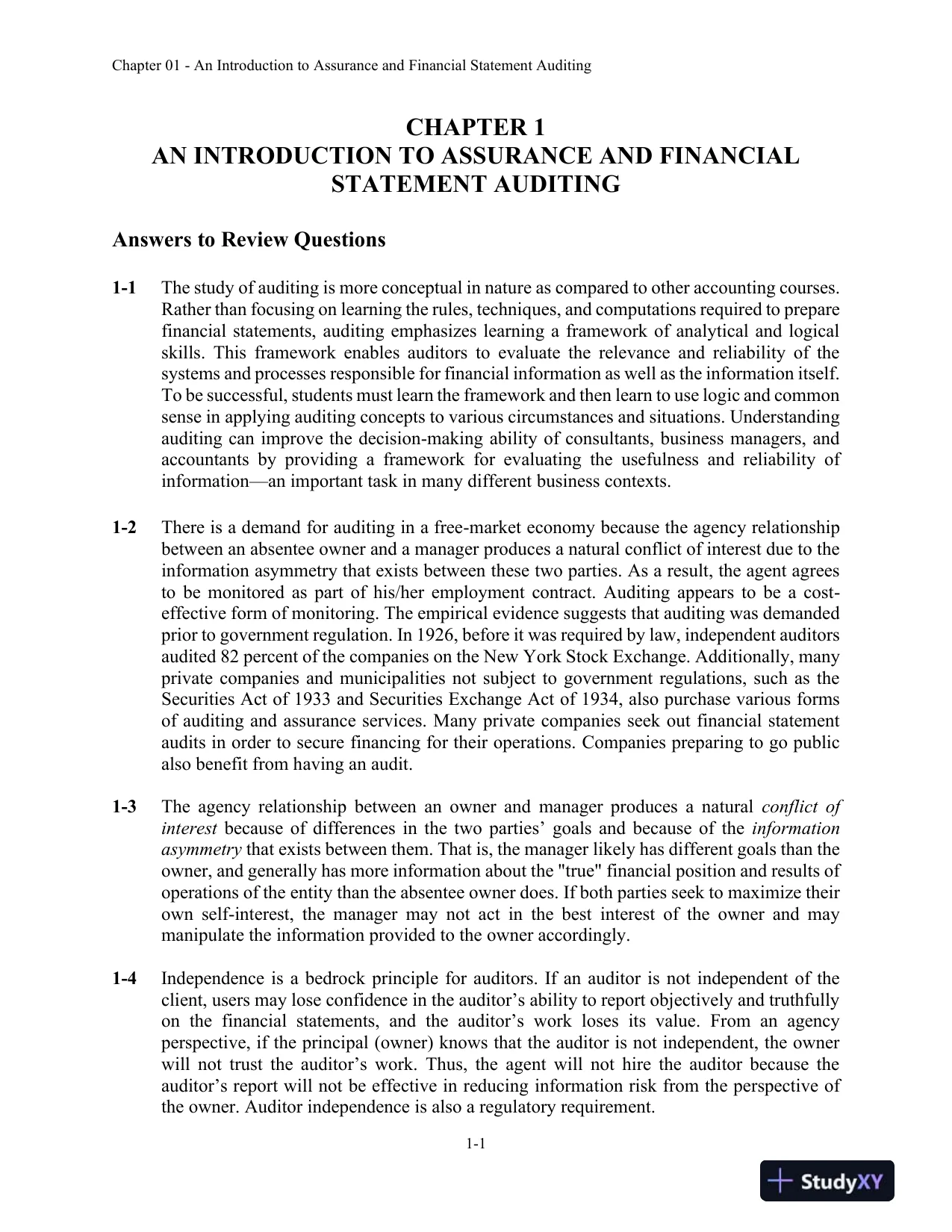
Chapter01-AnIntroduction toAssurance andFinancial Statement Auditing1-1CHAPTER 1AN INTRODUCTION TO ASSURANCE AND FINANCIALSTATEMENT AUDITINGAnswers to Review Questions1-1The study of auditing is more conceptual in natureascompared to other accounting courses.Rather than focusing onlearning the rules, techniques, and computations required to preparefinancial statements, auditing emphasizes learning a framework of analytical and logicalskills. This framework enables auditorsto evaluate the relevance and reliability of thesystems and processes responsible for financial information as well as the information itself.To be successful, students must learn the framework and then learn to use logic and commonsense in applying auditing concepts to various circumstances and situations.Understandingauditing can improve the decision-making ability of consultants, business managers, andaccountants by providing a framework for evaluating the usefulness and reliability ofinformationan important task in many differentbusinesscontexts.1-2There is a demand for auditing in a free-market economy because the agency relationshipbetween an absentee owner and a manager produces a natural conflict of interest due to theinformation asymmetry that exists betweenthese two parties. As a result, the agent agreesto be monitored as part of his/her employment contract. Auditing appears to be a cost-effective form of monitoring.The empirical evidence suggeststhatauditing was demandedprior to government regulation. In 1926, before it was requiredby law, independent auditorsaudited 82 percent of the companies on the New York Stock Exchange. Additionally, manyprivate companies and municipalities not subject to government regulations, such as theSecurities Act of 1933 and Securities Exchange Actof 1934, also purchase various formsof auditing and assurance services.Many private companies seek out financial statementaudits in order to secure financing for their operations.Companiespreparing to go publicalso benefit from having an audit.1-3The agency relationship between an owner and manager produces a naturalconflict ofinterestbecause of differences in the two parties’ goals and because of theinformationasymmetrythat exists between them. That is, the managerlikely hasdifferent goals than theowner, and generally has more information about the "true" financial position and results ofoperations of the entity than the absentee owner does. If both parties seek to maximize theirown self-interest, the managermaynot act in the bestinterest of the owner and maymanipulate the information provided to the owner accordingly.1-4Independence is a bedrock principle for auditors. If an auditor is not independent of theclient, users may lose confidence in the auditor’s ability to report objectively and truthfullyon the financial statements, and the auditor’s work loses its value.From an agencyperspective, if the principal (owner) knows that the auditor is not independent, the ownerwill not trust the auditor’s work. Thus, the agent will not hire the auditor because theauditor’s report will not be effective in reducing information risk from the perspective ofthe owner.Auditor independenceis also a regulatory requirement.

Page 2

Solution Manual for Auditing and Assurance Services: A Systematic Approach, 11th Edition - Page 2 preview image

Loading page ...

Page 3

Solution Manual for Auditing and Assurance Services: A Systematic Approach, 11th Edition - Page 3 preview image

Loading page ...

Chapter01-AnIntroduction toAssurance andFinancial Statement Auditing1-21-5Auditing(broadly defined) is a systematic process of (1) objectively obtaining andevaluating evidence regarding assertions about economic actions and events to ascertain thedegree of correspondence between those assertions and established criteria and (2)communicating the results to interested users.Attestservices occur when a practitioner issues a report on subject matter, or an assertionabout subject matter, that is the responsibility of another party.Assuranceservices are independent professional services that improve the quality ofinformation, or its context, for decision makers.1-6The phrasesystematic processimplies that there should be a well-planned, logical approachfor conducting an audit that involvesobjectively obtaining and evaluating evidence.Itrequires organizing a plan for gathering evidence and documenting steps taken during theauditto evaluate the relevance and validity of the evidence.1-7Audit riskis defined as the risk that the auditor may unknowingly fail to appropriatelymodify his or her opinion on financial statements that are materially misstated (AS 1101).Materialityis defined as "the magnitude of an omission or misstatement of accountinginformation that, in the light of surrounding circumstances, makes it probable that thejudgment of a reasonable person relying on the information would have been changed orinfluenced by the omission or misstatement" (FASBStatement of Financial AccountingConcepts No. 8, Chapter 3: Qualitative Characteristics of Useful Accounting Information,which ispendingrevision at the time of the writing of this book per the Board’s November2017 decision to revert to a definition of materiality similar to the one found in supersededConcept No. 2).The concept of materiality is reflected in the wording of the auditor's standard audit reportthrough the phrase "the financial statements present fairlyin all material respects." This isthe manner in which the auditor communicates the notion of materiality to the users of theauditor's report. The auditor's standard report states that the audit provides onlyreasonableassurancethat the financial statements do not contain material misstatements. The term"reasonable assurance" implies that there issome risk that a material misstatement could bepresent in the financial statements and the auditor will fail to detect it.1-8The major phases of the audit are:Client acceptance/continuancePreliminary engagement activitiesPlan the auditConsider and audit internal controlAudit business processes and related accountsComplete the auditEvaluate results and issue audit report1-9Plan the audit: During this phase of the audit, the auditor uses knowledge aboutthe clientand any controls in placeto plan the audit and perform preliminary analytical procedures.The outcome of the planning process is a written audit plan that sets forth the nature, extent,and timing of the audit procedures to be performed. The purpose of this phase is to plan aneffective and efficient audit.

Page 4

Solution Manual for Auditing and Assurance Services: A Systematic Approach, 11th Edition - Page 4 preview image

Loading page ...

Chapter01-AnIntroduction toAssurance andFinancial Statement Auditing1-31-10The auditor's standard unqualified report for a public company clientincludesthe followingsections: (1)opinion on the financial statements, (2)basis foropinion,and(3)critical auditmatters, as illustrated in this chapter.1-11The emergence of advanced audit technologies will help remove many of the tedious tasksthat are usually performed by junior auditors. Thus, auditors of allpositions and experiencewillbe required tospend additional time reasoning through fundamentalbusiness,accounting, and auditing concepts. An auditors’ knowledge in these areas will enable themto provide greater benefit to clients by asking the right questions and identifying new, moreeffectiveways to collect, analyze,andinterpret results.In using audit data analytics, forexample, auditors must understand the client and its industry, as well as the fundamentalsof accounting and auditing, in orderto ask the right questions in querying the data and ininterpreting the results obtained.1-12Auditors frequently face situations where no standard audit procedure exists, such as theexample from the text of verifying the inventory of cattle. Such circumstances require thatthe auditor exercise creativity and innovation when planning and administering auditprocedures where little or no guidance or precedent exists. Every client is different, andapplying auditing concepts in different situations requires logic and common sense, andfrequently creativity and innovation.Answers to Multiple-Choice Questions1-13b1-19a1-14b1-20d1-15c1-21d1-16c1-22d1-17c1-23b1-18cSolutions to Problems1-24There are two major factors that may make an audit necessary for Greenbloom GardenCenters. First, the company may require long-term financing for its expansion into othercities in Florida. Entities such as banks or insurance companies are likely to be the sourcesofthecompany'sdebtfinancing.Theseentitiesnormallyrequireauditedfinancialstatementsbeforelendingsignificantfundsandgenerallyrequireauditedfinancialstatements during the time period the debt is outstanding. There is informationasymmetrybetween the lender of funds and the owner of the business, and this asymmetry results ininformation risk to the lender. Even if the business could get funding without an audit, aclean audit report by a reputable auditor might very well reducethe lender’s informationrisk and make the terms of the loan more favorable to the owner. Second, as the companygrows, the family will lose control over the day-to-day operations of the stores. An auditcan provide an additional monitoring activity for the family in controlling the expandedoperations of the company.

Page 5

Solution Manual for Auditing and Assurance Services: A Systematic Approach, 11th Edition - Page 5 preview image

Loading page ...

Chapter01-AnIntroduction toAssurance andFinancial Statement Auditing1-41-25a.Evidence that assists the auditor in evaluating financial statement assertions consists ofthe underlying accounting data and any additional information available to theauditor,whether originating from the client or externally.b.Management makes assertions about components of the financial statements. Forexample, an entity's financial statements may contain a line item that accountsreceivable amount to$1,750,000. In this instance, management is asserting, amongother things, that the receivables exist, the entity owns the receivables, and thereceivables are properly valued. Audit evidence helps the auditor determine whethermanagement’s assertions arebeing met. If the auditor is comfortable that he or she canprovide reasonable assurance that all assertions are met for all accounts, he or she canissue a clean audit report. In short, the assertions are a conceptual tool to help theauditor ensure thatshe or he has “covered all the bases.”c.In searching for and evaluating evidence, the auditor should be concerned with therelevance and reliability of evidence. If the auditor mistakenly relies on evidence thatdoes not relate to the assertion being tested, an incorrect conclusion may be reachedabout the management assertion. Reliability refers to the ability of evidence to signalthe true state of the assertion, i.e., whether it is actually being met or not.1-26a.The major phases of the audit and their descriptions are:1.Client acceptance/continuance.The auditor decides to accept a new client orto retain an existing client.2.Preliminary engagement activities. This phase involves (1) determining theaudit engagement team requirements, (2) ensuring the independence of theaudit team and audit firm, and (3) establishing an understanding with the clientregarding the services to be performed and the other terms of the engagement.3.Plan the audit.During this phase of the audit, the auditor uses the knowledgeof the client to plan the audit and perform preliminary analytical procedures.The purpose of this phase is to plan an effective and efficient audit.4.Consider and audit internal control. The auditor understands and evaluatesthe client’s internal controls in order to assess the risk that they will not preventor detect a material misstatement. In the case of a public company, the auditorwill conduct an audit of internal control over financial reporting.5.Auditbusinessprocessesandrelatedaccounts.Theauditorconductssubstantive tests, including analytical procedures and the details of the accountbalances, searching for material misstatements.6.Complete the audit. The auditor searches for contingent liabilities andsubsequent events, and performs a final review of the evidence gathered.7.Evaluate results and issue the audit report. Based on the collection andevaluation of evidence, the auditor issues a report on whether the financialstatements are fairly presented.b.As the book explains, if the auditor designs procedures to test whether the entity’sinternal controlover financial transactions is effective, the auditor can obtain additionalindirect information regarding whether the account balances are fairly stated: if controlsare effective, then the transactions will probably be captured and summarized properly,which means in turn that the account balances are likely to be free of material

Page 6

Solution Manual for Auditing and Assurance Services: A Systematic Approach, 11th Edition - Page 6 preview image

Loading page ...

Chapter01-AnIntroduction toAssurance andFinancial Statement Auditing1-5misstatement.Whileit is indirect, evidence about internal control is often arelativelycost-effective form of audit evidenceabout the fairness of account balances.c.Auditors develop an understanding of an entity's internal control in order to establishthe scope of the audit. However, during the course of this work, the auditor may becomeaware of weaknesses in the entity's accounting systems. The auditor is required tocommunicate this information to management. The auditor may also make suggestionson how to correct the weaknesses. The auditor's work on internal control may also havea preventive effect on the behavior of the entity's employees. If the employees knowthat their work will be audited, they are less likely to commit errors or fraud. Becauseof the Sarbanes-Oxley Act, internal control is a topic that is front-and-center in theaccounting profession.1-27A search of the homepage of most public companies will include links to their latestfinancial information or 10-K filings. The SEC’s homepage willalso include thisinformation along with any other recent filings. Examining the independent auditor’s reportand financial statements will allow the student to have a better idea as to how the chapter’sinformation is applied in real companies.1-28Opinion paragraph: “…the financial statements present fairly, in all material respects,…”This sentence indicates that the financial statements are a “fair”, not exact, representation.Also, the idea of materiality is revisited here, indicating thatthe audit does not provideassurance that there are noimmaterialerrors in the financial statements.Basis for Opinionparagraph:[These]standards require that we plan and perform theaudit to obtain reasonable assurance about whether the financial statements are free ofmaterial misstatement” The use of the termreasonable assuranceindicates that there isno guarantee that the financial statements are correct, onlyreasonable assurance. Also thestatement that the financials are “free of material misstatement” indicates thatthe auditdoes not provide assurance that thefinancialsare free oferror that is not material.Such procedures include examining, on a test basis, evidence…”The explanation thatthe auditorusesa test basisindicates that some of the figureswere not fully examined, butrather only a sample of information was taken to gather evidence.“We believe that our audits provide a reasonable basis for our opinion.” This statementindicates that the audit is not “proof” that the financial statements are exact, only that thereis reasonable evidence about theirfairness in accordance with GAAP.Critical Audit Matter paragraph: “…involvedespecially challenging, subjective, orcomplexauditjudgments.” This sentence prefaces the entire purpose of the paragraphwhich is to ensure the public is aware thatsome financial statement amounts anddisclosuresrequire extensive judgment by managementand auditors,suggesting that thefinancial statements inherently are not precisely accurate.Solution to Discussion Case1-29The memo should cite the following facts:

Page 7

Solution Manual for Auditing and Assurance Services: A Systematic Approach, 11th Edition - Page 7 preview image

Loading page ...

Chapter01-AnIntroduction toAssurance andFinancial Statement Auditing1-6There is a historical relationship between accounting and auditing.When parties to the agency relationship (contract) do not possess thesame amount ofinformation (information asymmetry) there is a natural conflict of interest between theparties. For example, when an owner and manager are negotiating an employmentcontract, the owner may assume that the manager likely will use organizational fundsfor personal uses. Auditing plays an important role in such relationships. The ownerand manager will consummate an employment contract only if the manager agrees tobe monitored. Auditing can be used to monitor the contract agreed to by the twoparties.(As an attorney,Dashawnshould be well versed in contract law.)Auditing is also used to monitor other types of contracts for which no laws orregulations require an audit, for example, contracts between management and debtholders.There is historical evidence of forms of auditing in the early Greek states and in theUnited Kingdom during the industrial revolution. More relevant evidence is the factthat 82 percent of the NYSE companies were audited prior to the securities acts.Additional evidence for the demand for auditing is also provided by the fact that manyprivate companies and municipalities not subject to the securities acts contract foraudits.Solution to Internet Assignment1-30There are numerous Internet sites thatcontain accounting information. Following are somesuggested sites:The AICPA's home page(www.aicpa.org)contains extensive information on theorganization's activities.Forexample, it contains the entire report of the SpecialCommittee on Assurance Services.The American Accounting Association’s home page (www.aaahq.org)has numerouslinks, including professional organizations, accounting journals, and education sites.The Association of Certified Fraud Examiners'home page (www.acfe.com)hasextensive information on the Association’s certification (CFE)program.The Institute of Internal Auditors'home page(www.theiia.org)contains detailedinformation on internal auditing.The International Federation of Accountants' website(www.ifac.org)provides detailedinformation on international accounting and auditing standards.The Government Accountability Office's website (formerly the General AccountingOffice,(www.gao.gov)provides detailed information on the GAO’s activities andallows users to obtain copies of GAO reports.The SEC’s Edgarwebsite(www.sec.gov)contains all filings by public companies withthe SEC.It also contains information on other activities by the SEC.The PCAOB’swebsite(www.pcaobus.org) offers detailed information about thePCAOB and the standards it has proposed and established.The major public accounting firms and many smaller firms also maintainwebsites.

Page 8

Solution Manual for Auditing and Assurance Services: A Systematic Approach, 11th Edition - Page 8 preview image

Loading page ...

Chapter 02-The Financial Statement Auditing Environment2-1CHAPTER 2THE FINANCIAL STATEMENT AUDITING ENVIRONMENTAnswers to Review Questions2-1Auditors can be classified under four types: (1) external auditors, (2) internal auditors, (3)government auditors, and (4) forensic auditors.Externalauditors:provide reasonable assurance that financial statements are fairly statedfor publicly traded and private companies, partnerships, universities, and governmententities, but are not employees of the entity being auditedInternal auditors:employed by companies to provide independent, objective assuranceand consulting services designed to add value and improve an organization’s operationsGovernment auditors:employed by federal, state, and local agencies to provide servicessimilar to internal auditorsForensic auditors:employed by corporations, government agencies, public accountingfirms, and consulting and investigative services firms to detect, investigate, and deter fraudand white-collar crime2-2Examples ofcomplianceaudits include (1) internal auditors determining whether corporaterules and policies are being followed by departments within the organization, (2) anexamination of tax returns of individuals and companies by the Internal Revenue Servicefor compliancewith the tax laws, and (3) an audit under the Single Audit Act of 1984 todetermine whether an entity receiving federal assistance is in compliance with applicablelaws and regulations.Examples ofoperationalaudits include (1) an audit by the GAO of the Food and DrugAdministration to determine the efficiency and effectiveness of procedures for introducingnew drugs to the market, (2) internal auditors examining the effectiveness and efficiency offunds beingspent on the entity’s computer resources, and (3) a university hiring an externalauditor to examine the effectiveness and efficiency of student advisory services.Examples offorensicaudits include (1) an examination by an external auditor of cashdisbursements for payments to unauthorized vendors, (2) assistance by an auditor to a lawenforcement agency in tracing laundered monies by organized criminals, and (3) anindependent auditor helping identify hidden assets as part of a divorce settlement.Student answers will likely be less detailed but should capture the general idea of each typeof audit.2-3During the late 1990s and early 2000s, accounting firms aggressively sought opportunitiesto expand their business in non-audit services such as consulting. This expansion from their

Page 9

Solution Manual for Auditing and Assurance Services: A Systematic Approach, 11th Edition - Page 9 preview image

Loading page ...

Chapter 02-The Financial Statement Auditing Environment2-2coreauditpractice,combinedwithallegationsofauditorsrefusingtochallengemanagement’sactions,resultedinconflictbetweenregulatorsandtheaccountingprofession. Subsequent financial fiascos such as those at Enron, WorldCom, Tyco, andmany others caused investors to doubt the fundamental integrity of the financial reportingsystem. Under pressure to restore the public’s confidence, Congress passed the Sarbanes-Oxley Act and created the PCAOB in 2002.2-4The accounting profession’s expansion into new areas, combined with changes in theoverall business environment, resulted in new regulations and guidelines. The scandals ofthe late 1990s and early 2000s brought into question the profession’s ability to self-regulate,resulting in new legislation. While these changes have caused pain and turmoil, theyhighlight the essential importance of auditing in our economic system. Ultimately, the “backto basics” emphasis, along with auditing firms’ renewed focus onthorough and effectivefinancial statement audits, will likely prove healthy for the U.S. financial reporting systemand for the profession. Further, somewhat ironically, the SOX-mandated audit of internalcontrol over financial reporting has brought significant new revenues to accounting firms.2-5Management is responsible to prepare financial statements that fairly present the company’sfinancial condition and operations in accordance with established accounting standards.Note that the auditor’s opinion explicitly states that the financial statements are theresponsibility of management. The auditor is responsible to issue an opinion in regards tothe financial statements prepared by management. In order to issue this opinion, the auditormust plan and perform the audit in accordance with established standards to obtainreasonable assurance that the financial statements are free of material misstatement, whethercaused by error or fraud. However, it is important to note that an auditor’s unqualifiedopinion does not mean that errors or fraud do not exist but rather that there is reasonableassurance that they do not exist in material amounts.2-6The essential components of the high-level model of business offered in the chapterincludethefollowing:corporategovernance,objectives,strategies,processes,controls,transactions, and financial statements. Corporate governance is carried out by managementand the board of directors in order to ensure that business objectives are carried out and thatcompany assets are safeguarded. To achieve its objectives, management must formulatestrategies and implement various processes which are in turncarried out through businesstransactions. The entity’s information and internal control systems must be designed toensure that these transactions are properly executed, captured, and processed in order toproduce accurate financial statements. It is important that the auditor obtain a firmunderstanding of these components in order to understand relevant risks and to plan thenature, timing, and extent of the audit so that it is efficient and effective.2-7The information system must maintain a record of all businesses transactions. It should becapable of producing accurate financial reports to summarize the effects of the entity’stransactions. Among other things, internal control is required to ensure that a properenvironment is established and that transactions are appropriately conducted and recordedby the information system and company employees. Effective internal control providessafeguards to ensure the (1) reliability of financial reporting,(2) compliance with laws and

Page 10

Solution Manual for Auditing and Assurance Services: A Systematic Approach, 11th Edition - Page 10 preview image

Loading page ...

Chapter 02-The Financial Statement Auditing Environment2-3regulations, and (3) the effectiveness and efficiency of operations. Auditing standardsrequire that the auditor obtain an understanding of the client’s environment, including itsinternal control, in planning the nature, timing, and extent of testing.2-8The AICPA issues the following standards:Statements on Auditing StandardsStatements on Standards for Attestation EngagementsStatements on Standards for Accounting and Review ServicesStatements on Quality Control StandardsStandards for Performing and Reporting on Peer ReviewsStatements on Standards for Consulting ServicesStatements on Standards for Tax Services2-9The PCAOB is a quasi-governmental organization overseen by the SEC. It was formed toprovide governmental regulation of the standards used in conducting public company auditsbecause of a perceived failure of the profession to adequately regulate itself.2-10The SEC has congressional authority from the original Securities Acts of 1933 and 1934 toestablish accounting and auditing standards for publicly traded companies; however, in thepast the SEC has largely delegated this authority to other bodies, including the FASB andthe AICPA’s Auditing Standards Board. The Sarbanes-Oxley Act of 2002 gave the SEC themandatetoactivelyregulatethepublicaccountingprofessionbyestablishingandoverseeing the PCAOB and its standard-setting process relating to the audits of publiccompanies. The SEC has authority to implement and oversee standards relating to all aspectsof the audits of public companies, including standards relating to auditor independence(such as the requirement for audit firms to rotate auditpartners off audit engagements everyfive years).2-11The documents most frequently encountered by auditors under the Securities Exchange Actof 1934 are forms10K,10Q, and8K. Forms10Kand10Qare, respectively, annual andquarterly reports, which include the audited financial statements periodically filed with theSEC by a publicly traded entity. An8Kis filed whenever a“material corporate event”occurs, such as a change of independent auditors.2-12The four categories of PrinciplesUnderlying an Audit Conducted inAccordance withGAASare:Purpose of an Audit and Premise upon which an Audit is ConductedThis section explains the purpose and value of a financial statement audit and lays out theresponsibilities of management and those charged with governance.ResponsibilitiesThis section describes the responsibilities of the auditorregarding their capabilities,professional skepticism, and ethical behavior.PerformanceThis section describes the auditor’s responsibilities in performing an effective audit. Thisincludes their reasonable, rather thanabsolute, assurance that the financial statements are

Page 11

Solution Manual for Auditing and Assurance Services: A Systematic Approach, 11th Edition - Page 11 preview image

Loading page ...

Chapter 02-The Financial Statement Auditing Environment2-4free of materialmisstatementsand the costversus benefit analysisindeterminingprocedures.ReportingThis section describes the responsibility of the auditor for expressing an opinion andproviding a written report of that opinion.2-13Auditing standards are important for evaluating whether an auditor has done an adequateaudit. Users of financial statements desire consistency between audits of various companies.Standardsare a way to hold auditors accountable by ensuring that they fulfilltherequirementsdefining what a good audit entails.If the auditor fails to identify a materialmisstatement, this does not necessarily mean that the auditor has failed to perform a high-quality audit, since an audit can only provide reasonable, rather than absolute, assurance. Ifa material misstatement goes undetected, the auditorcan defend her or hisperformancebyshowingconformance with auditing standards.2-14Independence is a fundamental principle for auditors. If an auditor is not independent of theclient, users may lose confidence in the auditor’s ability to report objectively and truthfullyon the financial statements, and the auditor’s work loses its value. From an agencyperspective, if the principal (owner) knows that the auditor is not independent, the ownerwill not trust the auditor’s work. Thus, the agent will not hire the auditor because theauditor’s report will not be effective in reducing information risk from the perspective ofthe owner.Answers to Multiple-Choice Questions2-15b2-20a2-16a2-21a2-17d2-22c2-18d2-23c2-19cSolutions toProblems2-24Item NumberType of AuditType of Auditora.OperationalGovernmentb.Financial statementExternalc.Compliance or operational orpossibly internal controlInternal or externald.Forensic/FinancialInternal,external, or forensice.OperationalGovernment, external, or

Page 12

Solution Manual for Auditing and Assurance Services: A Systematic Approach, 11th Edition - Page 12 preview image

Loading page ...

Chapter 02-The Financial Statement Auditing Environment2-5internalf.OperationalInternal or externalg.ComplianceGovernmenth.Compliance or forensicGovernment, external, orforensic2-25Brief Description ofPrinciples Underlying anAuditSally Jones' Actions Resulting in Failure toComply with Principles Underlying an AuditPurpose and Premise of an Audit:An audit is to provide an opinion by an auditor onwhether financial statements are presentedfairly,in all material respects, according to the applicableframework. Management and those charged withgovernance are responsible for the preparation andfair presentation of the financial statements and forthe design, implementation, and maintenanceofinternal control over financial reporting. They arealso responsible for providing the auditor with allinformation relevant to the preparation of thefinancial statements.Jones expressed an opinion regarding the financialstatements,butnotonwhetherthefinancialstatements are presented fairly in accordance withgenerally accepted accounting principles, or anyother financial reporting framework. Therefore, shedid not fulfill the primary purpose of the audit.Jones did not ensure that management fulfilled itsresponsibilitiesforthefairpresentationofthefinancial statements, since that requires making theappropriatefootnotedisclosuresinthefinancialstatements.Responsibilities:Auditors are responsible for havingappropriatecompetence and capabilities to perform the audit;complying with relevant ethical requirements; andmaintainingprofessionalskepticismandexercising professional judgment, throughout theplanning and performance of the audit.It was inappropriate for Jones to hire the twostudents to conduct the audit, because they do nothave appropriate competence and capabilities.In order to comply with ethical requirements, Jonesmust be without bias with respect to the client underaudit. Because of the financial interest in whetherthe bank loan is granted to Boucher, Jones is notindependentineitherfactorappearancewithrespect to the assignment undertaken.NeitherJonesnorhertwoassistantsexercised

Page 13

Solution Manual for Auditing and Assurance Services: A Systematic Approach, 11th Edition - Page 13 preview image

Loading page ...

Chapter 02-The Financial Statement Auditing Environment2-6professional skepticism or professional judgment inperforming the audit.Performance:The auditor must obtain reasonable assuranceabout whether the financial statements as a wholeare free from material misstatement, whether dueto fraud or error. To do so, the auditor must planthe workand supervise any assistants; determineanappropriatematerialitylevel;identifyandassess risks of material misstatement based on anunderstanding of the entity and its environment,including its internal control; and obtain sufficientappropriateauditevidenceaboutwhethermisstatements exist. The auditor is unable toobtainabsoluteassurancethatthefinancialstatements are free from material misstatements.Jones failed to supervise the assistants. The workperformed was not adequatelyplanned.Jones did not study the client or its environment,including internal control, nor did the assistants.Consequently, she could not have identified risks ofmaterial misstatements.Jones acquired little evidence that would support thefairness of the financial statements. Jones merelychecked the mathematical accuracy of the recordsand summarized the accounts. Several standardaudit procedures and techniques were neglected.Reporting:Based on an evaluation of the audit evidenceobtained, the auditor expresses an opinion inaccordance with the auditor’s findings, or statesthat an opinion cannot be expressed. The opinionstates whether the financial statements arepresented fairly, in all material respects, inaccordance with theapplicable financialreporting framework.Although Jones' report contains an expression ofopinion, her opinion is not based on the results of aproper audit examination. Jones should disclaim anopinionbecauseshefailedtoconductanexamination in accordance with generally acceptedauditing standards.Jones' opinion made no reference to the applicablefinancialreportingframework.Also,sincethefinancialstatementsdidnotcontainadequatedisclosures, they could not have been in accordancewith any financial reporting framework.Solutions to Discussion Cases2-26Merry-Go-Round Part I.a. EY is alleged to have violated the Principles of responsibilities and performance.The firm is alleged to haveviolated the Principle of responsibilities in the sense thatit appeared that the staff assigned to the engagement did not have sufficient trainingor experience for the engagement. EY’s relationship with MGR’s landlords andattorneys likely caused them to violate this Principle, which requires compliancewith relevant ethical requirements.Poor staff assignments, the leader’s vacation, and the use of inexperiencedpersonnel all suggest that the engagement was not adequately planned and thatassistantswerenotproperlysupervised,whichviolatesthePrincipleofperformance. Also, the inadequate nature of EY’s recommendations suggests thatthey likely did not gain a sufficient understanding of the entity and its operations.

Page 14

Solution Manual for Auditing and Assurance Services: A Systematic Approach, 11th Edition - Page 14 preview image

Loading page ...

Chapter 02-The Financial Statement Auditing Environment2-7b.There are arguments both for and against having formal standards for CPAs whoconsult. Advantages include potential increase in public trust, some assurance that aminimal level of service quality would be attained, and perhaps more guidance forconsultants (to allow them to perform more effective consulting engagements). Theprimary disadvantage would result from the fact that CPAs who consult compete withconsulting firms comprised of non-CPAs. If standards were not thought out carefully,perhaps thestandards would put CPAs at a disadvantage relative to non-CPAs in thesense that CPAs would be subject to standards that constrain their activities or perhapsresult in their not being able to compete with non-CPAs in the area of fees. Note thatCPAs face certain restrictions in providing consulting services to audit clients. Theserestrictions are covered in a later chapter.2-27Merry-Go-Round Part II.a.In one sense, EY acted unethically. That is, it should have disclosed the nature of theserelationships to MGR. In another sense, it is difficult to ascertain whether theserelationships caused EY to act unethically. Specifically, was EY’s advice affected byits relationship with the landlord? Is this relationship the reason that EY’s cost-cuttingsuggestionsdidnotgofarther?Thesequestionspointouttheimportanceofindependence in fact and appearance, even when acting in a consulting capacity. Evenif EY acted ethically, this relationship creates the appearance of impropriety.b.As mentioned in Part a, the relationship with Rouse could have caused EY to hesitateto suggest that the stores for which Rouse was the landlord be closed for fear of losingbusiness from Rouse. Its relationship with Swidler could have made EY feel that itcould not lose the engagement under any circumstances, thereby possibly explainingits apparently lackadaisical attitude towards the engagement.Solutions to Internet Assignments2-28A search of the GAO’s homepage will identify recent audits conducted by this agency.2-29a.According to its website, the AICPA’s mission is to “provide members with theresources, information, and leadership that enable them to provide valuable services in thehighest professional manner to benefit the public as well as employers and clients.”b. The SEC’s website states that its mission is “toprotect investors, maintain fair, orderly,and efficient markets, and facilitate capital formation.” It goes on to emphasize that itspurpose is to promote and sustain economic growth. The site also mentions that the SECpromotes the disclosure of important market information, maintains fair dealings, protectsagainst fraud, and enforces its authority.c. During the 1920s, many people began investing heavily in the stock market without fully

Page 15

Solution Manual for Auditing and Assurance Services: A Systematic Approach, 11th Edition - Page 15 preview image

Loading page ...

Chapter 02-The Financial Statement Auditing Environment2-8thinking about the risk that they were taking upon themselves. As a result of poorinvestment choices and unreliable information, the stock market crashed in 1929. In anattempt to restore confidence in the capital markets, Congress passed theSecurities Act of1933.One year later, the SEC was created by theSecurities Exchange Act of 1934.d. The PCAOB’s website provides information on the Board’s organization, policies, andstandards. It also indicates that the Board uses an expert advisory group to help the Boarddevelop standards. Though many observers dispute this claim, the Board asserts that itsstandards are also developed in an open, public process to allow all parties of interest tocomment. Section 103 of the Sarbanes-Oxley Act empowers the PCAOB to set auditingstandards for audits of public companies.The Dodd-Frank Act amended the Sarbanes-Oxley Actto givethe PCAOB the authorityto establish auditing and related professional practice standards for audits of the financialstatements and selected practices and procedures of broker-dealers. The Board's Office ofthe Chief Auditor is responsible for developingthese standards.e. The International Auditing Practices Committee (IAPC) was founded in 1978. Duringits first meeting, the group agreed to issue its publications as guidelines rather thanstandards. The IAPC’s initial work focused on three areas: object and scope of audits offinancial statements, engagement letters, and general auditing guidelines.During thisinitial meeting, the IAPC also agreed to respond to a request from the InternationalAccounting Standards Committee (IASC) chairman and Governors of the CentralBanksto develop guidance on inter-bank confirmations.In 1988, the IAPC approved the release ofThe Auditor’s Report on Financial Statementsguidelines. It later developed final guidelines on three key subjects: related parties, goingconcern, and management representations.In 1985, Chairman Justin Fryer called on the IAPC to act in the interests of the public. Healso called on the IAPC to resolve differences in auditing standards where differences existin different countries and to establish a single set of international standards. The IAPCrecognized that a fundamental way to protect the public interest was to require theapplication of a core set of internationally recognized auditing and assurance standards.IFAC was among the first organizations to refer to international auditing guidelines in itsown financial statements.In 1991,the IAPC proposed to IFAC member bodies that theterm “guidelines” be replaced with “standards.” With that, International Standards onAuditing, or ISAs, were born.In 2001, IAPC was renamed as the International Auditing and Assurance Standards Board(IAASB). The IAASB then embarked on its first joint project with a national standardsetter, the AICPA, which resulted in the development of the suite of audit risk standards.In 2003, IFAC approved a series of reforms designed to strengthen the IAASB’s standard-setting processes so that it are properly responsible to the public interest. By 2007, the

Page 16

Solution Manual for Auditing and Assurance Services: A Systematic Approach, 11th Edition - Page 16 preview image

Loading page ...

Chapter 02-The Financial Statement Auditing Environment2-9IAASB had become arguably the most transparent auditing standard setter in the world.To encourage greater use of its standards and facilitate translation, in 2004 the IAASBlaunched a project designed to improve the clarity of its pronouncements. It revised itsdrafting conventions to make the ISAs more readily understood. By the end of 2008, theIAASB had approved all final redrafted auditing standards. The IAASB is currentlyworking on revising its standards for assurance engagements other thanaudits.f. The IASB is the independent accounting standard-setting body of the IFRS Foundation.The IASB is composedof 16 expertswith an appropriate mix of recent practical experiencein setting accounting standards, in preparing, auditing, or using financial reports, and inaccounting education. The IASB is advised by the IFRS Advisory Council which, alongwith the IASB, is overseen by the IFRS Foundation trustees. The IFRS Foundation isoverseen by a monitoring board of public capital market authorities.The IFRS Foundation is a not-for-profit, private sector body that raises funds to supportthe operations of the IASB as an independent accounting standard setter. Mandatory leviesare issued for listed and non-listed companies in a growing number of countries. TheFoundation strives to ensure that its financial support is broad based.The IASB is responsible for the development and publication of IFRSs and for approvingInterpretations of IFRSs as developed by the IFRS Interpretations Committee.Allmeetingsof the IASB are held in public and are broadcast through the internet. In fulfilling itsstandard-setting duties, the IASB follows a thorough, open and transparent process ofwhich the publication of consultative documents, such as discussion papers and exposuredrafts for public comment is an important component. The IASB engages closely withstakeholders around the world, including investors, analysts, regulators, business leaders,accounting standard-setters,and the accountancy profession.The SEC has not yet reached a decision as to how, or even whether, the U.S. will adoptIFRS. Currently, the FASB is working to converge many of its standards with those oftheIASB. For example, the FASB’sguidance on fair value measurement is largely identicalto guidance issued by the IASB. The FASB is currently working on converging itsstandards regarding revenue recognition, financial instruments, and lease accounting to bemore in line with IFRS.
Preview Mode

This document has 232 pages. Sign in to access the full document!