

Biochemistry I - Introduction to Biological Energy Flow
- Biochemistry
- Texas A&M University
- 19 pages
- Shared March 2026
Preview 6 of 19 pages
See the first 6 pages exactly as they appear in the document.
Page 1 Read page 1 as text
Study Guide Biochemistry I – Introduction to Biological Energy Flow 1. Enzyme Catalysts Almost all biochemical reactions in living cells need help to occur efficiently. This help comes from enzymes , which are specialized biochemical catalysts . For example, the biological synthesis of ammonia does not happen on its own at a useful rate. It requires a specific enzyme to make the reaction proceed properly. Most enzymes are proteins , and they act as true catalysts . This means they: • Speed up chemical reactions • Are not used up during the reaction • Can carry out the same reaction over and over again Because enzymes are so efficient and reusable, they make it possible for thousands of chemical reactions to occur quickly and in a controlled way inside living cells. Key Takeaway Enzymes are protein catalysts that make life’s chemistry possible by speeding up reactions without being consumed in the process. 2. Space and Time Links in the Cell At any given moment, thousands of chemical reactions are happening inside a single cell. Even a simple bacterium must perform many tasks at the same time. It has to: • Copy its DNA • Make new enzymes • Break down carbohydrates to release energy • Produce building blocks for proteins and nucleic acids • Bring nutrients into the cell and remove waste products All of this happens simultaneously and efficiently .
Page 2 Read page 2 as text
Study Guide 2.1 Metabolic Pathways Each major task in the cell is carried out through a series of enzyme - driven steps called a metabolic pathway . • A pathway is a sequence of reactions • Each step is catalyzed by a specific enzyme • The product of one step becomes the substrate for the next These reactions occur in a precise order, ensuring that the final product is made correctly. 2.2 Channeling Reactions for Efficiency Cells also control where and when reactions occur. In many cases, the molecules moving through a pathway are channeled directly from one enzyme to the next , instead of freely mixing in the cell. This organization has important advantages: • Increases efficiency • Prevents interference between pathways • Allows tight regulation of metabolism Example: Muscle Cells In muscle cells, glucose is used for different purposes: • Some glucose provides energy for muscle contraction • Other glucose is used to power ion transport across the cell membrane These two uses are kept separate. The glucose molecules do not mix randomly because they are directed through different enzyme pathways in specific locations. Key Takeaway Cells manage enormous chemical complexity by organizing reactions in both space and time . By using enzyme pathways and directing substrates through specific routes, cells can carry out many essential processes at once without confusion or waste.
Page 3 Read page 3 as text
Study Guide 3. Energy Flow and Thermodynamics 3.1 What Is Thermodynamics? Thermodynamics is the branch of chemistry and physics that studies energy flow in physical and chemical systems. In simple terms, it helps us understand how energy moves, changes, and determines whether reactions can happen. 3.2 The Laws of Thermodynamics First Law of Thermodynamics: Energy Is Conserved The First Law of Thermodynamics states that energy cannot be created or destroyed . It can only change from one form to another. For example, chemical energy in food can be converted into mechanical energy when muscles move — but the total amount of energy stays the same. 3.3 Second Law of Thermodynamics: Direction of Reactions The Second Law of Thermodynamics explains why some reactions happen and others do not . • Spontaneous reactions occur naturally without extra energy input. • These reactions are associated with an increase in entropy , which means an increase in disorder . What Is Entropy? Entropy can be thought of as energy that is spread out and not useful for doing work . For example: • The oceans contain huge amounts of thermal energy from moving water molecules. • However, this energy is too dispersed to power a boat. • To move the boat, we need usable energy like fuel or wind.
Page 4 Read page 4 as text
Study Guide 3.4 Free Energy: Usable Energy in a System The energy that can be used to do work is called free energy . The change in free energy for a reaction is given by: Δ G = Δ H − T Δ S Where: • Δ G = change in free energy • Δ H = change in enthalpy (heat content) • T = temperature in Kelvin • Δ S = change in entropy What Does This Equation Mean? • A reaction releases usable energy when Δ G is negative . • Another way to state the Second Law is: Reactions proceed in the direction that lowers free energy. 3.5 Free Energy and Chemical Equilibrium The free energy change of a reaction under standard conditions (all reactants and products at 1 M concentration) is related to the equilibrium constant: Δ G° = −RT ln(Kₑq) Where: • R = gas constant • T = temperature in Kelvin • Kₑq = equilibrium constant What This Tells Us: • If Kₑq > 1 , the reaction is favored. o ln(Kₑq) is positive o Δ G° is negative o The reaction is exergonic (releases energy)
Page 5 Read page 5 as text
Study Guide • If Kₑq < 1 , the reaction is unfavored. o ln(Kₑq) is negative o Δ G° is positive o The reaction is endergonic (requires energy) 3.6 Standard States in Biochemistry In chemistry, standard free energy changes are measured with all substances at 1 M concentration . However, this does not work well for biological systems. Why Biochemistry Uses a Different Standard State • Many biomolecules are unstable in strong acid. • Living cells operate around pH 7.0 , not pH 0. Because of this, biochemistry uses a biochemical standard state : • pH = 7.0 • Standard free energy is written as Δ G°′ • The prime (′) indicates this special biological condition 3.7 Free Energy Under Real Cellular Conditions Inside cells, reactant and product concentrations are much lower than 1 M . To calculate free energy under these real conditions, we use: Δ G = Δ G°′ + RT ln( Π[ Products] / Π[ Reactants]) Where: • Π[ Products] = concentrations of all products multiplied together • Π[ Reactants] = concentrations of all reactants multiplied together If a substance appears more than once in the reaction, its concentration is raised to the appropriate power — just like in equilibrium expressions.
Page 6 Read page 6 as text
Study Guide 3.8 Special Cases • Standard conditions (1 M): Δ G = Δ G°′ • At equilibrium: Δ G = 0 At equilibrium, the equation becomes: Δ G°′ = −RT ln(Kₑq) Here, Kₑq is the equilibrium constant for the reaction at pH 7.0 . Key Takeaway • Energy is conserved but becomes less useful as entropy increases. • Free energy tells us whether a reaction can occur. • Negative Δ G means a reaction is spontaneous. • Equilibrium and free energy are closely connected. • Biochemistry uses a special standard state to match real biological conditions. 4. Free - Energy Calculations in Biochemical Reactions 4.1 Free Energy in Biochemistry In biochemistry, free - energy changes are usually reported as standard free energies of hydrolysis . This is because many important cellular reactions involve breaking bonds using water. Hydrolysis of Glucose - 6 - Phosphate Consider the hydrolysis of glucose - 6 - phosphate: Glucose - 6 - phosphate + H ₂ O → Glucose + P ᵢ Under standard biochemical conditions, this reaction has: • Δ G°′ = −4.0 kcal/mol (−16.5 kJ/mol)
13 more pages in the full document
Unlock it once and it stays in your library, ready to chat with or turn into flashcards.
Unlock the full documentMore Biochemistry study materials
See all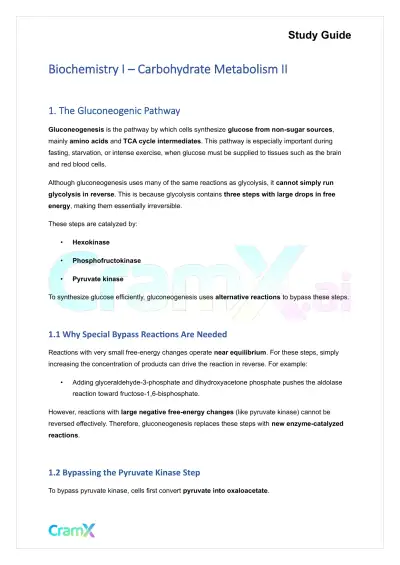 Quick Guides
Biochemistry I - Carbohydrate Metabolism II
Biochemistry
25 pagesMar 2026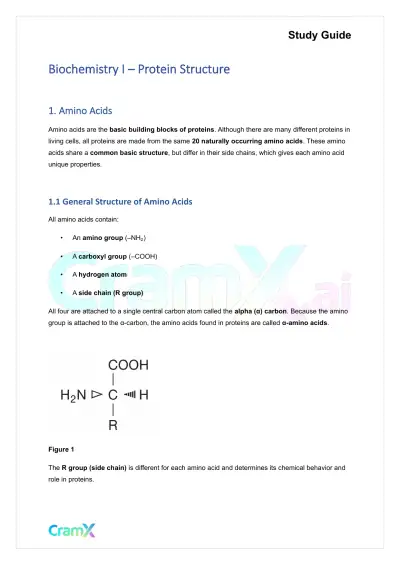 Quick Guides
Biochemistry I - Protein Structure
Biochemistry
29 pagesMar 2026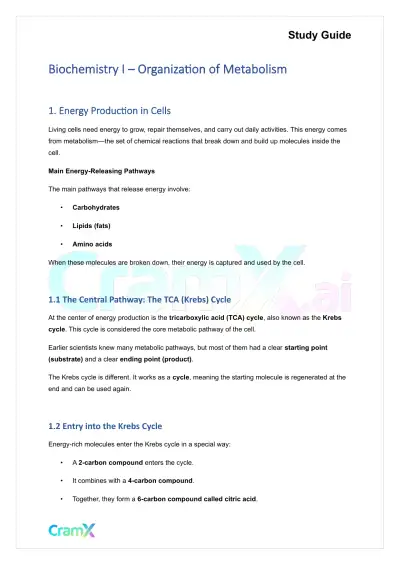 Quick Guides
Biochemistry I - Organization of Metabolism
Biochemistry
8 pagesMar 2026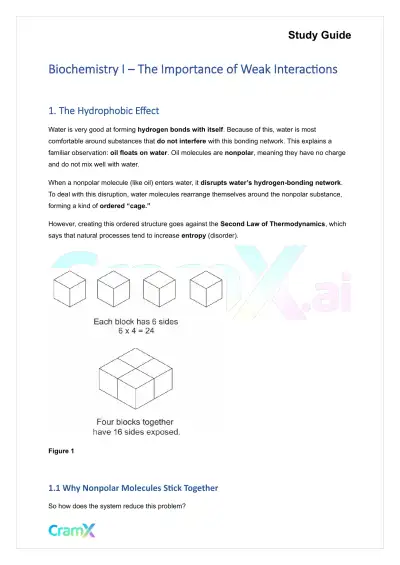 Quick Guides
Biochemistry I - The Importance of Weak Interactions
Biochemistry
18 pagesMar 2026 Quick Guides
Biochemistry I - Oxidative Phosphorylation
Biochemistry
24 pagesMar 2026 Quick Guides
Biochemistry I - The Tricarboxylic Acid TCA Cycle
Biochemistry
17 pagesMar 2026 Quick Guides
Biochemistry I - The Scope of Biochemistry
Biochemistry
20 pagesMar 2026 Quick Guides
Biochemistry I - Oxygen Binding by Myoglobin and Hemoglobin
Biochemistry
14 pagesMar 2026
Study this document with CramX
Once it is in your library, every tool can work from it.