

Biochemistry I - Organization of Metabolism
- Biochemistry
- Texas A&M University
- 8 pages
- Shared March 2026
Preview 3 of 8 pages
See the first 3 pages exactly as they appear in the document.
Page 1 Read page 1 as text
Study Guide Biochemistry I – Organization of Metabolism 1. Energy Production in Cells Living cells need energy to grow, repair themselves, and carry out daily activities. This energy comes from metabolism — the set of chemical reactions that break down and build up molecules inside the cell. Main Energy - Releasing Pathways The main pathways that release energy involve: • Carbohydrates • Lipids (fats) • Amino acids When these molecules are broken down, their energy is captured and used by the cell. 1.1 The Central Pathway: The TCA (Krebs) Cycle At the center of energy production is the tricarboxylic acid (TCA) cycle , also known as the Krebs cycle . This cycle is considered the core metabolic pathway of the cell. Earlier scientists knew many metabolic pathways, but most of them had a clear starting point (substrate) and a clear ending point (product) . The Krebs cycle is different. It works as a cycle , meaning the starting molecule is regenerated at the end and can be used again. 1.2 Entry into the Krebs Cycle Energy - rich molecules enter the Krebs cycle in a special way: • A 2 - carbon compound enters the cycle. • It combines with a 4 - carbon compound . • Together, they form a 6 - carbon compound called citric acid .
Page 2 Read page 2 as text
Study Guide Because citric acid is formed at the start, the cycle is also called the citric acid cycle . This step is very important because it allows carbon - containing compounds from food to enter the cycle. 1.3 Carbon Changes During the Cycle 4 + 2 = 6; 6 = 5 + 1; 5 = 4 + 1 E xplain what happens to carbon atoms during the cycle: • A 4 - carbon molecule combines with a 2 - carbon molecule to form a 6 - carbon compound. • The 6 - carbon compound loses one carbon to become a 5 - carbon compound. • The 5 - carbon compound loses another carbon to return to a 4 - carbon compound. This simple number pattern is a shorthand way to track carbon atoms. You will see this type of shorthand used often in metabolism to make complex steps easier to understand. 1.4 Oxidation and Energy Transfer As citric acid is broken down: • Carbon atoms are released as carbon dioxide (CO ₂ ) . • At the same time, a cofactor called NAD is reduced (it gains electrons). NAD carries these high - energy electrons through a series of reactions. Eventually, the electrons are passed to a terminal electron acceptor . • In animals and plants, the final acceptor is oxygen , which forms water . • Some organisms, especially bacteria , use other acceptors such as sulfur or certain organic compounds . 1.5 How Different Nutrients Feed into the Cycle Different nutrients enter the Krebs cycle in different forms:
Page 3 Read page 3 as text
Study Guide • Carbohydrates and lipids are broken down into 2 - carbon compounds that enter the cycle. • Amino acids can be converted into 2 - carbon or 4 - carbon compounds , depending on their type. • Purines and pyrimidines (components of nucleic acids) are usually recycled in animals and plants rather than broken down. o However, in plants and bacteria, they can be broken down into carbon dioxide and ammonia . Key Takeaway The Krebs cycle acts as a central meeting point for the breakdown of carbohydrates, fats, and proteins. By carefully breaking down carbon compounds and transferring electrons, the cell efficiently produces the energy it needs to survive and function. 2. Biosynthetic vs. Catabolic Reactions Cells constantly carry out two major types of chemical reactions: • Biosynthetic (anabolic) reactions , which build molecules • Catabolic reactions , which break molecules down Understanding the difference between these two is essential for understanding metabolism. 2.1 Building Molecules: Biosynthetic (Anabolic) Reactions Biosynthetic reactions involve making large, complex molecules from smaller, simpler ones . During this process, carbon atoms usually become more reduced (they gain electrons). Some common examples include: • Making glucose from carbon dioxide during photosynthesis • Making lipids (fats) from carbohydrates in animals These reactions do not happen automatically. They require energy and careful control by the cell.
5 more pages in the full document
Unlock it once and it stays in your library, ready to chat with or turn into flashcards.
Unlock the full documentMore Biochemistry study materials
See all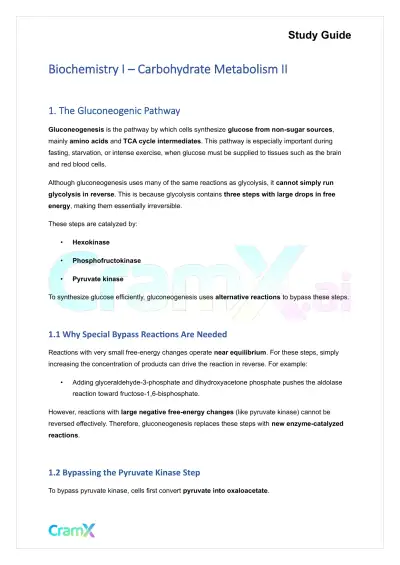 Quick Guides
Biochemistry I - Carbohydrate Metabolism II
Biochemistry
25 pagesMar 2026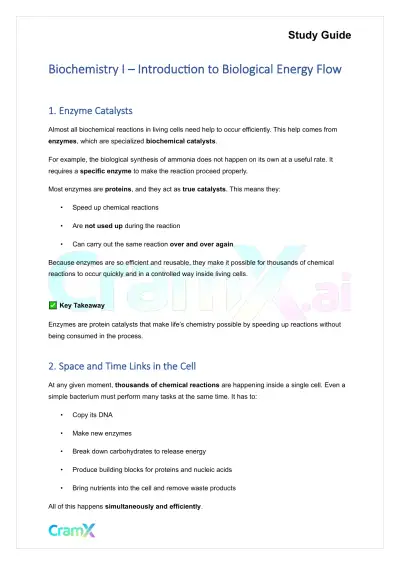 Quick Guides
Biochemistry I - Introduction to Biological Energy Flow
Biochemistry
19 pagesMar 2026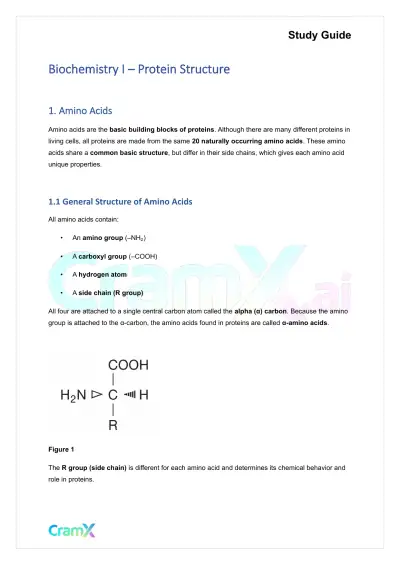 Quick Guides
Biochemistry I - Protein Structure
Biochemistry
29 pagesMar 2026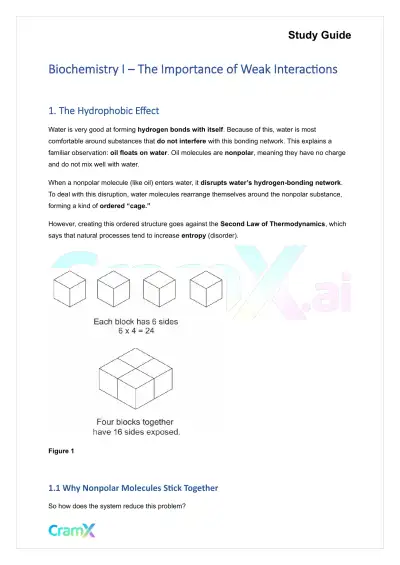 Quick Guides
Biochemistry I - The Importance of Weak Interactions
Biochemistry
18 pagesMar 2026 Quick Guides
Biochemistry I - Oxidative Phosphorylation
Biochemistry
24 pagesMar 2026 Quick Guides
Biochemistry I - The Tricarboxylic Acid TCA Cycle
Biochemistry
17 pagesMar 2026 Quick Guides
Biochemistry I - The Scope of Biochemistry
Biochemistry
20 pagesMar 2026 Quick Guides
Biochemistry I - Oxygen Binding by Myoglobin and Hemoglobin
Biochemistry
14 pagesMar 2026
Study this document with CramX
Once it is in your library, every tool can work from it.