

Biochemistry I - The Scope of Biochemistry
- Biochemistry
- Texas A&M University
- 20 pages
- Shared March 2026
Preview 6 of 20 pages
See the first 6 pages exactly as they appear in the document.
Page 1 Read page 1 as text
Study Guide Biochemistry I – The Scope of Biochemistry 1. Biochemistry Is a Contemporary Science Biochemistry is a relatively young scientific field , but it has completely changed how we understand life at the molecular level. From “Living” Chemistry to Modern Science In the early 1800s , scientists divided chemistry into two categories: • Inorganic chemistry , which dealt with nonliving matter • Organic chemistry , which focused on compounds containing carbon and hydrogen At the time, many scientists believed that organic compounds could only be made by living organisms . Wöhler’s Breakthrough (1828) This belief changed in 1828 when Friedrich Wöhler , a German chemist, performed a groundbreaking experiment. • He heated an inorganic compound , ammonium carbamate • The result was urea , an organic compound found in animal urine This experiment showed that organic molecules do not require living systems to be formed . It demonstrated that the chemistry of living and nonliving worlds is continuous, not separate. Do Cells Have to Be Alive to Work? Later in the late 1800s , another important question arose:
Page 2 Read page 2 as text
Study Guide Do biochemical reactions require an intact, living cell? Büchner’s Experiment Hans Büchner , also working in Germany, answered this question. • He used a cell - free extract from brewer’s yeast • The extract still produced ethanol (alcohol) • This showed that biochemical reactions can occur outside living cells These reactions worked because of enzymes , special proteins that speed up chemical reactions. In fact, the word enzyme comes from the Greek word zymos , meaning yeast . This discovery proved that biochemical reactions can be studied in vitro — literally “in glass,” or outside a living organism. 1.1 The Birth of Biochemistry Biochemistry became a distinct scientific discipline in the early 20th century . In the United States, it developed from the merging of: • Physiological chemistry • Agricultural chemistry Today, biochemistry focuses on understanding life at the molecular level. 1.2 The Three Main Branches of Biochemistry Modern biochemistry is often divided into three major areas: 1. Metabolism Metabolism studies how biological molecules are converted from one form to another . Examples include: • Sugar being broken down into carbon dioxide and water • Fats being converted into cholesterol
Page 3 Read page 3 as text
Study Guide Metabolic biochemists study: • Individual enzyme - catalyzed reactions • Sequences of reactions called metabolic pathways 2. Structural Biochemistry Structural biochemistry focuses on how the structure of molecules affects their function . For example: • How the three - dimensional shape of an enzyme • Allows it to bind specific molecules • And catalyze specific chemical reactions 3. Molecular Genetics Molecular genetics examines: • How genetic information is expressed • How genes regulate cellular structure and function This area connects biochemistry with genetics and molecular biology. 1.3 An Interconnected Science Although these branches are described separately, the boundaries between them are not strict. Modern biochemistry overlaps with many other sciences, including: • Organic and physical chemistry • Physiology • Microbiology • Genetics • Cell biology Key Takeaway Biochemistry shows that life follows the same chemical rules as the nonliving world. Through key discoveries and modern research, biochemistry connects chemistry and biology to explain how living systems function at the molecular level.
Page 4 Read page 4 as text
Study Guide 2. Extrapolating Biochemical Information Biochemistry works as a science because living organisms share many of the same chemical processes . If every organism carried out biochemical reactions in completely different ways, it would be nearly impossible to study life or apply scientific discoveries to medicine. Modern biochemistry depends on the idea that information learned from one organism can often be applied to others . 2.1 Why Extrapolation Matters Consider cholesterol metabolism as an example. If humans and animals produced cholesterol in totally different ways, scientists would have no practical way to develop treatments for high cholesterol or to prevent heart attacks . It would be: • Impossible to test millions of chemical compounds directly in humans • Unethical to experiment blindly on people 2.2 How Scientists Solve This Problem Instead of testing drugs directly in humans, researchers use a step - by - step approach: 1. Enzyme systems are studied in the laboratory (in vitro) o Thousands of compounds can be tested to see if they block a specific enzyme 2. Only the most promising compounds are selected o This greatly reduces the number of substances being studied 3. Selected compounds are tested in laboratory animals o This helps determine safety and effectiveness 4. Successful compounds are then tested in humans This process is only possible because biochemical pathways are similar across many species . Key Takeaway The ability to extrapolate biochemical information from one system to another makes biochemistry practical, ethical, and powerful. Shared biochemical pathways allow scientists to develop treatments efficiently while minimizing risk to humans.
Page 5 Read page 5 as text
Study Guide 3. Common Themes in Biochemistry At first, biochemistry can seem overwhelming because there are so many molecules, reactions, and pathways to learn. The good news is that biochemistry is built around a few common themes . Once you understand these patterns, the subject becomes much easier to follow — and much less about memorization. 3.1 Biochemical Reactions Use Small Molecular Building Blocks Most of the complex molecules found in living cells are built from a small number of simple molecular types . These small molecules combine and interact to form the large structures needed for life. Four major classes of small molecules make up most biological structures: • Amino acids • Carbohydrates • Lipids • Nucleosides and nucleotides Most of these molecules are optically active , meaning they exist in only one specific three - dimensional form. Molecules that have the same atoms but different arrangements are called stereoisomers . Living cells usually use only one stereoisomer, which is why shape matters so much in biology. 3.2 Amino Acids All amino acids share a common core structure. In nature, amino acids are almost always found as the L - stereoisomers . Amino acids are important because they: • Are the building blocks of proteins • Play roles in energy metabolism • Act in cell signaling • Contribute (in small but important ways) to cell membranes Proteins made from amino acids perform most of the work inside cells.
Page 6 Read page 6 as text
Study Guide 3.3 Carbohydrates Carbohydrates follow the general formula C ₙ (H ₂ O) ₙ , where n usually ranges from 3 to 7. They are found in: • Sugars and starches • Parts of nucleotides • Components of cell membranes Carbohydrates are especially important because: • They are major energy sources • They are central to energy - producing pathways • They help store and transport energy in cells 3.4 Lipids Lipids are molecules related to hydrocarbons, meaning they contain mostly carbon and hydrogen, along with a few other atoms. Key features of lipids: • Poorly soluble in water • Essential components of cell membranes • Important energy storage molecules in plants and animals Examples include fats, oils, and membrane phospholipids. 3.5 Nucleosides and Nucleotides Nucleosides and nucleotides are made of: • A carbohydrate (sugar) • A nitrogen - containing base These molecules are crucial because: • They form the energy currency of the cell (such as ATP) • When linked together, they form DNA and RNA • DNA and RNA store and transmit genetic information
14 more pages in the full document
Unlock it once and it stays in your library, ready to chat with or turn into flashcards.
Unlock the full documentMore Biochemistry study materials
See all Quick Guides
Biochemistry I - Carbohydrate Metabolism II
Biochemistry
25 pagesMar 2026 Quick Guides
Biochemistry I - Introduction to Biological Energy Flow
Biochemistry
19 pagesMar 2026 Quick Guides
Biochemistry I - Protein Structure
Biochemistry
29 pagesMar 2026 Quick Guides
Biochemistry I - Organization of Metabolism
Biochemistry
8 pagesMar 2026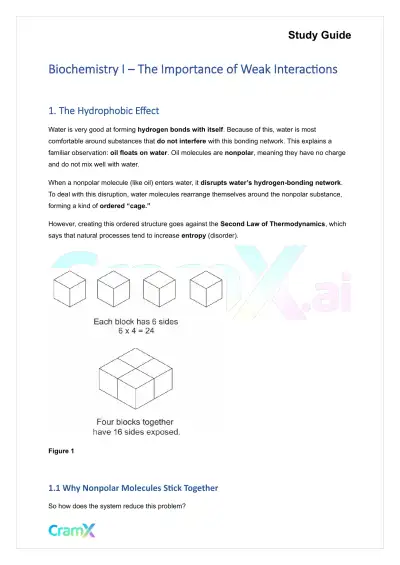 Quick Guides
Biochemistry I - The Importance of Weak Interactions
Biochemistry
18 pagesMar 2026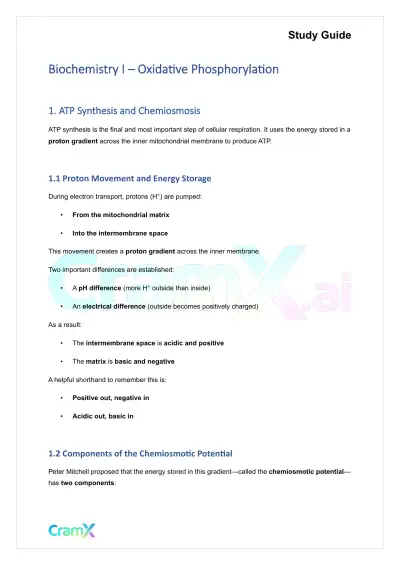 Quick Guides
Biochemistry I - Oxidative Phosphorylation
Biochemistry
24 pagesMar 2026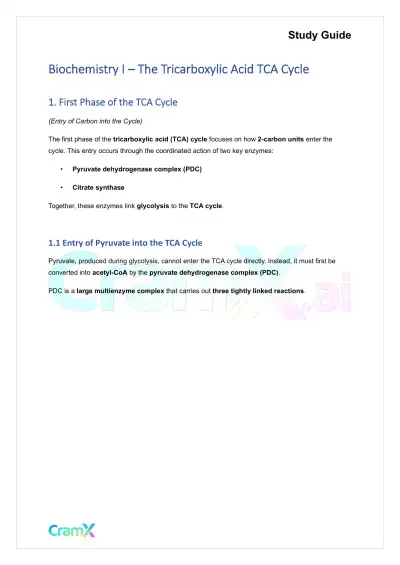 Quick Guides
Biochemistry I - The Tricarboxylic Acid TCA Cycle
Biochemistry
17 pagesMar 2026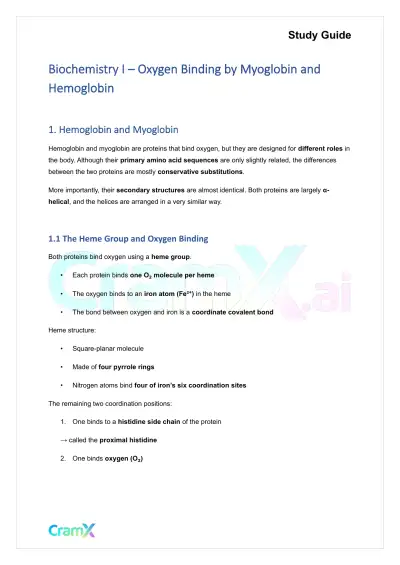 Quick Guides
Biochemistry I - Oxygen Binding by Myoglobin and Hemoglobin
Biochemistry
14 pagesMar 2026
Study this document with CramX
Once it is in your library, every tool can work from it.