

Brock Biology of Microorganisms 12th Edition Test Bank
- Biology
- 345 pages
- Shared May 2025
Master exam questions and boost your confidence with Brock Biology of Microorganisms 12th Edition Test Bank.
Preview 16 of 345 pages
See the first 16 pages exactly as they appear in the document.
Page 1 Read page 1 as text
Exam Name___________________________________ MULTIPLE CHOICE. Choose the one alternative that best completes the statement or answers the question. 1) Which statement is not true as a general rule? 1) _______ A) Microbial cells carry out their life processes of growth independently. B) Microbial cells exist as single cells. C) Microbial cells include both bacteria and viruses. D) Microbial cells exclude the cells of plants and animals. 2) Basic microbiology can be used to 2) _______ A) probe the fundamental processes of life. B) model our understanding of cellular processes in multicellular organisms, including humans. C) study characteristics of cells of multicellular organisms. D) do all of the above. 3) Applied microbiology deals with important practical problems in 3) _______ A) industry. B) medicine. C) agriculture. D) all of the above. 4) The largest mass of living material on Earth comes from 4) _______ A) plants. B) animals. C) microorganisms. D) plants and animals together. 5) The cell's genome is stored in 5) _______ A) the nucleus or nucleoid. B) the cytoplasmic membrane. C) the cytoplasm. D) none of the above. 6) Because the cell communicates, exchanges materials with its environment, and undergoes evolution, it is called a(n) 6) _______ A) ancestral system. B) nucleoid system. C) closed system. D) living system. 7) Changes in cellular characteristics are transmitted to offspring through the process of 7) _______ A) chemical signaling. B) evolution. C) reproductive initiative. D) none of the above. 8) Catalysts involved in the acceleration of the rate of chemical reactions are called 8) _______ A) evolutionary molecules. B) catalytic converters. C) growth agents. D) enzymes. 9) Regarding early life on Earth, 9) _______ A) microbial life existed long before animals but has been around for about the same amount of time as plants. B) microbial life existed for billions of years before plant and animal life. C) microbial life, plant life, and animal life all appeared at about the
Page 2 Page 3 Read page 3 as text
same time. D) it is impossible to determine which type of life first appeared. 10) Most prokaryotic cells reside 10) ______ A) in lakes, rivers, and oceans. B) on Earth's surface. C) in the oceanic and terrestrial subsurfaces. D) in and on nonprokaryotic organisms (including humans and other animals). 11) The person who described the "wee animalcules" was 11) ______ A) van Leeuwenhoek. B) Cohn. C) Pasteur. D) Hooke. 12) Fannie Hesse is credited with giving __________ the idea to use agar as a solidifying agent. 12) ______ A) Koch B) Cohn C) Pasteur D) Winogradsky 13) Which of the following is/are characteristic of cellular organisms? 13) ______ A) communication B) regeneration and reproduction C) metabolism D) all of the above 14) Which of the following is not a major ecosystem? 14) ______ A) atmospheric B) aquatic C) terrestrial D) other organisms, such as plants and animals 15) Which statement is true? 15) ______ A) Microbial communities are assemblages of populations. B) Populations are assemblages of microbial communities. C) Populations are assemblages of habitats. D) Habitats are assemblages of microbial communities. 16) During a very scientifically productive period in his life, Pasteur developed vaccines for 16) ______ A) rabies. B) fowl cholera. C) anthrax. D) all of the above. 17) The discovery of antibiotics and other important chemicals led to the field of 17) ______ A) industrial microbiology. B) aquatic microbiology. C) marine microbiology. D) agricultural microbiology. 18) Microbial sterilization is used to 18) ______ A) clean a work area. B) kill all microbes in or on objects. C) kill bacteria but not necessarily viruses or other microbes. D) decrease the possibility of contaminants growing in a culture.
Page 4 Read page 4 as text
19) Transparent double - sided dishes used for growing microbes are most commonly called 19) ______ A) culture medium plates. B) Petri dishes. C) sterilization plates. D) baker dishes. 20) Microbes playing a role in nitrogen fixation in plants live in __________, while those playing a role in the digestive tract of certain herbivores live in __________. 20) ______ A) nodules / fortrans B) rumens / nodules C) nodules / rumens D) fortrans / rumens 21) Genetic engineering could best be described as 21) ______ A) treatment of diseases with synthetic drugs. B) the expansion of biomass to meet specific needs. C) the creation of life from nonlife. D) the artificial manipulation of genes and gene products. 22) The ultimate downfall of the theory of spontaneous generation was the result of work by 22) ______ A) Pasteur. B) Hooke. C) van Leeuwenhoek. D) Koch. 23) A Pasteur flask has a(n) 23) ______ A) inverted upper edge to prevent spillage while swirling. B) secondary opening at the base to allow for drainage. C) double neck so two substances may be added at the same time. D) swan neck to prevent particulate matter from getting into the main body of the flask. 24) Koch's greatest accomplishment in the field of medical bacteriology was with 24) ______ A) Bacillus subtilis. B) Mycobacterium tuberculosis. C) Escherichia coli . D) Bacillus cereus. 25) A pure culture 25) ______ A) is a population of identical cells. B) was cultured for a certified stock culture. C) is made of a clearly defined chemical medium. D) is sterile. 26) Beijerinck was the first to isolate 26) ______ A) certain sulfate - reducing bacteria. B) green algae. C) certain nitrogen - fixing root nodule bacteria. D) all of the above. 27) Chemolithotrophy involves 27) ______ A) oxidation of organic compounds. B) metabolic autotrophy. C) reduction of organic compounds. D) oxidation of inorganic compounds.
Page 5 Read page 5 as text
28) Developments in the fields of immunology and medical microbiology were practical extensions of the work of 28) ______ A) Lister. B) van Leeuwenhoek. C) Koch. D) Winogradsky. 29) Microbial control in wastewaters would most logically be a part of 29) ______ A) bacterial energetics. B) aquatic microbiology. C) microbial genetics. D) microbial technology. 30) Viruses that infect bacteria are known as 30) ______ A) microphages. B) bacteriophages. C) bacterial consumers. D) viroids. 31) The science of grouping and classifying microorganisms is known as 31) ______ A) microbial physiology. B) proteomics. C) microbial systematics. D) metabolomics. 32) Mycobacterium tuberculosis is very difficult to stain because of the 32) ______ A) large amounts of a waxy lipid present in its cell wall. B) location of the DNA within the cell. C) presence of ribosomes in the cytoplasm. D) lack of a cell wall. 33) Pasteur's most famous success was his work on 33) ______ A) fermentation in the winemaking process. B) optical isomers. C) Mycobacterium tuberculosis . D) the rabies vaccine. 34) Microorganisms play key roles in the cycling of important nutrients in plant nutrition, particularly those of 34) ______ A) sulfur. B) nitrogen. C) carbon. D) carbon, nitrogen, and sulfur. 35) Microbial ecology is the study of 35) ______ A) microbial processes in the soil that benefit plant growth. B) microorganisms in their natural environments. C) the grouping and classifying of microorganisms. D) the diversity and activities of marine microorganisms. 36) The structure that confers structural strength on the cell and protects it from osmotic lysis is known as the 36) ______ A) cell wall. B) cytoplasmic membrane. C) ribosome. D) cytoplasm. TRUE/FALSE. Write 'T' if the statement is true and 'F' if the statement is false. 37) Without microorganisms, all higher life forms on Earth would cease to exist. 37) ______ 38) Most microorganisms are pathogenic. 38) ______
Page 6 Read page 6 as text
39) All microorganisms require molecular oxygen to carry on life functions. 39) ______ 40) Metabolism is common to all cellular organisms. 40) ______ 41) According to our present understanding, each of the major domains has what is known as its own universal ancestor. 41) ______ 42) Microbiology as a distinct science did not develop until the eighteenth century. 42) ______ 43) The environment in which a microbial population lives is its habitat. 43) ______ 44) Differentiation occurs only in multicellular organisms. 44) ______ 45) The study of nutrients that microorganisms require is known as microbial systematics. 45) ______ 46) Smallpox is a major killer in parts of the developing world. 46) ______ 47) Winogradsky worked with bacteria involved in cycling nitrogen and sulfur. 47) ______ 48) Specific bacteria are linked to specific biogeochemical transformations. 48) ______ 49) Marine microorganisms likely control many important global parameters, including climate and atmospheric chemistry. 49) ______ SHORT ANSWER. Write the word or phrase that best completes each statement or answers the question. 50) The four macromolecules common to all cells are: __________, __________, __________, and __________. 50) _____________ 51) Our concept of what is a living organism is constrained by __________. 51) _____________ 52) The study of the structure of microorganisms would be a part of microbial __________. 52) _____________ 53) List three contributions of Ferdinand Cohn to the development of microbiology. 53) _____________ 54) The process whereby microorganisms are used to help clean up pollution created by human activities is known as __________. 54) _____________ 55) An ecosystem could be defined as __________ along with their __________. 55) _____________ 56) Robert Koch received the 1905 Nobel Prize for Physiology or Medicine for __________. 56) _____________ 57) The barrier that separates the inside of the cell from the outside environment is known as the __________. 57) _____________
Page 7 Read page 7 as text
58) Microbial biochemistry involves the discovery of __________ and the __________. 58) _____________ 59) DNA sequencing has allowed for the development of the field of __________ , which has itself spawned the subdisciplines of __________ and __________. 59) _____________ 60) The __________ is the fundamental unit of life. 60) _____________ 61) The disease anthrax is caused by the organism __________, which produces heat - resistant structures known as __________. 61) _____________ 62) Groups of cells derived from a single parent cell by successive cell divisions are known as __________ and they live in environments known as __________. 62) _____________ 63) The first self - replicating entities were probably __________. 63) _____________ 64) __________ produced by microbial fermentation of glucose from sugarcane or cornstarch is becoming a more important component of fuels in the United States. 64) _____________ 65) __________ was the first to describe microorganisms, while __________ was the first person to see bacteria. 65) _____________ 66) A population of identical cells is known as a(n) __________. 66) _____________ 67) __________ described the first virus and also the basic principles of virology. 67) _____________ 68) The discoveries of Beijerinck and Winogradsky led to practical advances in the field of __________. 68) _____________ 69) Bacterial genetics became a major field of study within microbiology following the discovery in the 1950s that __________. 69) _____________ 70) Bioremediation __________ by introducing pollutant - consuming microorganisms or specific nutrients that help microorganisms degrade pollutants. 70) _____________ 71) Explain the nature and function of an enrichment culture. 71) _____________ 72) Why is it incorrect to say that an object is partially sterile? 72) _____________ ESSAY. Write your answer in the space provided or on a separate sheet of paper. 73) Microbes were first formally observed in the mid - 1600s, but the cell theory wasn't enunciated until 1839. Write a brief essay explaining why microbiology did not become a formally recognized science until Pasteur's and Koch's time. 74) Compare and contrast the works of Louis Pasteur and Robert Koch in terms of both
Page 8 Read page 8 as text
applied and basic science. 75) Explain why microbial cells are excellent models for understanding cell function in higher organisms. 76) Compare and contrast the leading causes of death in 1900 with the leading causes of death today. What roles have microbiologists played in the dramatic changes that are evident? 77) Consider hypothetical disease X. How would Koch's postulates be used to demonstrate whether or not organism Y is the causative agent of disease X? 78) The text states that antibiotics are derived from microorganisms. What is the benefit to an antibiotic - producing microorganism of producing an antibiotic in its natural habitat? 79) Explain how bacteria can be both beneficial and detrimental to the food industry. 80) Provide evidence supporting the statement that an ecosystem is controlled by microbial activities. 81) Explain why only anaerobic bacteria inhabited Earth for the first two billion years of its existence. 82) How would the presence of endospores in Pasteur's nutrient solutions have affected his conclusions about spontaneous generation? 83) Explain how you would use Koch's postulates to determine that Streptococcus pyogenes is the causative agent of streptococcal pharyngitis ("strep throat"). 84) Using specific examples, explain why it is sometimes impossible to satisfy Koch's postulates. 85) Explain why infectious diseases are much less lethal in developed countries than in underdeveloped countries.
Page 9 Read page 9 as text
1) C 2) D 3) D 4) C 5) A 6) D 7) B 8) D 9) B 10) C 11) A 12) A 13) D 14) A 15) A 16) D 17) A 18) B 19) B 20) C 21) D 22) A 23) D 24) B 25) A 26) D 27) D 28) C 29) B 30) B 31) C 32) A 33) D 34) D 35) B 36) A 37) TRUE 38) FALSE 39) FALSE 40) TRUE 41) FALSE 42) FALSE 43) TRUE 44) FALSE 45) FALSE 46) FALSE 47) TRUE 48) TRUE 49) FALSE 50) proteins / lipids / carbohydrates / nucleic acids (any order) 51) what we can observe on Earth or deduce from the fossil record
Page 10 Read page 10 as text
52) cytology 53) Answers could possibly include: founding bacteriology as a separate science, studying Beggiatoa , discovering the genus Bacillus (along with its endospore formation and its life cycle), devising methods to prevent contamination, and founding a major scientific journal. 54) bioremediation 55) living organisms / chemical and physical environments 56) his contributions on tuberculosis 57) cytoplasmic membrane 58) microbial enzymes / chemical reactions they carry out 59) genomics / proteomics / metabolomics (second and third in either order) 60) cell 61) Bacillus anthracis / endospores 62) (microbial) populations / (microbial) habitats 63) small molecules of RNA 64) Ethanol 65) Robert Hooke / Antoni van Leeuwenhoek 66) pure culture 67) Beijerinck 68) agricultural microbiology 69) genetic exchange occurred in bacteria 70) accelerates the natural cleanup process 71) Answers will vary, but an enrichment culture uses media, chemicals, or culture conditions to select for or enhance specific characteristics of an organism. 72) Answers will vary, but sterile means the absence of living organisms. Something is either sterile or it is not. 73) Answers will vary. 74) Answers will vary. 75) Answers will vary but should include commonality of function, biochemical and genetic similarities, and ease and speed with which they can be grown in large quantities. 76) Answers will vary. 77) Answers will vary. 78) Answers will vary. 79) Answers will vary. 80) Answers will vary. 81) Answers will vary. 82) Answers will vary. 83) Answers will vary. 84) Answers will vary. 85) Answers will vary.
Page 11 Read page 11 as text
Exam Name___________________________________ MULTIPLE CHOICE. Choose the one alternative that best completes the statement or answers the question. 1) The presence of membrane - enclosed organelles is a characteristic of 1) _______ A) all cells. B) viruses. C) eukaryotic cells. D) prokaryotic cells. 2) Which of the following are made up of prokaryotic cells? 2) _______ A) Archaea and fungi B) Bacteria and fungi C) Bacteria and Archaea D) protozoa and animals 3) Protein - coding sequences of DNA are known as 3) _______ A) histones. B) chromosomes. C) RNA segments. D) genes. 4) Based on our present understanding, which statement is probably true? 4) _______ A) Bacteria and Eukarya evolved from one line; Archaea had a totally different ancestor. B) Bacteria and Eukarya evolved from an archaeal ancestor. C) Bacteria , Archaea , and Eukarya all diverged from a common universal ancestor or community of organisms. D) Bacteria and Archaea diverged from a Eukarya ancestor. 5) Disease - causing prokaryotes are found exclusively among the 5) _______ A) Archaea . B) viruses. C) fungi. D) Bacteria . 6) Organisms most likely to be found in extreme environments are 6) _______ A) Archaea . B) Bacteria . C) viruses. D) fungi. 7) The cyanobacteria are most closely related to the 7) _______ A) Eukarya . B) gram - negative Bacteria . C) Archaea . D) gram - positive Bacteria . 8) Syphilis and Lyme disease are both caused by 8) _______ A) spirochetes. B) endospores from the Bacillus group. C) toxins from the Streptomyces. D) mycoplasmas. 9) Which of the following organisms lives within the host cell as a means of avoiding destruction by the host's immune response? 9) _______ A) Streptococcus sp. B) Chloroflexus sp. C) Deinococcus radiodurans D) Mycobacterium tuberculosis 10) At the present time, __________ phyla of the Archaea have been identified. 10) ______ A) 2 B) 4 C) 3 D) 5 11) Which statement is true about the genus Natronobacterium ? 11) ______ A) They are alkaliphilic but not halophilic.
Page 12 Read page 12 as text
B) They are halophilic and alkaliphilic. C) They are acidophilic but not halophilic. D) They are halophilic and acidophilic. 12) Which statement is true? 12) ______ A) Both yeasts and molds are fungi. B) Both yeasts and molds are degenerate plants. C) Yeasts are fungi, whereas molds are degenerate plants. D) Yeasts are degenerate plants, whereas molds are fungi. 13) In a lichen, the __________ is the phototrophic component and the __________ provides the phototroph with an anchor and with protection from the elements. 13) ______ A) fungus / alga B) fungus / cyanobacterium C) alga or cyanobacterium / fungus D) alga / cyanobacterium 14) The eukaryotic fruiting body is generally associated with the 14) ______ A) yeast. B) slime mold. C) trypanosome. D) Paramecium. 15) Early branching Eukarya lack 15) ______ A) genetic material. B) ribosomes. C) mitochondria. D) nuclei. 16) In relation to eukaryotic cells, prokaryotic cells are generally 16) ______ A) smaller. B) about the same size. C) larger. D) There is no general rule about comparative cell size. 17) Paired chromosomes are found in the 17) ______ A) eukaryotes. B) Archaea . C) bacteria. D) viruses. 18) Mechanisms for controlling gene expression are found 18) ______ A) only in eukaryotes. B) only in prokaryotes. C) in all cells, prokaryotic and eukaryotic. D) in some but not all prokaryotes and in some but not all eukaryotes. 19) Ribosomal RNA - based studies reveal that 19) ______ A) all eukaryotic organisms are related but that all prokaryotic organisms are not necessarily related. B) all organisms are thought to have diverged from a common ancestral organism or community of organisms. C) all prokaryotic organisms are related but that all eukaryotic organisms are not necessarily related. D) the Archaea are most closely related to the viruses. 20) Which statement is true? 20) ______
Page 13 Read page 13 as text
A) Most natural and most synthetic compounds can be broken down by one or more microorganisms. B) All synthetic and most natural compounds can be broken down by one or more microorganisms. C) All natural and all synthetic compounds can be broken down by one or more microorganisms. D) All natural and most synthetic compounds can be broken down by one or more microorganisms. 21) According to our present understanding, mitochondria and chloroplasts are probably __________ in origin. 21) ______ A) eukaryotic B) archaeal C) viral D) bacterial 22) The model organism for microbial physiology, biochemistry, and molecular biology is 22) ______ A) Candida albicans. B) Azotobacter sp. C) Pseudomonas aeruginosa. D) Escherichia coli. 23) Which of the following groups of organisms is not gram - positive? 23) ______ A) Clostridium B) Pseudomonas C) Streptococcus D) Lactobacillus 24) RNA - based phylogenies have impacted many subdisciplines of microbiology, including 24) ______ A) clinical diagnostics. B) microbial classification. C) microbial ecology. D) all of the above. 25) What type of energy - yielding metabolism is found only in prokaryotes? 25) ______ A) phototrophy B) chemoorganotrophy C) autotrophy D) chemolithotrophy 26) In which of the following habitats might an extremophile be isolated? 26) ______ A) boiling hot springs B) garden soil at neutral pH C) a freshwater pond D) human skin 27) Which organism has unusual cell walls, can reassemble its chromosome after it has been damaged, and has an innate resistance to high levels of radiation? 27) ______ A) Lactobacillus B) Chlamydia C) Deinococcus D) Pseudomonas 28) How was it determined that mitochondria and chloroplasts of eukaryotes are actually ancestors of specific lineages of Bacteria ? 28) ______ A) clinical diagnosis B) molecular sequencing C) evolutionary studies D) visual inspection 29) The ultimate limit of what we are able to see with a microscope is dictated by 29) ______ A) light intensity. B) magnification. C) resolution. D) visual acuity.
Page 14 Read page 14 as text
30) The most common type of microscopy for laboratory courses in biology and microbiology is done with the 30) ______ A) bright - field microscope. B) electron microscope. C) phase - contrast microscope. D) dark - field microscope. 31) When the oil - immersion lens is used, 31) ______ A) light rays are collected to increase clarity. B) objects are held in place on the microscope slide. C) light rays are scattered so unnecessary background material is not seen. D) magnification of objects is increased by about tenfold. 32) A tiny stylus positioned so close to a specimen that weak repulsive forces are established is used in 32) ______ A) dark - field microscopy. B) atomic force microscopy. C) confocal scanning laser microscopy. D) none of the above. 33) The cytoplasmic membrane is the 33) ______ A) source of nutrient production. B) primary support structure of the cell. C) structure that identifies a cell as eukaryotic or prokaryotic. D) permeability barrier of the cell. 34) If the magnification of an ocular lens of a particular microscope is 10 × and the magnification of the objective on the same microscope is 47 × , the total magnification achieved is 34) ______ A) 57 × . B) 4.7 × . C) 4,700 × . D) 470 × . 35) Fluorescent microscopy is commonly used in 35) ______ A) cancer therapy. B) the detection of chemical contaminants in a solution. C) radiation biology. D) clinical diagnostic microbiology. 36) Bacteria stain as gram - positive or gram - negative because of differences in the cell 36) ______ A) nucleus. B) chromosome. C) wall. D) cytoplasm. 37) What type of microscopy has found widespread use in microbial ecology because of its ability to resolve the different layered components of a biofilm? 37) ______ A) dark - field microscopy B) confocal scanning laser microscopy (CSLM) C) differential interference contrast (DIC) microscopy D) scanning electron microscopy 38) Why is the presence of a cell wall significant from a clinical standpoint? 38) ______ A) All types of cells have a cell wall and it makes identification of the causative agent of disease difficult.
Page 15 Read page 15 as text
B) Only gram - negative Bacteria have cell walls. C) The cell wall protects microorganisms from destruction by the immune system. D) Animal cells do not have cell walls, so antibiotics that target cell walls can destroy invading microorganisms. TRUE/FALSE. Write 'T' if the statement is true and 'F' if the statement is false. 39) Microorganisms today are probably a degeneration of the earliest life forms. 39) ______ 40) Ribosomes function primarily in energy production. 40) ______ 41) Prokaryotic chromosomes are generally linear. 41) ______ 42) Meiosis is the process by which haploid gametes are formed. 42) ______ 43) Ribosomal RNAs can be used to study phylogenetic relationships between organisms. 43) ______ 44) Endosymbiosis is an explanation for the origin of mitochondria and chloroplasts in eukaryotic cells. 44) ______ 45) Phototrophs use light as an energy source. 45) ______ 46) Viruses necessarily cause disease in the organisms they infect. 46) ______ 47) Species of Archaea are more closely related to Eukarya than to Bacteria . 47) ______ 48) The waste products of chemoorganotrophs are often used for energy by chemolithotrophs. 48) ______ 49) The evolutionary significance of extreme thermophiles may be that they are modern descendants of very ancient cell lines dating back to a time when the planet was very warm. 49) ______ 50) Organisms of the genus Halobacterium can grow within salt crystals. 50) ______ 51) The Picrophilus are the most alkaliphilic prokaryotes known. 51) ______ 52) All known Archaea are extremophiles of one sort or another. 52) ______ 53) The cyanobacteria were the first oxygenic phototrophs to evolve on Earth. 53) ______ 54) The genus Chlamydia harbors respiratory and sexually transmitted pathogens of humans. 54) ______ 55) A differential stain is called "differential" because it does not stain all kinds of cells the same color. 55) ______ 56) In bright - field microscopy, contrast differences arise because different cells and cellular components absorb and scatter light in varying deg rees .
Page 16 Read page 16 as text
56) ______ 57) In phase - contrast microscopy, the differences in refractive indices between organisms and their environments are utilized for better viewing of living specimens. 57) ______ 58) Light microscopy is an effective way of viewing objects in three dimensions. 58) ______ SHORT ANSWER. Write the word or phrase that best completes each statement or answers the question. 59) The distinct feature of the planctomyces group is a(n) __________. 59) _____________ 60) To say that an organism is an "obligate intracellular parasite" means __________. 60) _____________ 61) One major difference between chromosomes and plasmids is that plasmids generally contain __________ rather than __________ genes. 61) _____________ 62) A eukaryotic, chlorophyll - containing organism that can live in environments containing only a few minerals, water, carbon dioxide, and light is a(n) __________. 62) _____________ 63) Two major roles of fungi are __________ and __________. 63) _____________ 64) The total number of genes within a cell is called the __________. 64) _____________ 65) The evolutionary relationships between organism s are studied in the science of __________. 65) _____________ 66) The three options by which an organism may obtain energy are: __________, __________, and __________. 66) _____________ 67) The difference between chemoorganotrophy and chemolithotrophy is __________. 67) _____________ 68) A cell that uses carbon dioxide as its carbon source is a(n)__________. 68) _____________ 69) The largest division (or phylum) of Bacteria is the __________. 69) _____________ 70) The unique feature of the mycoplasmas is the __________. 70) _____________ 71) The function of the chloroplast is to __________. 71) _____________ 72) Lichens are called mutualistic organisms because __________. 72) _____________ 73) The commonality linking the Aquifex and Thermotoga species is __________. 73) _____________
329 more pages in the full document
Unlock it once and it stays in your library, ready to chat with or turn into flashcards.
Unlock the full documentMore Biology study materials
See all Exam Guides
Test Bank for Brock Biology of Microorganisms, 16th Global Edition (Chapters 1-33)
Biology
338 pages93downloadsFeb 2025 Exam Guides
Test Bank for Genetics Essentials: Concepts and Connections, 3rd Edition
Biology
561 pages147downloadsFeb 2025 Past Exams
2024-2025 BIOL235 Nutrition Practice Exam with Answers (38 Solved Questions)
Biology
6 pages145downloadsFeb 2025 Exam Guides
Test Bank for Macroeconomics, 6th Edition
Biology
373 pages143downloadsFeb 2025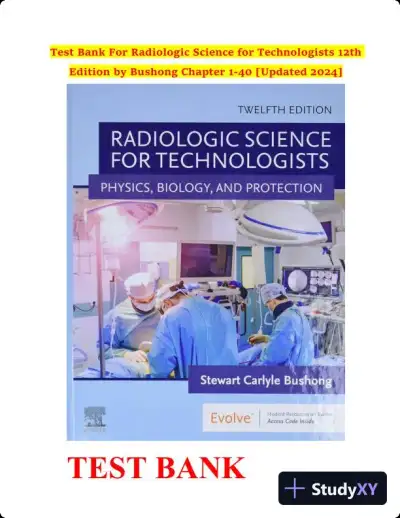 Exam Guides
Test Bank for Radiologic Science for Technologists: Physics, Biology, and Protection, 12th Edition (Chapters 1-40)
Biology
235 pages139downloadsFeb 2025 Past Exams
BIO1100 Anatomy and Physiology Openstax Test Bank with Answers (166 Solved Questions)
Biology
40 pages130downloadsFeb 2025 Exam Guides
Human Biology: Concepts And Current Issues, 8th Edition Test Bank
Biology
631 pages125downloadsFeb 2025 Textbook Guides
Solution Manual for Macroeconomics, 13th Edition
Biology
245 pages108downloadsFeb 2025
Study this document with CramX
Once it is in your library, every tool can work from it.