

Plant Biology - A Synopsis of the Living World
- Biology
- Texas A&M University
- 11 pages
- Shared March 2026
Preview 4 of 11 pages
See the first 4 pages exactly as they appear in the document.
Page 1 Read page 1 as text
Study Guide Plant Biology – A Synopsis of the Living World 1. Classification: Plants, Other Organisms 1.1 How Plant Classification Has Changed Over Time About 100 years ago , botanists grouped plants into just four major categories . As scientists learned more — especially by studying structure and life cycles — these broad groups were split and rearranged into many smaller ones. Within 50 years , plant classification became much more detailed. Some of the older group names are still familiar today because they are often used as common names , such as: • Thallophytes • Gymnosperms • Monocots Even though the names have changed, many major plant groups — like mosses, ferns, and flowering plants — are still recognized today. They now appear under new scientific (technical) names in modern classification systems.
Page 2 Read page 2 as text
Study Guide 1.2 Modern Classification and Molecular Biology Today, plant scientists (called plant systematists ) are actively debating the best way to classify plants using new information from molecular biology , such as DNA and genetic data . Earlier classification systems relied mostly on: • Shape • Structure • Internal anatomy Now, scientists combine these features with genetic evidence to better understand how organisms are related through evolution (phylogeny) .
Page 3 Read page 3 as text
Study Guide 1.3 The Debate About Bacteria One major debate focuses on bacteria . Scientists agree that there are two very different kinds of bacteria , but they disagree on how to rank them: • Should they be called kingdoms ? • Superkingdoms ? • Or domains ? Another key question is whether all life should first be divided into: • Prokaryotes (cells without a nucleus) • Eukaryotes (cells with a nucleus) Different scientists answer these questions in different ways, which is why multiple classification systems exist today. 1.4 Comparing Modern Classification Systems Even though classification systems differ, they share an important similarity: • The four major eukaryotic groups (plants, animals, fungi, and protists) are always kept as kingdoms . These systems mainly differ in how bacteria are grouped and ranked .
Page 4 Read page 4 as text
Study Guide 1.5 What Is Studied in Plant Biology Courses? Introductory plant biology courses mainly focus on plants , but they also include: • Fungi (like mushrooms and molds) • Bacteria • Some plant - like protists Although fungi and bacteria are no longer considered plants , they are still studied because they: • Interact closely with plants • Play important roles in ecosystems Animals are usually mentioned briefly, while the most plant - like protists are discussed in more detail.
7 more pages in the full document
Unlock it once and it stays in your library, ready to chat with or turn into flashcards.
Unlock the full documentMore Biology study materials
See all Quick Guides
Plant Biology - Bryophytes—The Non‐Vascular Plants
Biology
11 pagesMar 2026 Quick Guides
Plant Biology - Themes of Plant Biology
Biology
10 pagesMar 2026 Quick Guides
Plant Biology - Plant Geography
Biology
8 pagesMar 2026 Quick Guides
Plant Biology - Tissues
Biology
10 pagesMar 2026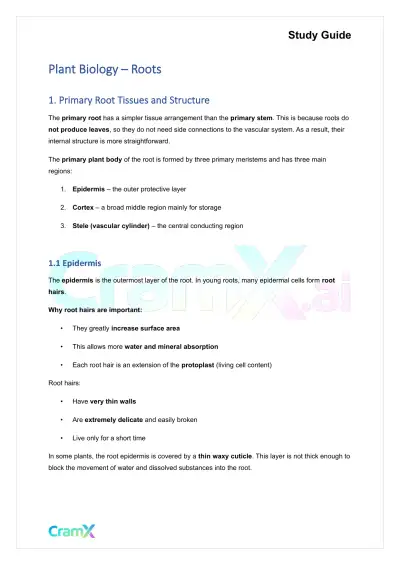 Quick Guides
Plant Biology - Roots
Biology
15 pagesMar 2026 Quick Guides
Plant Biology - Evolution
Biology
5 pagesMar 2026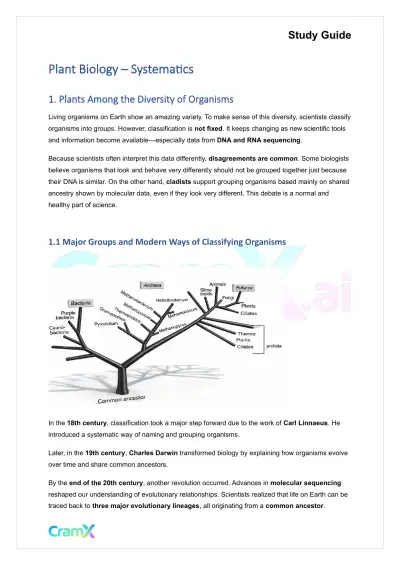 Quick Guides
Plant Biology - Systematics
Biology
20 pagesMar 2026 Quick Guides
Plant Biology - The Shoot System Stems
Biology
12 pagesMar 2026
Study this document with CramX
Once it is in your library, every tool can work from it.