

Plant Biology - Biogeochemical Cycles
- Biology
- Texas A&M University
- 15 pages
- Shared March 2026
Preview 5 of 15 pages
See the first 5 pages exactly as they appear in the document.
Page 1 Read page 1 as text
Study Guide Plant Biology – Biogeochemical Cycles 1. The Carbon Cycle 1.1 Why Carbon Matters Carbon is the element that makes life possible. It forms the backbone of molecules like carbohydrates, proteins, lipids, and DNA. Carbon enters living systems through photosynthesis , and the oxygen released during this process allows most organisms to carry out aerobic respiration . Even though carbon is essential for life, only a small fraction of Earth’s carbon is actively cycling through living organisms. Most carbon is stored in abiotic reservoirs such as sedimentary rocks, fossil fuels, and deep - sea sediments. 1.2 The Core of the Carbon Cycle The carbon cycle is driven mainly by photosynthesis and respiration . • Photosynthesis: Plants, algae, and some bacteria take in carbon dioxide (CO ₂ ) from the atmosphere. Using energy from sunlight, they convert CO ₂ into carbohydrates and other organic molecules.
Page 2 Read page 2 as text
Study Guide • Respiration: Plants, animals, decomposers, and microorganisms break down organic molecules to release energy. During this process, carbon is returned to the atmosphere as CO ₂ . Because of this back - and - forth movement, carbon constantly cycles between living organisms and the atmosphere. 1.3 Carbon on Land and in the Oceans On land, plants remove CO ₂ from the air during photosynthesis. This removal is mostly balanced by CO ₂ released through respiration by plants and by decomposers in the soil. In the oceans, plankton play a similar role. They absorb CO ₂ near the surface during photosynthesis and release it back through respiration. However, a small amount of carbon sinks into deeper waters and becomes buried in ocean sediments. Over long periods, this carbon can be locked away from the atmosphere. 1.4 The Atmosphere: The Connecting Link The atmosphere connects all parts of the carbon cycle — land, oceans, and living organisms. Because of this, changes in atmospheric CO ₂ levels give scientists an important clue about the health and balance of ecosystems around the world. 1.5 Human Impact on the Carbon Cycle One concerning trend today is the steady increase in atmospheric CO ₂ . Over the last 50 years of accurate measurements, CO ₂ levels have risen by about 0.4% per year (around 1.5 parts per million) . This shows that a carbon cycle that stayed balanced for roughly 100,000 years is now out of balance. Since the start of the Industrial Revolution , atmospheric CO ₂ has increased by as much as 30% . This rise is strongly linked to: • Burning fossil fuels (coal, oil, and natural gas) • Large - scale changes to natural vegetation, such as deforestation
Page 3 Read page 3 as text
Study Guide 1.6 The Greenhouse Effect Higher CO ₂ levels can trap more heat in the atmosphere. This trapped heat increases Earth’s surface temperature, a process known as the greenhouse effect . As a result, changes in the carbon cycle are closely tied to global climate change and have major consequences for ecosystems worldwide. 2. The Nitrogen Cycle Nitrogen is essential for life. It is a key part of proteins, DNA, and many important molecules in living organisms. Even though nitrogen is everywhere, using it is not as simple as it seems. 2.1 Nitrogen in the Atmosphere: Plenty but Unusable The atmosphere contains the largest supply of nitrogen , mostly as nitrogen gas (N ₂ ). However, this form of nitrogen is chemically inert because the two nitrogen atoms are held together by a strong triple bond. • Plants cannot use N ₂ directly . • Most other organisms also cannot use it. So even though nitrogen is abundant, it must first be changed into a usable form. 2.2 Nitrogen Fixation: Making Nitrogen Usable Only a few special bacteria can use atmospheric nitrogen. These bacteria have an enzyme called nitrogenase , which allows them to convert nitrogen gas (N ₂ ) into ammonium ions (NH ₄⁺ ) .
Page 4 Read page 4 as text
Study Guide This process is called nitrogen fixation . • Ammonium can be used by plants and other organisms. • Nitrogen fixation is as important to life as photosynthesis , because it makes nitrogen available to living systems. 2.3 From Death to Reuse: Recycling Nitrogen When plants and animals die, decomposer bacteria and fungi break down their bodies. During this process: • Nitrogen from organic compounds is released back into the soil. • This nitrogen is reused by new organisms to build: o Amino acids and proteins o Nucleic acids (DNA and RNA) o Nucleotides, coenzymes, and vitamins These molecules are essential for all life. 2.4 Returning Nitrogen to the Air: Denitrification Some bacteria carry out a process called denitrification . • These bacteria convert nitrogen compounds back into nitrogen gas (N ₂ ) . • The nitrogen is then released into the atmosphere. • Denitrification occurs under anaerobic (low - oxygen) conditions . • It takes place in almost all types of soil . Because bacteria carry out fixation, recycling, and denitrification, microorganisms control the major steps of the nitrogen cycle .
Page 5 Read page 5 as text
Study Guide 2.5 Abiotic Nitrogen Fixation: Nature Without Life Not all nitrogen fixation involves living organisms. A smaller amount of nitrogen is fixed through abiotic (non - living) processes , such as: • Lightning • Volcanic emissions These processes create nitrogen compounds that are washed out of the atmosphere by rain , adding usable nitrogen to soil and water. 2.6 Human Impact on the Nitrogen Cycle Human activities have greatly changed the natural nitrogen balance. Major influences include: • Manufacturing and using nitrogen fertilizers • Burning fossil fuels • Growing nitrogen - fixing crops These activities disrupt the natural balance between nitrogen fixation and denitrification. In addition: • Burning fuels releases nitrogen oxides ( NOₓ compounds ) into the air. • These pollutants contribute to air pollution and can combine with rain to form acid rain , especially in industrialized regions. 2.7 Nitrogen Cycle (At a Glance) The nitrogen cycle is easiest to understand when broken into five main processes: 1. Nitrogen Fixation – Converting N ₂ into usable nitrogen forms 2. Ammonification – Releasing ammonium from dead organisms 3. Nitrification – Converting ammonium into nitrates 4. Assimilation – Plants absorbing nitrogen to build organic molecules 5. Denitrification – Returning nitrogen to the atmosphere as N ₂
10 more pages in the full document
Unlock it once and it stays in your library, ready to chat with or turn into flashcards.
Unlock the full documentMore Biology study materials
See all Quick Guides
Plant Biology - A Synopsis of the Living World
Biology
11 pagesMar 2026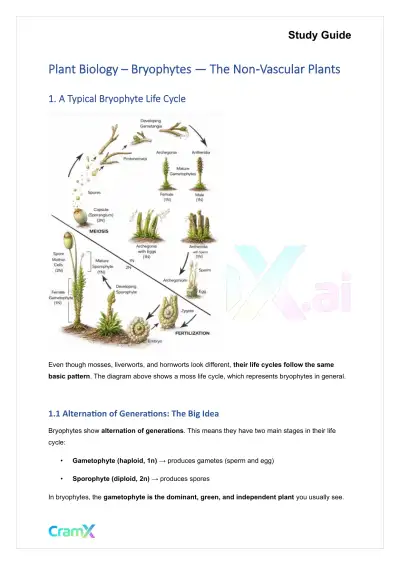 Quick Guides
Plant Biology - Bryophytes—The Non‐Vascular Plants
Biology
11 pagesMar 2026 Quick Guides
Plant Biology - Themes of Plant Biology
Biology
10 pagesMar 2026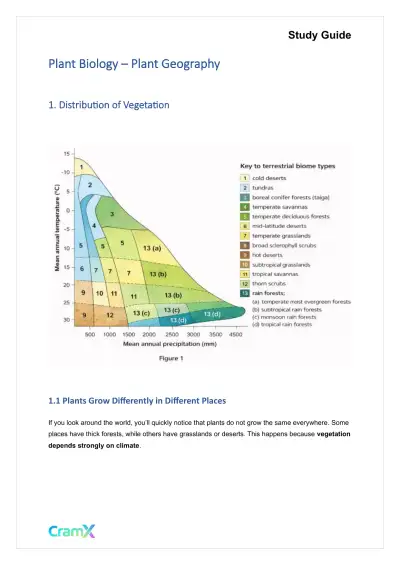 Quick Guides
Plant Biology - Plant Geography
Biology
8 pagesMar 2026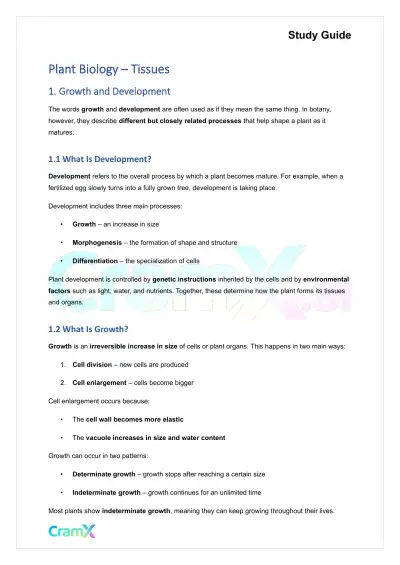 Quick Guides
Plant Biology - Tissues
Biology
10 pagesMar 2026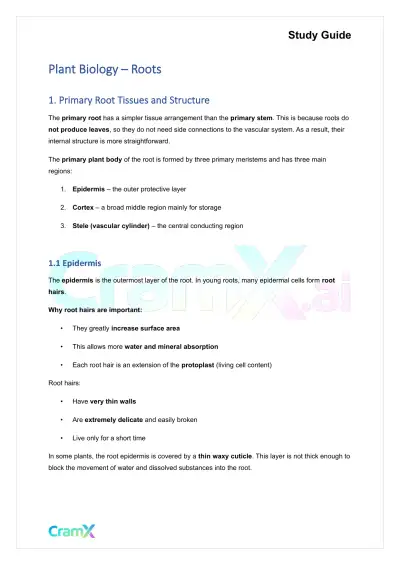 Quick Guides
Plant Biology - Roots
Biology
15 pagesMar 2026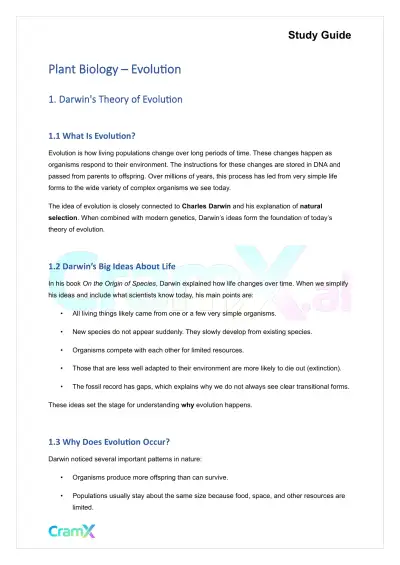 Quick Guides
Plant Biology - Evolution
Biology
5 pagesMar 2026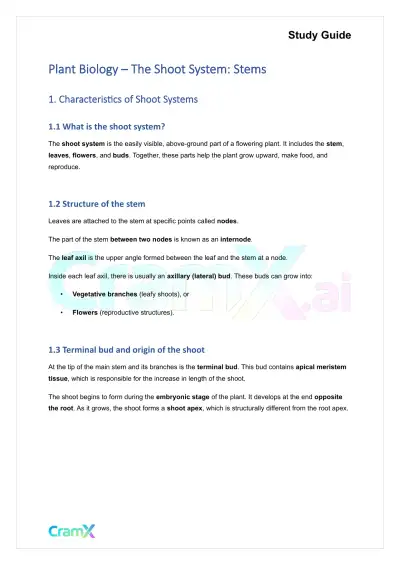 Quick Guides
Plant Biology - The Shoot System Stems
Biology
12 pagesMar 2026
Study this document with CramX
Once it is in your library, every tool can work from it.