

Plant Biology - Cells
- Biology
- Texas A&M University
- 13 pages
- Shared March 2026
Preview 4 of 13 pages
See the first 4 pages exactly as they appear in the document.
Page 1 Read page 1 as text
Study Guide Plant Biology – Cells 1. Cell Theory 1.1 What Is Cell Theory? Cell theory is a basic idea in biology that explains what cells are and why they are important. The modern cell theory says: • All living organisms are made of one or more cells . • New cells come from pre - existing cells . This means life has continued without a break from the first cells that appeared on Earth more than 3.5 billion years ago . • Hereditary information (DNA) is passed from a parent cell to its daughter cells. • All the basic chemical reactions of life happen inside cells. In simple words: cells are the building blocks of life , and everything living depends on them. 1.2 Methods of Studying Cells Microscopes The study of cells is called cytology . Our knowledge of cells has grown because microscopes have improved over time. Light Microscopes • Invented in the 1500s . • Can magnify objects 100× to 1000× . • Their maximum resolving power is about 0.2 μ m (micrometer) . • Resolution depends on the wavelength of visible light , which limits how clear the image can be. Resolution means the ability to see two close objects as separate.
Page 2 Read page 2 as text
Study Guide 1.3 Electron Microscopes • Use beams of electrons , which have much shorter wavelengths than light. • Can magnify over 100,000× . • Have a resolution of 2 – 0.4 nm (nanometer) . There are two main types: • Transmission Electron Microscope (TEM): • Electrons pass through thin sections of a specimen to show internal details. • Scanning Electron Microscope (SEM): • Electrons bounce off the surface to create a 3D - like image. 1.4 Laboratory Techniques • In light microscopy , special dyes (stains) are used to color different cell parts. • For electron microscopy , specimens must be: o Cut into very thin sections o Observed in a vacuum • Living cells cannot be seen with electron microscopes. This creates a challenge: scientists must ask whether the image truly represents the living cell or if preparation changed its appearance. Today, cell knowledge comes from: 1. Biochemical studies , and 2. High - magnification microscopy 1.5 Cell Size • Plant cells range from about 7 μ m (dividing cells at root and shoot tips) to very long fiber cells . • Most plant and animal cells are 10 – 100 μ m in size.
Page 3 Read page 3 as text
Study Guide • The human eye can only resolve objects larger than 100 μ m , so cells cannot be seen without a microscope . Magnification makes objects look bigger, but resolution makes them clearer. 1.6 Limits to Cell Growth Cells are surrounded by: • A cell wall (in plants) • A plasma membrane that encloses the cytoplasm and nucleus As a cell grows: • Volume increases faster than surface area • Materials must move in and out through the cell surface Eventually, the surface area cannot support the cell’s needs. This limits how large a cell can grow. The solution? Many small cells instead of one large cell This led to multicellular organisms , which have advantages: • Cells can specialize for different functions • Complex structures can form • The nucleus controls fewer activities per cell , making regulation more efficient 1.7 Two Kinds of Cells: Prokaryotes and Eukaryotes All cells contain: • A plasma membrane made of a lipid bilayer with proteins • DNA , which stores genetic information 1.8 The Fundamental Difference Living organisms are divided into two major groups based on cell structure: • Prokaryotes (bacteria):
Page 4 Read page 4 as text
Study Guide o No nucleus o No membrane - bound organelles • Eukaryotes (plants, animals, fungi, protists): o Have a true nucleus o Have membrane - bound organelles 1.9 Origin of Eukaryotic Cells Scientists believe that the earliest life forms were prokaryotes . Over billions of years, these organisms adapted to Earth’s changing conditions. Modern organisms still carry genetic evidence of these ancient adaptations.
9 more pages in the full document
Unlock it once and it stays in your library, ready to chat with or turn into flashcards.
Unlock the full documentMore Biology study materials
See all Quick Guides
Plant Biology - A Synopsis of the Living World
Biology
11 pagesMar 2026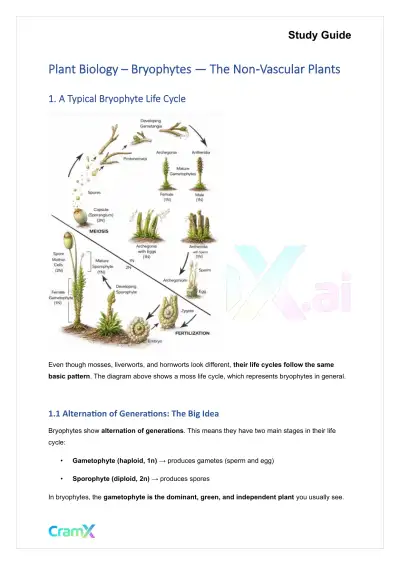 Quick Guides
Plant Biology - Bryophytes—The Non‐Vascular Plants
Biology
11 pagesMar 2026 Quick Guides
Plant Biology - Themes of Plant Biology
Biology
10 pagesMar 2026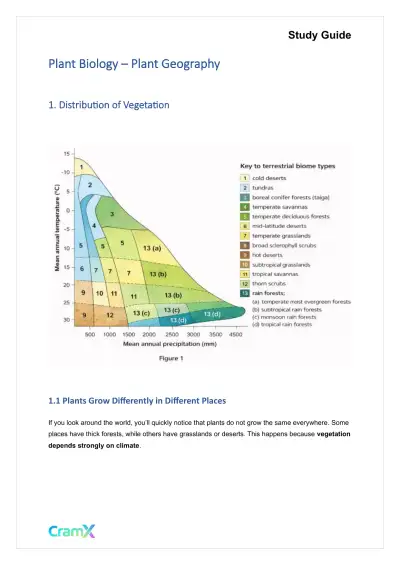 Quick Guides
Plant Biology - Plant Geography
Biology
8 pagesMar 2026 Quick Guides
Plant Biology - Tissues
Biology
10 pagesMar 2026 Quick Guides
Plant Biology - Roots
Biology
15 pagesMar 2026 Quick Guides
Plant Biology - Evolution
Biology
5 pagesMar 2026 Quick Guides
Plant Biology - The Shoot System Stems
Biology
12 pagesMar 2026
Study this document with CramX
Once it is in your library, every tool can work from it.