

Test Bank For Biology 11th Edition Test Bank
- Biology
- 4691 pages
- Shared May 2025
Test Bank For Biology 11th Edition Test Bank delivers an efficient way to prepare, covering all important topics with clarity and precision.
Preview 16 of 4691 pages
See the first 16 pages exactly as they appear in the document.
Page 1 Read page 1 as text
Chapter 01 The Science of Biology Multiple Choice Questions 1. Science is subdivided into specific areas of study termed disciplines. These divisions are artificial but are helpful to narrow the massive scope of scientific knowledge to a manageable amount. Given what you know about each, which scientific division is likely to present the best answer to a question about how fluid dynamics affect blood pressure in mammals? A. Bioinformatics – use of technology to study and store biological data B. Biochemistry – study of chemical reactions needed for life function, usually at the cellular level. C. Biology – study of life D. Biophysics – study of biological processes through physics
Page 2 Page 3 Read page 3 as text
Clarify Question • What is the key concept addressed by the question? The question is about the differences between different divisions of biological research. • What type of thinking is required? This question is asking for you to apply your understanding to identify which areas of research would focus on the movement of fluids. • What key words does the question contain and what do they mean? o Fluid dynamics refers to the physics of how fluids (liquids) move. Gather Content • What do you know about different divisions of biology?How does it relate to the question? o Bioinformatics is the study of biological data like sequences using computers o Biology is a very broad area of research covering all areas of the study of life o Biochemistry is the study of biological molecules smaller than a cell o Biophysics is the study of how biological molecules move using the laws of physics Consider Possibilities • What other information is related to the question? Which information is most useful? • In which disciplines are the properties of fluids likely to be studied? o The study of the movement of fluids like blood are not sequence or structural data and not biological molecules, thus bioinformatics and biochemistry are not good answers. o Biology is a very broad heading, and not the best answer. Choose Answer • Given what you now know, what information and/or problem solving approach is most likely to produce the correct answer? The best answer is biophysics because the movement of fluids are well described using the laws of physics. Reflect on Process • Did your problem-solving process lead you to the correct answer? If not, where did the process break down or lead you astray? How can you revise your approach to produce a more desirable result? o This question asked you to apply the definitions different areas of biology to determine which might study fluid dynamics. If you got the correct answer, great job! If you got an incorrect answer, where did the process break down? Did you think that fluid dynamics were part of a cell or represented by large data sets? Did you not know that the movement of fluids was an area of study in physics?
Page 4 Read page 4 as text
Blooms Level: 3. Apply Gradable: automatic LO: 01.01.01 Compare biology to other natural sciences. Section: 01.01 Topic: The Science of Life 2. Based on hierarchical levels of biological organization, which of these choices represents the broadest level? A. Endocrine system B. 3 toed sloths C. School of piranhas D. Amazon Basin E. Jaguars, giant anteaters, macaws, capybaras Blooms Level: 3. Apply Gradable: automatic LO: 01.01.03 Characterize the hierarchical organization of living systems. Section: 01.01 Topic: The Science of Life 3. Experiments are carried out to test a hypothesis by changing one variable at a time and including an unchanged variable termed a(n) _____. A. experimental variable B. altered variable C. control D. stable variable Blooms Level: 1. Remember Gradable: automatic LO: 01.02.02 Demonstrate how to formulate a hypothesis. Section: 01.02 Topic: The Nature of Science
Page 5 Read page 5 as text
4. The method of reasoning that uses construction of general principles by careful examination of many specific cases is called: A. experimental reasoning. B. theoretical reasoning. C. inductive reasoning. D. hypothetical reasoning. E. deductive reasoning. Blooms Level: 1. Remember Gradable: automatic LO: 01.02.01 Compare the different types of reasoning used by biologists. Section: 01.02 Topic: The Nature of Science 5. Dr. Ratard was trying to determine the cause of a mysterious epidemic affecting fish in the gulf of New Mexico. His proposal that the deaths were caused by an organism called a protist is considered a(n) _________ A. theory. B. data set. C. hypothesis. D. conclusion. E. experiment. Blooms Level: 2. Understand Gradable: automatic LO: 01.02.02 Demonstrate how to formulate a hypothesis. Section: 01.02 Topic: The Nature of Science 6. After Darwin concluded his voyage on the Beagle , he proposed that the process of natural selection was a mechanism for: A. overpopulation of finches on the Galapagos Islands. B. speciation. C. artificial selection. D. sexual selection. E. evolution. Blooms Level: 1. Remember Gradable: automatic LO: 01.03.01 Examine Darwin's theory of evolution by natural selection as a scientific theory. Section: 01.03 Topic: An Example of Scientific Inquiry: Darwin and Evolution
Page 6 Read page 6 as text
7. A scientific theory is: A. a suggested explanation that accounts for observations. B. a way to organize how we think about a problem. C. a concept that is supported by experimental evidence that explains the facts in an area of study. D. a way to understand a complex system by reducing it to its working parts. Blooms Level: 1. Remember Gradable: automatic LO: 01.02.02 Demonstrate how to formulate a hypothesis. Section: 01.02 Topic: The Nature of Science 8. What common life characteristic would cells from a daisy, an apple and a dog all have? A. DNA B. tissues C. organs D. viruses Blooms Level: 2. Understand Gradable: automatic LO: 01.01.02 Describe the characteristics of living systems. Section: 01.01 Topic: The Science of Life 9. A yellow jacket, an insect in the order hymenoptera, stung me. A wasp, an insect in hymenoptera, stung me. A hornet, an insect in hymenoptera, stung me. I see a pattern. All insects in this order must have stingers. What type of reasoning does this represent? A. inductive reasoning B. deductive reasoning C. reductionism D. comparative reasoning Blooms Level: 2. Understand Gradable: automatic LO: 01.02.01 Compare the different types of reasoning used by biologists. Section: 01.02 Topic: The Nature of Science
Page 7 Read page 7 as text
10. You explain to your study group that a hypothesis is: A. constant over time. B. a proposition that will be true and fits the known facts. C. an explanation that accounts for careful observations. D. a theory. Blooms Level: 1. Remember Gradable: automatic LO: 01.02.02 Demonstrate how to formulate a hypothesis. Section: 01.02 Topic: The Nature of Science 11. A suggested explanation that might be true and is subject to testing by further observations is a(n): A. hypothesis. B. experiment. C. scientific principle. D. generality. E. theory. Blooms Level: 1. Remember Gradable: automatic LO: 01.02.02 Demonstrate how to formulate a hypothesis. Section: 01.02 Topic: The Nature of Science
Page 8 Read page 8 as text
12. Based on the literature, you hypothesize that students in traditional biology lectures will have the same grades as students in online biology lectures. You decide to test your hypothesis by comparing grades of students in traditional and online biology lectures over a semester. As a result of the experiment, you observe that the grades in the traditional lectures and the grades in the online lectures are not significantly different. What do these observations allow you to do? A. develop a scientific theory B. reject the hypothesis C. accept the hypothesis without further question D. reject the null hypotheses
Page 9 Read page 9 as text
Clarify Question • What is the key concept addressed by the question? The question is about hypotheses. • What type of thinking is required? This question is asking to apply your knowledge of a hypothesis to interpret the results of an experiment. • What key words does the question contain and what do they mean? o You hypothesize that students in traditional biology lectures will have the same grades as students in online biology lectures o the grades in the traditional lectures and the grades in the online lectures are not significantly different Gather Content • What do you know about hypotheses?How does it relate to the question? Can you accept or reject a hypothesis? A null hypothesis is the opposite of your hypothesis. In this case it would be that the scores of the two groups of students will be different. Consider Possibilities • What other information is related to the question? Which information is most useful? • Do you accept a hypothesis or reject a null hypothesis? o Your results support your hypothesis, so you do not reject the hypothesis. Choose Answer • Given what you now know, what information and/or problem solving approach is most likely to produce the correct answer? The correct answer is to reject the null hypothesis which is the opposite of what you wrote in your hypothesis. Reflect on Process • Did your problem-solving process lead you to the correct answer? If not, where did the process break down or lead you astray? How can you revise your approach to produce a more desirable result? o This question asked you to apply the definition of a hypothesis to a specific example. If you got the correct answer, great job! If you got an incorrect answer, where did the process break down? Did you think that you could accept your hypothesis instead of rejecting the null hypothesis? Blooms Level: 3. Apply Gradable: automatic LO: 01.02.02 Demonstrate how to formulate a hypothesis. Section: 01.02 Topic: The Nature of Science
Page 10 Read page 10 as text
13. Your microwave will not turn on, and you speculate that a circuit breaker in the house has been tripped. In scientific terminology, the steps would be described as: A. forming conclusions from the results of experiments. B. developing an observation based on a hypothesis. C. developing a hypothesis based on an observation. D. testing a prediction generated from a hypothesis. Blooms Level: 2. Understand Gradable: automatic LO: 01.02.02 Demonstrate how to formulate a hypothesis. Section: 01.02 Topic: The Nature of Science 14. A student poses the question: How does the presence of dissolved salt affect the freezing point of water? To answer this question, the student set up two conditions. In the first condition, the student added salt to water in a container and referred to this condition as the variable. In the second condition, the student did not add any salt to water in a second container and referred to this condition as the control. The student took both containers and attempted to freeze the water at various temperatures to assess the freezing point. Would this be a valid experiment? A. Yes, because there is more than one variable. B. Yes, because there is one variable and a control C. No, because there is not more than one variable D. No because there is only one variable and a control Blooms Level: 2. Understand Gradable: automatic LO: 01.02.02 Demonstrate how to formulate a hypothesis. Section: 01.02 Topic: The Nature of Science
Page 11 Read page 11 as text
15. Karl Popper suggested that scientists use "imaginative preconception," which means that successful scientists: A. do not keep records of experiments that fail. B. do not need to do experiments to test their ideas. C. only perform applied research. D. often predict the outcome of experiments. E. cannot predict the outcome of experiments. Blooms Level: 1. Remember Gradable: automatic LO: 01.02.02 Demonstrate how to formulate a hypothesis. Section: 01.02 Topic: The Nature of Science 16. The proposal that one type of organism can change gradually into another type over a long period of time is known as: A. preconception. B. preservation. C. natural history. D. evolution. Blooms Level: 1. Remember Gradable: automatic LO: 01.03.01 Examine Darwin's theory of evolution by natural selection as a scientific theory. Section: 01.03 Topic: An Example of Scientific Inquiry: Darwin and Evolution 17. Darwin's ideas on evolution were advanced for his time. His approach to science and natural selection were supported by what main tenet? A. Species were unchangeable over the course of time. B. Operation of natural laws produces constant change and improvement. C. Various organisms and their structures resulted from a spontaneous action. D. The world is fixed and constant. Blooms Level: 2. Understand Gradable: automatic LO: 01.03.01 Examine Darwin's theory of evolution by natural selection as a scientific theory. Section: 01.03 Topic: An Example of Scientific Inquiry: Darwin and Evolution
Page 12 Read page 12 as text
18. Besides Darwin, the theory of evolution by means of natural selection was also independently proposed by: A. Charles Lyell. B. Karl Popper. C. Thomas Malthus. D. Peter Raven. E. Alfred Wallace. Blooms Level: 1. Remember Gradable: automatic LO: 01.03.01 Examine Darwin's theory of evolution by natural selection as a scientific theory. Section: 01.03 Topic: An Example of Scientific Inquiry: Darwin and Evolution 19. The term that Darwin used to describe the concept that those with superior physical, behavior or other attributes are more likely to survive than those that are not so well endowed, and thus are more likely to pass their traits to the next generation, is called: A. geometric progression B. natural selection C. superior beings D. survival of modifications E. biological diversity Blooms Level: 1. Remember Gradable: automatic LO: 01.03.01 Examine Darwin's theory of evolution by natural selection as a scientific theory. Section: 01.03 Topic: An Example of Scientific Inquiry: Darwin and Evolution 20. A key contribution to Darwin's thinking was the concept of limits put on the geometric growth of populations by nature, originally proposed by: A. Charles Lyell. B. Karl Popper. C. Russel Wallace. D. Thomas Malthus. E. Peter Raven. Blooms Level: 1. Remember Gradable: automatic LO: 01.03.01 Examine Darwin's theory of evolution by natural selection as a scientific theory. Section: 01.03 Topic: An Example of Scientific Inquiry: Darwin and Evolution
Page 13 Read page 13 as text
21. Darwin's book in which he described his views on evolution is: A. Principles of Geology. B. Survival of the Fittest. C. On the Origin of Species. D. On the Principle of Population. Blooms Level: 1. Remember Gradable: automatic LO: 01.03.01 Examine Darwin's theory of evolution by natural selection as a scientific theory. Section: 01.03 Topic: An Example of Scientific Inquiry: Darwin and Evolution 22. Recent discoveries of microscopic fossils have extended the known history of life to about: A. 1 billion years ago. B. 2 billion years ago. C. 3.5 billion years ago. D. 4.5 billion years ago. Blooms Level: 1. Remember Gradable: automatic LO: 01.03.02 Describe the evidence that supports the theory of evolution. Section: 01.03 Topic: An Example of Scientific Inquiry: Darwin and Evolution
Page 14 Read page 14 as text
23. In California, a species of salamanders were geographically separated over time. The group that lived in southern California relied heavily on large gold blotches on their skin that helped to camouflage them from predators. The group that lived along the coast adopted a color pattern that mimicked a poisonous, colorful newt common to that area. Instead of being camouflaged, these salamanders advertised their colors. What type of selection process has occurred over time? A. theoretical selection B. artificial selection C. experimental selection D. natural selection
Page 15 Read page 15 as text
Clarify Question • What is the key concept addressed by the question? The question is about different forms of selection. • What type of thinking is required? This question is asking you to apply the definition of different forms of selection to a specific example. • What key words does the question contain and what do they mean? o Geographic separation means that members of those two populations could no longer interbreed which can drive the evolution of new species. o One group of salamanders hides by being camouflaged while the other has bright colors that mimic another poisonous species. Gather Content • What do you know about selection?How does it relate to the question? Selection works on the phenotype of an organism, with beneficial traits being more likely to be passed on to the next generation. Consider Possibilities • What other information is related to the question? Which information is most useful? • Which types of selection make sense? o Artificial selection requires humans to be involved to make the selection. o Theoretical and experimental selection are part of an experiment. The selection in this example did not involve humans or any experiments. Choose Answer • Given what you now know, what information and/or problem solving approach is most likely to produce the correct answer? This is an example of natural selection due to geographic separation. Once the two groups of salamanders became separated they could no longer interbreed and developed different adaptations to their local environments. Reflect on Process • Did your problem-solving process lead you to the correct answer? If not, where did the process break down or lead you astray? How can you revise your approach to produce a more desirable result? o This question asked you to apply the definitions selection to a specific example. If you got the correct answer, great job! If you got an incorrect answer, where did the process break down? Did you think that natural selection would not occur with geographical separation, or that humans were involved in the speciation in some way?
Page 16 Read page 16 as text
Blooms Level: 3. Apply Gradable: automatic LO: 01.03.01 Examine Darwin's theory of evolution by natural selection as a scientific theory. Section: 01.03 Topic: An Example of Scientific Inquiry: Darwin and Evolution 24. The same basic array of bones is modified to give rise to the wing of a bat and the fin of a porpoise. Such anatomical structures are called: A. uniform. B. inherited. C. homologous. D. analogous. E. evolutionary modifications. Blooms Level: 2. Understand Gradable: automatic LO: 01.03.02 Describe the evidence that supports the theory of evolution. Section: 01.03 Topic: An Example of Scientific Inquiry: Darwin and Evolution 25. Structures that have similar structure and function but different evolutionary origins are called: A. inherited. B. evolutionary modifications. C. analogous. D. homologous. E. uniform. Blooms Level: 1. Remember Gradable: automatic LO: 01.03.02 Describe the evidence that supports the theory of evolution. Section: 01.03 Topic: An Example of Scientific Inquiry: Darwin and Evolution
4675 more pages in the full document
Unlock it once and it stays in your library, ready to chat with or turn into flashcards.
Unlock the full documentMore Biology study materials
See all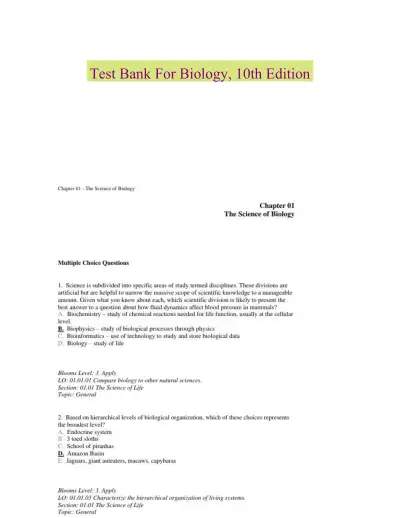 Exam Guides
Test Bank For Biology, 10th Edition�
Biology
1998 pagesMay 2025 Exam Guides
Test Bank for Genetics Essentials: Concepts and Connections, 3rd Edition
Biology
561 pages147downloadsFeb 2025 Past Exams
2024-2025 BIOL235 Nutrition Practice Exam with Answers (38 Solved Questions)
Biology
6 pages145downloadsFeb 2025 Exam Guides
Test Bank for Macroeconomics, 6th Edition
Biology
373 pages143downloadsFeb 2025 Exam Guides
Test Bank for Radiologic Science for Technologists: Physics, Biology, and Protection, 12th Edition (Chapters 1-40)
Biology
235 pages139downloadsFeb 2025 Past Exams
BIO1100 Anatomy and Physiology Openstax Test Bank with Answers (166 Solved Questions)
Biology
40 pages130downloadsFeb 2025 Exam Guides
Human Biology: Concepts And Current Issues, 8th Edition Test Bank
Biology
631 pages125downloadsFeb 2025 Textbook Guides
Solution Manual for Macroeconomics, 13th Edition
Biology
245 pages108downloadsFeb 2025
Study this document with CramX
Once it is in your library, every tool can work from it.