

Test Bank for Concepts of Genetics, 12th edition
- Biology
- 285 pages
- Shared May 2025
Test Bank for Concepts of Genetics, 12th edition offers a selection of past exam questions and answers to give you an edge in your preparation.
Preview 16 of 285 pages
See the first 16 pages exactly as they appear in the document.
Page 1 Read page 1 as text
Exam Name___________________________________ MULTIPLE CHOICE. Choose the one alternative that best completes the statement or answers the question. 1) 1) CRISPR - Cas functions in bacteria to ________. A) replicate viral DNA B) edit genomes C) code for restriction enzymes D) fight viruses 2) 2) Mechanisms of adaptive immunity include ________. A) blocking phage DNA insertion B) blocking phage adsorption C) learning from past exposures D) restriction enzymes 3) 3) cas genes code for a variety of proteins, including ________. A) lysozymes B) crRNAs C) RNases D) polysaccharides 4) 4) Which of the following is the correct order of steps for the CRISPR - Cas mechanism? A) cleavage, target interference, biogenesis B) transcription, cleavage, spacer acquisition C) spacer acquisition, biogenesis, target interference D) target interference, transcription, biogenesis 5) 5) Type II CRISPR - Cas systems are the most widely used systems because ________. A) they were discovered first B) they only require a single protein, Cas9 C) Streptococcus pyogenes is an important research organism D) they use a nuclease complex 6) 6) Which of the following is required to efficiently target DNA in vitro using CRISPER - Cas9? A) target RNA B) native crRNA C) Cas9 D) tRNA 7) 7) Genome editing is based on ________. A) transcribing specific DNA sequences with specific proteins B) methylating specific DNA sequences with specific proteins C) acetylating specific DNA sequences with specific nucleases D) targeting and manipulating specific DNA sequences with specific nucleases 8) 8) Which of the following is a pathway available to cells to repair double - stranded DNA breaks? A) nonhomologous directed repair B) homologous end - joining C) nonhomologous end - joining D) homologous directed end joining 1
Page 2 Page 3 Read page 3 as text
9) 9) The promiscuity of the CRISPER - Cas9 system likely benefits bacteria by ________. A) enabling faster search of large genomes B) facilitating defense against new viral attacks C) continuing the evolutionary process D) increasing the safety of medical applications 10) 10) The primary benefit of CRISPR - Cas over TALENs and ZFNs is ________. A) the speed of the process B) the ability of Cas9 to bind engineered sgRNA C) the cost D) the specificity of the nuclease 11) 11) A strategy to induce random indels in a target sequence might use ________. A) NHEJ and Cas9 B) HDR and a donor template C) NHEJ to ligate fragments D) HDR to match damaged and undamaged chromosomes 12) 12) Reverse genetics is a strategy with which researchers ________. A) delete genes and monitor the effects B) turn on a gene and monitor the effects C) investigate the function of proteins D) delete a genome and investigate the function of plasmids 13) 13) dCas9 is a useful tool in the CRISPER - Cas toolkit because it can ________. A) deactivate the transcription of a gene B) bind DNA, but it cannot cut DNA C) fluoresce and help researchers locate target sequences D) bind DNA, but it cannot travel down the template strand 14) 14) All of the following are challenges in gene therapy EXCEPT ________. A) inaccessible tissues B) unknown cell types C) unknown specific mutations D) designing a strategy 15) 15) Examples of modifications to Cas9 include all of the following EXCEPT ________. A) repression domains B) promotor domains C) fluorescent proteins D) epigenetic modifiers 16) 16) The primary value of the CRISPER - Cas system in biotechnology is ________. A) the removal of ineffective genes B) rapid and cost - effective production of genetically modified organisms C) simple modifications of genomes D) addition of random indels 2
Page 4 Read page 4 as text
17) 17) Applications of CRISPER - Cas in biotechnology include all of the following EXCEPT ________. A) modulating epigenetic regulation B) engineering pigs that are resistance to PRRS C) creating bioreactors to manufacture human proteins D) increasing drought resistance of crops 18) 18) An advantage of base editor technology is that ________. A) specific basic sequences are edited, leading to a more specific product B) uracil is more specific than cytosine and enables greater fidelity C) DNA is not cut, so there are no indels D) the hybrid protein changes A to T for greater variability 19) 19) A major limitation of CRISPER - Cas to treat human disease in vivo is modifying millions of cells. What are the characteristics of successful delivery vehicles? A) They induce an immune response. B) They are carried by erythrocytes. C) They are encapsulated in target cells (via endosomes). D) They bind to target proteins. 20) 20) A strategy to reduce off target effects of the CRISPER - Cas system is to limit homology with other regions of the genome. This principle capitalizes on the specificity of which step of the mechanism? A) target interference B) crRNA biogenesis C) spacer acquisition D) leader sequence determination 3
Page 5 Read page 5 as text
Answer Key Testname: UNTITLED27 1) D 2) C 3) C 4) C 5) B 6) C 7) D 8) C 9) B 10) B 11) C 12) A 13) B 14) D 15) B 16) B 17) A 18) C 19) C 20) A 4
Page 6 Read page 6 as text
Exam Name___________________________________ MULTIPLE CHOICE. Choose the one alternative that best completes the statement or answers the question. 1) 1) In the 1600s, William Harvey studied reproduction and development. What is the term given to the theory that states that an organism develops from the fertilized egg by a succession of developmental events that lead to an adult? A) equational transformation B) sequential pattern formation C) preformation D) epigenesis E) transduction 2) 2) What is the term given to the theory that states that the fertilized egg contains a complete miniature adult? A) cell theory B) preformation C) conjugation D) transformation E) transduction 3) 3) What is the term given to the theory that put forth the idea that living organisms could arise by incubating nonliving components? A) spontaneous generation B) collective combination C) natural selection D) preformation E) evolution 4) 4) What is a homunculus? A) a sperm or egg containing a miniature adult, perfect in size and proportion B) a large cyst or growth on a plant due to viral infection C) when the mitochondrion grows in size before splitting into two via fission D) the intermediate stage of the DNA after CRISPR - Cas treatment E) during development sometimes a growing individual's cell can become mutated and one part of the child has different characteristics than the other 5) 5) Who, along with Alfred Wallace, formulated the theory of natural selection? A) William Harvey B) Charles Darwin C) Gregor Mendel D) Louis Pasteur E) James Watson 1
Page 7 Read page 7 as text
6) 6) Who was the Augustinian monk that conducted a decade of experiments on the garden pea, eventually showing that traits are passed from parents to offspring in predictable ways? A) Aristotle B) Gregor Mendel C) Hippocrates D) Alfred Wallace E) Francis Crick 7) 7) In many species, there are two representatives of each chromosome. In such species, the characteristic number of chromosomes is called the ________ number. It is usually symbolized as ________. A) haploid; n B) haploid; 2n C) monoploid; n D) diploid; 2n E) diploid; n 8) 8) Genetics is the study of ________. A) mutation and recession B) replication and recombination C) inheritance and variation D) diploid and haploid E) transcription and translation 9) 9) Early in the twentieth century, Walter Sutton and Theodor Boveri noted that the behavior of chromosomes during meiosis is identical to the behavior of genes during gamete formation. They proposed that genes are carried on chromosomes, which led to the basis of the ________. A) Law of Segregation B) Law of Independent Assortment C) First Law of Thermodynamics D) Chromosome Theory of Inheritance E) Chromosomal Maintenance Theory 10) 10) What is a mutation? A) an inherited change in a DNA sequence B) an inherited changed in DNA sequence that is always bad for an organism C) a change in DNA that leads to death D) an inherited change in DNA sequences that is the source of all genetic variation E) the source of all genetic variation 2
Page 8 Read page 8 as text
11) 11) Which of the following is TRUE about alleles? A) Alleles come in two forms, the good form and the bad form. B) An allele is a variant form of a gene. C) Individuals carry both forms of each allele. D) An individual will only carry one version of an allele. E) The phenotype of the individual will always indicate with certainty the alleles of the individual. 12) 12) Until the mid - 1940s, many scientists considered proteins to be the likely candidates for the genetic material. Which of the following characteristics led scientist to believe DNA was NOT the genetic material? A) DNA has less variation than protein. B) DNA is more stable than protein. C) DNA is less abundant than protein. D) DNA is less abundant than protein and DNA has less variation than protein. E) Protein can fold into may shapes. 13) 13) Name the individual who, while working with the garden pea in the mid - 1850s, demonstrated quantitative patterns of heredity and developed a theory involving the behavior of hereditary factors. A) Barbara McClintock B) George Wallace C) Walter Sutton D) Gregor Mendel E) Theodor Boveri 14) 14) Which of the following is the subdiscipline of biology concerned with the study of heredity and variation at the molecular, cellular, developmental, organismal, and populational levels? A) biochemistry B) molecular biology C) cytogenetics D) genetics E) cell biology 15) 15) Which of the following is an example of natural selection? A) a bird's beak is able to effectively crack the seeds it encounters B) bacteria can be effectively killed by treatment with bleach C) depending on the food a turtle eats, it shell may grow faster or slower D) sometime during human's life they break a bone and it heals E) human beings develop freckles from being out in the sun 3
Page 9 Read page 9 as text
16) 16) What term is used to describe the fact that different genes in an organism often provide differences in observable features? A) phenotype B) inheritance C) natural selection D) genotype E) alleles 17) 17) Which of the following is an example of heredity? A) Flies and molluscs both have eyes. B) Dalmation dogs all have spots. C) Both moths and birds have wings and can fly. D) Flying squirrels have a different mechanism of flight than mosquitos. E) Doberman pinschers and boxers have similar body shapes. 18) 18) Which of the following is NOT an example of variation? A) both monocotyledons and dicotyledons perform the dark reaction B) a child does not have her mother's hair color C) cats can have long or short fur D) lobsters can come in many colors including blue, read, and brown E) giraffes have not been seen in an albino form 19) 19) What would happen if, during meiosis, the chromosome number was not halved before egg and sperm formation? A) n would become halved B) each offspring would have different phenotypes than their parents C) the spindle would be compromised D) nothing E) in each successive generation, the offspring would double their chromosome number 20) 20) Alternative forms of a gene are called ________. A) phenotypes B) mutants C) genotypes D) alleles E) meiotic products 21) 21) The various characteristics of organisms that result from their genetic makeup are collectively referred to as an organism's ________. A) phenotype B) genome C) proteome D) alleles E) genotype 4
Page 10 Read page 10 as text
22) 22) Name the substance that serves as the hereditary material in eukaryotes and prokaryotes. A) carbohydrate B) protein C) RNA or ribonucleic acid D) DNA or deoxyribonucleic acid E) lipid 23) 23) Which of the following contains all the others? A) DNA strand B) double helix C) hydrogen bond D) nucleotide E) sugar 24) 24) A fundamental property of DNA's nitrogenous bases that is necessary for the double - stranded nature of its structure is ________. A) ring structure B) anti - parallel C) sugar phosphate backbone D) complementarity E) deoxyribose versus ribose 25) 25) Which of the following is the function of DNA? A) DNA is responsible for the storage and replication of genetic information. B) DNA is involved in the expression of stored genetic information. C) DNA serves to hold the information for protein, lipid, and carbohydrate storage. D) DNA is used structurally to hold the nucleus together. E) DNA is required when cells are using their ribosomes to translate a protein. 26) 26) Which of the following molecules serves the function to express the genetic material by being translated to protein? A) RNA B) cholesterol C) lipid D) DNA E) carbohydrate 27) 27) Name the bases in DNA and their pairing specificities. A) adenine:cytosine, guanine:uracil B) adenine:guanine, guanine:uracil C) adenine:thymine, guanine:cytosine D) adenine:uracil, guanine:cytosine E) adenine:guanine, thymine:cytosine 5
Page 11 Read page 11 as text
28) 28) The ________ consists of a linear series of three adjacent nucleotides present in mRNA molecules. A) law of segregation B) genetic code C) Watson—Crick base pairing D) messenger RNA E) chromosomal theory of inheritance 29) 29) Which of the following processes describes the formation of a complementary RNA molecule? A) translation B) transcription C) mosaicism D) replication E) mutation 30) 30) If a scientist changed a cell's ionic composition and complementarity between DNA strands could no longer occur, what would the scientist first detect? A) RNA would start binding to DNA B) DNA strands become shorter C) cell membranes would become less permeable D) ribosomes would move into the nucleus E) DNA becomes single stranded 31) 31) Reference is often made to adapter molecules when describing protein synthesis in that they allow amino acids to associate with nucleic acids. To what class of molecules does this term refer? A) amino acids B) protein C) mRNA D) tRNA E) DNA 32) 32) Given that DNA is the genetic material in prokaryotes and eukaryotes, what other general structures (macromolecules) and substances made by the cell are associated with the expression of that genetic material? A) DNA and RNA B) RNA (messenger, ribosomal, and transfer), ribosomes, enzymes, and proteins C) chromosomes D) lipids and carbohydrates E) DNA and protein 6
Page 12 Read page 12 as text
33) 33) Which of the following are true about codons? A) They are placed at random in the RNA. B) They are complementary to DNA and are a two - nucleotide code for an amino acid. C) They are complementary to DNA and specify amino acids at the ribosome. D) They are complementary to RNA and specify amino acids at the ribosome. E) They are a circular series of nucleotide triplets. 34) 34) What is another term for a biological catalyst? A) protein B) lipid C) codon D) ribosome E) enzyme 35) 35) A protein's shape and chemical behavior are determined by ________. A) the type of cell in which it resides B) the cell's age C) its linear sequence of amino acids D) the cholesterol makeup of the lipid membrane E) the environment of an organism 36) 36) Once a protein is made, its biochemical or structural properties play a role in producing ________. A) DNA B) mutant C) chromosome D) genotype E) phenotype 37) 37) When mutation alters a gene, it may modify or even eliminate the encoded protein's usual ________ and cause an altered ________. A) function; phenotype B) cell type; genotype C) function; genotype D) ribosome; phenotype E) structure; genotype 38) 38) Recombinant DNA technology is dependent on a particular class of enzymes, known as ________ that cuts DNA at specific nucleotide sequences. A) genomes B) clones C) recombinant DNA technology D) restriction enzymes E) vectors 7
Page 13 Read page 13 as text
39) 39) What represents an organism's genome? A) an organism's genome can be defined as the complete haploid nuclear DNA content of an organism. B) a catalog of mutations in a cell C) the nuclear and mitochondrial DNAs D) all the RNA in a cell E) all the protein in a cell 40) 40) A ________ is an organism produced by biotechnology that involves the transfer of hereditary traits across species. A) transgenic organism B) frankenfood C) mutant D) vector E) clone 41) 41) What term is applied to a variety of projects whereby genome sequences are deposited in databases for research purposes? A) cloning B) genomics C) proteomics D) genetics E) bioinformatics 42) 42) Organisms that are well understood from a scientific standpoint and are often used in basic biological research are often called ________. A) model organisms B) restriction enzymes C) clones D) vectors E) recombinant DNA technology 43) 43) ________ is a discipline involved in the development of both hardware and software for processing, storing, and retrieving nucleotide and protein data. A) Bioinformatics B) Cloning C) Proteomics D) Recombinant DNA technology E) Genomics 8
Page 14 Read page 14 as text
Answer Key Testname: UNTITLED1 1) D 2) B 3) A 4) A 5) B 6) B 7) D 8) C 9) D 10) D 11) B 12) D 13) D 14) D 15) A 16) A 17) B 18) A 19) E 20) D 21) A 22) D 23) B 24) D 25) A 26) A 27) C 28) B 29) B 30) E 31) D 32) B 33) C 34) E 35) C 36) E 37) A 38) D 39) A 40) A 41) B 42) A 9
Page 15 Read page 15 as text
Answer Key Testname: UNTITLED1 43) A 10
Page 16 Read page 16 as text
Exam Name___________________________________ MULTIPLE CHOICE. Choose the one alternative that best completes the statement or answers the question. 1) 1) Living organisms are categorized into two major groups based on the presence or absence of a nucleus. What group is defined by the presence of a nucleus? A) virus B) eukaryotic organism C) prokaryotic organism D) mitochondrial organism E) bacterium 2) 2) What is the name of the membranous structure that compartmentalizes the cytoplasm of eukaryotic organisms? A) cytosol B) ribosome C) nucleoid D) mitochondria E) endoplasmic reticulum 3) 3) You have identified a mutant in human cells that when shifted to 37°C, the microfilaments depolymerize (fall apart). Which of the following would be true about this mutant at 37°C? A) The cells would no longer be able to produce ATP. B) The mitochondria would no longer work. C) The cells would change shape. D) The endoplasmic reticulum could still import polypeptides but could no longer synthesize lipids. E) The sister chromatids would no longer be attached to each other. 4) 4) Name two cellular organelles, each containing genetic material, which are involved in either photosynthesis or respiration. A) chloroplast and endoplasmic reticulum B) chloroplasts and mitochondria C) rough and smooth endoplasmic reticula D) lysosome and chloroplast E) peroxisomes and mitochondria 5) 5) The nucleolus organizer region (NOR) is responsible for production of what type of cell structure? A) chromatids B) mitochondria C) endoplasmic reticulum D) nucleolus E) ribosome 1
269 more pages in the full document
Unlock it once and it stays in your library, ready to chat with or turn into flashcards.
Unlock the full documentMore Biology study materials
See all Exam Guides
Concepts of Genetics, 11th Edition Test Bank
Biology
194 pages87downloadsFeb 2025 Exam Guides
Test Bank for Genetics Essentials: Concepts and Connections, 3rd Edition
Biology
561 pages147downloadsFeb 2025 Past Exams
2024-2025 BIOL235 Nutrition Practice Exam with Answers (38 Solved Questions)
Biology
6 pages145downloadsFeb 2025 Exam Guides
Test Bank for Macroeconomics, 6th Edition
Biology
373 pages143downloadsFeb 2025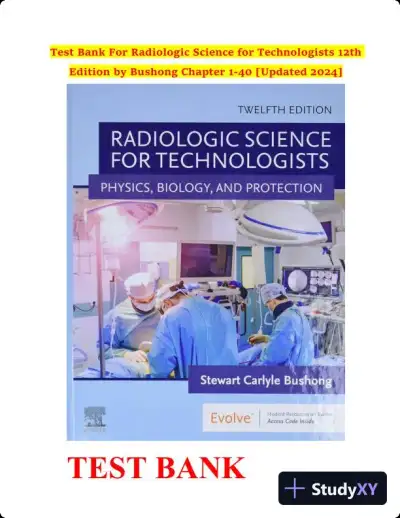 Exam Guides
Test Bank for Radiologic Science for Technologists: Physics, Biology, and Protection, 12th Edition (Chapters 1-40)
Biology
235 pages139downloadsFeb 2025 Past Exams
BIO1100 Anatomy and Physiology Openstax Test Bank with Answers (166 Solved Questions)
Biology
40 pages130downloadsFeb 2025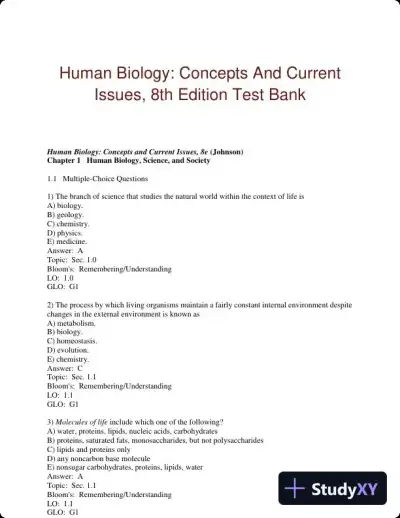 Exam Guides
Human Biology: Concepts And Current Issues, 8th Edition Test Bank
Biology
631 pages125downloadsFeb 2025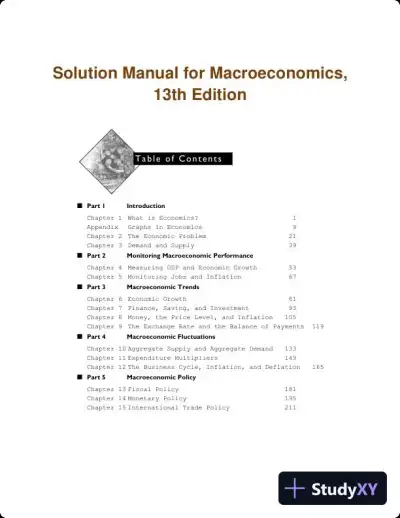 Textbook Guides
Solution Manual for Macroeconomics, 13th Edition
Biology
245 pages108downloadsFeb 2025
Study this document with CramX
Once it is in your library, every tool can work from it.