

ISC2 CISSP Certified Information Systems Security Professional Official Study Guide and Practice Tests (2024)
- Certified Information Systems Security Professional
- 1899 pages
- Shared May 2025
Prepare confidently with ISC2 CISSP Certified Information Systems Security Professional Official Study Guide and Practice Tests (2024), offering structured revision tests to reinforce key concepts.
Preview 16 of 1899 pages
See the first 16 pages exactly as they appear in the document.
Page 1 Read page 1 as text
ISC2 (= Certified Information Systems Security Professional Tenth Edition COVERS ALL OF THE 2024 UPDATED CISSP OBJECTIVES Includes interactive online learning environment and study tools with: + More than 900 practice questions and exercises « More than 1,000 electronic flashcards « Searchable key term glossary «+ More than 2 hours of Study Essentials Audio Review Mike Chapple, CISSP James Michael Stewart, CISSP Darril Gibson, CISSP
Page 2 Read page 2 as text
Downloaded from StudyXY.com ® + StudyXY Sd Ye. o> \ | iF ’ pr E \ 3 S Stu dy Anything This ContentHas been Posted On StudyXY.com as supplementary learning material. StudyXY does not endrose any university, college or publisher. Allmaterials posted are under the liability of the contributors. wv 8) www.studyxy.com
Page 3 Read page 3 as text
ISC2 |=, Certified Information Systems Security Professional Tenth Edition COVERS ALL OF THE 2024 UPDATED CISSP OBJECTIVES Includes interactive online learning environment and study tools with: «More than 900 practice questions and exercises «More than 1,000 electronic flashcards « Searchable key term glossary « More than 2 hours of Study Essentials Audio Review Mike Chapple, CISSP James Michael Stewart, CISSP. Ce SYBEX Darril Gibson, CISSP A Wioy Brand Study
Page 4 Read page 4 as text
Table of Contents Cover Table of Contents Title Page Copyright Dedication Acknowledgments About the Authors About the Technical Editors Introduction Overview of the CISSP Exam The Elements of This Study Guide Interactive Online Learning Environment and Test Bank Study Guide Exam Objectives Objective Map How to Contact the Publisher Assessment Test Answers to Assessment Test Chapter 1: Security Governance Through Principles and Policies Security 101 Understand and Apply Security Concepts Security Boundaries Evaluate and Apply, Security Governance Principles Manage the Security Function Security, Policy, Standards, Procedures, and Guidelines Threat Modeling Supply. Chain Risk Management Summary
Page 5 Read page 5 as text
Study Essentials Written Lab Review Questions Chapter 2: Personnel Security and Risk Management Concepts Personnel Security Policies and Procedures Understand and Apply Risk Management Concepts Social Engineering Establish and Maintain a Security Awareness, Education, and Training Program Summary Study Essentials Written Lab Review Questions Chapter 3; Business Continuity Planning Planning for Business Continuity, Project Scope and Planning Business Impact Analysis Continuity Planning Plan Approval and Implementation Summary, Study Essentials Written Lab Review Questions Chapter 4: Laws, Regulations, and Compliance Categories of Laws Laws State Privacy Laws Compliance Contracting and Procurement Summary Study Essentials
Page 6 Read page 6 as text
Written Lab Review Questions Chapter 5; Protecting Security of Assets Identifying and Classifying Information and Assets Establishing Information and Asset Handling Requirements Data Protection Methods Understanding Data Roles Using Security Baselines Summary Study Essentials Written Lab Review Questions Chapter 6: Cryptography and Symmetric Key Algorithms Cryptographic Foundations Modern Cryptography, Symmetric Cryptography. Cryptographic Life Cycle Summary Study Essentials Written Lab Review Questions Chapter 7: PKI and Cryptographic Applications Asymmetric Cryptography. Hash Functions Digital Signatures Public Key Infrastructure Asymmetric Key Management Hybrid Cryptography, Applied Cryptography. Cryptographic Attacks
Page 7 Read page 7 as text
Summary Study Essentials Written Lab Review Questions Chapter 8: Principles of Security Models, Design, and Capabilities Secure Design Principles Techniques for Ensuring CIA Understand the Fundamental Concepts of Security Models Select Controls Based on Systems Security Requirements Understand Security Capabilities of Information Systems Summary, Study Essentials Written Lab Review Questions Chapter 9: Security Vulnerabilities, Threats, and Countermeasures Shared Responsibility, Data Localization and Data Sovereignty. Assess and Mitigate the Vulnerabilities of Security, Architectures, Designs, and Solution Elements Client-Based Systems Server-Based Systems Industrial Control Systems Distributed Systems High-Performance Computing (HPC) Systems Real-Time Operating Systems Internet of Things Edge and Fog Computing Embedded Devices and Cyber-Physical Systems Microservices
Page 8 Read page 8 as text
Infrastructure as Code Immutable Architecture Virtualized Systems Containerization Mobile Devices Essential Security Protection Mechanisms Common Security Architecture Flaws and Issues Summary, Study Essentials Written Lab Review Questions Chapter 10: Physical Security Requirements Apply Security, Principles to Site and Facility Design Implement Site and Facility Security Controls Implement and Manage Physical Security, Summary, Study Essentials Written Lab Review Questions Chapter 11: Secure Network Architecture and Components OSI Model TCP/IP Model Analyzing Network Traffic Common Application Layer Protocols Transport Layer Protocols Domain Name System Internet Protocol (IP) Networking ARP Concerns Secure Communication Protocols Implications of Multilayer Protocols
Page 9 Read page 9 as text
Segmentation Edge Networks Wireless Networks Satellite Communications Cellular Networks Content Distribution Networks (CDNs) Secure Network Components Summary, Study Essentials Written Lab Review Questions Chapter 12: Secure Communications and Network Attacks Protocol Security Mechanisms Secure Voice Communications Remote Access Security Management Multimedia Collaboration Monitoring and Management Load Balancing Manage Email Security Virtual Private Network Switching and Virtual LANs Network Address Translation Third-Party Connectivity, Switching Technologies WAN Technologies Fiber-Optic Links Prevent or Mitigate Network Attacks Summary, Study Essentials Written Lab
Page 10 Read page 10 as text
Review Questions Chapter 13: Managing Identity and Authentication Controlling Access to Assets The AAA Model Implementing Identity Management Managing the Identity and Access Provisioning Life Cycle Summary, Study Essentials Written Lab Review Questions Chapter 14: Controlling and Monitoring Access Comparing Access Control Models Implementing Authentication Systems Zero-Trust Access Policy Enforcement Understanding Access Control Attacks Summary, Study Essentials Written Lab Review Questions Chapter 15; Security Assessment and Testing Building a Security Assessment and Testing Program Performing Vulnerability Assessments Testing Your Software Training and Exercises Implementing Security Management Processes and Collecting Security Process Data Summary Exam Essentials Written Lab Review Questions Chapter 16: Managing Security Operations
Page 11 Read page 11 as text
Apply Foundational Security Operations Concepts Address Personnel Safety and Security Provision Information and Assets Securely, Apply, Resource Protection Managed Services in the Cloud Perform Configuration Management (CM) Manage Change Manage Patches and Reduce Vulnerabilities Summary Study Essentials Written Lab Review Questions Chapter 17: Preventing and Responding to Incidents Conducting Incident Management Implementing Detection and Preventive Measures Logging and Monitoring Automating Incident Response Summary Study Essentials Written Lab Review Questions Chapter 18: Disaster Recovery Planning The Nature of Disaster Understand System Resilience, High Availability, and Fault Tolerance Recovery Strategy Recovery Plan Development Training, Awareness, and Documentation Testing and Maintenance Summary Study Essentials
Page 12 Read page 12 as text
Written Lab Review Questions Chapter 19: Investigations and Ethics Investigations Major Categories of Computer Crime Ethics Summary, Study Essentials Written Lab Review Questions Chapter 20: Software Development Security, Introducing Systems Development Controls Establishing Databases and Data Warehousing Storage Threats Understanding Knowledge-Based Systems Summary, Study Essentials Written Lab Review Questions Chapter 21: Malicious Code and Application Attacks Malware Malware Prevention Application Attacks Injection Vulnerabilities Exploiting Authorization Vulnerabilities Exploiting Web Application Vulnerabilities Application Security Controls Secure Coding Practices Summary Study Essentials
Page 13 Read page 13 as text
Written Lab Review Questions Appendix A: Answers to Review Questions Chapter 1: Security Governance Through Principles and Policies Chapter 2: Personnel Security and Risk Management Concepts Chapter 3; Business Continuity Planning Chapter 4: Laws, Regulations, and Compliance Chapter 5; Protecting Security, of Assets Chapter 6: Cryptography and Symmetric Key Algorithms Chapter 7: PKI and Cryptographic Applications Chapter 8: Principles of Security Models, Design, and Capabilities Chapter 9: Security Vulnerabilities, Threats, and Countermeasures Chapter 10: Physical Security Requirements Chapter 11: Secure Network Architecture and Components Chapter 12: Secure Communications and Network Attacks Chapter 13: Managing Identity and Authentication Chapter 14: Controlling and Monitoring Access Chapter 15; Security Assessment and Testing Chapter 16: Managing Security Operations Chapter 17: Preventing and Responding to Incidents Chapter 18: Disaster Recovery Planning Chapter 19: Investigations and Ethics Chapter 20: Software Development Security, Chapter 21: Malicious Code and Application Attacks Appendix B: Answers to Written Labs Chapter 1: Security Governance Through Principles and Policies
Page 14 Read page 14 as text
Chapter 2: Personnel Security and Risk Management Concepts Chapter 3; Business Continuity Planning Chapter 4: Laws, Regulations, and Compliance Chapter 5; Protecting Security, of Assets Chapter 6: Cryptography and Symmetric Key Algorithms Chapter 7: PKI and Cryptographic Applications Chapter 8: Principles of Security Models, Design, and Capabilities Chapter 9: Security Vulnerabilities, Threats, and Countermeasures Chapter 10: Physical Security Requirements Chapter 11: Secure Network Architecture and Components Chapter 12: Secure Communications and Network Attacks Chapter 13: Managing Identity and Authentication Chapter 14: Controlling and Monitoring Access Chapter 15; Security Assessment and Testing Chapter 16: Managing Security Operations Chapter 17: Preventing and Responding to Incidents Chapter 18: Disaster Recovery Planning Chapter 19: Investigations and Ethics Chapter 20: Software Development Security, Chapter 21: Malicious Code and Application Attacks Index End User License Agreement List of Tables Chapter 2 TABLE 2.1 Comparison of quantitative and qualitative risk analysis
Page 15 Read page 15 as text
TABLE 2.2 Quantitative risk analysis formulas Chapter 5 TABLE 5.1 Securing email data TABLE 5.2 Unmodified data within a database TABLE 5.3 Masked data Chapter 6 TABLE 6.1 AND operation truth table TABLE 6.2 OR operation truth table TABLE 6.3 NOT operation truth table TABLE 6.4 Exclusive OR operation truth table TABLE 6.5 Using the Vigenere system TABLE 6.6 The encryption operation TABLE 6.7 Symmetric and asymmetric key comparison TABLE 6.8 Comparison of symmetric and asymmetric cryptography systems TABLE 6.9 Symmetric encryption memorization chart Chapter 7 TABLE 7.1 Hash algorithm memorization chart TABLE 7.2 Digital certificate formats Chapter 8 TABLE 8.1 Subjects and objects TABLE 8.2 Fail terms’ definitions related to physical and digital products TABLE 8.3 An access control matrix TABLE 8.4 Common Criteria evaluation assurance levels Chapter 10 TABLE 10.1 Static voltage and damage
Page 16 Read page 16 as text
TABLE 10.2 Fire extinguisher classes Chapter 11 TABLE 11.1 IP classes TABLE 11.2 IP classes’ default subnet masks TABLE 11.3 802.11 wireless networking amendments TABLE 11.4 UTP categories Chapter 12 TABLE 12.1 Common load-balancing scheduling techniques TABLE 12.2 Circuit switching vs. packet switching TABLE 12.3 Bandwidth levels of SDH and SONET List of Illustrations Chapter 1 FIGURE 1.1 The CIA Triad FIGURE 1.2 The five elements of AAA services FIGURE 1.3 Strategic, tactical, and operational plan timeline comparison FIGURE 1.4 An example of diagramming to reveal threat concerns FIGURE 1.5 A risk matrix or risk heat map Chapter 2 FIGURE 2.1 Former employees must return all company, property. FIGURE 2.2 The cyclical relationships of risk elements FIGURE 2.3 The six major elements of quantitative risk analysis FIGURE 2.4 The categories of security controls in a defense-in-depth impleme...
1883 more pages in the full document
Unlock it once and it stays in your library, ready to chat with or turn into flashcards.
Unlock the full documentMore Certified Information Systems Security Professional study materials
See all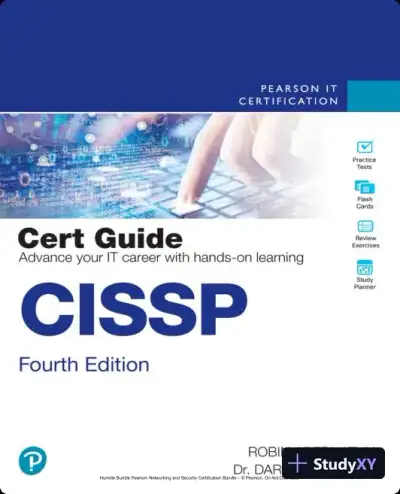 Certification Guides
CISSP Cert Guide (2022)
Certified Information Systems Security Professional
1033 pages148downloadsFeb 2025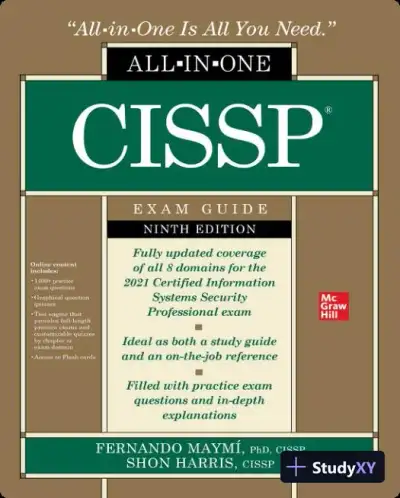 Certification Guides
CISSP All-in-One Exam Guide (2021)
Certified Information Systems Security Professional
1361 pages145downloadsFeb 2025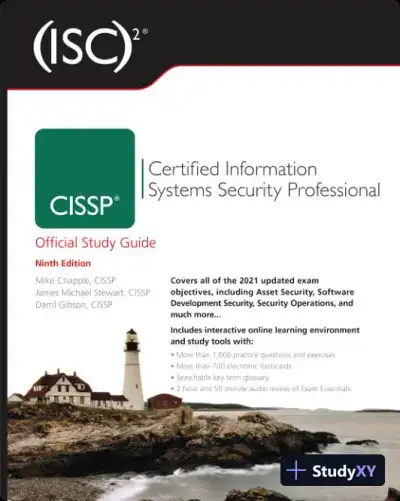 Certification Guides
CISSP Official Study Guide (2021)
Certified Information Systems Security Professional
1250 pages143downloadsFeb 2025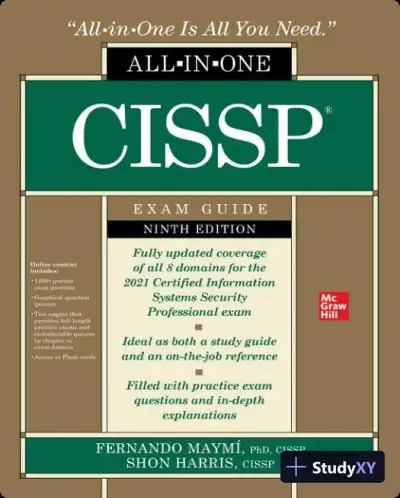 Certification Guides
All in One CISSP Exam Guide (2022)
Certified Information Systems Security Professional
1361 pages143downloadsFeb 2025 Certification Guides
CISSP Official Practice Tests (2021)
Certified Information Systems Security Professional
499 pages109downloadsFeb 2025 Certification Guides
ISC2 Cissp Certified Information Systems Security Professional Official Practice Tests (2021)
Certified Information Systems Security Professional
744 pages109downloadsFeb 2025 Certification Guides
CISSP® Study Guide (2023)
Certified Information Systems Security Professional
642 pages56downloadsFeb 2025 Certification Guides
The Official ISC2 CISSP CBK Reference (2021)
Certified Information Systems Security Professional
674 pages53downloadsFeb 2025
Study this document with CramX
Once it is in your library, every tool can work from it.