

Chemistry - Gases
- Chemistry
- Texas A&M University
- 39 pages
- Shared March 2026
Preview 10 of 39 pages
See the first 10 pages exactly as they appear in the document.
Page 1 Read page 1 as text
Study Guide Chemistry – Gases 1. Boyle's Law 1.1 What is pressure? Pressure is the amount of force applied to a unit area . You experience pressure in everyday life, even if you do not notice it. A helpful example is an ocean diver : • The deeper a diver goes, the greater the pressure . • This happens because more water is pushing down from above. Pressure is not limited to liquids. • Gases , liquids , and even solids can all transmit pressure. 1.2 Atmospheric pressure At Earth’s surface, we live under atmospheric pressure . This pressure comes from the weight of the air above us . Scientists often describe atmospheric pressure by comparing it to a column of mercury: • Normal atmospheric pressure can support a column of mercury 760 mm high . Because of this, two common pressure units used in chemistry are: • atmospheres (atm) • millimeters of mercury (mm Hg) The relationship between them is: 1 atm = 760 mm Hg
Page 2 Read page 2 as text
Study Guide 1.3 The SI unit of pressure The standard international (SI) unit for pressure is the pascal (Pa) . The conversion is: 1 atm = 101,325 Pa 1.4 Boyle’s discovery In 1662, the English scientist Robert Boyle studied how gases behave under different pressures. From his experiments, he discovered an important relationship: • When temperature stays constant , the volume of a gas changes inversely with pressure . This means: • If pressure increases , volume decreases • If pressure decreases , volume increases 1 .5 Boyle’s Law Boyle’s discovery is written as: PV = constant This equation is known as Boyle’s Law . It applies only when temperature remains constant . 1.6 Understanding inverse relationships Pressure and volume are inversely related . This is very important to remember: • Increasing pressure requires a proportional decrease in volume • Decreasing pressure causes a proportional increase in volume Both changes happen at the same time.
Page 3 Read page 3 as text
Study Guide 1.7 A balloon and changing pressure Imagine an elastic balloon filled with 5.0 liters of air at normal atmospheric pressure ( 760 mm Hg ). If a storm approaches: • The outside pressure drops to 735 mm Hg • The balloon expands Why does this happen? • The pressure decreases • The volume must increase to keep PV constant • The temperature does not change So: Initial pressure × initial volume = final pressure × final volume Practice problems Try applying Boyle’s Law to these situations: 1. Convert a pressure of 611 mm Hg to atmospheres. 2. A gas occupies 732 mL at a pressure of 1.13 atm. 3. What pressure is required to reduce the volume to 500 mL , assuming the temperature stays constant? P ₁ V ₁ = P ₂ V ₂ (760 mm)(5 liters) = (735 mm)(x liters) x = (760 × 5) / 735 x = 5.17 liters Summary Boyle’s Law explains how gases respond to pressure changes.
Page 4 Read page 4 as text
Study Guide As long as temperature remains constant, pressure and volume always change in opposite directions . Understanding this relationship helps explain everything from breathing to weather changes. 2. Quiz: Boyle's Law 1. Question Which state of matter was the easiest for early scientists to describe? Answer Choices • Solid • Liquid • Gas Correct Answer Solid Why This is Corre ct Early scientists could easily observe solids because they have a fixed shape and fixed volume. Solids do not flow or change shape like liquids and gases, so they were simpler to describe and understand. For Example A stone or a wooden block keeps the same shape and size wherever it is placed. 2. Question The Italian chemist, Amedeo Avogadro, concluded that: Answer Choices • Different volumes of different gases contain the same number of molecules • Equal volumes of different gases contain the same number of molecules • Equal volumes of different gases contain a different number of molecules
Page 5 Read page 5 as text
Study Guide Correct Answer Equal volumes of different gases contain the same number of molecules Why This is Corre ct Amedeo Avogadro stated that when gases are measured at the same temperature and pressure , equal volumes will always contain the same number of molecules , regardless of the type of gas. For Example One litre of hydrogen gas and one litre of oxygen gas, kept at the same temperature and pressure, contain the same number of molecules , even though the gases are different. 3. Question The amount of force exerted on one unit area is Answer Choices • Pressure • Acceleration • Newton Correct Answer Pressure Why This is Corre ct Pressure is defined as the force applied on a surface divided by the area over which the force acts. In simple terms, it tells us how much force is acting on each unit area. For Example When you press a sharp needle on your skin, it hurts more than pressing with your finger. This is because the same force acts on a much smaller area, creating more pressure .
Page 6 Read page 6 as text
Study Guide 4. Question Boyle's law states that for a given amount of gas at constant temperature, the volume and pressure of a gas vary Answer Choices • directly • proportional to the square • inversely Correct Answer inversely Why This is Corre ct According to Boyle’s law, when the temperature of a gas remains constant, an increase in pressure causes a decrease in volume, and a decrease in pressure causes an increase in volume. This means pressure and volume change in opposite directions. For Example When a balloon is squeezed, its volume decreases and the pressure inside increases. 5. Question The standard international unit of pressure is Answer Choices • torr • atmospheres • pascal Correct Answer pascal
Page 7 Read page 7 as text
Study Guide Why This is Corre ct The Pascal (Pa) is the SI (International System of Units) unit of pressure. It is defined as the force of one newton acting on an area of one square meter. For Example 1 atm = 101325 pascal 6. Question 2.5 atmospheres of pressure is Answer Choices • 0.0033 torr • 1900 mm Hg • 41 Pa Correct Answer 1900 mm Hg Why This is Corre ct Pressure can be converted using standard unit relationships. We know that: 1 atmosphere = 760 mm Hg So, 2.5 atm × 760 mm Hg/atm = 1900 mm Hg For Example Just like converting kilograms to grams using a fixed conversion factor, atmospheres can be converted to millimeters of mercury using the standard value (760 mm Hg per atm). 7. Question According to Boyle's law, as the pressure exerted on a gas is increased, the volume will
Page 8 Read page 8 as text
Study Guide Answer Choices • increase • remain the same • decrease Correct Answer decrease Why This is Corre ct Boyle’s law states that for a fixed amount of gas at constant temperature, pressure and volume are inversely proportional. When pressure increases, volume must decrease to maintain the relationship. For Example If you squeeze a balloon, the pressure inside increases and the volume of the balloon becomes smaller. 8. Question At constant temperature, if a gas occupies 312 mL at a pressure of 1.60 atm, what pressure is necessary for this gas to occupy a volume of 500 mL? Answer Choices • 1.00 atm • 0.624 atm • 156 atm Correct Answer 0.624 atm Why This is Corre ct According to Boyle’s law, P1V1 = P2V2
Page 9 Read page 9 as text
Study Guide So, P2 = (P1 × V1) / V2 P2 = (1.60 × 312) / 500 P2 = 0.9984 ≈ 0.624 atm For Example When the volume of a gas increases while temperature stays constant, its pressure decreases proportionally. 9. Question For a given sample of a gas, what must remain constant if Boyle's law is to be applied? Answer Choices • Pressure • Volume • Temperature Correct Answer Temperature Why This is Corre ct Boyle’s law states that the pressure of a gas is inversely proportional to its volume only when the temperature remains constant . If the temperature changes, the relationship described by Boyle’s law will no longer hold. For Example When a gas is compressed in a closed container without changing its temperature, its pressure increases while its volume decreases, following Boyle’s law.
Page 10 Read page 10 as text
Study Guide 3. Charles' Law In 1787 , a French scientist named Jacques Charles made an important discovery while studying hydrogen balloons. He observed that the volume of a gas changes when the temperature changes . He found that: • When the temperature increases , the volume of a gas increases • When the temperature decreases , the volume of a gas decreases This relationship is known as Charles’ Law . 3.1 Charles’ Law states that: At constant pressure, the volume of a gas is directly proportional to its absolute temperature. This can be written as: (V 1 /T 1 ) – (V 2 /T 2 ) Where: • ( V ) = volume of the gas • ( T ) = temperature in Kelvin (K) Important condition: For Charles’ Law to work correctly: • Pressure must remain constant • Temperature must always be in Kelvin , not Celsius 3.2 Why Do We Use the Kelvin Scale? Scientists noticed that as gases are cooled, their volume keeps decreasing. This led to the idea of a lowest possible temperature , where the volume of a gas would theoretically become zero. This temperature is called absolute zero . To represent this, a new temperature scale was created by the physicist Kelvin . This scale is called the Kelvin scale , and it is used widely in chemistry.
29 more pages in the full document
Unlock it once and it stays in your library, ready to chat with or turn into flashcards.
Unlock the full documentMore Chemistry study materials
See all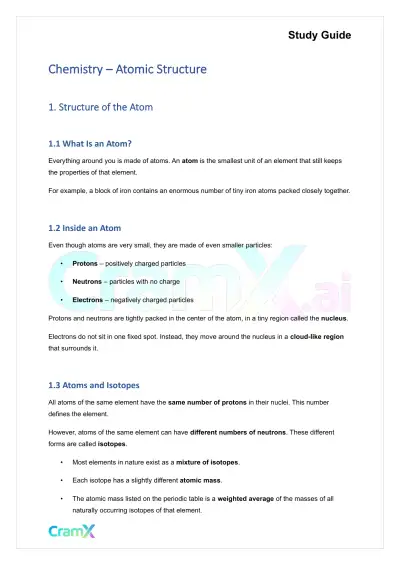 Quick Guides
Chemistry - Atomic Structure
Chemistry
42 pagesMar 2026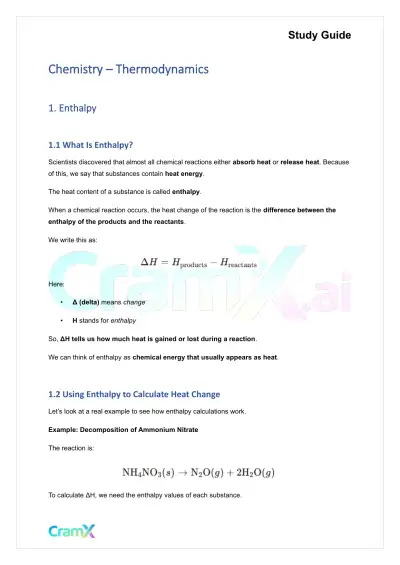 Quick Guides
Chemistry - Thermodynamics
Chemistry
38 pagesMar 2026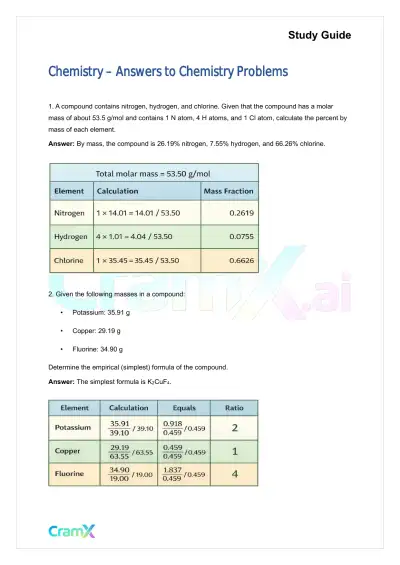 Quick Guides
Chemistry - Answers to Chemistry Problems
Chemistry
16 pagesMar 2026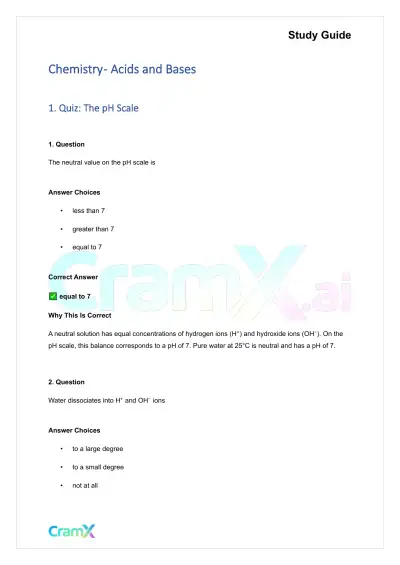 Quick Guides
Chemistry - Acids and Bases
Chemistry
38 pagesMar 2026 Quick Guides
Chemistry - Organic Compounds
Chemistry
41 pagesMar 2026 Quick Guides
Chemistry - Electrochemistry
Chemistry
35 pagesMar 2026 Quick Guides
Chemistry - Atoms
Chemistry
40 pagesMar 2026 Quick Guides
Chemistry - Elements
Chemistry
37 pagesMar 2026
Study this document with CramX
Once it is in your library, every tool can work from it.