

Chemistry - Organic Compounds
- Chemistry
- Texas A&M University
- 41 pages
- Shared March 2026
Preview 10 of 41 pages
See the first 10 pages exactly as they appear in the document.
Page 1 Read page 1 as text
Study Guide Chemistry – Organic Compounds 1. Quiz: Structural Formulas 1. Question The electron configuration for carbon is Answer Choices • 1s² 2s¹ 2p³ • 1s² 2s² 2p² • 1s² 2s³ 2p¹ Correct Answer 1s² 2s² 2p² Why This is Correct Carbon has an atomic number of 6 , which means it has 6 electrons . These electrons fill orbitals in order of increasing energy. • 1s orbital holds 2 electrons • 2s orbital holds 2 electrons • The remaining 2 electrons go into the 2p orbital So, the correct electron configuration of carbon is 1s² 2s² 2p² . For Example Hydrogen (atomic number 1) has the electron configuration 1s¹ , while oxygen (atomic number 8) has 1s² 2s² 2p⁴ . 2. Question In order to completely fill the valence shell, carbon wants how many bonds?
Page 2 Read page 2 as text
Study Guide Answer Choices • 2 • 3 • 4 Correct Answer 4 Why This is Correct Carbon has 4 valence electrons in its outer shell. To achieve a stable octet (8 electrons) , carbon needs 4 more electrons . It does this by forming four covalent bonds with other atoms, sharing electrons to completely fill its valence shell. For Example In methane (CH ₄ ), carbon forms four single bonds with four hydrogen atoms, which gives carbon a full valence shell and makes the molecule stable. 3. Question A carbon atom has __________ valence electrons and needs __________ electrons to fill the valence shell orbitals. Answer Choices • 4, 2 • 4, 4 • 2, 4 Correct Answer 4, 4
Page 3 Read page 3 as text
Study Guide Why This is Correct Carbon has 4 valence electrons in its outer shell. To achieve a stable octet (8 electrons in the valence shell), it needs 4 more electrons . Therefore, the correct pair is 4 valence electrons and needs 4 electrons . For Example Carbon forms four covalent bonds (like in methane, CH ₄ ) to complete its valence shell. 4. Question In a structural formula, __________ are used to depict two electrons in a chemical bond. Answer Choices • dots • two small e ⁻ • a single line Correct Answer a single line Why This is Correct In a structural formula, a single line represents a pair of shared electrons between two atoms, which makes up a chemical bond. For Example In the structural formula of hydrogen (H — H), the single line between the two hydrogen atoms shows one shared pair of electrons. 5. Question A molecular formula tells the
Page 4 Read page 4 as text
Study Guide Answer Choices • number and types of atoms in the molecule • arrangement of the atoms in the molecule • total number of bonds in the molecule Correct Answer number and types of atoms in the molecule Why This is Correct A molecular formula shows which elements are present in a molecule and how many atoms of each element it contains. It does not show how the atoms are arranged or bonded. For Example The molecular formula H ₂ O tells us there are two hydrogen atoms and one oxygen atom, but it does not show their arrangement. 6. Question The same molecular formula can represent Answer Choices • only one specific molecule • several different isomers • the physical state of the molecule Correct Answer several different isomers Why This is Correct A molecular formula shows only the number and types of atoms present in a molecule.
Page 5 Read page 5 as text
Study Guide It does not show how those atoms are arranged. Because atoms can be connected in different ways, the same molecular formula can represent different compounds called isomers . For Example : C ₂ H ₆ O can represent ethanol or dimethyl ether. 7. Question The structure of a molecule affects Answer Choices • only the chemical properties of the compound • only the physical properties of the compound • both the chemical and physical properties of the compound Correct Answer both the chemical and physical properties of the compound Why This is Correct The structure of a molecule determines how its atoms are arranged and bonded. This arrangement affects how the molecule reacts with other substances (chemical properties) and also influences characteristics such as melting point, boiling point, shape, and solubility (physical properties). For Example Glucose and fructose have the same molecular formula but different structures. Because of this, they show differences in both physical properties (such as sweetness and solubility) and chemical behavior. 8. Question In organic chemistry, structure is just as important as ________. Answer Choices • composition • isomerism • nomenclature
Page 6 Read page 6 as text
Study Guide Correct Answer composition Why This is Correct In organic chemistry, composition tells us what atoms are present in a compound, while structure tells us how those atoms are arranged. Both are equally important because compounds with the same composition can have different structures and show different properties. For Example Two compounds may both have the formula C ₂ H ₆ O, but one can be ethanol and the other dimethyl ether. They have the same composition, but different structures and different properties. 9. Question What type of formula omits the carbon – hydrogen (C – H) bonds? Answer Choices • structural • molecular • condensed structural Correct Answer condensed structural Why This is Correct A condensed structural formula shows how atoms are connected but does not display every individual bond. Carbon – hydrogen (C – H) bonds are not written out; instead, hydrogen atoms are grouped with the carbon atoms they are attached to. For Example Ethane can be written as CH ₃ – CH ₃ in a condensed structural formula, instead of showing every C – H bond separately.
Page 7 Read page 7 as text
Study Guide 10. Question Isopropyl alcohol and n - propanol have the same molecular formula, C ₃ H ₇ OH, yet their structures are different. These compounds are known as Answer Choices • alkenes • isomers • aldehydes Correct Answer isomers Why This is Correct Isomers are compounds that have the same molecular formula but different structural arrangements of atoms. Although isopropyl alcohol and n - propanol both have the formula C ₃ H ₇ OH, the atoms are connected differently in each compound, giving them different structures and properties. For Example Butane and isobutane both have the molecular formula C ₄ H ₁₀ , but their structures are different, so they are isomers. 11. Question Carbon always forms __________ covalent bonds. Answer Choices • 2 • 3 • 4
Page 8 Read page 8 as text
Study Guide Correct Answer 4 Why This is Correct Carbon has four valence electrons in its outer shell. To achieve a stable octet (8 electrons), carbon shares electrons with other atoms and therefore forms four covalent bonds . This bonding ability allows carbon to form a wide variety of compounds. For Example In methane (CH ₄ ), one carbon atom forms four covalent bonds with four hydrogen atoms. 2. Hydrocarbons 2.1 What Are Hydrocarbons? Hydrocarbons are compounds made using only carbon and hydrogen atoms. Even though they use just these two elements, hydrocarbons can form an enormous variety of substances . These compounds are very important in everyday life. They make up petroleum and natural gas , which are major sources of fuel and raw materials for industry. 2.2 Alkanes: Hydrocarbons with Single Bonds
Page 9 Read page 9 as text
Study Guide Hydrocarbons that contain only single covalent bonds between carbon atoms are called alkanes . Examples include: • Propane • Butane • Isobutane Alkanes do not contain: • Double bonds • Triple bonds • Ring structures These features make alkanes the simplest class of hydrocarbons . As the number of carbon atoms increases, the number of possible structures also increases. 2.3 Isomers: Same Formula, Different Structures When a molecule has more than one way to connect its carbon atoms, it forms isomers . Isomers have: • The same molecular formula • Different arrangements of carbon atoms The identity of an isomer depends on how the carbon atoms are bonded , not on how the molecule looks when drawn. Understanding Butane Figure 1. Both molecules are the same isomer of butane.
Page 10 Read page 10 as text
Study Guide Figure 2. The condensed structural formula of butane. Sometimes molecules may look different in drawings, but they are still the same compound . In butane: • A straight chain drawing and a bent chain drawing represent the same isomer • Both have the same condensed structural formula So, these drawings do not represent different isomers. 2.4 Alkenes: Hydrocarbons with Double Bonds Figure 3. Ethylene — an alkene. An alkene is a hydrocarbon that contains at least one carbon – carbon double bond . Ethylene (Ethene) • The simplest alkene • Molecular formula: C ₂ H ₄ Each carbon atom still forms four bonds , filling its valence shell with eight electrons.
31 more pages in the full document
Unlock it once and it stays in your library, ready to chat with or turn into flashcards.
Unlock the full documentMore Chemistry study materials
See all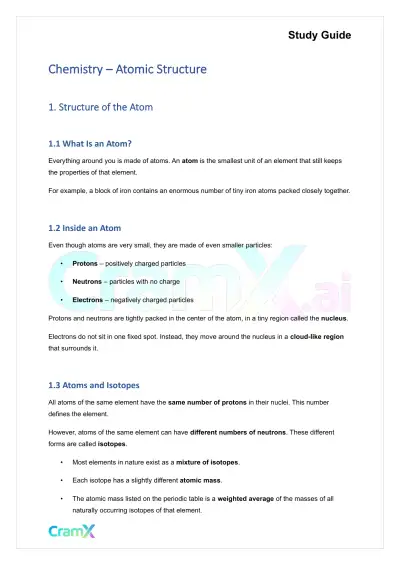 Quick Guides
Chemistry - Atomic Structure
Chemistry
42 pagesMar 2026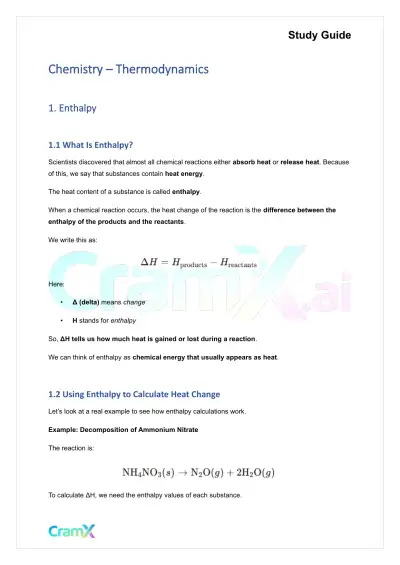 Quick Guides
Chemistry - Thermodynamics
Chemistry
38 pagesMar 2026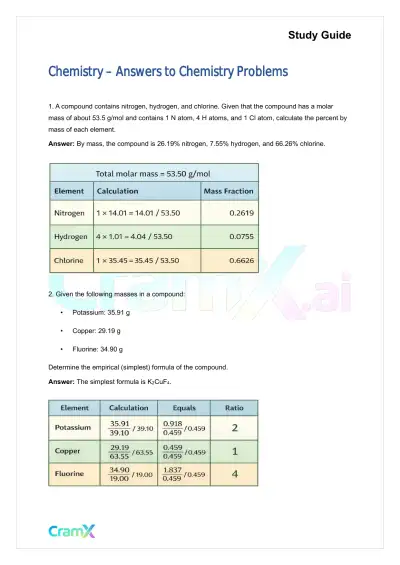 Quick Guides
Chemistry - Answers to Chemistry Problems
Chemistry
16 pagesMar 2026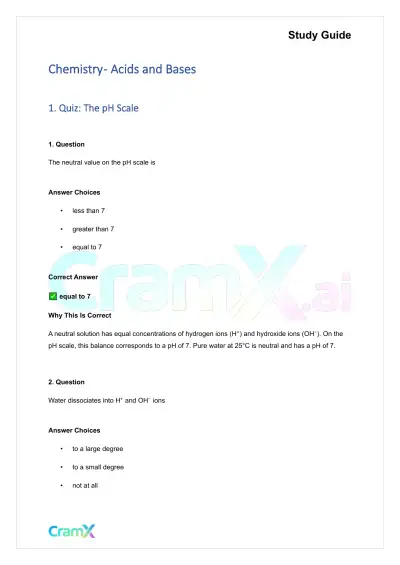 Quick Guides
Chemistry - Acids and Bases
Chemistry
38 pagesMar 2026 Quick Guides
Chemistry - Gases
Chemistry
39 pagesMar 2026 Quick Guides
Chemistry - Electrochemistry
Chemistry
35 pagesMar 2026 Quick Guides
Chemistry - Atoms
Chemistry
40 pagesMar 2026 Quick Guides
Chemistry - Elements
Chemistry
37 pagesMar 2026
Study this document with CramX
Once it is in your library, every tool can work from it.