

Elementary Surveying: An Introduction to Geomatics, 15th Edition Solution Manual
- Civil Engineering
- 270 pages
- Shared May 2025
Elementary Surveying: An Introduction to Geomatics, 15th Edition Solution Manual is your guide to textbook mastery, offering detailed solutions to every chapter's exercises.
Preview 16 of 270 pages
See the first 16 pages exactly as they appear in the document.
Page 1 Read page 1 as text
TABLE OF CONTENTS Preface v Part I: Solutions to Problems 1 1 Introduction 2 2 Units, Significant Figures, and Field Notes 7 3 Theory of Errors in Observations 12 4 Leveling Theory, Methods, and Equipment 18 5 Leveling — Field Procedures and Computations 25 6 Distance Measurement 36 7 Angles, Azimuths, and Bearings 42 8 Total Station Instruments; Angle Observations 49 9 Traversing 56 10 Traverse Computations 61 11 Coordinate Geometry in Surveying Calculations 73 12 Area 80 13 Global Navigation Satellite Systems—Introduction and Principles of Operation 90 14 Global Navigation Satellite Systems—Static Surveys 95 15 Global Navigation Satellite Systems—Kinematic Surveys 102 16 Adjustment by Least Squares 107 17 Mapping Surveys 119 18 Mapping 125 19 Control Surveys and Geodetic Reductions 130 20 State Plane Coordinates and Other Map Projections 137 21 Boundary Surveys 152 22 Public Land Surveys 161 23 Construction Surveying 165 24 Horizontal Curves 173 25 Vertical Curves 190 26 Volumes 200 27 Photogrammetry 210 28 Introduction to Geographic Information Systems 221 Part II: Sample Introductory Course 231 Sample Syllabus 232 Sample Practical Exercises 235 Sample Quizzes 239 Quiz 1 239 Quiz 2 239 Quiz 3 240 Quiz 4 240 Quiz 5 241 Quiz 6 242 Sample Exams 248
Page 2 Page 3 Read page 3 as text
PART I: SOLUTIONS TO PROBLEMS
Page 4 Read page 4 as text
Solution Manual 2 Elementary Surveying: An Introduction to Geomatics 1 I NTRODUCTION NOTE: Answers for some of these problems, and some in later chapters, can be obtained by consulting the bibliographies, later chapters, websites, or professional surveyors. 1.1 List 10 uses for surveying in areas other than boundary surveying. Answers may vary many are included in Section 1.6, which lists control, topographic hydrographic, alignment, construction, as-built, mine, solar, optical tooling, ground, aerial, and satellite surveys. This list is not complete and could also include other types of surveys such as hydrographic surveys, for example. 1.2 Explain the difference between geodetic and plane surveys. From Section 1.4: In geodetic surveys the curved surface of the earth is considered by performing the computations on an ellipsoid (curve surface approximating the size and shape of the earth). In plane surveys, except for leveling, the reference base for fieldwork and computations is assumed to be a flat horizontal surface. The direction of a plumb line (and thus gravity) is considered parallel throughout the survey region, and all measured angles are presumed to be plane angles. 1.3 Describe some surveying applications in: (a) Archeology There are many different uses of surveying in archeology. Some include using sonar to identify possible underground or underwater archeology sites, LiDAR to help identify possible ancient human settlements in unexplored forest and jungles, and traditional surveying and laser scanning to help locate artifacts in site excavations. (b) Gas exploration There are several stages of surveying in gas exploration, which include but are not limited to determining anomalies in the gravity field, which identify possible gas deposits, boundary surveys identifying properties that have mineral rights to the gas deposits, alignment surveys for placement of pipelines to transport extracted gas. (c) Agriculture In agriculture, surveying is used to determine the acreage of fields, to locate lines of constant elevation for strip farming, to track harvesting machinery to enable the size of the harvest, and to track the position of the planting equipment to allow for precise applications of seeds and fertilizers. The field is known as high-precision agriculture.
Page 5 Read page 5 as text
1.4 List some application of surveying in geology, forestry, and archeology. Applications in each are multiple. For some in geology and archeology see the answer to Problem 1.3 (a) and (b). Some uses of surveying in forestry identifying forest boundaries, locating spread of diseases and insects through remote sensing, using GIS to help inventory and keep records on resources in forested regions. 1.5 Why is it important to make accurate surveys of underground utilities? To provide an accurate record of the locations of these utilities so they can be found if repairs or servicing is needed, and to prevent their accidental destruction during excavation for other projects. 1.6 Discuss the uses for topographic surveys. Topographic surveys are used whenever elevation data is required in the end product. Some examples include (1) creating maps for highway design; (2) creating maps for construction surveys; (3) creating maps for flood plain delineation; (4) creating maps for site location of buildings; and so on. 1.7 What are hydrographic surveys, and why are they important? From Section 1.6, hydrographic surveys define shorelines and depths of lakes, streams, oceans, reservoirs, and other bodies of water. Sea surveying is associated with port and offshore industries and the marine environment, including measurements and marine investigations made by ship borne personnel. 1.8 Print a view of your location using Google Earth. ® Answers will vary but should be an image in your region. 1.9 Briefly explain the procedure used by Eratosthenes in determining the Earth’s circumference. From Section 1.3, paragraph 8 of text: His procedure, which occurred about 200 B.C., is illustrated in Figure 1.3. Eratosthenes had concluded that the Egyptian cities of Alexandria and Syene were located approximately on the same meridian, and he had also observed that at noon on the summer solstice, the sun was directly overhead at Syene. (This was apparent because at that time of that day, the image of the sun could be seen reflecting from the bottom of a deep vertical well there.) He reasoned that at that moment, the sun, Syene, and Alexandria were in a common meridian plane, and if he could measure the arc length between the two cities, and the angle it subtended at the earth's center, he could compute the earth's circumference. He determined the angle by measuring the length of the shadow cast at Alexandria from a tall vertical staff of known length. The arc length was found from multiplying the number of caravan days between Syene and Alexandria by the average daily distance traveled. From these measurements
Page 6 Read page 6 as text
Solution Manual 4 Elementary Surveying: An Introduction to Geomatics Eratosthenes calculated the earth's circumference to be about 25,000 mi. Subsequent precise geodetic measurements using better instruments, but techniques similar geometrically to Eratosthenes', have shown his value, though slightly too large, to be amazingly close to the currently accepted one. 1.10 Describe the steps a land surveyor would need to do when performing a boundary survey. Briefly, the steps should include (1) preliminary walking of property with owner; (2) courthouse research to locate deed of property and adjoiners to determine ownership, possible easements, right-of-ways, conflicts of interest, and so on; (3) location survey of property noting any encroachments; conflicting elements; and so on; (4) resolution of conflicting elements between deed and survey; (5) delivery of surveying report to owner. 1.11 What is the name of the state-level professional surveying organization in your state or region? Answer will vary by location. 1.12 What organizations in your state furnish maps and reference data to surveyors and engineers? Responses will vary but some common organizations are the (1) county surveyor, (2) register of deeds, (3) county engineer or county highway department (4) Department of Transportation, (5) Department of Natural Resources of its equivalent, and so on. 1.13 List the legal requirements for registration as a land surveyor in your state. Responses will vary. Contact with your licensing board can be found on the NCEES website at http://www.ncees.org/licensure/licensing_boards/. 1.14 Briefly describe an Earth-Centered, Earth-Fixed coordinate system. From Section 1.4 and 13.4.3, a ECEF coordinate system is an Earth-based three- dimensional coordinate system with its origin a the mass-center of the Earth, it Z axis aligned with the semi-minor (spin) axis of the Earth defined at some epoch, it X axis in the plane of the equator passing through mean Greenwich meridian, and it Y axis in the plane of the equator and creating a right-handed coordinate system. At this stage of their introduction to surveying it should be sufficient for students to simply know that it is an Earth-based three-dimensional coordinate system. 1.15 List the professional societies representing the geospatial industry in the (a) United States. There are several including AAGS, ASCE, ASPRS, GLIS, NSPS, and SaGES. (b) Canada. Canadian Institute of Geomatics (CIG)
Page 7 Read page 7 as text
(c ) International. International Federation of Surveyors (FIG) 1.15 Explain how aerial photographs and satellite images can be valuable in surveying. Photogrammetry presently has many applications in surveying. It is used, for example, in land surveying to compute coordinates of section corners, boundary corners, or point of evidence that help locate these corners. Large–scale maps are made by photogrammetric procedures for many uses, one being subdivision design. Photogrammetry is used to map shorelines, in hydrographic surveying, to determine precise ground coordinates of points in control surveying, and to develop maps and cross sections for route and engineering surveys. Photogrammetry is playing an important role in developing the necessary data for modern Land and Geographic Information Systems. 1.16 Search the Internet and define a Very Long Baseline Interferometry (VLBI) station. Discuss why these stations are important to the geospatial industry. VLBI stands for Very Long Baseline Interferometry. Responses will vary. These stations provide extremely accurate locations on the surface of the Earth. The stations are used to develop world-wide reference frameworks such as ITRF08 and thus provide a worldwide coordinate system that links continents. They also may provide tracking information for satellites. 1.17 Describe how a GIS can be used in flood emergency planning. Responses will vary but may mention the capabilities of a GIS to overlay soil type and their permeability with slopes, soil saturation, and watershed regions. A GIS can also be used to provide a list of business and residences that will be affected by possible flooding for evacuation purposes. It can provide “best” routes out of a flooded region. Visit one of the surveying websites listed in Table 1.1, and write a brief summary of its contents. Briefly explain the value of the available information to surveyors. Responses will vary with time, but below are brief responses to the question · NGS – control data sheets, CORS data, surveying software 1.19 · USGS – maps, software · BLM – cadastral maps, software, ephemerides · U.S. Coast Guard Navigation Center - GPS information · U.S. Naval Observatory –Notice Advisory for NAVSTAR Users (NANU) and other GPS related links · National Society of Professional Surveyors – professional organization for boundary and construction · American Association for Geodetic Surveying – professional organization for control surveying · Geographic and Land Information Society – professional organization for developers and users of geographic and land information systems
Page 8 Read page 8 as text
Solution Manual 6 Elementary Surveying: An Introduction to Geomatics · American Society for Photogrammetry and Remote Sensing – professional organization for photogrammetry and remote sensing · The Pearson Prentice Hall publishers access to software and support materials that accompany this book. · SaGES – An organization to advance surveying/geomatics education 1.20 Read one of the articles cited in the bibliography for this chapter, or another of your choosing, that describes an application where satellite surveying methods were used. Write a brief summary of the article. Answer will vary. 1.21 Same as Problem 1.20, except the article should be on safety as related to surveying. Answers will vary but should be related to safety issues in surveying.
Page 9 Read page 9 as text
1.20 Read one of the articles cited in the bibliography for this chapter, or another of your choosing, that describes an application where satellite surveying methods were used. Write a brief summary of the article. Answers will vary. Students should be told to look in trade journals for articles. 1.21 Same as Problem 1.20, except the article should be on safety as related to surveying. Answers will vary. Students should be told to look in trade journals for articles.
Page 10 Read page 10 as text
Instructor’ Solution Manual 7 Elementary Surveying: An Introduction to Geomatics 2 UNITS, SIGNIFICANT FIGURES, AND FIELD NOTES 2.1 List the five types of measurements that form the basis of traditional plane surveying. From Section 2.1, they are (1) horizontal angles, (2) horizontal distances, (3) vertical (altitude or zenith) angles, (4) vertical distances, and (5) slope (or slant) distances. 2.2 Give the basic units that are used in surveying for length, area, volume, and angles in (a) The English system of units. From Section 2.2: length (U.S. survey ft or in some states international foot), area (sq. ft. or acres), volume (cu. ft. or cu. yd.), angle (sexagesimal) (b) The SI system of units. From Section 2.3: length (m), area (sq. m. or hectare), volume (cu. m.), angle (sexagesimal, grad, or radian) 2.3 The easting coordinate for a point is 725,316.911 m. What is the coordinate using the (a) Survey foot definition? (b) International foot definition? (c) Why was the survey foot definition maintained in the United States? (a) 2,379,643.90 sft ; 725,316.911 ( 39.37 12 ) = 2,379,643.899 sft (b) 2,379,648,66 ft ; 725,316.911/0.3048 = 2,379,648.658 ft (c) From Section 2.2: “Because of the vast number of surveys performed prior to 1959, it would have been extremely difficult and confusing to change all related documents and maps that already existed. Thus the old standard, now called the U.S. survey foot , is still used.” 2.4 Convert the following distances given in meters to U.S. survey feet: *(a) 4129.574 m 13,548.44 sft (b) 588.234 m 1929.90 sft (c) 102,302.103 m 335,636.15 sft
Page 11 Read page 11 as text
8 Solution Manual Elementary Surveying: An Introduction to Geomatics 2.5 Convert the following distances given in survey feet to meters: *(a) 537.52 sft 163.836 m (b) 2,405,687.82 sft 733,255.114 m (c) 5783.12 sft 1762.699 m or 1762.70 m 2.6 Compute the lengths in survey feet corresponding to the following distances measured with a Gunter’s chain: *(a) 10 ch 13 lk 668.6 sft (b) 56 ch 83 lk 3750.8 sft (c) 124 ch 35 lk 8207.1 sft 2.7 Express 5,377,700 sft 2 in: *(a) acres 123.46 ac (b) hectares 49.961 ha (c) square Gunter’s chains 1234.6 sq. ch. 2.8 Convert 23.4587 ha to: (a) square survey feet 2,525,070 sft 2 (b) acres 57.9676 ac (b) square Gunter’s chains 579.676 sq. ch 2.9 What are the lengths in feet and decimals for the following distances shown on a building blueprint: (a) 12 ft 6-1/4 in. 12.5 ft 601/4/12 (b) 10 ft 6-1/2 in. 10.5 ft 253/2/12 2.10 What is the area in acres of a rectangular parcel of land measured with a Gunter’s chain if the recorded sides are as follows: *(a) 9.17 ch and 10.64 ch 9.76 ac (b) 16 ch 78 lk and 52 ch 49 lk 88.08 ac 2.11 Compute the area in acres of triangular lots shown on a plat having the following recorded right-angle sides: (a) 335.36 ft and 804.02 ft 3.0945 ac (b) 93.064 m and 30.346 m 0.69785 ac 2.12 A distance is expressed as 9756.12 sft. What is the length in *(a) international feet? 9756.14 ft (b) meters? 2973.67 m 2.13 What are the radian and degree-minute-second equivalents for the following angles given in grads:
Page 12 Read page 12 as text
Instructor’ Solution Manual 9 Elementary Surveying: An Introduction to Geomatics (a) * 136.000 grads 𝟏𝟐𝟐°𝟐𝟒′𝟎𝟎" ; 2.13628 rad (b) 115.089 grads 𝟏𝟎𝟑°𝟑𝟒′𝟓𝟎″ ; 1.80781 rad (c) 363.809 grads 𝟑𝟐𝟕°𝟐𝟓′𝟒𝟎″ ; 5.71469 rad 2.14 Give answers to the following problems in the correct number of significant figures: * (a) sum of 23.15, 0.984, 124, and 12.5 161 (b) sum of 2.115, 23.04, 13.8, and 199.66 238.6 (c) product of 127.08 and 13.1 1660 (d) quotient of 4466.83 divided by 35.61 125.4 2.15 Express the value or answer in powers of 10 to the correct number of significant figures: (a) 4586.49 4.58679 × 10 3 (b) 2450 2.45 × 10 3 (c) square of 199.99 3.9996 × 10 4 (d) sum of (32.087 + 1.56 + 206.44) divided by 2.3 1.95 × 10 1 2.16 Convert the angles of a triangle to radians and show a computational check: * (a) 39°41 ′ 54, 91°30'16", 48°47′50" 0.692867, 1.59705, and 0.851672 0.6928666 + 1.597054 + 0.8516721 = 3.14159 check (b) 96°23'18, 44°56′53", 38°39 ′ 49" 1.68229, 0.784492 , and 0.674807 1.682294 + 0.784492 + 0.674807 = 3.14159 check 2.17 Why should a ball point pen not be used in field notekeeping? From Section 2.7: "Books so prepared (with 3h or higher pencil) will withstand damp weather in the field (or even a soaking) and still be legible, whereas graphite from a soft pencil, or ink from a pen or ballpoint, leaves an undecipherable smudge under such circumstances." 2.18 Explain why one number should not be superimposed over another or the lines of sketches. From Section 2.7: This can be explained with the need for integrity since it would raise the issue of what are you hiding, legibility since the numbers are often hard to interpret when so written, or by clarity since the notes are being crowded. 2.19 Explain why data should always be entered directly into the field book at the time measurements are made, rather than on scrap paper for neat transfer to the field book later. From Section 2.7: Data should always be entered into the field book directly at the time of the measurements to avoid loss of data. 2.20 Why should the field notes show the precision of the measurements?
Page 13 Read page 13 as text
10 Solution Manual Elementary Surveying: An Introduction to Geomatics Field notes should show the precision of the measurements made to indicate the accuracy of the measurements. 2.21 Explain the reason for item 7 in Section 2.11 when recording field notes. In general a sketch will show more than a table of numbers. As the saying goes, “A picture is worth a thousand words.” 2.22 Explain the reason for item 13 in Section 2.11 when recording field notes. A standard set of symbols and signs improve the clarity of drawings. 2.23 Explain the reason for item 18 in Section 2.11 when recording field notes. A zero should be placed before a decimal point for the sake of clarity. 2.24 When should sketches be made instead of just recording data? Sketches should be made instead of recording data anytime observations need to be clarified so that the personnel interpreting the notes can have a clear understanding of the field conditions. This also serves as a reminder of the work performed and any unusual conditions in later references to the project. 2.25 Justify the requirement to list in a field book the makes and serial numbers of all instruments used on a survey. Listing the makes and serial numbers of the instruments used in the survey may help isolate instrumental errors later when reviewing the project. 2.26 Discuss the advantages of survey controllers that can communicate with several different types of instruments. The ability of survey controllers to communicate with several different types of instruments allows the surveyor to match the specific conditions of the project with the instrument that this is ideally suited for the job. Thus total station, digital levels, and GNSS receivers can all be used in a single project. 2.27 Discuss why data should always be backed up at regular intervals. From Section 2.13, paragraph 1: “At regular intervals, usually at lunchtime and at the end of a day’s work, or when a survey has been completed, the information stored in files within a data collector is transferred to another device. This is a safety precaution to avoid accidentally losing substantial amounts of data.” 2.28 Search the Internet and find at least two sites related to (a) Manufacturers of survey controllers. (b) Manufacturers of total stations. (c) Manufacturers of global navigation satellite system (GNSS) receivers. Answers should vary with students.
Page 14 Read page 14 as text
Instructor’ Solution Manual 11 Elementary Surveying: An Introduction to Geomatics 2.29 Why do many survey controllers contain digital cameras? From Section 2.15: “Many modern survey controllers also contain digital cameras that allow field personnel to capture a digital image of the survey.” 2.30 What are the dangers involved in using a survey controller? From Section 2.15: “Although survey controllers have many advantages, they also present some dangers and problems. There is the slight chance, for example, the files could be accidentally erased through carelessness or lost because of malfunction or damage to the unit.” 2.31 Describe what is meant by the phrase “field-to-finish.” From Section 2.15, "The field codes can instruct the drafting software to draw a map of the data complete with lines, curves and mapping symbols. The process of collecting field data with field codes that can be interpreted later by software is known as a field-to-finish survey. This greatly reduces the time needed to complete a project." 2.32 Why are sketches in field books not usually drawn to scale? This is true since this would require an overwhelming amount of time. The sketches are simply to provide readers of the notes an approximate visual reference to the measurements.
Page 15 Read page 15 as text
12 Solution Manual Elementary Surveying: An Introduction to Geomatics 3 THEORY OF ERRORS IN OBSERVATIONS 3.1 Discuss the difference between an error and a residual. From Section 3.3, an error is the difference between the observation and its true value, or 𝐸 = 𝑋 − 𝑋̅ whereas a residual, which is defined in Section 3.11 is the difference between the mean of a set of observations and the observation or 𝑣 = 𝑀̅ − 𝑀 3.2 Give two examples of (a) direct and (b) indirect measurements. From Section 3.2: A direct observation is made by applying a measurement instrument directly to a quantity to be measured and an indirect observation is made by computing a quantity from direct observations. Examples should vary by student response. 3.3 Define the term systematic error , and give two surveying examples of a systematic error. See Section 3.6 3.4 Define the term random error , and give two surveying examples of a random error. See Section 3.6 3.5 Discuss the difference between accuracy and precision. From Section 3.7, accuracy is the nearness of the observed quantities to the true value, which is never known. Precision is the degree of refinement or consistency of a group of observations and is evaluated on the basis of discrepancy size. 3.6 The observations of 124.53, 124.55, 142.51, and 124.52 are obtained when taping the length of a line. What should the observer consider doing before a mean length is determined from the set of observations? It appears that the observation 142.51 is an outlier and a possible mistake in the data set. The observer should collect another tape observation of the line and discard the offending observation(s). A distance AB is observed repeatedly using the same equipment and procedures, and the results, in meters, are listed in Problems 3.7 through 3.10. Calculate (a) the line’s most probable length, (b) the standard deviation and (c) the standard deviation of the mean for each set of results. * 3.7 65.401, 65.400, 65.402, 65.396, 65.406, 65.401, 65.396, 65.401, 65.405, and 65.404 (a) 65.401 ∑654.012
Page 16 Read page 16 as text
Solution Manual 13 Elementary Surveying: An Introduction to Geomatics (b) ±0.003 ∑ν 2 = 0.000091 (c) ±0.001 3.8 Same as Problem 3.7 but discard only one 65.396 observation. (a) 65.402 ∑588.616 (b) ±0.003 ∑ν 2 = 0.000064 (c) ±0.0009 3.9 Same as Problem 3.7, but discard both 65.396 observations. (a) 65.402 ∑523.220 (b) ±0.002 ∑ν 2 = 0.000030 (c) ±0.0007 3.10 Same as Problem 3.7, but include two additional observations, 65.402 and 65.405. (a) 65.402 ∑784.819 (b) ±0.003 ∑ν 2 = 0.000115 (c) ±0.0009 In Problems 3.11 through 3.14, determine the range within which observations should fall (a) 90% of the time and (b) 95% of the time. List the percentage of values that actually fall within these ranges. 3.11 For the data of Problem 3.7. *(a) 65.4012±0.0052 (65.3960, 65.4064), 100% (b) 65.4012±0.0062 (65.3950, 65.4074), 100% 3.12 For the data of Problem 3.8. (a) 65.4018±0.0046 (65.3971, 65.4064), 90%, 65.396 outside of range (b) 65.4018±0.0055 (65.3963, 65.4073), 90%, 65.396 outside of range 3.13 For the data of Problem 3.9. (a) 65.4025±0.0034 (65.3991, 65.4059), 90%, 65.406 outside of range (b) 65.4025±0.0040 (65.3985, 65.4065), 100% 3.14 For the data of Problem 3.10. (a) 65.4016±0.0053 (65.3963, 65.4069), 83.3%, both 65.396 outside of range (b) 65.4016±0.0063 (65.3952, 65.4079), 100%
254 more pages in the full document
Unlock it once and it stays in your library, ready to chat with or turn into flashcards.
Unlock the full documentMore Civil Engineering study materials
See all Textbook Guides
Solution Manual For Elementary Surveying: An Introduction To Geomatics, 13th Edition
Civil Engineering
242 pagesMay 2025 Textbook Guides
Solution Manual for Transportation Engineering and Planning, 3rd Edition
Civil Engineering
78 pages92downloadsFeb 2025 Textbook Guides
Reinforced Concrete Design, 9th Edition Solution Manual
Civil Engineering
198 pages65downloadsFeb 2025 Exam Guides
Principles Of Foundation Engineering, 8th Edition Test Bank
Civil Engineering
166 pages49downloadsFeb 2025 Textbook Guides
Solution Manual for A First Course in the Finite Element Method, 6th Edition
Civil Engineering
644 pagesMay 2025 Past Exams
The CE Shop Construction Final Exam With Answers (100 Solved Questions)
Civil Engineering
55 pagesMay 2025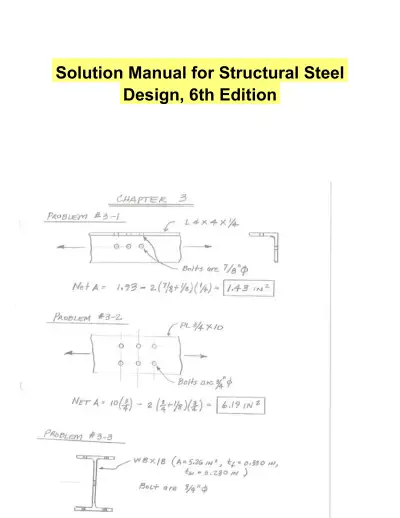 Textbook Guides
Solution Manual for Structural Steel Design, 6th Edition
Civil Engineering
511 pagesMay 2025 Textbook Guides
Solution Manual For Structural Wood Design: ASD/LRFD, 2nd Edition
Civil Engineering
268 pagesMay 2025
Study this document with CramX
Once it is in your library, every tool can work from it.