

LEG 500 Employment-At-Will Doctrine Assignment#1
- Civil Law
- Strayer University
- 11 pages
- Shared May 2025
Analysis of employment-at-will doctrine and legal implications.
Preview 4 of 11 pages
See the first 4 pages exactly as they appear in the document.
Page 1 Read page 1 as text
Running Head: Employment - At - Will Doctrine 1 Employment - At - Will Doctrine Assignment#1 LEG 500 Assignment 2: Employment - At - Will Doctrine Imagine you are a recently - hired Chief Operating Officer (COO) in a midsize company preparing for an Initial Public Offering (IPO). You quickly discover multiple personnel problems that require your immediate attention. 1. John posted a rant on his Facebook page in which he criticized the company’s most important customer. 2. Ellen started a blog to protest the CEO’s bonus, noting that no one below director has gotten a raise in two (2) years and portraying her bosses as “know - nothings” and “out - of - touch” 3. Bill has been using his company - issued BlackBerry to run his own business on the side. 4. After being disciplined for criticizing a customer in an email (sent from his personal email account on a company computer), Joe threatens to sue the company for invasion of privacy. 5. One of the department supervisors requests your approval to fire his secretary for insubordination. Since the secretary has always received glowing reviews, you call her into your office and determine that she has refused to prepare false expense reports for her boss. 6. Anna’s boss refused to sign her leave request for jury duty and now wants to fire her for being absent without permission.
Page 2 Page 3 Read page 3 as text
Running Head: Employment - At - Will Doctrine 2 Introduction Since the 19th century, America’s employment philosophy has traditionally been what is ref erred to as employment - at - will. It basis is found on two of America’s enduring founding structures. For example, the laissez - faire concept of the free market philosophy, and the traditional principle of democracy — of personal liberty as embodied in the constitution. As two sides of the same coin, the free - market and the constitution, each in its own way views the employer/employee relationship to be on equal a footing. By definition, "employment - at - will is a legal rule…giving employers’ unfettered power to 'dismiss their employees for good cause, no cause, or for cause morally wrong, without being guilty of legal wrong (Ingulli, 2012).’” By the same token employees also have the free will to choose to terminate their employments with their employers for no cause, or for good cause, or for cause morally wrong without any obligation. But the seemingly unfettered power at the disposal of employers to terminate the employment of employees at will, which some people particularly the trade unions, had variously characterized as exploitative, inhumane and unfairly stacked against employees has not been so unfettered after all. Overtime, some major exceptions to employer’s right to fire at - will have since been gradually introduced into this arrangement. As of the 1950s, at least four major exceptions to employment - at - will which are deemed to be adversely disparaging to employees have been put in place by way of America common law tradition, and tort law. Most notable and adopted in all 50 states among these exceptions is the one which prohibits termination actions taken against an employee for either not participating or reporting a violation of a state policy or local ordinance. Then there is the exception which prohibits as a basis for termination, race, age, gender, national origin and disability. Another exception that is enforced nation - wide is the one that places a
Page 4 Read page 4 as text
Running Head: Employment - At - Will Doctrine 3 prohibition on termination in which an implied — orally, by employer handbook, or a concretely stipulated contract has been reached. Finally although not all, but majority of the state’s project into employment - at - will, an implied covenant of good faith to the effect that terminations could be only for good cause — not done in bad faith. At this point, I now proceed to deal with the myriad of personnel problems that await my attention as a recently hired in my hypothetical position as Chief Operating Officer (COO) of a midsize company. Before reacting to any of the problems on hand I would first undertake a careful study of what the company’s policy stipulates as to what course of action could be taken in the breach of company’s policy in reference to the cases before me. In addition I would take a thorough look at the specific law that pertain to each case to avert the possibility of law suits filed against the company for wrongful termination. 1. John posted a rant on his Facebook page in which he criticized the company’s most important customer. Clearly, whatever his reason is, John’s behavior in regard to publicly criticizing the company’s customer irrespective of the customer’s status or the medium he uses to level his criticism at the customer, is unprofessional, counterproductive and unbecoming of his status as company’s employee. But before I come to a decision regarding John’s fate with the company, I would conduct an exhaustive investigation as to what drove him to take the action he took howbeit unjustifiable as it is. To this end, let us assume that John has some clout in the company probably an expert of sort. In that case we can also assume that John may be privy to information of impropriety involving this particular customer. If that is the case, it may be reasonable to further assume that he may have broached the matter to senior management to no avail, and probably as
7 more pages in the full document
Unlock it once and it stays in your library, ready to chat with or turn into flashcards.
Unlock the full documentMore Civil Law study materials
See all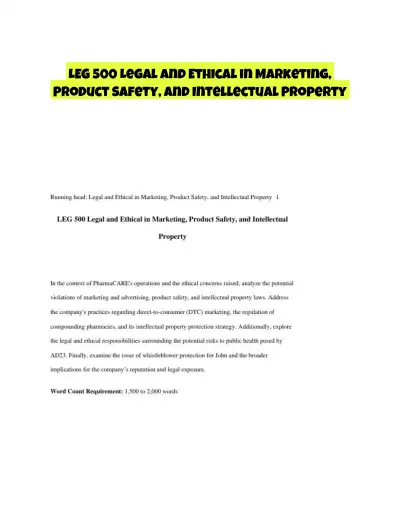 Solved Assignments
LEG 500 Legal and Ethical in Marketing, Product Safety, and Intellectual Property
Civil Law
11 pagesMay 2025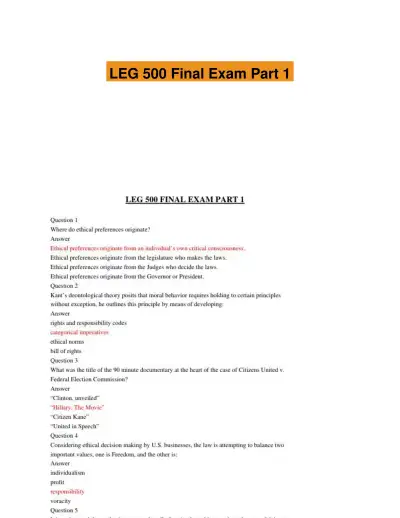 Solved Assignments
LEG 500 Final Exam Part 1
Civil Law
14 pagesMay 2025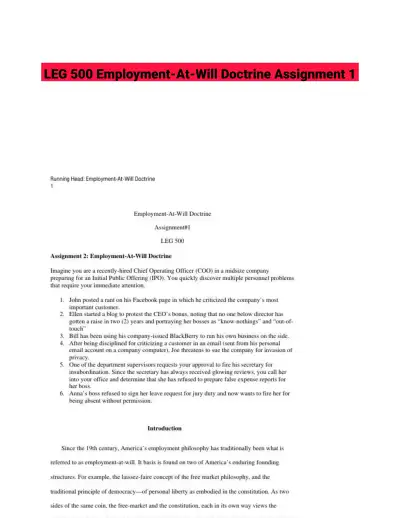 Solved Assignments
LEG 500 Employment-At-Will Doctrine Assignment 1
Civil Law
11 pagesMay 2025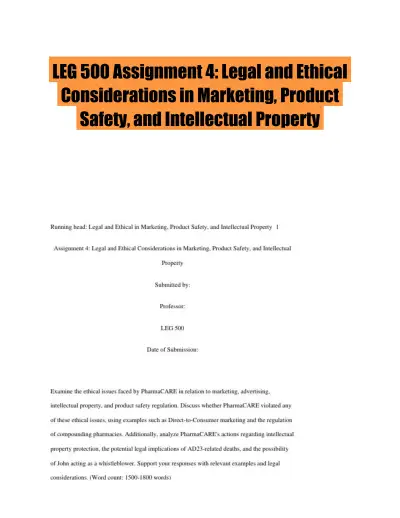 Solved Assignments
LEG 500 Assignment 4: Legal and Ethical Considerations in Marketing, Product Safety, and Intellectual Property
Business Law
9 pagesMay 2025 Class Notes
Class Notes For Legal Terminology, 6th Edition
Civil Law
168 pages149downloadsFeb 2025 Class Notes
Lecture Notes for Introduction to Law, 7th Edition
Civil Law
310 pages121downloadsFeb 2025 Past Exams
2024-2025 TCOLE Basic Jailer Course Practice Exam with Answers (1401 Solved Questions)
Civil Law
84 pages72downloadsFeb 2025 Class Notes
Lecture Notes For Legal Research, Analysis, and Writing, 14th Edition
Civil Law
618 pages57downloadsFeb 2025
Study this document with CramX
Once it is in your library, every tool can work from it.