

CompTIA CySA+ Cybersecurity Analyst Certification All-in-One Exam Guide (Exam CS0-003) (2024)
- CompTIA Certifications
- 787 pages
- Shared May 2025
CompTIA CySA+ Cybersecurity Analyst Certification All-in-One Exam Guide (Exam CS0-003) (2024) is your key to certification success, featuring exam papers that simulate real test conditions.
Preview 16 of 787 pages
See the first 16 pages exactly as they appear in the document.
Page 1 Read page 1 as text
“ . ‘All-in-One Is All You Need.” i | I CompTIA Cybersecurity Analyst Certification EE Save 10% on any EXAM GUIDE ComptTIA exam EXAM CS0-003 voucher! Coupon = fire THIRD EDITION Complete coverage ey of all objectives for ws [oh a exam CS0-003 Graw * Test engine that Hill | provides full-length A a Ideal as both a study tool se ies and an on-the-job reference ] Filled with practice exam questions and in-depth explanations r______________________________________________________________________________| MYA HEATH, BOBBY E. ROGERS, BRENT CHAPMAN, FERNANDO J. MAYMI = 1 1 - Study
Page 2 Read page 2 as text
Downloaded from StudyXY.com ® + StudyXY Sd Ye. o> \ | iF ’ pr E \ 3 S Stu dy Anything This ContentHas been Posted On StudyXY.com as supplementary learning material. StudyXY does not endrose any university, college or publisher. Allmaterials posted are under the liability of the contributors. wv 8) www.studyxy.com
Page 3 Read page 3 as text
“All-in-One Is All You Need.” | ALL INONE | CompTIA Cybersecurity Analyst Certification Save 10% on any E X A M G U I D E CompTIA exam EXAM CS0-003 voucher! Cou, E—— ticinsia ll THIRD EDITION Complete coverage pg of all objectives for n EA exam CS0-003 Toseis, . = Ei, Ideal as both a study tool Ee and an on-the-job reference n Filled with practice exam questions and in-depth explanations —— MYA HEATH, BOBBY E. ROGERS, BRENT CHAPMAN, FERNANDO J. MAYMf
Page 4 Read page 4 as text
CompTIA CySA+ A Cybersecurity Analyst ‘ ‘ Certification EXAM GUIDE Third Edition (Exam CS0-003) Mya Heath, Bobby E. Rogers, Brent Chapman, & Fernando J. Maymi New York Chicago San Francisco Athens London Madrid Mexico City Milan New Delhi Singapore Sydney Toronto eres plly eink bcm dor dy amperes ade Rp vrcebi] memset ie publication and accompanying media will ensure pning any cam. CompTIA and CySA+™ are trademarks or registered trademarks of CompTIA in the United States and/or other countries. All other trademarks are trademarks of their respective owners. The CompTIA Marks are the proprictary trademarks and/or service marks of CompTIA and its affiliates used under license from CompTIA.
Page 5 Read page 5 as text
Copyright © 2024 by McGraw Hill. All rights reserved. Except as permitted under the Copyright Act of 1976, no part of this publication may be reproduced or distributed in any form or by any means, or stored in a database or retrieval system, without the prior written permission of publisher, with the exception that the program listings may be entered, stored, and executed in a computer system, but they may not be reproduced for publication. ISBN: 978-1-26-545315-2 MHID: 1-26-545315-2 The material in this eBook also appears in the print version of this title: ISBN: 978-1-26-545243-8, MHID: 1-26-545243-1. eBook conversion by codeMantra Version 1.0 All trademarks are trademarks of their respective owners. Rather than put a trademark symbol after every occurrence of a trademarked name, we use names in an editorial fashion only, and to the benefit of the trademark owner, with no intention of infringement of the trademark. Where such designations appear in this book, they have been printed with initial caps. McGraw Hill eBooks are available at special quantity discounts to use as premiums and sales promotions or for use in corporate training programs. To contact a representative, please visit the Contact Us page at www.mhprofessional.com. Information has been obtained by McGraw Hill from sources believed to be reliable. However, because of the possibility of human or mechanical error by our sources, McGraw Hill, or others, McGraw Hill does not guarantee the accuracy, adequacy, or completeness of any information and is not responsible for any errors or omissions or the results obtained from the use of such information. TERMS OF USE
Page 6 Read page 6 as text
This is a copyrighted work and McGraw Hill (“McGraw Hill”) and its licensors reserve all rights in and to the work. Use of this work is subject to these terms. Except as permitted under the Copyright Act of 1976 and the right to store and retrieve one copy of the work, you may not decompile, disassemble, reverse engineer, reproduce, modify, create derivative works based upon, transmit, distribute, disseminate, sell, publish or sublicense the work or any part of it without McGraw Hill’s prior consent. You may use the work for your own noncommercial and personal use; any other use of the work is strictly prohibited. Your right to use the work may be terminated if you fail to comply with these terms. THE WORK IS PROVIDED “AS IS.” McGRAW HILL AND ITS LICENSORS MAKE NO GUARANTEES OR WARRANTIES AS TO THE ACCURACY, ADEQUACY OR COMPLETENESS OF OR RESULTS TO BE OBTAINED FROM USING THE WORK, INCLUDING ANY INFORMATION THAT CAN BE ACCESSED THROUGH THE WORK VIA HYPERLINK OR OTHERWISE, AND EXPRESSLY DISCLAIM ANY WARRANTY, EXPRESS OR IMPLIED, INCLUDING BUT NOT LIMITED TO IMPLIED WARRANTIES OF MERCHANTABILITY OR FITNESS FOR A PARTICULAR PURPOSE. McGraw Hill and its licensors do not warrant or guarantee that the functions contained in the work will meet your requirements or that its operation will be uninterrupted or error free. Neither McGraw Hill nor its licensors shall be liable to you or anyone else for any inaccuracy, error or omission, regardless of cause, in the work or for any damages resulting therefrom. McGraw Hill has no responsibility for the content of any information accessed through the work. Under no circumstances shall McGraw Hill and/or its licensors be liable for any indirect, incidental, special, punitive, consequential or similar damages that result from the use of or inability to use the work, even if any of them has been advised of the possibility of such damages. This limitation of liability shall apply to any claim or cause whatsoever whether such claim or cause arises in contract, tort or otherwise.
Page 7 Read page 7 as text
Elijah, You’ve unlocked within me an abundance of love, ignited joy, and guided me towards an inner peace I hadn’t known before. Inspired by you, I strive to be the best mom and person I can be. My deepest hope is that, one day, you will look back and find in me the same inspiration you spark within my heart each day. With all my love, —Mom (Mya) I'd like to dedicate this book to the cybersecurity professionals who tirelessly, and sometimes thanklessly, protect our information and systems from all who would do them harm. I also dedicate this book to the people who serve in uniform as military personnel, public safety professionals, police, firefighters, and medical professionals, sacrificing sometimes all that they are and have so that we may all live in peace, security, and safety. —Bobby
Page 8 Read page 8 as text
ABOUT THE AUTHORS Mya Heath, CySA+, CISSP, GCFA, is a seasoned detection engineer, threat hunter, and purple teamer with over 20 years of experience in the cybersecurity industry. She has held pivotal roles at prominent organizations, leveraging her expertise to develop advanced detection technologies, improve security architecture, and secure critical systems against advanced persistent threats. Mya has built a robust career that marries proficiency in Python programming, adversarial simulation, and cloud security with an in-depth understanding of data science and machine learning. Her ability to bridge the gap between these key areas has not only facilitated the creation of next- generation technologies but also improved threat hunting and detection efforts on a global scale. In every facet of her work, Mya has demonstrated a commitment to diversity, innovation, collaboration, and the advancement of the cybersecurity field. Bobby E. Rogers, CySA+, CISSP-ISSEP, CRISC, MCSE: Security, is a cybersecurity professional with over 30 years in the information technology and cybersecurity fields. He currently works for a major engineering company in Huntsville, Alabama, as a contractor for commercial, state, and federal agencies, helping to secure their information systems. Bobby’s specialties are cybersecurity engineering, security compliance auditing, and cyber risk management, but he has worked in almost every area of cybersecurity, including network defense, computer forensics, incident response, and penetration testing. He is a retired master sergeant from the US Air Force, having served for over 21 years. Bobby has built and secured networks in the United States, Chad, Uganda, South Africa, Germany, Saudi Arabia, Pakistan, Afghanistan, and several other countries all over the world. He has narrated and produced over 30 information security training videos
Page 9 Read page 9 as text
for several training companies and is also the author of CRISC Certified in Risk and Information Systems Control All-In-One Exam Guide, CompTIA CySA+ Cybersecurity Analyst Certification Passport, and CISSP Passport. He is also the contributing author/technical editor for the popular CISSP All- In-One Exam Guide, Ninth Edition, all from McGraw Hill. Brent Chapman, CySA+, GCIH, GCFA, GCTI, CISSP, is an information security engineer with more than 15 years of experience in information technology and cybersecurity. He is a former cyber operations officer in the United States Army and has held a number of unique assignments, including researcher at the Army Cyber Institute, instructor in the Department of Electrical Engineering and Computer Science at the US Military Academy at West Point, and project manager at the Defense Innovation Unit in Silicon Valley. He is a professional member of the Association of Computing Machinery, FCC Amateur Radio license holder, and contributor to several technical and maker-themed publications. Fernando J. Maymi, PhD, CISSP, is a consultant, educator, and author with more than 25 years of experience in information security. He currently leads teams of cybersecurity consultants, analysts, and red teamers in providing services around the world. Fernando was the founding deputy director of the Army Cyber Institute, a government think tank he helped create for the secretary of the army to solve future cyberspace operations problems affecting the whole country. He has served as advisor to congressional leaders, corporate executives, and foreign governments on cyberspace issues. Fernando taught computer science and cybersecurity at the US Military Academy at West Point for 12 years. Fernando has written extensively and is the coauthor of the ninth edition of the bestselling CISSP All-in-One Exam Guide. About the Technical Editor Robert Shimonski, CySA+, CASP+, PenTest+, Security+, is a technology executive specializing in healthcare IT for one of the largest health systems in America. In his current role, Rob is responsible for bringing technical, tactical, and operational support into the future with the help of new technologies such as cloud and artificial intelligence.
Page 10 Read page 10 as text
His current focus is on deploying to cloud (Azure, AWS, and Google), security solutions like CNAPP, DevOps, DevSecOps, AlOps, digital transformation, machine learning, IoT, and the development of new technologies in healthcare. Rob spent many years in the technology “trenches” doing networking and security architecture, design, engineering, testing, and development. A go-to person for all things security, Rob has been a major force in deploying security-related systems for 25+ years. Rob has worked for various companies, reviewing and developing curriculum as well as other security-related books, technical articles, and publications based on technology deployment, testing, hacking, pen testing, and many other aspects of security. Rob has written and edited over 100 books on security-related topics. Rob also helped develop CompTIA exams as an SME and has over 20 current CompTIA-based certifications.
Page 11 Read page 11 as text
CONTENTS AT A GLANCE PartI Security Operations Chapter 1 System and Network Architectures Chapter 2 Standardizing and Streamlining Security Operations Chapter 3 Attack Methodology Frameworks Chapter 4 Analyzing Potentially Malicious Activity Chapter 5 Techniques for Malicious Activity Analysis Chapter 6 Tools for Malicious Activity Analysis Chapter 7 Fundamentals of Threat Intelligence Chapter 8 Applying Threat Intelligence in Support of Organizational Security Part II Vulnerability Management Chapter 9 Vulnerability Scanning Methods and Concepts Chapter 10 Vulnerability Assessment Tools Chapter 11 Analyzing and Prioritizing Vulnerabilities Chapter 12 Mitigating Vulnerabilities Chapter 13 Vulnerability Handling and Response Part III Incident Response Chapter 14 Incident Response Procedures
Page 12 Read page 12 as text
Chapter 15 Post-Incident Response Activities Chapter 16 Utilize Basic Digital Forensics Techniques Part IV Appendixes and Glossary Appendix A Objective Map Appendix B About the Online Content Glossary Index
Page 13 Read page 13 as text
CONTENTS Acknowledgments Introduction PartI Security Operations Chapter 1 System and Network Architectures The Importance of Logging Logging Levels Log Ingestion Time Synchronization Operating System Concepts Windows Registry Linux Configuration Settings System Hardening File Structure System Processes Hardware Architecture Network Architecture On-premises Architecture Network Segmentation Zero Trust Software-Defined Networking Secure Access Secure Edge Cloud Service Models Cloud Deployment Models Hybrid Models Cloud Access Security Broker
Page 14 Read page 14 as text
Infrastructure Concepts Virtualization Containerization Serverless Architecture Identity and Access Management Multifactor Authentication Single Sign-On Federation Privileged Access Management Encryption Symmetric Cryptography Asymmetric Cryptography Symmetric vs. Asymmetric Cryptography Public Key Infrastructure Digital Signatures Sensitive Data Protection Personally Identifiable Information Personal Health Information Cardholder Data Data Loss Prevention Secure Sockets Layer and Transport Layer Security Inspection Chapter Review Questions Answers Chapter 2 Standardizing and Streamlining Security Operations Streamlining Security Operations Automation and Orchestration Orchestration Playbooks Process Standardization Identification of Tasks Suitable for Automation Minimizing Human Engagement Team Coordination to Manage and Facilitate Automation Technology and Tool Integration
Page 15 Read page 15 as text
Scripting Application Programming Interface Representational State Transfer Automating API Calls Webhooks Plug-Ins Orchestrating Threat Intelligence Data Data Enrichment Single Pane of Glass Use of Automation Protocols and Standards Security Content Automation Protocol Chapter Review Questions Answers Chapter 3 Attack Methodology Frameworks Attack Frameworks MITRE ATT&CK The Diamond Model of Intrusion Analysis Kill Chain Open Source Security Testing Methodology Manual OWASP Web Security Testing Guide Chapter Review Questions Answers Chapter 4 Analyzing Potentially Malicious Activity Network-Related Indicators Bandwidth Consumption Beaconing Irregular Peer-to-Peer Communication Rogue Devices on the Network Scans/Sweeps Unusual Traffic Spikes Activity on Unexpected Ports
Page 16 Read page 16 as text
Network-Related Indicators Summary Host-Related Indicators Capacity Consumption Unauthorized Software Malicious Processes Memory Contents Unauthorized Changes Unauthorized Privileges Data Exfiltration Registry Change or Anomaly Unauthorized Scheduled Task Application-Related Indicators Anomalous Activity Introduction of New Accounts Unexpected Output Unexpected Outbound Communication Service Interruption Memory Overflows Application Logs Other Indicators Social Engineering Obfuscated Links Chapter Review Questions Answers Chapter 5 Techniques for Malicious Activity Analysis Capturing Network Traffic Log Analysis and Correlation Security Information and Event Management Security Orchestration, Automation, and Response Endpoint Endpoint Detection and Response Reputation Analysis File Analysis
771 more pages in the full document
Unlock it once and it stays in your library, ready to chat with or turn into flashcards.
Unlock the full documentMore CompTIA Certifications study materials
See all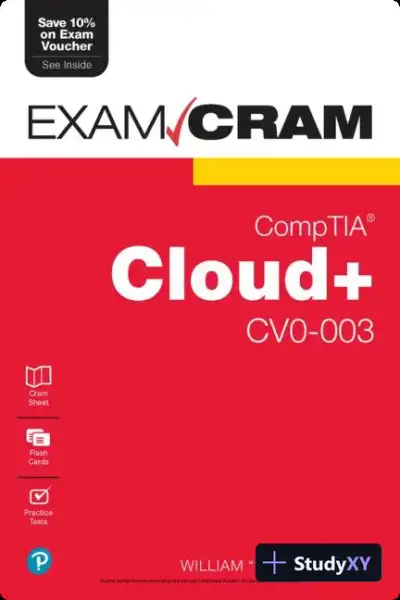 Certification Guides
CompTIA Cloud+ CV0-003 Exam Cram (2021)
CompTIA Certifications
434 pages156downloadsFeb 2025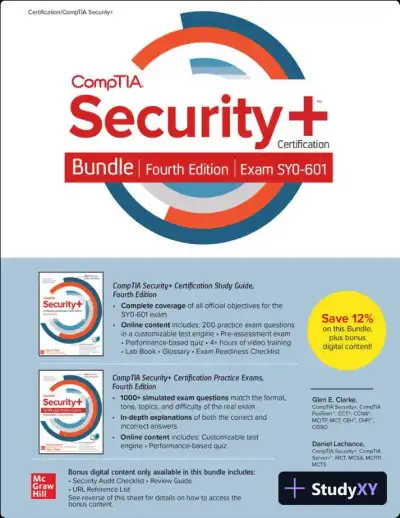 Certification Guides
CompTIA Security+ SY0-601 Exam Certification Bundle, 4th Edition (2021)
CompTIA Certifications
1897 pages152downloadsFeb 2025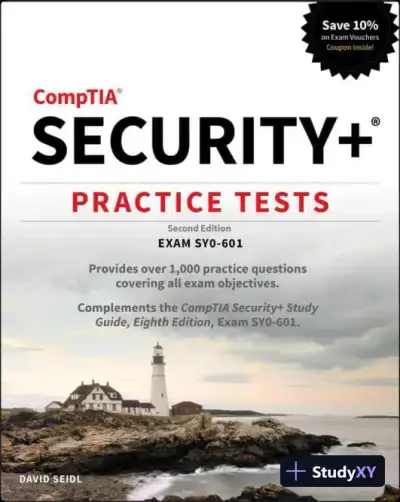 Certification Guides
Comptia Security+ Practice Tests : exam sy0-601, 2nd Edition (2021)
CompTIA Certifications
339 pages144downloadsFeb 2025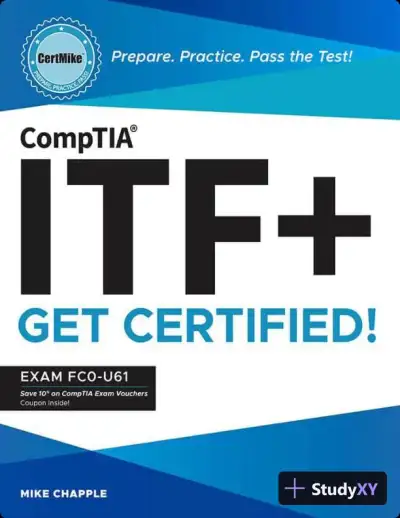 Certification Guides
CompTIA ITF+ CertMike: Exam FC0-U61 (2023)
CompTIA Certifications
464 pages144downloadsFeb 2025 Certification Guides
CompTIA Security+ All-in-One SY0-601 Exam Guide, 6th Edition (2021)
CompTIA Certifications
1093 pages144downloadsFeb 2025 Certification Guides
CompTIA Server+ SK0-005 Certification All-in-One Exam Guide, 2nd Edition (2021)
CompTIA Certifications
628 pages144downloadsFeb 2025 Certification Guides
CompTIA Network+ N10-008 Exam Cram (2021)
CompTIA Certifications
654 pages143downloadsFeb 2025 Certification Guides
CompTIA Security+ Certification Study Guide Exam SY0-601 (2022)
CompTIA Certifications
1024 pages134downloadsFeb 2025
Study this document with CramX
Once it is in your library, every tool can work from it.