

CompTIA CySA+ Cybersecurity Analyst Certification CS0-002 All-in-One Exam Guide (2021)
- CompTIA Certifications
- 821 pages
- Shared February 2025
- 88 downloads
CompTIA CySA+ Cybersecurity Analyst Certification CS0-002 All-in-One Exam Guide (2021) provides everything you need to pass your certification test.
Preview 31 of 821 pages
See the first 31 pages exactly as they appear in the document.
Page 1 Page 2 Read page 2 as text
Downloaded from StudyXY.com [= Ww + StudyXY oi as . Za \ Rr ' BE \ Stu dy Anything This ContentHas been Posted On StudyXY.com as supplementary learning material. StudyXY does not endrose any university, college or publisher. Allmaterials posted are under the liability of the contributors. | 8) www.studyxy.com
Page 3 Page 4 Page 5 Read page 5 as text
ABOUT THE AUTHORS Brent Chapman, GCIH, GCFA, GCTI, CISSP, CySA+, is an information security engineer with more than 15 years of experience in information technology and cybersecurity. He is a former cyber operations officer in the United States Army and has held a number of unique assignments, including researcher at the Army Cyber Institute, instructor in the Department of Electrical Engineering and Computer Science at the US Military Academy at West Point, and project manager at the Defense Innovation Unit in Silicon Valley. He is a professional member of the Association of Computing Machinery, FCC Amateur Radio license holder, and contributor to several technical and maker-themed publications. Fernando J. Maymi, PhD, CISSP, is a consultant, educator, and author with more than 25 years of experience in information security. He currently leads teams of cybersecurity consultants, analysts, and red teamers in providing services around the world. Fernando was the founding deputy director of the Army Cyber Institute, a government think tank he helped create for the Secretary of the Army to solve future cyberspace operations problems affecting the whole country. He has served as advisor to congressional leaders, corporate executives, and foreign governments on cyberspace issues. Fernando taught computer science and cybersecurity at the US Military Academy at West Point for 12 years. Fernando has written extensively and is the co-author of the eighth edition of the bestselling CISSP All-in-One Exam Guide. About the Technical Editor and Contributor Bobby E. Rogers is a cybersecurity professional with over 30 years in the information technology and cybersecurity fields. He currently works for a major engineering company in Huntsville, Alabama, as a contractor for
Page 6 Read page 6 as text
Department of Defense agencies, helping to secure, certify, and accredit their information systems. Bobby’s specialties are cybersecurity engineering, security compliance, and cyber risk management, but he has worked in almost every area of cybersecurity, including network defense, computer forensics, incident response, and penetration testing. He is a retired Master Sergeant from the US Air Force, having served for over 21 years. Bobby has built and secured networks in the United States, Chad, Uganda, South Africa, Germany, Saudi Arabia, Pakistan, Afghanistan, and several other countries all over the world. He holds a Master of Science degree in Information Assurance and is currently writing his dissertation for a doctoral degree in cybersecurity. His many certifications include CISSP-ISSEP, CRISC, and CySA+. He has narrated and produced over 30 computer security training videos for several training companies, and is also the author of CompTIA Mobility+ Certification All-In-One Exam Guide (Exam MB0-001), CRISC Certified in Risk and Information Systems Control All-In-One Exam Guide, Mike Meyers’ CompTIA Security+ Certification Guide (Exam SY0-401), and contributing author/technical editor for the popular CISSP All-In-One Exam Guide, Eighth Edition, all from McGraw Hill.
Page 7 Page 8 Page 9 Read page 9 as text
Copyright © 2021 by McGraw Hill. All rights reserved. Except as permitted under the United States Copyright Act of 1976, no part of this publication may be reproduced or distributed in any form or by any means, or stored in a database or retrieval system, without the prior written permission of the publisher. ISBN: 978-1-26-046431-3 MHID: ~~ 1-26-046431-8 The material in this eBook also appears in the print version of this title: ISBN: 978-1-26-046430-6, MHID: 1-26-046430-X. eBook conversion by codeMantra Version 1.0 All trademarks are trademarks of their respective owners. Rather than put a trademark symbol after every occurrence of a trademarked name, we use names in an editorial fashion only, and to the benefit of the trademark owner, with no intention of infringement of the trademark. Where such designations appear in this book, they have been printed with initial caps. McGraw-Hill Education eBooks are available at special quantity discounts to use as premiums and sales promotions or for use in corporate training programs. To contact a representative, please visit the Contact Us page at www.mhprofessional.com. Information has been obtained by McGraw Hill from sources believed to be reliable. However, because of the possibility of human or mechanical error by our sources, McGraw Hill, or others, McGraw Hill does not guarantee the accuracy, adequacy, or completeness of any information and is not responsible for any errors or omissions or the results obtained from the use of such information. TERMS OF USE This is a copyrighted work and McGraw-Hill Education and its licensors reserve all rights in and to the work. Use of this work is subject to these
Page 10 Read page 10 as text
terms. Except as permitted under the Copyright Act of 1976 and the right to store and retrieve one copy of the work, you may not decompile, disassemble, reverse engineer, reproduce, modify, create derivative works based upon, transmit, distribute, disseminate, sell, publish or sublicense the work or any part of it without McGraw-Hill Education’s prior consent. You may use the work for your own noncommercial and personal use; any other use of the work is strictly prohibited. Your right to use the work may be terminated if you fail to comply with these terms. THE WORK IS PROVIDED “AS IS.” McGRAW-HILL EDUCATION AND ITS LICENSORS MAKE NO GUARANTEES OR WARRANTIES AS TO THE ACCURACY, ADEQUACY OR COMPLETENESS OF OR RESULTS TO BE OBTAINED FROM USING THE WORK, INCLUDING ANY INFORMATION THAT CAN BE ACCESSED THROUGH THE WORK VIA HYPERLINK OR OTHERWISE, AND EXPRESSLY DISCLAIM ANY WARRANTY, EXPRESS OR IMPLIED, INCLUDING BUT NOT LIMITED TO IMPLIED WARRANTIES OF MERCHANTABILITY OR FITNESS FOR A PARTICULAR PURPOSE. McGraw-Hill Education and its licensors do not warrant or guarantee that the functions contained in the work will meet your requirements or that its operation will be uninterrupted or error free. Neither McGraw-Hill Education nor its licensors shall be liable to you or anyone else for any inaccuracy, error or omission, regardless of cause, in the work or for any damages resulting therefrom. McGraw-Hill Education has no responsibility for the content of any information accessed through the work. Under no circumstances shall McGraw-Hill Education and/or its licensors be liable for any indirect, incidental, special, punitive, consequential or similar damages that result from the use of or inability to use the work, even if any of them has been advised of the possibility of such damages. This limitation of liability shall apply to any claim or cause whatsoever whether such claim or cause arises in contract, tort or otherwise.
Page 11 Read page 11 as text
To Gina and Carol, for being patient, supportive, and loving, and for reminding us of what really matters in life.
Page 12 Read page 12 as text
CONTENTS AT A GLANCE PartI Threat and Vulnerability Management Chapter 1 The Importance of Threat Data and Intelligence Chapter 2 Threat Intelligence in Support of Organizational Security Chapter 3 Vulnerability Management Activities Chapter 4 Vulnerability Assessment Tools Chapter 5 Threats and Vulnerabilities Associated with Specialized Technology Chapter 6 Threats and Vulnerabilities Associated with Operating in the Cloud Chapter 7 Mitigating Controls for Attacks and Software Vulnerabilities Part II Software and Systems Security Chapter 8 Security Solutions for Infrastructure Management Chapter 9 Software Assurance Best Practices Chapter 10 Hardware Assurance Best Practices Part III Security Operations and Monitoring Chapter 11 Data Analysis in Security Monitoring Activities Chapter 12 Implement Configuration Changes to Existing Controls to Improve Security Chapter 13 The Importance of Proactive Threat Hunting Chapter 14 Automation Concepts and Technologies
Page 13 Read page 13 as text
Part IV Incident Response Chapter 15 The Importance of the Incident Response Process Chapter 16 Appropriate Incident Response Procedures Chapter 17 Analyze Potential Indicators of Compromise Chapter 18 Utilize Basic Digital Forensics Techniques Part V Compliance and Assessment Chapter 19 The Importance of Data Privacy and Protection Chapter 20 Security Concepts in Support of Organizational Risk Mitigation Chapter 21 The Importance of Frameworks, Policies, Procedures, and Controls Part VI Appendixes and Glossary Appendix A Objective Map Appendix B About the Online Content Glossary Index
Page 14 Read page 14 as text
CONTENTS Acknowledgments Introduction PartI Threat and Vulnerability Management Chapter 1 The Importance of Threat Data and Intelligence Foundations of Intelligence Intelligence Sources Open Source Intelligence Proprietary/Closed Source Intelligence Characteristics of Intelligence Source Data Confidence Levels Indicator Management Indicator Lifecycle Structured Threat Information Expression Trusted Automated Exchange of Indicator Information OpenlOC Threat Classification Known Threats vs. Unknown Threats Zero Day Advanced Persistent Threat Threat Actors Nation-State Threat Actors Hacktivists Organized Crime Insider Threat Actors Intelligence Cycle
Page 15 Read page 15 as text
Requirements Collection Analysis Dissemination Feedback Commodity Malware Information Sharing and Analysis Communities Chapter Review Questions Answers Chapter 2 Threat Intelligence in Support of Organizational Security Levels of Intelligence Attack Frameworks MITRE ATT&CK The Diamond Model of Intrusion Analysis Kill Chain Threat Research Reputational Behavioral Indicator of Compromise Common Vulnerability Scoring System Threat Modeling Methodologies Adversary Capability Total Attack Surface Attack Vector Impact Likelihood STRIDE PASTA Threat Intelligence Sharing with Supported Functions Incident Response Vulnerability Management Risk Management Security Engineering
Page 16 Read page 16 as text
Detection and Monitoring Chapter Review Questions Answers Chapter 3 Vulnerability Management Activities Vulnerability Identification Regulatory Environments Corporate Security Policy Data Classification Asset Inventory Active vs. Passive Scanning Scanning Parameters and Criteria Risks Associated with Scanning Activities Regulatory Requirements Technical Constraints Workflow Sensitivity Levels Vulnerability Feed Scope Noncredentialed vs. Credentialed Server Based vs. Agent Based Internal vs. External Types of Data Tool Updates and Plug-Ins SCAP Special Considerations Intrusion Prevention System, Intrusion Detection System, and Firewall Settings Generating Reports Automated vs. Manual Distribution Validation True Positives False Positives True Negatives
Page 17 Read page 17 as text
False Negatives Remediation Patching Prioritizing Hardening Compensating Controls Risk Acceptance Verification of Mitigation Inhibitors to Remediation Memorandum of Understanding Service Level Agreement Organizational Governance Business Process Interruption Degrading Functionality Legacy and Proprietary Systems Ongoing Scanning and Continuous Monitoring Chapter Review Questions Answers Chapter 4 Vulnerability Assessment Tools Web Application Scanners OWASP Zed Attack Proxy Burp Suite Nikto Arachni Infrastructure Vulnerability Scanners Nessus OpenVAS Qualys Software Assessment Tools and Techniques Static Analysis Dynamic Analysis Reverse Engineering Fuzzing
Page 18 Read page 18 as text
Enumeration Tools and Techniques nmap hping Passive vs. Active Enumeration Techniques responder Wireless Assessment Tools Aircrack-ng Reaver oclHashcat Cloud Infrastructure Assessment Tools Scout Suite Prowler Pacu Chapter Review Questions Answers Chapter 5 Threats and Vulnerabilities Associated with Specialized Technology Access Points Virtual Private Networks Mobile Devices Network Vulnerabilities Device Vulnerabilities Operating System Vulnerabilities App Vulnerabilities Internet of Things The Mirai Botnet Embedded Systems Real-Time Operating Systems System on a Chip Field Programmable Gate Array Physical Access Control Connected Vehicles CAN Bus
Page 19 Read page 19 as text
Drones Hardware Security Communications Channels Security Web Portal Security Industrial Control Systems SCADA Devices Modbus Process Automation Systems Chapter Review Questions Answers Chapter 6 Threats and Vulnerabilities Associated with Operating in the Cloud Cloud Service Models Shared Responsibility Model Software as a Service Platform as a Service Infrastructure as a Service Cloud Deployment Models Public Private Community Hybrid Serverless Architecture Function as a Service Infrastructure as Code Insecure Application Programming Interface Broken Object Level Authorization Broken User Authentication Excessive Data Exposure Lack of Resources and Rate Limiting Broken Function Level Authorization Mass Assignment Security Misconfiguration
Page 20 Read page 20 as text
Injection Improper Asset Management Insufficient Logging and Monitoring Improper Key Management Unprotected Storage Logging and Monitoring Chapter Review Questions Answers Chapter 7 Mitigating Controls for Attacks and Software Vulnerabilities Attack Types Injection Attacks Buffer Overflow Attacks Privilege Escalation Authentication Attacks Rootkits Vulnerabilities Improper Error Handling Dereferencing Insecure Object Reference Race Condition Sensitive Data Exposure Insecure Components Insufficient Logging and Monitoring Weak or Default Configurations Use of Insecure Functions Chapter Review Questions Answers Part II Software and Systems Security Chapter 8 Security Solutions for Infrastructure Management Cloud vs. On-Premises Solutions Network Architecture
Page 21 Read page 21 as text
Physical Network Software-Defined Network Virtual Private Cloud Network Virtual Private Network Serverless Network Virtualization Hypervisors Virtual Desktop Infrastructure Containerization Network Segmentation Virtual Local Area Networks Physical Segmentation Jump Boxes System Isolation Honeypots and Honeynets Asset Management Asset Inventory Asset Tagging Change Management Identity and Access Management Privilege Management Multifactor Authentication Single Sign-On Identity Federation Role-Based Access Control Attribute-Based Access Control Mandatory Access Control Manual Review Cloud Access Security Broker Monitoring and Logging Encryption Symmetric Cryptography Asymmetric Cryptography Symmetric vs. Asymmetric Cryptography
Page 22 Read page 22 as text
Certificate Management Active Defense Chapter Review Questions Answers Chapter 9 Software Assurance Best Practices Platforms and Software Architectures Client/Server Web Application Mobile Embedded System on a Chip Firmware Service-Oriented Architecture Simple Object Access Protocol Representational State Transfer Microservices Security Assertions Markup Language The Software Development Lifecycle Requirements Development Implementation Operation and Maintenance DevOps and DevSecOps Software Assessment Methods User Acceptance Testing Stress Testing Security Regression Testing Code Reviews Static Analysis Tools Dynamic Analysis Tools Formal Methods of Verifying Critical Software Secure Coding Best Practices Input Validation
Page 23 Read page 23 as text
Output Encoding Session Management Authentication Data Protection Parameterized Queries Chapter Review Questions Answers Chapter 10 Hardware Assurance Best Practices Hardware Root of Trust Trusted Platform Module Hardware Security Module eFuse Firmware Unified Extensible Firmware Interface Measured Boot and Attestation Trusted Firmware Updates Self-Encrypting Drive Bus Encryption Secure Processing Trusted Execution Environment Processor Security Extensions Atomic Execution Trusted Foundry Anti-Tamper Techniques Chapter Review Questions Answers Part III Security Operations and Monitoring Chapter 11 Data Analysis in Security Monitoring Activities Security Data Analytics Data Aggregation and Correlation Data Analysis
Page 24 Read page 24 as text
Trend Analysis Historical Analysis Behavioral Analysis Heuristics Anomaly Analysis Endpoint Security Malware Detect and Block Fileless Malware Sandbox Cloud-Connected Protection User and Entity Behavior Analytics Network Domain Name System Analysis Domain Generation Algorithms Flow Analysis Packet Analysis Malware Log Review Packet Captures System Logs Firewall Logs Intrusion Detection/Prevention Systems Authentication Logs Impact Analysis Availability Analysis Security Information and Event Management Review Query Writing E-mail Analysis Malicious Payload DomainKeys Identified Mail Sender Policy Framework Domain-Based Message Authentication, Reporting, and Conformance
Page 25 Read page 25 as text
Header Phishing Forwarding Digital Signatures and Encryption Embedded Links Impersonation Chapter Review Questions Answers Chapter 12 Implement Configuration Changes to Existing Controls to Improve Security Permissions Users Groups Blacklisting Whitelisting Firewalls Web Proxies Web Application Firewalls Operating System Firewalls Intrusion Prevention System Rules Snort Rule Building Zeek Logs Suricata Rule-Building Host-Based Intrusion Prevention Systems Data Loss Prevention Endpoint Detection and Response Network Access Control Time-Based Solution Rule-Based Solution Role-Based Solution Location-Based Solution Sinkholing Malware Signatures
Page 26 Read page 26 as text
Sandboxing Port Security Chapter Review Questions Answers Chapter 13 The Importance of Proactive Threat Hunting Establishing a Hypothesis Profiling Threat Actors and Activities Threat-Hunting Tactics High-Impact TTPs Delivering Results Documenting the Process Reducing the Attack Surface Area and Bundling Critical Assets Attack Vectors Integrated Intelligence Improving Detection Capabilities Chapter Review Questions Answers Chapter 14 Automation Concepts and Technologies Workflow Orchestration Security Orchestration, Automation, and Response Platforms Orchestration Playbooks Data Enrichment Scripting Python Scripting PowerShell Scripting Application Programming Interface Integration Representational State Transfer Automating API Calls Automated Malware Signature Creation Threat Feed Combination
Page 27 Read page 27 as text
Machine Learning Use of Automation Protocols and Standards Security Content Automation Protocol Software Engineering Continuous Integration Continuous Delivery Continuous Deployment Chapter Review Questions Answers Part IV Incident Response Chapter 15 The Importance of the Incident Response Process Establishing a Communication Process Internal Communications External Communications Response Coordination with Relevant Entities Factors Contributing to Data Criticality Personally Identifiable Information Personal Health Information High-Value Assets Payment Card Information Intellectual Property Corporate Confidential Information Chapter Review Questions Answers Chapter 16 Appropriate Incident Response Procedures Preparation Training Testing Documentation Detection and Analysis Characteristics of Severity Level Classification
Page 28 Read page 28 as text
Reverse Engineering Containment Segmentation Isolation Removal Eradication and Recovery Vulnerability Mitigation Sanitization Reconstruction Secure Disposal Patching Restoration of Permissions Restoration of Services and Verification of Logging Post-Incident Activities Lessons-Learned Report Change Control Process Updates to Response Plan Summary Report Indicator of Compromise Generation Monitoring Chapter Review Questions Answers Chapter 17 Analyze Potential Indicators of Compromise Network-Related Indicators Bandwidth Utilization Beaconing Irregular Peer-to-Peer Communication Rogue Devices on the Network Scan Sweeps Common Protocol over a Nonstandard Port Host-Related Indicators Capacity Consumption Unauthorized Software
Page 29 Read page 29 as text
Malicious Processes Memory Contents Unauthorized Changes Unauthorized Privileges Data Exfiltration Registry Change or Anomaly Unauthorized Scheduled Task Application-Related Indicators Anomalous Activity Introduction of New Accounts Unexpected Output Unexpected Outbound Communication Service Interruption Memory Overflows Application Logs Chapter Review Questions Answers Chapter 18 Utilize Basic Digital Forensics Techniques Phases of an Investigation Seizure Data Acquisition Analysis Reporting Network Network Tap Hub Switches Wireshark/TShark tcpdump Endpoints Servers OS and Process Analysis Mobile Device Forensics
Page 30 Read page 30 as text
Virtualization and the Cloud Procedures Building Your Forensic Kit Cryptography Tools Acquisition Utilities Forensic Duplicators Password Crackers Hashing Utilities Forensic Suites File Carving Chapter Review Questions Answers Part V Compliance and Assessment Chapter 19 The Importance of Data Privacy and Protection Privacy vs. Security Types of Data Legal Requirements for Data Nontechnical Controls Data Ownership Data Classification Data Confidentiality Data Sovereignty Data Minimization Data Purpose Limitation Data Retention Technical Controls Access Controls Encryption Sharing Data While Preserving Privacy Digital Rights Management Data Loss Prevention Chapter Review
Page 31 Read page 31 as text
Questions Answers Chapter 20 Security Concepts in Support of Organizational Risk Mitigation Business Impact Analysis Risk Assessment Risk Identification Process Risk Calculation Communication of Risk Factors Risk Prioritization Security Controls Engineering Tradeoffs Documented Compensating Controls Systems Assessment Supply Chain Risk Assessment Vendor Due Diligence Hardware Source Authenticity Training and Exercises Types of Exercises Red Team Blue Team White Team Chapter Review Questions Answers Chapter 21 The Importance of Frameworks, Policies, Procedures, and Controls Security Frameworks NIST ISO/IEC 27000 Series Center for Internet Security Controls Policies and Procedures Ethics and Codes of Conduct Acceptable Use Policy Password Policy
790 more pages in the full document
Unlock it once and it stays in your library, ready to chat with or turn into flashcards.
Unlock the full documentMore CompTIA Certifications study materials
See all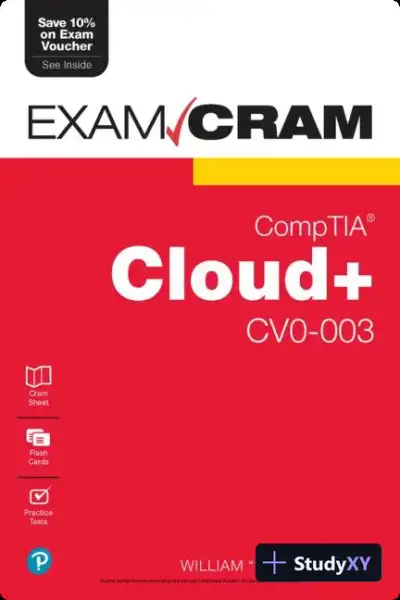 Certification Guides
CompTIA Cloud+ CV0-003 Exam Cram (2021)
CompTIA Certifications
434 pages156downloadsFeb 2025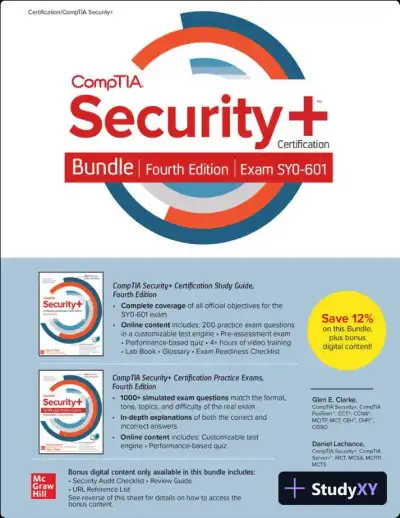 Certification Guides
CompTIA Security+ SY0-601 Exam Certification Bundle, 4th Edition (2021)
CompTIA Certifications
1897 pages152downloadsFeb 2025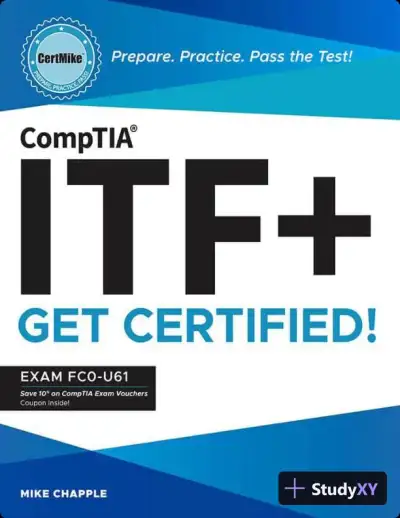 Certification Guides
CompTIA ITF+ CertMike: Exam FC0-U61 (2023)
CompTIA Certifications
464 pages144downloadsFeb 2025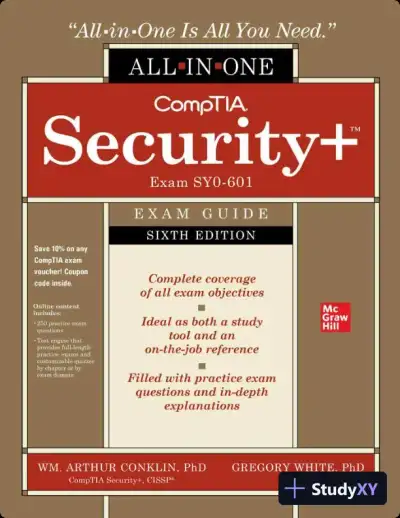 Certification Guides
CompTIA Security+ All-in-One SY0-601 Exam Guide, 6th Edition (2021)
CompTIA Certifications
1093 pages144downloadsFeb 2025 Certification Guides
Comptia Security+ Practice Tests : exam sy0-601, 2nd Edition (2021)
CompTIA Certifications
339 pages144downloadsFeb 2025 Certification Guides
CompTIA Server+ SK0-005 Certification All-in-One Exam Guide, 2nd Edition (2021)
CompTIA Certifications
628 pages144downloadsFeb 2025 Certification Guides
CompTIA Network+ N10-008 Exam Cram (2021)
CompTIA Certifications
654 pages143downloadsFeb 2025 Certification Guides
CompTIA Security+ Certification Study Guide Exam SY0-601 (2022)
CompTIA Certifications
1024 pages134downloadsFeb 2025
Study this document with CramX
Once it is in your library, every tool can work from it.