

CompTIA Security+ All-in-One SY0-601 Exam Guide, 6th Edition (2021)
- CompTIA Certifications
- 1093 pages
- Shared February 2025
- 144 downloads
CompTIA Security+ All-in-One SY0-601 Exam Guide, 6th Edition (2021) simplifies exam prep with well-structured content and practice questions.
Preview 31 of 1093 pages
See the first 31 pages exactly as they appear in the document.
Page 1 Page 2 Read page 2 as text
Downloaded from StudyXY.com [= Ww + StudyXY oi as . Za \ Rr ' BE \ Stu dy Anything This ContentHas been Posted On StudyXY.com as supplementary learning material. StudyXY does not endrose any university, college or publisher. Allmaterials posted are under the liability of the contributors. | 8) www.studyxy.com
Page 3 Page 4 Page 5 Page 6 Page 7 Read page 7 as text
Copyright © 2021 by McGraw Hill. All rights reserved. Except as permitted under the United States Copyright Act of 1976, no part of this publication may be reproduced or distributed in any form or by any means, or stored in a database or retrieval system, without the prior written permission of the publisher, with the exception that the program listings may be entered, stored, and executed in a computer system, but they may not be reproduced for publication. ISBN: 978-1-26-046401-6 MHID: ~~ 1-26-046401-6 The material in this eBook also appears in the print version of this title: ISBN: 978-1-26-046400-9, MHID: 1-26-046400-8. eBook conversion by codeMantra Version 1.0 All trademarks are trademarks of their respective owners. Rather than put a trademark symbol after every occurrence of a trademarked name, we use names in an editorial fashion only, and to the benefit of the trademark owner, with no intention of infringement of the trademark. Where such designations appear in this book, they have been printed with initial caps. McGraw-Hill Education eBooks are available at special quantity discounts to use as premiums and sales promotions or for use in corporate training programs. To contact a representative, please visit the Contact Us page at www.mhprofessional.com. Information has been obtained by McGraw Hill from sources believed to be reliable. However, because of the possibility of human or mechanical error by our sources, McGraw Hill, or others, McGraw Hill does not guarantee the accuracy, adequacy, or completeness of any information and is not responsible for any errors or omissions or the results obtained from the use of such information. TERMS OF USE
Page 8 Read page 8 as text
This is a copyrighted work and McGraw-Hill Education and its licensors reserve all rights in and to the work. Use of this work is subject to these terms. Except as permitted under the Copyright Act of 1976 and the right to store and retrieve one copy of the work, you may not decompile, disassemble, reverse engineer, reproduce, modify, create derivative works based upon, transmit, distribute, disseminate, sell, publish or sublicense the work or any part of it without McGraw-Hill Education’s prior consent. You may use the work for your own noncommercial and personal use; any other use of the work is strictly prohibited. Your right to use the work may be terminated if you fail to comply with these terms. THE WORK IS PROVIDED “AS IS.” McGRAW-HILL EDUCATION AND ITS LICENSORS MAKE NO GUARANTEES OR WARRANTIES AS TO THE ACCURACY, ADEQUACY OR COMPLETENESS OF OR RESULTS TO BE OBTAINED FROM USING THE WORK, INCLUDING ANY INFORMATION THAT CAN BE ACCESSED THROUGH THE WORK VIA HYPERLINK OR OTHERWISE, AND EXPRESSLY DISCLAIM ANY WARRANTY, EXPRESS OR IMPLIED, INCLUDING BUT NOT LIMITED TO IMPLIED WARRANTIES OF MERCHANTABILITY OR FITNESS FOR A PARTICULAR PURPOSE. McGraw-Hill Education and its licensors do not warrant or guarantee that the functions contained in the work will meet your requirements or that its operation will be uninterrupted or error free. Neither McGraw-Hill Education nor its licensors shall be liable to you or anyone else for any inaccuracy, error or omission, regardless of cause, in the work or for any damages resulting therefrom. McGraw-Hill Education has no responsibility for the content of any information accessed through the work. Under no circumstances shall McGraw-Hill Education and/or its licensors be liable for any indirect, incidental, special, punitive, consequential or similar damages that result from the use of or inability to use the work, even if any of them has been advised of the possibility of such damages. This limitation of liability shall apply to any claim or cause whatsoever whether such claim or cause arises in contract, tort or otherwise.
Page 9 Read page 9 as text
This book is dedicated to the many information security professionals who quietly work to ensure the safety of our nation’s critical infrastructures. We want to recognize the thousands of dedicated individuals who strive to protect our national assets but who seldom receive praise and often are only noticed when an incident occurs. To you, we say thank you for a job well done!
Page 10 Read page 10 as text
ABOUT THE AUTHORS Dr. Wm. Arthur Conklin, CompTIA Security+, CISSP, GICSP, GRID, GCIP, GCFA, GCIA, GCDA, CSSLP, CRISC, is a professor and director at the Center for Information Security Research and Education in the College of Technology at the University of Houston. He holds two terminal degrees—a PhD in business administration (specializing in information security) from the University of Texas at San Antonio (UTSA) and an electrical engineer degree (specializing in space systems engineering) from the Naval Postgraduate School in Monterey, California. He is a fellow of ISSA and (CS)2AI as well as a senior member of ASQ, IEEE, and ACM. His research interests include the use of systems theory to explore information security, specifically in cyber-physical systems. He has a strong interest in cybersecurity education and is involved with the NSA/DHS Centers of Academic Excellence in Cyber Defense (CAE CD) and the NIST National Initiative for Cybersecurity Education (NICE) Cybersecurity Workforce Framework (NICE Framework). He has coauthored six security books and numerous academic articles associated with information security. He is co- chair of the steering committee for the DHS-sponsored Industrial Control Systems Joint Working Group (ICSJWG) efforts associated with workforce development and cybersecurity aspects of industrial control systems. He has an extensive background in secure coding and has been co-chair of the DHS/DoD Software Assurance Forum Working Group for workforce education, training, and development. Dr. Gregory White has been involved in computer and network security since 1986. He spent 19 years on active duty with the United States Air Force and 11 years in the Air Force Reserves in a variety of computer and security positions. He obtained his PhD in computer science from Texas A&M University in 1995. His dissertation topic was in the area of computer network intrusion detection, and he continues to conduct research in this area today. He is currently the director for the Center for Infrastructure Assurance
Page 11 Read page 11 as text
and Security (CIAS) and is a professor of computer science at the University of Texas at San Antonio (UTSA). Dr. White has written and presented numerous articles and conference papers on security. He is also the coauthor of six textbooks on computer and network security and has written chapters for two other security books. Dr. White continues to be active in security research. His current research initiatives include efforts in community incident response, intrusion detection, and secure information sharing. Chuck Cothren, CISSP, is Manager of Development Operations at Ionic Security, applying over 20 years of information security experience in consulting, research, and enterprise environments. He has assisted clients in a variety of industries, including healthcare, banking, information technology, retail, and manufacturing. He advises clients on topics such as security architecture, penetration testing, training, consultant management, data loss prevention, and encryption. He is coauthor of the books Voice and Data Security and Principles of Computer Security. Roger L. Davis, CISSP, CISM, CISA, is a Senior Customer Success Account Manager for Microsoft supporting enterprise-level companies. He has served as president of the Utah chapter of the Information Systems Security Association (ISSA) and various board positions for the Utah chapter of the Information Systems Audit and Control Association (ISACA). He is a retired Air Force lieutenant colonel with 40 years of military and information systems/security experience. Mr. Davis served on the faculty of Brigham Young University and the Air Force Institute of Technology. He coauthored McGraw-Hill’s Principles of Computer Security and Voice and Data Security. He holds a master’s degree in computer science from George Washington University, a bachelor’s degree in computer science from Brigham Young University, and performed post-graduate studies in electrical engineering and computer science at the University of Colorado. Dwayne Williams, CISSP, CASP, is Associate Director, Technology and Research, for the Center for Infrastructure Assurance and Security (CIAS) at the University of Texas at San Antonio and is Director of the National Collegiate Cyber Defense Competition. Mr. Williams has over 24 years of experience in information systems and network security. His experience includes six years of commissioned military service as a Communications- Computer Information Systems Officer in the United States Air Force, specializing in network security, corporate information protection, intrusion detection systems, incident response, and VPN technology. Prior to joining
Page 12 Read page 12 as text
the CIAS, he served as Director of Consulting for SecureLogix Corporation, where he directed and provided security assessment and integration services to Fortune 100, government, public utility, oil and gas, financial, and technology clients. Mr. Williams graduated in 1993 from Baylor University with a Bachelor of Arts in computer science. Mr. Williams is a coauthor of Voice and Data Security and Principles of Computer Security. About the Technical Editor Chris Crayton, MCSE, is an author, technical consultant, and trainer. He has worked as a computer technology and networking instructor, information security director, network administrator, network engineer, and PC specialist. Chris has authored several print and online books on PC repair, CompTIA A+, CompTIA Security+, and Microsoft Windows. He has also served as technical editor and content contributor on numerous technical titles for several of the leading publishing companies. He holds numerous industry certifications, has been recognized with many professional teaching awards, and has served as a state-level SkillsUSA competition judge.
Page 13 Read page 13 as text
CONTENTS AT A GLANCE Part I Threats, Attacks, and Vulnerabilities Chapter 1 Social Engineering Techniques Chapter 2 Type of Attack Indicators Chapter 3__ Application Attack Indicators Chapter 4 Network Attack Indicators Chapter 5 Threat Actors, Vectors, and Intelligence Sources Chapter 6 Vulnerabilities Chapter 7 Security Assessments Chapter 8 Penetration Testing Part IT Architecture and Design Chapter 9 Enterprise Security Architecture Chapter 10_ Virtualization and Cloud Security Chapter 11 Secure Application Development, Deployment, and Automation Concepts Chapter 12 Authentication and Authorization Chapter 13_ Cybersecurity Resilience Chapter 14 Embedded and Specialized Systems Chapter 15_ Physical Security Controls Chapter 16 Cryptographic Concepts Part ITI Implementation
Page 14 Read page 14 as text
Chapter 17_ Secure Protocols Chapter 18 Host and Application Security Chapter 19 Secure Network Design Chapter 20 Wireless Security Chapter 21 Secure Mobile Solutions Chapter 22 Implementing Cloud Security Chapter 23_ Identity and Account Management Controls Chapter 24 Implement Authentication and Authorization Chapter 25_ Public Key Infrastructure Part IV_ Operations and Incident Response Chapter 26_ Tools/Assess Organizational Security Chapter 27 Incident Response Policies, Processes, and Procedures Chapter 28_ Investigations Chapter 29 Mitigation Techniques and Controls Chapter 30_ Digital Forensics Part V_ Governance, Risk, and Compliance Chapter 31_ Security Controls Chapter 32_ Regulations, Standards, and Frameworks Chapter 33_ Organizational Policies Chapter 34 Risk Management Chapter 35_ Privacy Part VI Appendixes and Glossary Appendix A OSI Model and Internet Protocols Appendix B_ About the Online Content
Page 15 Read page 15 as text
Glossary Index
Page 16 Read page 16 as text
CONTENTS Preface Acknowledgments Introduction Objective Map: Exam SY0-601 PartI Threats, Attacks, and Vulnerabilities Chapter 1 Social Engineering Techniques Social Engineering Methods Tools Phishing Smishing Vishing Spam Spam over Instant Messaging (SPIM) Spear Phishing Dumpster Diving Shoulder Surfing Pharming Tailgating Eliciting Information Whaling Prepending Identity Fraud Invoice Scams Credential Harvesting Reconnaissance Hoax
Page 17 Read page 17 as text
Impersonation Third-Party Authorization Contractors/Outside Parties Online Attacks Defenses Watering Hole Attack Typosquatting Pretexting Influence Campaigns Principles (Reasons for Effectiveness) Authority Intimidation Consensus Scarcity Familiarity Trust Urgency Defenses Chapter Review Questions Answers Chapter 2 Type of Attack Indicators Malware Ransomware Trojans Worms Potentially Unwanted Programs Fileless Viruses Command and Control Bots Crypto-malware Logic Bombs Spyware Keyloggers Remote-Access Trojans (RATS)
Page 18 Read page 18 as text
Rootkit Backdoors Password Attacks Spraying Dictionary Brute Force Rainbow Tables Plaintext/Unencrypted Physical Attacks Malicious Universal Serial Bus (USB) Cable Malicious Flash Drives Card Cloning Skimming Adversarial Artificial Intelligence (AI) Tainted Training Data for Machine Learning (ML) Security of Machine Learning Algorithms Supply-Chain Attacks Cloud-Based vs. On-Premises Attacks Cryptographic Attacks Birthday Collision Downgrade Chapter Review Questions Answers Chapter 3__ Application Attack Indicators Privilege Escalation Cross-Site Scripting Injection Attacks Structured Query Language (SQL) Dynamic-Link Library (DLL) Lightweight Directory Access Protocol (LDAP) Extensible Markup Language (XML) Pointer/Object Dereference Directory Traversal
Page 19 Read page 19 as text
Buffer Overflow Race Condition Time of Check/Time of Use Improper Error Handling Improper Input Handling Replay Attacks Session Replay Integer Overflow Request Forgery Server-Side Request Forgery Cross-Site Request Forgery Application Programming Interface (API) Attacks Resource Exhaustion Memory Leak Secure Sockets Layer (SSL) Stripping Driver Manipulation Shimming Refactoring Pass the Hash Chapter Review Questions Answers Chapter 4 Network Attack Indicators Wireless Evil Twin Rogue Access Point Bluesnarfing Bluejacking Disassociation Jamming Radio Frequency Identification (RFID) Near Field Communication (NFC) Initialization Vector (IV) On-path Attack Layer 2 Attacks
Page 20 Read page 20 as text
Address Resolution Protocol (ARP) Poisoning Media Access Control (MAC) Flooding MAC Cloning Domain Name System (DNS) Domain Hijacking DNS Poisoning Universal Resource Locator (URL) Redirection Domain Reputation Distributed Denial-of-Service (DDoS) Network Application Operational Technology (OT) Malicious Code and Script Execution PowerShell Python Bash Macros Visual Basic for Applications (VBA) Chapter Review Questions Answers Chapter 5__ Threat Actors, Vectors, and Intelligence Sources Actors and Threats Advanced Persistent Threats (APTs) Insider Threats State Actors Hacktivists Script Kiddies Criminal Syndicates Hackers Shadow IT Competitors Attributes of Actors Internal/External Level of Sophistication/Capability
Page 21 Read page 21 as text
Resources/Funding Intent/Motivation Vectors Direct Access Wireless E-mail Supply Chain Social Media Removable Media Cloud Threat Intelligence Sources Open Source Intelligence (OSINT) Closed/Proprietary Vulnerability Databases Public/Private Information Sharing Centers Dark Web Indicators of Compromise Automated Indicator Sharing (AIS) Structured Threat Information Expression (STIX) / Trusted Automated Exchange of Intelligence Information (TAXI) Predictive Analysis Threat Maps File/Code Repositories Research Sources Vendor Websites Vulnerability Feeds Conferences Academic Journals Requests for Comment (RFCs) Local Industry Groups Social Media Threat Feeds Adversary Tactics, Techniques, and Procedures (TTPs) Chapter Review
Page 22 Read page 22 as text
Questions Answers Chapter 6__ Vulnerabilities Cloud-based vs. On-premises Vulnerabilities Zero Day Weak Configurations Open Permissions Unsecure Root Accounts Errors Weak Encryption Unsecure Protocols Default Settings Open Ports and Services Third-Party Risks Vendor Management Supply Chain Outsourced Code Development Data Storage Improper or Weak Patch Management Firmware Operating System (OS) Applications Legacy Platforms Impacts Data Loss Data Breaches Data Exfiltration Identity Theft Financial Reputation Availability Loss Chapter Review Questions Answers
Page 23 Read page 23 as text
Chapter 7 Security Assessments Threat Hunting Intelligence Fusion Threat Feeds Advisories and Bulletins Maneuver Vulnerability Scans False Positives False Negatives Log Reviews Credentialed vs. Non-Credentialed Intrusive vs. Non-Intrusive Application Web Application Network Common Vulnerabilities and Exposures (CVE)/Common Vulnerability Scoring System (CVSS) Configuration Review Syslog/Security Information and Event Management (SIEM) Review Reports Packet Capture Data Inputs User Behavior Analysis Sentiment Analysis Security Monitoring Log Aggregation Log Collectors Security Orchestration, Automation, and Response (SOAR) Chapter Review Questions Answers Chapter 8 Penetration Testing Penetration Testing Known Environment Unknown Environment
Page 24 Read page 24 as text
Partially Known Environment Rules of Engagement Lateral Movement Privilege Escalation Persistence Cleanup Bug Bounty Pivoting Passive and Active Reconnaissance Drones War Flying War Driving Footprinting OSINT Exercise Types Red Team Blue Team White Team Purple Team Chapter Review Questions Answers Part IT Architecture and Design Chapter 9 Enterprise Security Architecture Configuration Management Diagrams Baseline Configuration Standard Naming Conventions Internet Protocol (IP) Schema Data Sovereignty Data Protection Data Loss Prevention (DLP) Masking Encryption
Page 25 Read page 25 as text
At Rest In Transit/Motion In Processing Tokenization Rights Management Geographical Considerations Response and Recovery Controls Secure Sockets Layer (SSL)/Transport Layer Security (TLS) Inspection Hashing API Considerations Site Resiliency Hot Sites Warm Sites Cold Sites Deception and Disruption Honeypots Honeyfiles Honeynets Fake Telemetry DNS Sinkhole Chapter Review Questions Answers Chapter 10_ Virtualization and Cloud Security Cloud Models Infrastructure as a Service (IaaS) Platform as a Service (PaaS) Software as a Service (SaaS) Anything as a Service (XaaS) Level of Control in the Hosting Models Public Community Private Hybrid
Page 26 Read page 26 as text
Cloud Service Providers Managed Service Provider (MSP) / Managed Security Service Provider (MSSP) On-Premises vs. Off-Premises Fog Computing Edge Computing Thin Client Containers Microservices/API Infrastructure as Code Software-Defined Networking (SDN) Software-Defined Visibility (SDV) Serverless Architecture Services Integration Resource Policies Transit Gateway Virtualization Typel Type II Virtual Machine (VM) Sprawl Avoidance VM Escape Protection Chapter Review Questions Answers Chapter 11 Secure Application Development, Deployment, and Automation Concepts Environment Development Test Staging Production Quality Assurance (QA) Provisioning and Deprovisioning Integrity Measurement Secure Coding Techniques
Page 27 Read page 27 as text
Normalization Stored Procedures Obfuscation/Camouflage Code Reuse and Dead Code Server-Side vs. Client-Side Execution and Validation Memory Management Use of Third-Party Libraries and Software Development Kits (SDKs) Data Exposure Open Web Application Security Project (OWASP) Software Diversity Compilers Binaries Automation/Scripting Automated Courses of Action Continuous Monitoring Continuous Validation Continuous Integration Continuous Delivery Continuous Deployment Elasticity Scalability Version Control Chapter Review Questions Answers Chapter 12 Authentication and Authorization Authentication Methods Directory Services Federation Attestation Technologies Smart Card Authentication Biometrics Fingerprint
Page 28 Read page 28 as text
Retina Iris Facial Voice Vein Gait Analysis Efficacy Rates False Acceptance False Rejection Crossover Error Rate Multifactor Authentication (MFA) Factors and Attributes Factors Attributes Authentication, Authorization, and Accounting (AAA) Cloud vs. On-premises Requirements Chapter Review Questions Answers Chapter 13_ Cybersecurity Resilience Redundancy Geographic Dispersal Disk Network Power Replication Storage Area Network (SAN) VM On-premises vs. Cloud Backup Types Full Incremental Snapshot Differential Tape Disk
Page 29 Read page 29 as text
Copy Network Attached Storage (NAS) Storage Area Network (SAN) Cloud Image Online vs. Offline Distance Considerations Nonpersistence Revert to Known State Last Known-Good Configuration Live Boot Media High Availability Scalability Restoration Order Diversity Technologies Vendors Crypto Controls Chapter Review Questions Answers Chapter 14 Embedded and Specialized Systems Embedded Systems Raspberry Pi Field Programmable Gate Arrays (FPGAs) Arduino Supervisory Control and Data Acquisition (SCADA) / Industrial Control System (ICS) Facilities Industrial Manufacturing Energy Logistics Internet of Things (IoT)
Page 30 Read page 30 as text
Sensors Smart Devices Wearables Facility Automation Weak Defaults Specialized Systems Medical Systems Vehicle Systems Aircraft Systems Smart Meters Voice over IP (VoIP) Heating, Ventilation, Air Conditioning (HVAC) Drones Multifunction Printers (MEPs) Real-time Operating Systems (RTOSs) Surveillance Systems System on a Chip (SoC) Communication Considerations 5G Narrow-Band Radio Baseband Radio Subscriber Identity Module (SIM) Cards Zigbee Constraints Power Compute Network Cryptographic Functions Inability to Patch Authentication Range Cost Implied Trust Chapter Review Questions
Page 31 Read page 31 as text
Answers Chapter 15_ Physical Security Controls Bollards/Barricades Access Control Vestibules Badges Alarms Signage Cameras Motion Recognition Object Detection Closed-Circuit Television (CCTV) Industrial Camouflage Personnel Guards Robot Sentries Reception Two-Person Integrity/Control Locks Biometrics Electronic Physical Cable Locks USB Data Blocker Lighting Fencing Fire Suppression Sensors Motion Detection Noise Detection Proximity Reader Moisture Detection Cards Temperature Drones Visitor Logs
1062 more pages in the full document
Unlock it once and it stays in your library, ready to chat with or turn into flashcards.
Unlock the full documentMore CompTIA Certifications study materials
See all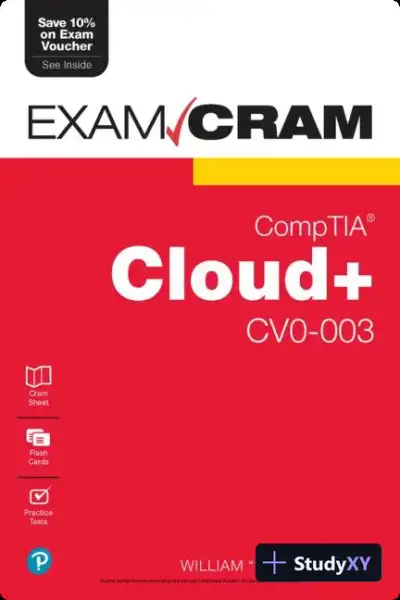 Certification Guides
CompTIA Cloud+ CV0-003 Exam Cram (2021)
CompTIA Certifications
434 pages156downloadsFeb 2025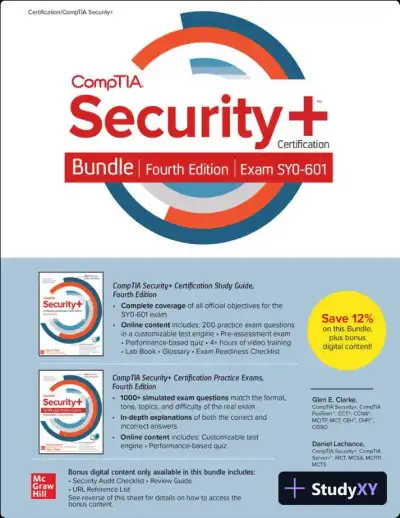 Certification Guides
CompTIA Security+ SY0-601 Exam Certification Bundle, 4th Edition (2021)
CompTIA Certifications
1897 pages152downloadsFeb 2025 Certification Guides
CompTIA Server+ SK0-005 Certification All-in-One Exam Guide, 2nd Edition (2021)
CompTIA Certifications
628 pages144downloadsFeb 2025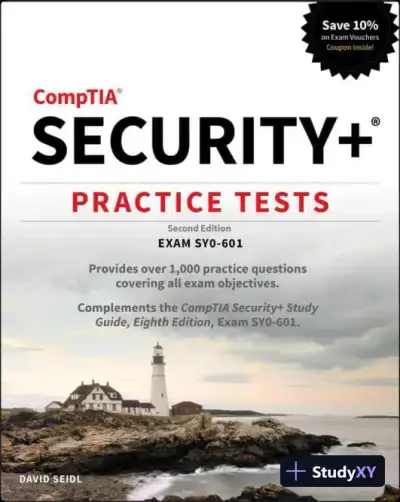 Certification Guides
Comptia Security+ Practice Tests : exam sy0-601, 2nd Edition (2021)
CompTIA Certifications
339 pages144downloadsFeb 2025 Certification Guides
CompTIA ITF+ CertMike: Exam FC0-U61 (2023)
CompTIA Certifications
464 pages144downloadsFeb 2025 Certification Guides
CompTIA Network+ N10-008 Exam Cram (2021)
CompTIA Certifications
654 pages143downloadsFeb 2025 Certification Guides
CompTIA Security+ Certification Study Guide Exam SY0-601 (2022)
CompTIA Certifications
1024 pages134downloadsFeb 2025 Certification Guides
CompTIA Cloud Essentials+ Study Guide: Exam CLO-002 2nd Edition (2020)
CompTIA Certifications
370 pages115downloadsFeb 2025
Study this document with CramX
Once it is in your library, every tool can work from it.