

Community-Based Corrections 10th Edition Test Bank
- Criminal Justice
- 221 pages
- Shared May 2025
Make studying for your exam easier with Community-Based Corrections 10th Edition Test Bank, packed with essential test questions.
Preview 16 of 221 pages
See the first 16 pages exactly as they appear in the document.
Page 1 Read page 1 as text
1. How many people are currently under some form of correctional supervision in the United States? a. 7 million b. 1.2 million c. 42 million d. 5 million ANSWER: a REFERENCES: The Correctional Dilemma LEARNING OBJECTIVES: COBC.ALAR.13.3 - 5 2. The release of an offender under conditions imposed by the court for a specified period of time during which the court retains the authority to modify the conditions or to resentence the offender if he or she violates the conditions is: a. Probation b. Parole c. Mandatory conditional release d. Electronic monitoring ANSWER: a REFERENCES: The Correctional Dilemma LEARNING OBJECTIVES: COBC.ALAR.13.4 - 5 3. ______ refers to any sanction in which offenders serve all or a portion of their entire sentence in the community. a. Community corrections b. Social justice c. Restorative justice d. Halfway house ANSWER: a REFERENCES: The Correctional Dilemma LEARNING OBJECTIVES: COBC.ALAR.13.4 - 5 4. The most common form of community corrections is: a. Boot camp b. Community restitution c. Probation d. Parole ANSWER: c REFERENCES: The Correctional Dilemma LEARNING OBJECTIVES: COBC.ALAR.13.4 - 5 5. From the 1930s to the 1970s, _____ was the primary sentencing philosophy in the United States. a. determinate sentencing b. three-strikes c. indeterminate sentencing d. retribution ANSWER: c REFERENCES: Indeterminate Sentencing LEARNING OBJECTIVES: COBC.ALAR.13.3 - 5 Page 1 Chapter_1__An_Overview_of_Community_Corrections__Goals_and_Evidence_Based_Practices
Page 2 Page 3 Read page 3 as text
6. What type of sentence would a judge give an offender under an indeterminate sentencing model? a. 20 years b. Life c. 5 to 10 years d. Death ANSWER: c REFERENCES: Indeterminate Sentencing LEARNING OBJECTIVES: COBC.ALAR.13.3 - 5 7. Which of the following is NOT considered a determinate sentencing philosophy? a. mandatory minimums b. truth-in-sentencing c. discretionary parole d. three strikes laws ANSWER: c REFERENCES: Origins of Determinate Sentencing LEARNING OBJECTIVES: COBC.ALAR.13.3 - 5 8. Lack of confidence in correctional programming peaked in 1974 when _____ _____ publication concluded that, “with few exceptions, the rehabilitative efforts that have been reported so far had no appreciable effect on recidivism.” a. Robert Martinson’s b. Andrew von Hirsch’s c. Herbert Packer’s d. James Marquart’s ANSWER: a REFERENCES: Indeterminate Sentencing LEARNING OBJECTIVES: COBC.ALAR.13.3 - 5 9. Determinate sentencing is often referred to as: a. unconstitutional b. flat-time c. round time d. a range ANSWER: b REFERENCES: Origins of Determinate Sentencing LEARNING OBJECTIVES: COBC.ALAR.13.3 - 5 10. In 1975, _________ was the first state to return to a philosophy of determinate sentencing. a. Texas b. Maine c. Oklahoma d. Florida ANSWER: b REFERENCES: Origins of Determinate Sentencing LEARNING OBJECTIVES: COBC.ALAR.13.3 - 5 Page 2 Chapter_1__An_Overview_of_Community_Corrections__Goals_and_Evidence_Based_Practices
Page 4 Read page 4 as text
11. In determinate sentencing, the range of permissible sentences is determined largely by: a. Legislated statutes b. Treatment goals and objectives c. Parole boards d. Boards of pardons and clemency ANSWER: a REFERENCES: Origins of Determinate Sentencing LEARNING OBJECTIVES: COBC.ALAR.13.3 - 5 12. _____ require offenders to serve specified portions of their sentence prior to release. a. Three-strikes laws b. Mandatory minimum sentencing laws c. Community-based treatments d. Faith-based treatment programs ANSWER: b REFERENCES: Origins of Determinate Sentencing LEARNING OBJECTIVES: COBC.ALAR.13.3 - 5 13. Truth-in-sentencing laws require offenders to serve at least _________ of their original sentence length before becoming eligible for release. a. 90% b. 85% c. 75% d. 50% ANSWER: b REFERENCES: Origins of Determinate Sentencing LEARNING OBJECTIVES: COBC.ALAR.13.3 - 5 14. The concept that communities are made safer by removing unsafe residents is ingrained in American tradition, but correctional policy shifts according to legislators’ perceptions of what the public wants. This relationship is known as: a. The swing of the pendulum b. The enigma c. The revolution d. The paradox ANSWER: d REFERENCES: The Paradox LEARNING OBJECTIVES: COBC.ALAR.13.2 - 5 15. Surveys have suggested that adults support prisons that emphasize: a. Rehabilitation b. Retribution c. Deterrence d. Restitution ANSWER: a REFERENCES: The Paradox LEARNING OBJECTIVES: COBC.ALAR.13.4 - 5 Page 3 Chapter_1__An_Overview_of_Community_Corrections__Goals_and_Evidence_Based_Practices
Page 5 Read page 5 as text
16. A recent national opinion poll indicated that the most well-known alternatives to incarceration are probation, house arrest, and: a. Boot camp b. Electronic monitoring c. Day reporting centers d. Shock probation ANSWER: c REFERENCES: The Paradox LEARNING OBJECTIVES: COBC.ALAR.13.4 - 5 17. The three main decision points in the corrections system are bail, sentencing, and: a. reentry b. punishment c. probation d. diversion ANSWER: a REFERENCES: The Role of Corrections at Three Major Decision Points LEARNING OBJECTIVES: COBC.ALAR.13.1 - 3 18. (A) _____ is a monetary payment deposited with the court to ensure a defendant's return for the next court date, in exchange for the defendant's release. a. fine b. restitution c. bail d. retribution ANSWER: c REFERENCES: Pretrial and the Bail Decision LEARNING OBJECTIVES: COBC.ALAR.13.1 - 3 19. Any activity or program that is conducted to prepare parolees to return safely to the community and to live as law abiding citizens is known as: a. Compulsive education b. Prisoner reentry c. Intensive supervision d. Parole ANSWER: b REFERENCES: Reentry Decision LEARNING OBJECTIVES: COBC.ALAR.13.4 - 5 20. _____ offer graduated levels of supervision and provide rewards for positive behavior, with gradually less supervision when offenders are successful. a. Intermediate sanctions b. Incarcerative punishments c. Indeterminate sentences d. Restrictive sanctions ANSWER: a REFERENCES: Sentencing Decision LEARNING OBJECTIVES: COBC.ALAR.13.4 - 5 Page 4 Chapter_1__An_Overview_of_Community_Corrections__Goals_and_Evidence_Based_Practices
Page 6 Read page 6 as text
21. The discretionary release of an offender before the expiration of his or her sentence under conditions established by the releasing authority is: a. Intensive probation b. Restorative justice c. Parole d. Mandatory conditional release ANSWER: c REFERENCES: Reentry Decision LEARNING OBJECTIVES: COBC.ALAR.13.4 - 5 22. _____ assumes that offenders who are under community supervision will refrain from committing new crimes or technical violations if he or she feels that the costs outweigh the benefits. a. General deterrence b. Specific deterrence c. Absolute deterrence d. Initial deterrence ANSWER: b REFERENCES: Protecting the Public Through Specific Deterrence LEARNING OBJECTIVES: COBC.ALAR.13.4 - 5 23. _____ is focused on crime victims and emphasizes offender responsibility to repair the injustice the offender has caused. The philosophy is known as: a. Restorative justice b. Community justice c. Community restitution d. Social justice ANSWER: a REFERENCES: Restorative Justice LEARNING OBJECTIVES: COBC.ALAR.13.4 - 5 24. Restorative justice is most effective with _____ crimes. a. Drug b. Nonviolent c. Public order d. Sexual ANSWER: b REFERENCES: Restorative Justice LEARNING OBJECTIVES: COBC.ALAR.13.4 - 5 25. _____ is a form of corrections that uses current best practices or interventions for which there is consistent and solid scientific evidence showing that they work to meet intended outcomes is known. a. Evidence-based practice b. Outcome-based education c. Evaluative-based practice d. Empirical research ANSWER: a REFERENCES: Evidence-Based Practices in Community Corrections LEARNING OBJECTIVES: COBC.ALAR.13.4 - 5 Page 5 Chapter_1__An_Overview_of_Community_Corrections__Goals_and_Evidence_Based_Practices
Page 7 Read page 7 as text
26. Using an intermediate sanction as a stiffer punishment for offenders who would have ordinarily been sentenced to probation or other lesser sanctions is known as: a. Community service b. Net widening c. Prison population reduction d. Deferring sentence ANSWER: b REFERENCES: Evaluating Effectiveness LEARNING OBJECTIVES: COBC.ALAR.13.4 - 5 27. The most commonly used dependant variable when evaluating the effectiveness of treatment programs is: a. Financial goals and objectives b. Recidivism c. Restitution collected d. Number of probationers employed ANSWER: b REFERENCES: Outcome Measures in Evaluation LEARNING OBJECTIVES: COBC.ALAR.13.1 - 3 28. Which of the following is often used as a measure of recidivism? a. Rearrest b. Reconviction c. Reincarceration d. All of these choices ANSWER: d REFERENCES: Outcome Measures in Evaluation LEARNING OBJECTIVES: COBC.ALAR.13.4 - 5 29. The public demands correctional programs that satisfy both _________ and public safety objectives. a. Treatment b. Punishment c. Restoration d. Counseling ANSWER: b REFERENCES: Outcome Measures in Evaluation LEARNING OBJECTIVES: COBC.ALAR.13.2 - 5 30. Our nation’s crime control policies over the last three decades have resulted in a steady increase of convicted misdemeanants and felons in the correctional system today. a. True b. False ANSWER: True REFERENCES: The Correctional Dilemma LEARNING OBJECTIVES: COBC.ALAR.13.3 - 5 Page 6 Chapter_1__An_Overview_of_Community_Corrections__Goals_and_Evidence_Based_Practices
Page 8 Read page 8 as text
31. Community corrections are sanctions that may be completed after a defendant serves time in prison. a. True b. False ANSWER: False REFERENCES: The Correctional Dilemma LEARNING OBJECTIVES: COBC.ALAR.13.4 - 5 32. The most common form of community supervision is probation. a. True b. False ANSWER: True REFERENCES: The Correctional Dilemma LEARNING OBJECTIVES: COBC.ALAR.13.4 - 5 33. Nearly 3% of the total adult population in the United States is under some form of correctional supervision. a. True b. False ANSWER: True REFERENCES: The Correctional Dilemma LEARNING OBJECTIVES: COBC.ALAR.13.3 - 5 34. Until the 1990s, determinate sentencing was the primary sentencing philosophy in the United States. a. True b. False ANSWER: False REFERENCES: Indeterminate Sentencing LEARNING OBJECTIVES: COBC.ALAR.13.4 - 5 35. Robert Martinson found that correctional rehabilitation programs were effective at reducing recidivism. a. True b. False ANSWER: False REFERENCES: Indeterminate Sentencing LEARNING OBJECTIVES: COBC.ALAR.13.3 - 5 Page 7 Chapter_1__An_Overview_of_Community_Corrections__Goals_and_Evidence_Based_Practices
Page 9 Read page 9 as text
36. All states have adopted mandatory minimum sentencing laws for certain types of offenses and require that a minimum period of time be served before release can be considered. a. True b. False ANSWER: True REFERENCES: Origins of Determinate Sentencing LEARNING OBJECTIVES: COBC.ALAR.13.3 - 5 37. Parole is allowed at the federal level. a. True b. False ANSWER: False REFERENCES: Indeterminate Sentencing LEARNING OBJECTIVES: COBC.ALAR.13.3 - 5 38. The most well-known community-based corrections are probation, house arrest, and electronic monitoring,. a. True b. False ANSWER: True REFERENCES: The Paradox LEARNING OBJECTIVES: COBC.ALAR.13.2 - 5 39. "Redeemability" is convincing the public that offenders can change their ways. a. True b. False ANSWER: True REFERENCES: The Paradox LEARNING OBJECTIVES: COBC.ALAR.13.2 - 5 40. Due to the fiscal crisis, there is growing consensus that jail and prison facilities should be used for the most serious offenders. a. True b. False ANSWER: True REFERENCES: Prison is Expensive LEARNING OBJECTIVES: COBC.ALAR.13.4 - 5 Page 8 Chapter_1__An_Overview_of_Community_Corrections__Goals_and_Evidence_Based_Practices
Page 10 Read page 10 as text
41. Bail is one of the three major decision points in the corrections system. a. True b. False ANSWER: False REFERENCES: The Role of Corrections at Three Major Decision Points LEARNING OBJECTIVES: COBC.ALAR.13.1 - 3 42. Pretrial supervision is reserved for those who have not yet been convicted. a. True b. False ANSWER: True REFERENCES: Pretrial and the Bail Decision LEARNING OBJECTIVES: COBC.ALAR.13.1 - 3 43. Less than half of all prisoners will ever be released from prison. a. True b. False ANSWER: False REFERENCES: Reentry Decision LEARNING OBJECTIVES: COBC.ALAR.13.1 - 3 44. Parole is used for offenders who have not yet been convicted. a. True b. False ANSWER: False REFERENCES: Parole LEARNING OBJECTIVES: COBC.ALAR.13.2 - 5 45. In contrast to mainstream criminal justice that is focused on the punishment of the offender, restorative justice is centered on the victim throughout the process and emphasizes the offender’s responsibility to repair the injustice and wrong caused to the victim. a. True b. False ANSWER: True REFERENCES: Restorative Justice LEARNING OBJECTIVES: COBC.ALAR.13.4 - 5 Page 9 Chapter_1__An_Overview_of_Community_Corrections__Goals_and_Evidence_Based_Practices
Page 11 Read page 11 as text
46. Specific deterrence attempts to deter the general public. a. True b. False ANSWER: False REFERENCES: Protecting the Public Through Specific Deterrence LEARNING OBJECTIVES: COBC.ALAR.13.4 - 5 47. “Evidencebased practices” means using the experience and opinions of individuals in the field who have supervised caseloads for a long time to decide the impact a program has on participants. a. True b. False ANSWER: False REFERENCES: Evidence-Based Practices in Community Corrections LEARNING OBJECTIVES: COBC.ALAR.13.4 - 5 48. “Net Widening” results in a cost increase instead of a cost savings. a. True b. False ANSWER: True REFERENCES: Evaluating Effectiveness LEARNING OBJECTIVES: COBC.ALAR.13.4 - 5 49. Recidivism can be measured as re-arrest, reconviction, or re-incarceration. a. True b. False ANSWER: True REFERENCES: Outcome Measures in Evaluation LEARNING OBJECTIVES: COBC.ALAR.13.1 - 3 50. The release of a convicted offender under conditions imposed by the court for a specified period of time during which the court retains the authority to modify the conditions or to resentence the offender if he or she violates the conditions is known as __________. ANSWER: probation REFERENCES: The Correctional Dilemma LEARNING OBJECTIVES: COBC.ALAR.13.4 - 5 51. Community service, house arrest, day fines, and boot camps are examples of ____________________. ANSWER: intermediate sanctions REFERENCES: The Correctional Dilemma LEARNING OBJECTIVES: COBC.ALAR.13.4 - 5 Page 10 Chapter_1__An_Overview_of_Community_Corrections__Goals_and_Evidence_Based_Practices
Page 12 Read page 12 as text
52. _____ sentencing provides a range of punishments and allows the parole board to determine when an offender has been rehabilitated. ANSWER: Indeterminate REFERENCES: Indeterminate Sentencing LEARNING OBJECTIVES: COBC.ALAR.13.5 - 4 53. _____ became the first state to return to a determinate sentencing structure. ANSWER: Maine REFERENCES: Origins of Determinate Sentencig LEARNING OBJECTIVES: COBC.ALAR.13.3 - 5 54. A "flat sentence" is the same as a _____ sentence. ANSWER: determinate REFERENCES: The Origins of Determinate Sentencing LEARNING OBJECTIVES: COBC.ALAR.13.3 - 5 55. The three main decision points in the corrections system are bail, sentencing, and _____. ANSWER: reentry REFERENCES: The Role of Corrections at Three Major Decision Points LEARNING OBJECTIVES: COBC.ALAR.13.3 - 5 56. Examples of ___________ sentencing policies include mandatory minimums, truth in sentencing, three strikes laws, and sentencing guidelines. ANSWER: determinate REFERENCES: Origins of Determinate Sentencing LEARNING OBJECTIVES: COBC.ALAR.13.3 - 5 57. Correctional policy is in many ways a ____________, because it shifts according to the tide of public perception and what is important to vocal constituents and public interest groups. ANSWER: paradox REFERENCES: The Paradox LEARNING OBJECTIVES: COBC.ALAR.13.2 - 5 58. __________ is a monetary payment deposited with the court to ensure the return of a defendant charged with a crime. ANSWER: bail REFERENCES: Pretrial and the Bail Decision LEARNING OBJECTIVES: COBC.ALAR.13.1 - 3 Page 11 Chapter_1__An_Overview_of_Community_Corrections__Goals_and_Evidence_Based_Practices
Page 13 Read page 13 as text
59. Correcting an inadequacy of an offender is known as _____. ANSWER: rehabilitation REFERENCES: Rehabilitation through Risk/Need/Responsivity LEARNING OBJECTIVES: COBC.ALAR.13.1 - 3 60. The _____ assumes at a basic level that offender compliance and active participation are integral to the offender's own success on community supervision. ANSWER: participation process model REFERENCES: An Integrated Theory of Community Supervision: The Participation Process Model LEARNING OBJECTIVES: COBC.ALAR.13.4 - 5 61. Any activity or program to prepare parolees to return safely to the community is called _______________________. ANSWER: prisoner reentry REFERENCES: Reentry Decision LEARNING OBJECTIVES: COBC.ALAR.13.4 - 5 62. The philosophy and sanction of allowing the offender to remain in the community with the responsibility of repairing the injustice caused to the victim is ___________________. ANSWER: restorative justice REFERENCES: Restorative Justice LEARNING OBJECTIVES: COBC.ALAR.13.4 - 5 63. ___________________________is using current best practices or interventions for which there is consistent and solid scientific evidence showing that they work to meet the intended outcomes. ANSWER: Evidence-based practices REFERENCES: Evidence-Based Practices in Community Corrections LEARNING OBJECTIVES: COBC.ALAR.13.4 - 5 64. Return to criminal behavior, usually measured as either rearrest, reconviction, or reincarceration is called __________. ANSWER: recidivism REFERENCES: Evaluating Effectiveness LEARNING OBJECTIVES: COBC.ALAR.13.3 - 5 Page 12 Chapter_1__An_Overview_of_Community_Corrections__Goals_and_Evidence_Based_Practices
Page 14 Read page 14 as text
65. What does a “continuum of sanctions” mean in the sentencing process? If you were a judge, how would you apply this continuum? ANSWER: Figure 1.1 shows the wide variety of community-based sanctions available, including residential programs (e.g., halfway houses and therapeutic communities), economic sanctions (e.g., restitution, fines, and forfeitures), and nonresidential or outpatient options (e.g., probation, parole, and electronic monitoring). As a judge, I would apply this continuum by comparing the risks and needs presented by the offender to the ability of the chosen sanction to control the risk and meet the needs. At the most restrictive\punitive end of the continuum, I would reserve institutional corrections only for those offenses warranting retributive sentencing or to prevent any further crime by the offender until programming could be completed addressing the needs of the offender that would serve to diminish the probability of future criminal acts. As the degree of risk and severity of needs decrease, the sanction chosen from the continuum would be reduced commensurately all the way down to regular probation. REFERENCES: The Correctional Dilemma LEARNING OBJECTIVES: COBC.ALAR.13.5 - 4 66. What recent factors have contributed to correctional growth? ANSWER: Box 1.1 shows the latest government statistics regarding the number of people currently on some form of correctional supervision. As of December 31, 2006 there were 4.2 million offenders on probation, and nearly 800,000 on parole, which is considerably more than the 2.3 million offenders incarcerated in jail and prison. Over the last 7 years, there was an average increase of 2.4 percent of prisoners and 1.7 percent of those on community supervision each year in the corrections system (Bonczar 2008; Glaze & Bonczar 2008). The number of female offenders has grown as well, although women have always been underrepresented in the criminal justice system in comparison to their numbers in the general population. Sources say that in the last 15 years, the number of women on probation and parole has doubled. While this sounds like a lot, women still comprise only 12 percent of all parolees and 23 percent of probationers today. Although the increase is showing signs of slowing down some, the rise of convicted offenders is directly related to a number of factors including: changes in sentencing laws, an increase of probation and parole violators returning to prison, a decreased rate of release on discretionary parole, and differential police responses to drug offenses (Beck 2000). REFERENCES: The Correctional Dilemma LEARNING OBJECTIVES: COBC.ALAR.13.2 - 5 Page 13 Chapter_1__An_Overview_of_Community_Corrections__Goals_and_Evidence_Based_Practices
Page 15 Read page 15 as text
67. What is the value in public opinion poll research compared to social science research? ANSWER: Public opinion research on sentencing preferences demonstrated higher validity when the public was given diverse sentencing options and adequate information, such as program descriptions and detailed information about an offense or an offender. However, readers are cautioned that exposure to information may have only short-term effects rather than lasting effects, since many beliefs about crime and punishment are based on emotional rather than rational arguments (Maruna and King, 2008). This reliance on emotional reactions may lead to temporary increases in funding for particular programs, policies, or sanctions. However, it may also lead to the continuance of having punishments that do not achieve the desired outcomes. A good example is three-strikes legislation that has not always resulted in removing only the most serious offenders from society. Conversely, valid social science research removes the emotional response and measures the degree of effectiveness of programs based on the program’s ability to achieve desired outcomes/goals. REFERENCES: The Paradox LEARNING OBJECTIVES: COBC.ALAR.13.5 - 4 68. Will evidence-based practices (EBP) be just another passing fad? ANSWER: Decreasing risk, increasing rehabilitation, and restorative justice are important components in changing offenders’ attitudes and behaviors, leading to the prevention of future criminal behavior. Part of the challenge therein, lies in public recognition of the importance that community corrections serves to increase public safety and in the method of choice for those who break the law. One of the ways to accomplish such an image change is through evidence-based practices. EBP is not based on intuition, speculation, anecdotal evidence, or tradition (e.g., “that’s the way we’ve always done it around here”). Rather, EBP is grounded in empirical data and research in studying what works. The idea behind EBP in corrections is that agencies should use only the most successful programs. The programs that are the best are effective in changing offender behavior —whether that behavior is reducing rearrest, reducing technical violations, increasing the number of drug free days, or the number of days offender is working or employed while on supervision. Each goal will need a way to be measure empirically—meaning accurate data needs to be recorded electronically for later evaluation. To the extent that EPB is successful in describing programs that work and reduce crime and fear of crime then it will be accepted. However, in the past the public has relied upon recidivism as the variable that comes to their minds when discussing success. If recidivism is not reduced then it is possible that EPB will not be accepted on a long term basis. REFERENCES: Evidence-Based Practices in Community Corrections LEARNING OBJECTIVES: COBC.ALAR.13.5 - 4 Page 14 Chapter_1__An_Overview_of_Community_Corrections__Goals_and_Evidence_Based_Practices
1. Contemporary probation was the result of effort in England and the US to: a. avoid harsh corporal punishments b. ensure the capture of a greater number of offenders c. maximize punishment and retribution d. coordinate community corrections efforts with parole programs ANSWER: a REFERENCES: Precursors to American Probation LEARNING OBJECTIVES: COBC.ALAR.13.1 - 3 2. In early British criminal law, punishments consisted primarily of: a. Prison b. Jail c. Corporal punishment d. Fines ANSWER: c REFERENCES: Precursors to American Probation LEARNING OBJECTIVES: COBC.ALAR.13.1 - 3 3. In early British criminal law, a/n _____ was a monetary penalty imposed arbitrarily at the discretion of a court for an offense. a. amercement b. filing c. surety d. motion to quash ANSWER: a REFERENCES: Precursors to American Probation LEARNING OBJECTIVES: COBC.ALAR.13.1 - 3 4. The case of _____ is often cited as an example of the early use of release on recognizance. a. Roper v. Simmons b. Commonwealth v. Chase c. Gideon v. Wainwright d. In re Gault ANSWER: b REFERENCES: Procedures Related to Modern Probation LEARNING OBJECTIVES: COBC.ALAR.13.1 - 3 5. Security for good behavior is similar to modern day: a. bail b. fines c. day fines d. restitution ANSWER: a REFERENCES: Precursors to American Probation LEARNING OBJECTIVES: COBC.ALAR.13.1 - 3 Page 1 Chapter_2__How_Probation_Developed__Chronicling_Its_Past_and_Present
Page 16
205 more pages in the full document
Unlock it once and it stays in your library, ready to chat with or turn into flashcards.
Unlock the full documentMore Criminal Justice study materials
See all Exam Guides
Test Bank For Forensic Science, 4th Edition
Criminal Justice
370 pages132downloadsFeb 2025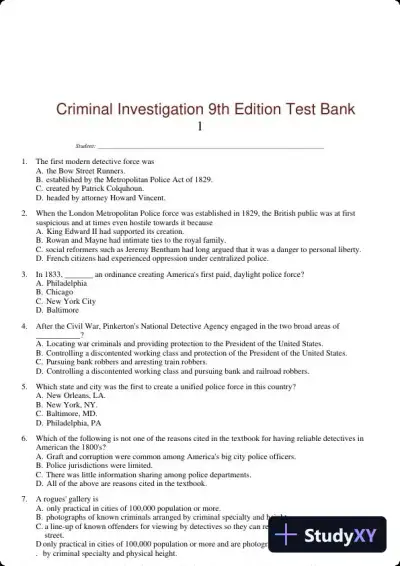 Exam Guides
Criminal Investigation 9th Edition Test Bank
Criminal Justice
344 pages103downloadsFeb 2025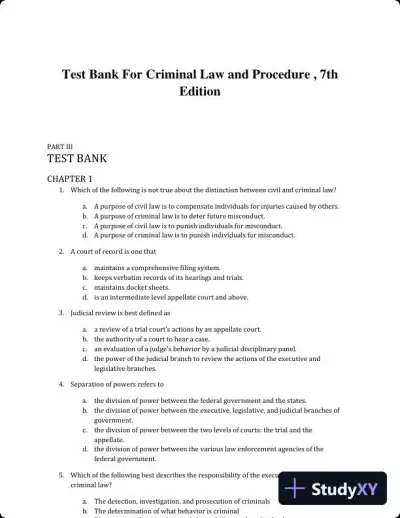 Exam Guides
Test Bank For Criminal Law and Procedure , 7th Edition
Criminal Justice
65 pages96downloadsFeb 2025 Past Exams
2024-2025 TCOLE Basic Jailer Course Practice Exam with Answers (259 Solved Questions)
Criminal Justice
33 pages47downloadsFeb 2025 Class Presentation
The Future Of The Juvenile System
Criminal Justice
11 pagesMay 2025 Class Notes
Lecture Notes For Crime Control In America: What Works, 4th Edition
Criminal Justice
66 pagesMay 2025- Past ExamsPast Exams
Technology in Criminal Justice CJ305-6-0
Criminal Justice
1 pageJun 2025 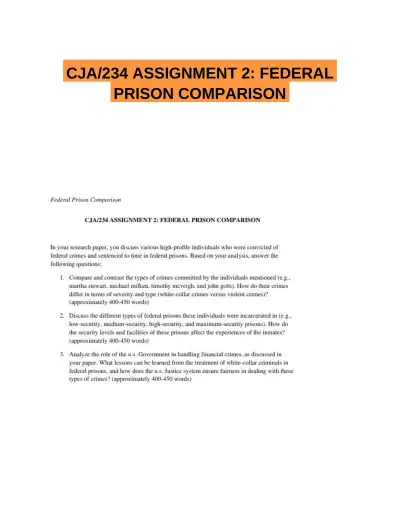 Solved Assignments
CJA/234 ASSIGNMENT 2: FEDERAL PRISON COMPARISON
Criminal Justice
9 pagesMay 2025
Study this document with CramX
Once it is in your library, every tool can work from it.